
Profit and revenue are like a match made in business heaven, and they’re the key metrics.

Your sales and popularity on Amazon might look great, but that doesn’t guarantee constant profitability.
Some merchants could forego their profit margins in order to provide low pricing in an effort to win the hearts of consumers and dominate the market.
However, dear, safeguarding your Amazon profit margin is the key to winning this trading game.
If you’re dreaming of financial success that will make your heart race, then managing and improve profit margins on Amazon is the name of the game.
And for those who are lost in the world of Amazon FBA profit margins, fear not, for this article is tailored just for you.
And if you’re yearning to pump up your margin game, we’ve got the best tips and tricks up our sleeve to make it happen.
Don’t keep your business waiting—let’s make some magic together!
Understanding Amazon profit margin:
Hey, you wanna know what is the profit margin for Amazon FBA?
Well, stick around, my friend, because we’ve got all the juicy details you need.
Amazon profit margin is the difference between business-generated sales revenue and your business costs. This is the way you can calculate your company’s profitability.
If you want to get successful in your business, your profit margins should be higher.
In other words, we can say that it is the percentage of your business profit you gathered from each order.
For Example,
A 30% profit margin indicates $0.30 of profit you earn from every dollar of orders generated.
Profit Margin = (Net Income/ Revenue) * 100
Before calculating the profit margin, you must understand the break-even advertising cost of sales (ACoS).
ACoS is defined by the division between ad spend and ad revenue after that is converted into percentages. For instance, you spent $40 on an ad campaign and gained $100, so your ACoS will be 40%.
If your ACoS is below your Amazon profit margin, that means your business is on a profitable scale. You are paying for the sale if it is greater than the profit margin.
What is the profit margin for Amazon FBA?
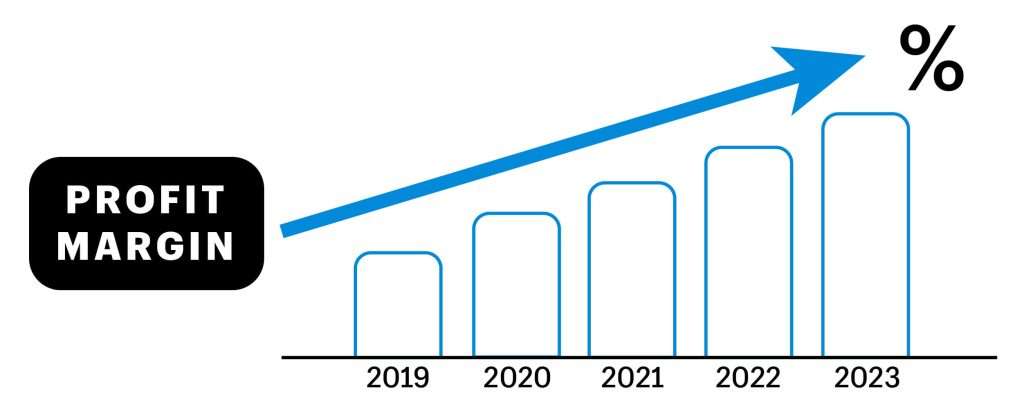
The simple answer is that it depends on the product, but generally speaking, Amazon profit margin for sellers range from 15% to 20%, depending on the market they are selling into.
Anything less than 5% is unsustainable for an e-commerce firm, even while a margin of 20% or greater is wonderful.
Amazon’s profit margin is 20% by default, but you can modify it in your account settings. Accordingly, if you sell your item for $100, Amazon will deduct $20 and pay you $80. They will deduct $40 and offer you $160 if you sell it for $200.
A good Amazon profit margin strikes a balance between earning enough money to pay your bills and investing more money in your company. It’s a fine balance, and you’ll need to maintain it.
Ready to boost your Amazon profit margin? Explore strategies to optimize your listings, streamline operations, and increase sales. It also helps to benchmark against real amazon seller profit data across business models before setting your margin targets.
Start maximizing your profits today!
How to find break-even ACoS:
- Visit the revenue calculator on your Amazon app
- Check your Product ASIN and search for that
- Select the particular product
- Include the cost of the sale
- Check gross profit margin
Types of Amazon profit margin:
There are 3 types of profit margins: gross profit margin, net profit margin and operating profit margin.
If you’re new to Amazon selling, start with our complete guide on how to sell on Amazon before diving into advanced profit margin optimization.
Gross profit margin:
Gross profit margin is the difference between your business’s total Revenue and the cost of goods sold, or COGS, divided by the Revenue. You will get it as a percentage.
With gross profit margin, you can determine how much money is left after excluding the costs of making and shipping the product.
The formula is
Gross profit margin = (Total Revenue – COGS)/ Total Revenue * 100
For Example,
We sell a toy car for $100 on Amazon, and the COGS is $25 per unit.
Gross Margin = $25/$100= 75% gross margin.
Operating profit margin:
Operating profit margins are similar to gross profit margins, but there is a key difference. When calculating the gross profit margin, we include the cost of goods sold.
Still, when calculating the operating profit margin, we include the operating costs of running the business, such as rent, labor costs, payroll, utilities, advertising and insurance.
Operating profit margin = (total revenue – (COGS + Operating Costs) / Total Revenue) * 100
For Example,
We sell a toy car for $100 on Amazon, and the COGS is $25 per unit.
Gross Margin = $25/$100= 75% gross margin.
For operating profit margin, we need to run all the costs, including Fees, Ads from Amazon. Say this is $50. Thus, ($25+$50) / $100 = 25 operating profit margin.
Net profit margin:
Net profit margin is the net income you gathered from your total Revenue by deducting all business expenses such as COGS, operating expenses, taxes and interest payments.
Net profit Margin = (Total Revenue – Total Costs)/ Total Revenue * 100
Identify a good profit margin for your business:

Identifying a good Amazon profit margin is very important because if you are looking for a higher margin, you increase your product price, which may affect your selling number.
Depending on their particular category, most Amazon sellers aim for a profit margin in the region of 15% to 20%.
Achieving a profit margin of 20% or higher is truly remarkable, indicating exceptional performance.
However, a good Amazon profit margin depends on several parameters, such as your industry, location and personal conditions.
For Example,
Industrial banks obtained the highest avg net profit margin of 51.8% in 2019, where the usual profit margins were around 8.5%.
Retail obtains lower profit margins rather than other sectors. The average Amazon profit margin for brick and mortar retailers is 0.5-4.5%. On the other hand, e-commerce retailers gained around 6.5% as an avg net profit margin.
The following factors have an impact on Amazon profit margin for FBA sellers:
Fees for Amazon FBA: You will pay fees for using Amazon’s platform to sell as an Amazon seller. Depending on your monthly sales amount and the particular product category you are selling in, these fees change. To understand what sellers actually keep after all these costs, see the full breakdown of amazon seller profit by business model and experience level.
For instance, the cost of gadgets could be higher than that of books or DVDs. Your costs can get less expensive as you have a history with Amazon. It’s crucial to take these costs into account in order to comprehend the profit margin for Amazon FBA.
Cost of shipping: A number of variables, including the product’s weight (in pounds) and the intended location, affect the shipping price.
The cost of transportation may have a big influence on your profit margin, whether you’re delivering one item from New York City to California or 500 products from Florida to Alaska.
Product margins: various categories have various profit margins for Amazon merchants.
While jewellery or watches often have lower profits, home products and fashion typically have larger margins.
It’s essential to evaluate the profitability of the specific area you’re operating in if you want to raise your profit margin on Amazon.
Incorporate these ways to increase Amazon profit margin and discover valuable insights.
Amazon profit margin calculator:
Regarding Amazon profit margin, we generally consider the Gross Profit Margin. We calculate it by deducting the COGS or costs of goods sold. That means,
Gross Profit = Net sales – Costs of Goods Sold (COGS)
Net Sales is the sales revenue your business creates on amazon after accounting, returns, discounts, coupons and several deductions.
Gross profit margin = (Total Revenue – COGS)/ Total Revenue * 100
We need to determine the net profit margin as well. By eliminating COGS, debts, operating expenses and taxes from total Revenue, we get net profit margins.
Net profit Margin = (Total Revenue – Total Costs)/ Total Revenue * 100
For Example, we are selling a coffee mug for $20, direct costs are $5, and indirect costs are $5.
Gross profit margin = $20 – $5/$20 * 100 = 75%
Net profit margin = $20 – $5 – $5 / $20 * 100 = 50%
Why is Amazon Profit Margin important for Sellers?
For sellers participating in the Amazon FBA programme, the Amazon profit margin is crucial. It has an immediate effect on their expansion and financial success.
Let’s examine the importance of the Amazon profit margin and how merchants may raise and enhance their Amazon profit margin:
Financial Success: By keeping a high profit margin, sellers may be sure that their sales will be sufficient to pay for expenditures like product sourcing, fulfillment, advertising, and operating expenses.
Competitive Positioning: Choosing the best price approach may assist merchants draw in clients while edging out rivals.
Business Expansion: By raising the profit margin, sellers are able to expand their company through reinvestment.
Cost Management: By reducing costs without compromising quality, sellers can improve profit margins on Amazon.
Pricing optimization: To strike the best balance between profitability and competitiveness, sellers should study the market, keep an eye on rival prices, and test out various pricing strategies.
Product differentiation can allow for greater pricing and increased Amazon profit margin by providing distinctive items or enhancing current offers.
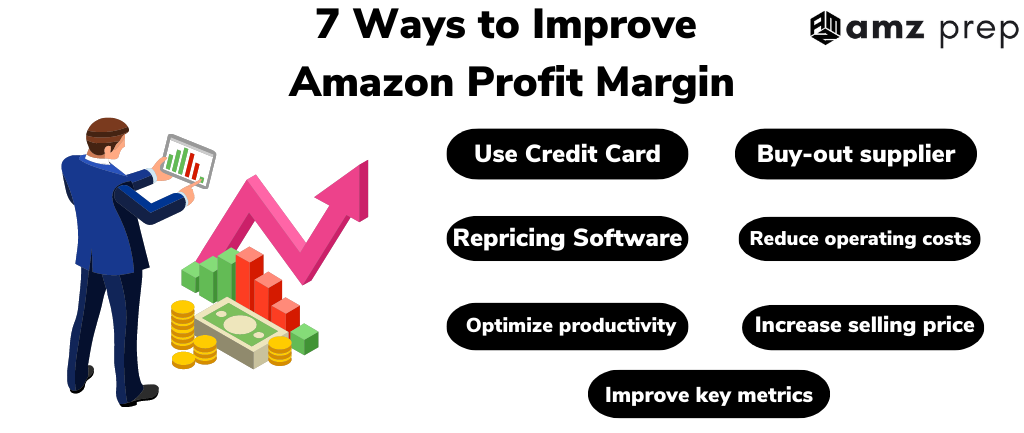
7 easy ways to improve profit margins on Amazon:
As a reseller, you should know that competition is getting ferocious on Amazon nowadays. Thus, your profit is not higher than the previous.
As a result, many sellers are not running their businesses as efficiently as they can.
Even so, many sellers don’t have good knowledge of listings and are not running operative promotions. So it can be an advantage for you.
Here we will discuss some effective and easy ways to increase amazon profit margin.
Use a credit card for inventory purchases:
Most sellers pay through a bank account or PayPal, which is okay for the small business owner or when your business is in the first phase.
But when you are running your business at a higher stage, it will be better to use a credit card to get notified about your expenses and reward points and cashback.
But please make sure to repay the credit card bill on time. It can be one of the best ways to increase Amazon Profit Margin.
Buy-out supplier:
Suppose you’ve noticed that your supplier only has a limited number of items left. In that case, it may be beneficial to purchase the rest, specifically if your seller doesn’t work with many Amazon sellers.
The main advantage is that you obtain all the residual products while competitors wait for the next purchase, so you are the only vendor for a while, giving you a chance to win a Buy Box.
You can generate further sales and increase your profits by driving prices up until the market levels out.
Another plus is that you can exchange a deduction by serving to buy anything because merchants love a no-sales guarantee.
Repricing Software:
It is the most important way to improve profit margins on Amazon. Amazon prices are always changing, and you must follow these to stay competitive.
But instead of doing it manually, find out wherefore you should use Amazon’s Repricer instead.
This allows you to fully automate price changes and run them in the background, freeing you up to spend your precious time on other parts of your business.
Recommended to read: Top 15 Amazon Repricers in 2024
Reduce your operating costs:
One of the impressive ways to increase Amazon profit margin is to reduce operating costs. Operating costs obtain so many expenses like payroll, rent, and utilities.
Many sellers also benefit from AI budgeting tools, which help forecast cash flow, monitor real-time expenses, and align budgets seamlessly with Amazon FBA and fulfillment systems.
It’s important to choose which expenses you have to cut down. You can reduce labor costs, utilities, maintenance fees and employee benefits to enhance profit.
Optimize your productivity:
If you don’t have good inventory control, you could end up with a surplus item that won’t sell.
In this case, you can use the discounts to transport your inventory.
Markdowns can significantly reduce Amazon profit margin.
But! A robust inventory management structure can support you to avoid overstocking an item on a discount shelf.
You have to check
- Fast shipping
- Create personalized ad campaigns
- Increase the order value.
Increase your selling price:
Price increases give you a chance to make extra money from each sale, which in turn increases your Amazon profit margin.
However, pricing can be a touchy subject. Your pricing approach is based on several factors, including economics, competition, and your aim market.
Conduct a competitive analysis before making a decision.
Find out how the competitors rate their goods and services. You want to serve competitive prices, but if the products are underpriced compared to your competitors, you may be underselling.
A price increase can upsurge the perceived worth of your brand. If you decide that an increasing pricing system is an accurate decision for your company, start small. Price increases around the world can shock your customers.
Improve your key metrics:
After reducing costs and increasing prices, there are lots of key metrics you have to keep in your mind in order to increase your Amazon profit margin.
One of the ways to increase Amazon profit margin is improving your CVR, the second is Improving your CTR, and the third is improving your ACOS.
Things to remember while calculating Amazon profit margin:
There are such things that you should remember while calculating your Amazon profit margin, such as:
Think long-term:
With short-term thinking, you cannot increase your profit; you need to think for the long term. The long-term goals include:
- Multi-channel selling
- Expand business
- Improve customer satisfaction
- Enhance product portfolio
- Improve brand loyalty.
When you stock your inventory through an Amazon FBA Prep center like AMZ Prep, you can increase your Amazon profit margin in the long term.
Customer acquisition cost (CAC):
The growth of a business depends on how it can attract new consumers and make sales from old consumers.
Customer Acquisition cost is the total expenses sustained to obtain an average consumer, including storage, shipping, marketing and sourcing.
Reducing CAC increases profit margins, which is a moral sign of a brand’s health, marketing efforts, and customer service.
Constant monitoring:
Constant monitoring is another way to protect your margins. When you constantly monitor the key metrics of your business, you will find out the opportunity to obtain more profit.
Important Factors you need to know before selling on Amazon FBA:
- To sell on Amazon, you must pay a charge. These expenses cover your product’s storage costs, listing fees, and other expenses related to selling it on Amazon. These prices are typically cheaper than those you might find on eBay or other internet markets.
- For every product sold through FBA, Amazon levies a delivery fee. In other words, if you sell something through FBA, your consumer will not be charged for shipping when they receive their goods from Amazon. They can order from you without worrying about extra delivery costs, which makes it simpler for them to do so than from a vendor who might not provide free shipping (some sellers do, but they also charge more for their goods).
Final Words:
If you want to make more money, you should maximize your profit margins, increase your productivity and eliminate all unnecessary expenses. Improving Amazon profit margin is an important step for all e-commerce sellers.
With a solid plan with these tips, you can improve profit margins on Amazon.
Try to keep the focus on customer satisfaction and your expenses so that you can obtain profit in the long term.
Questions About Amazon Profit Margins
Is Amazon FBA profitable?
Amazon FBA is a great way to make a profit without thinking about customer support or shipping. However, an FBA prep center also helps you to make more profit. Amazon FBA can be profitable for sellers who do their research and take the time to optimize their listings, price their products competitively, and manage their inventory effectively. Overall, whether or not Amazon FBA is profitable for you will depend on the specifics of your business and the products you sell.
Does Amazon have a good profit margin?
Amazon’s profit margin has varied over time and depends on the specific segment of the company being considered. According to the company’s financial reports, Amazon’s net profit margin was 6.3% in 2020, up from 4.1% in 2019.Profit margin is the percentage of total Revenue after deducting all the expenses. As of September 2022, amazon’s net profit margin is 2.25%.
How do I increase my margin?
Here are lots of ways to increase profit margin, such Reduce purchasing costs
Reduce operating costs
Increase product price
Manage inventory
Improve CTR, CVR Overall, increasing your profit margin requires a combination of strategic thinking, careful planning, and a willingness to adapt to changing market condition
Is a 100% profit margin possible?
Profit margin means the difference between the Revenue you generate and the cost of a product. Your profit margins never exceed 100%. It is only possible when you can access a product that costs you nothing.
How does an Amazon BSR sales estimator help calculate realistic profit margins?
A BSR sales estimator provides estimated monthly sales volumes, allowing you to calculate total revenue and compare it against costs (product, FBA fees, shipping, advertising). Understanding sales velocity helps you determine if a product’s profit margin is sustainable at expected volume levels.

Arishekar N is a Vice President (VP) of Marketing at AMZ Prep, specializing in ecommerce fulfillment and Amazon logistics strategies with a proven track record of driving growth for e-commerce businesses. He is a strategic leader with extensive expertise in marketing, e-commerce operations, SEO & advertising, and branding.
Stay updated on his latest insights by following him

















Comments