
Amazon never really stands still.
Every year brings new policies, new fees, new tools, and new expectations. Most of the updates seem small when they’re announced. A shorter product title here. A new fee there. A different inventory rule a few months later.
On their own, none of these changes feel like they will transform a business.
Together, they do.
I’ve learned that successful sellers rarely struggle because of one major decision. They struggle because they ignore dozens of small changes until they become bigger problems. By the time sales slow down or profits shrink, the cause usually isn’t obvious. It’s the result of rules that changed months earlier.
None of these changes are random. They all point in the same direction.
This guide looks at the biggest changes from the first half of 2026, what they actually mean, and where I think sellers should focus their attention going forward.
Amazon Wants Better Listings, Not Bigger Listings
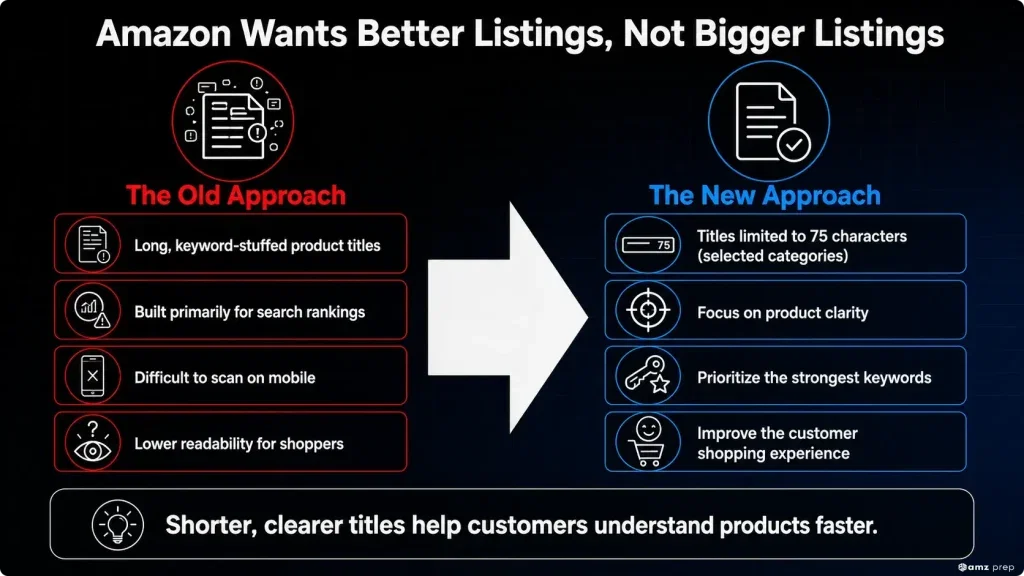
One of the most talked-about updates this year is the new 75-character limit for product titles in many non-Digital, Industrial, and Automotive categories.
For years, Amazon sellers treated product titles like search engines. The goal was to fit in as many keywords as possible. Many listings looked something like this:
“Stainless Steel Water Bottle Vacuum Insulated Leak Proof Sports Bottle Travel Flask BPA Free Wide Mouth Gym Hiking Outdoor.”
Did those titles include keywords?
Yes.
Were they pleasant to read?
Not really.
Think about how people actually shop today.
Most customers are using a phone. They scroll quickly. They compare several products in seconds. Long titles don’t help them. In many cases, shoppers never even see the full title because it gets cut off on smaller screens.
Amazon knows this.
That is why shorter titles are becoming the standard.
The purpose of a title has changed. Instead of trying to rank for every possible search term, the title should answer one simple question.
“What is this product?”
Nothing more.
Once the customer understands the product, the listing should help them decide. That’s it….
A clear title improves the shopping experience. It also forces sellers to focus on what really matters instead of stuffing every keyword into one sentence.
That doesn’t mean SEO disappears.
It means SEO needs to become smarter.
The strongest keywords should stay in the title.
Everything else belongs somewhere more appropriate.
Item Highlights Might Become the Most Important Part of Your Listing

When Amazon shortened product titles, it also introduced Item Highlights.
Some sellers treated this like just another field to complete before publishing a listing.
I think they’re missing the opportunity.
Item Highlights give sellers space to explain their product
Imagine you’re selling a camping flashlight.
you can use Item Highlights to explain things like:
- Battery life
- Water resistance
- Brightness
- Charging method
- Emergency features
- Best use cases
Now compare that to a title filled with twenty keywords.
Which one helps a customer make a buying decision?
The answer is obvious.
Customers don’t buy products because a title contains more words.
They buy because they quickly understand what makes one product better than another.
This is where I think many sellers need to change how they write listings.
Stop asking,
“How many keywords can I fit here?”
Start asking,
“What question is my customer trying to answer?”
That one change in thinking improves almost every listing.
Your Listing Should Read Like It Was Written for a Person
One mistake I continue to see is sellers writing listings for Amazon’s algorithm instead of real people.
Algorithms matter.
Search visibility matters.
But customers are still the ones clicking the Buy Now button.
A listing should feel natural.
It should answer common questions.
It should remove doubts.
It should make someone feel confident
Amazon notices too.
Today’s listings should feel simple.
Easy to scan.
Easy to understand.
Easy to trust.
That’s what converts visitors into buyers.
AI Is Now Helping Amazon Build Listings
Another major update this year is Amazon’s use of artificial intelligence to recommend or even create product titles when sellers don’t meet the new standards.
This has made some brands nervous.
I understand why.
Take advantage of that.
Read every suggestion carefully.
Keep the parts that improve clarity.
Change the parts that don’t match your brand.
At the end of the day, you’re still responsible for your listing.
Don’t wait for Amazon to make decisions you could make yourself.
Good Listings Are Becoming Easier to Read
If you step back and look at all these listing changes together, one thing stands out.
Amazon wants cleaner product pages.
Shorter titles.
Better highlights.
Clearer information.
Less keyword stuffing.
More helpful content.
That’s good news for customers.
International Sellers Finally Get Better Image Management
Amazon now allows country-specific product images directly inside Seller Central.
That means your U.S. listing can display one set of images while your Canadian, German, or Japanese listings display another.
Products often need different packaging.
Different languages.
Different certifications.
Sometimes even different lifestyle photos.
A winter product marketed in Canada can be marketed the saw way for Florida.
Those differences can be managed inside one platform,now.
Selling Internationally became either easy or Hard
Many sellers think international expansion is just translating their listing into another language.
It isn’t.
Every marketplace behaves differently.
Customers ask different questions.
Buying habits change.
Regulations change.
That’s why I see country-specific image management as more than just another Seller Central feature.
It’s another step toward making international selling easier for growing brands.
Referral Fee Changes Mean Margins Need Another Review
Fee Change
Sellers complain.
Then they move on.
I think that’s a mistake.
Every fee change should trigger one question.
“Does this product still make enough profit?”
Margins disappear slowly.
A higher referral fee here.
A placement fee there.
More expensive prep costs.
Higher shipping rates.
None of them look dangerous by themselves.
Together, they can completely change the profitability of a product.
This is why I recommend reviewing your numbers regularly instead of waiting until profits suddenly disappear.
A product that looked healthy six months ago might tell a very different story today.
Small Costs Have a Way of Becoming Big Problems
One lesson I’ve learned is that businesses rarely struggle because of one massive expense.
More often, they struggle because of dozens of small costs they never noticed.
An extra twenty cents.
Another storage charge.
A higher referral fee.
Additional labeling costs.
Eventually, those small increases add up.
That is why successful sellers know their numbers.
Not just revenue.
Profit.
Contribution margin.
Landed cost.
Advertising cost.
Every dollar matters.
Amazon has become too competitive to ignore the details.
The FBA New Selection Program Deserves Another Look
One announcement that didn’t receive as much attention as it deserved was the expansion of the FBA New Selection Program.
For brands launching new products, this can reduce some of the costs that normally come with entering the marketplace.
Storage incentives.
Coupon credits.
Vine enrollment benefits.
Lower referral fees during the launch period.
None of these guarantees success.
But they lower the cost of testing new ideas.
Learning Is Becoming Easier for Growing Teams
Amazon also made Seller University publicly available without requiring account access.
That may sound like a small change.
I don’t think it is.
Growing businesses depend on good training.
Warehouse teams.
Virtual assistants.
Customer service representatives.
Operations managers.
Good businesses invest in systems.
Great businesses invest in people.
Amazon has made that easier.
Modern warehouse platforms continue to improve inventory visibility, as seen in Navigate’s June release.
Every Update Tells the Same Story
Amazon isn’t asking sellers to work harder.
It’s asking them to work better.
Clearer listings.
Smarter product pages.
Better-trained teams.
Healthier margins.
Stronger systems.
The sellers who embrace these changes will probably adapt without much trouble.
The ones who keep relying on old habits may find themselves wondering why sales, profits, and rankings slowly begin to slip.
And the truth is, the answer won’t be one big mistake.
It will be a hundred small ones.
That’s how Amazon changes.
Slowly.
Quietly.
Then all at once.
In the next section, I’ll look at the biggest operational changes of the year, including the end of Amazon’s FBA prep services, rising inbound fees, inventory planning, and why logistics has become one of the biggest competitive advantages an Amazon seller can have.
Operations Are No Longer a Back Office Function. They’re Your Competitive Advantage.
If the first half of this year’s updates focused on improving product listings, the second half focused on something even bigger.
Operations.
For a long time, operations stayed behind the scenes. Customers never thought about it. Sellers didn’t always think about it either. As long as inventory arrived at Amazon and orders kept shipping, most people assumed everything was working.
This no longer works.
The End of Amazon’s Prep Services Changed Everything
One of the biggest shifts this year was Amazon ending FBA prep and item labeling services in the United States.
I don’t think many sellers realized how much they relied on those services until they disappeared.
Amazon used to help with things like:
- FNSKU labels
- Polybagging
- Bubble wrapping
- Bundling
- Prep work for products with special requirements
Now that responsibility sits with the seller.
At first, that may sound simple.
Just label the product before shipping it.
But anyone who has handled inbound inventory knows it isn’t that easy.
Every product category has different requirements.
Some products need suffocation warnings.
Others need opaque bags.
Fragile products need extra protection.
Some items require expiration dates.
Others need special barcode placement.
Miss one requirement and Amazon may reject the shipment, delay receiving, or charge additional fees.
I’ve seen businesses spend months improving advertising only to lose those gains because inventory couldn’t get checked into Amazon on time.
Marketing brings customers.
Operations make sure there’s something available to sell.
Small Prep Mistakes Create Big Problems
One of the most common questions I hear is,
“How strict is Amazon?”
The answer is simple.
Very.
A missing barcode doesn’t affect one unit.
It affects the entire shipment.
Incorrect packaging doesn’t slow down one order.
It slows down receiving.
One mistake at the warehouse can create problems that spread through your inventory, your advertising campaigns, and even your cash flow.
That’s why I believe sellers need to stop thinking about prep as a simple warehouse task.
It’s quality control.
Every shipment should go through the same checklist before it leaves the building.
Are the labels correct?
Is every barcode easy to scan?
Does every unit meet Amazon’s prep requirements?
Has someone physically checked random samples?
A five-minute inspection today can prevent weeks of headaches later.
Inbound Defect Fees Are Sending a Message
Amazon didn’t just remove prep services.
It also increased inbound defect fees.
Some of those increases surprised sellers because they were much higher than expected.
I don’t think the goal was simply to collect more money.
I think Amazon wants fewer mistakes entering its fulfillment network.
Think about it from Amazon’s point of view.
Every incorrectly prepared product creates extra work.
Employees spend more time fixing inventory.
Receiving slows down.
Storage becomes less efficient.
Orders take longer to process.
If your shipment is ready when it reaches Amazon, your costs stay lower.
If Amazon has to fix your mistakes, you’ll pay for it.
Your Supplier Is Now Part of Your Amazon Strategy
Can your supplier apply labels correctly?
Can they follow Amazon’s packaging requirements?
Can they make changes quickly when Amazon updates its rules?
Can they document their work?
These are the questions that need a positive answers from your supplier
That’s why I encourage sellers to build stronger relationships with suppliers.
Don’t assume they understand Amazon.
Teach them.
Share updated requirements.
Review shipments together.
Treat them like partners instead of vendors.
The stronger your supplier becomes, the fewer surprises you’ll face later.
Logistics Is Becoming a Profit Center
Many people still see logistics as an expense.
I look at it differently.
Good logistics create profit.
Bad logistics destroy it.
Imagine two sellers offering the exact same product.
One pays unnecessary placement fees.
The other doesn’t.
One receives inventory late.
The other stays in stock.
One gets charged inbound defect fees.
The other passes inspection the first time.
Who makes more money?
The product didn’t change.
The logistics did.
That is why operations deserve just as much attention as advertising.
Sometimes improving your warehouse process has a bigger financial impact than increasing your ad budget.
Placement Fees Changed the Way Inventory Moves
When Amazon introduced inbound placement fees, many sellers saw them as another cost of doing business.
I think they represent something larger.
Amazon wants inventory closer to customers before orders are placed.
That helps reduce shipping times.
It lowers transportation costs inside Amazon’s network.
It improves the customer experience.
The challenge for sellers is deciding whether to accept those fees or adjust their shipping strategy.
Some businesses choose to split shipments.
Others use inventory distribution programs.
Some work with third-party logistics providers to position inventory more efficiently.
There isn’t one solution that works for everyone.
The important thing is understanding why the fee exists.
Once you understand Amazon’s goal, it becomes easier to decide how your business should respond.
Inventory Rebalancing Is About More Than Cost
Another new expense that caught many sellers off guard is the inventory rebalancing fee.
Again, I don’t think this is just about revenue.
Amazon wants inventory spread across its fulfillment network.
If inventory is concentrated in one region, Amazon has to move products after they arrive.
That creates extra transportation and handling costs.
Instead of absorbing those costs, Amazon is passing more of them back to sellers.
This is another reminder that inventory planning now starts long before products reach an Amazon fulfillment center.
Forecasting demand by region.
Planning inbound shipments.
Understanding seasonal trends.
These activities have become much more valuable.
The businesses that forecast accurately often spend less fixing inventory problems later.
Inventory Planning Is No Longer Guesswork
Many sellers still manage inventory by looking at current stock levels.
I think that’s becoming too risky.
Inventory planning should start with questions like:
How long does production take?
How long does ocean freight take?
What happens if customs adds another week?
What if demand increases faster than expected?
What happens if one shipment gets delayed?
Good inventory planning isn’t about predicting the future perfectly.
It’s about preparing for uncertainty.
The businesses that survive disruptions aren’t always the biggest.
They’re usually the ones with the best planning.
The difference between backorders and stockouts, understanding stockouts, inventory shortages, backorders and inventory planning
Heavy and Bulky Sellers Have New Rules to Follow
If you sell oversized products, you’ve probably noticed Amazon’s continued expansion of its Heavy and Bulky network.
For some sellers, this means updating documentation.
For others, it changes how inventory moves through the entire supply chain.
Large products already cost more to store.
They cost more to transport.
They cost more to fulfill.
That means mistakes become even more expensive.
The best time to prepare for compliance isn’t after inventory starts moving.
It’s before the shipment is booked.
The earlier problems are found, the cheaper they are to fix.
Every Dollar of Landed Cost Matters
One habit I’ve developed over the years is looking beyond manufacturing cost.
Too many sellers stop there.
The product costs ten dollars to make.
Great.
What does it actually cost to sell?
Customs.
Warehousing.
Prep.
Labeling.
Placement fees.
Storage.
Advertising.
Returns.
Referral fees.
Packaging.
Payment processing.
By the time you add everything together, the number often looks very different.
That’s why landed cost matters.
If you only calculate production cost, you’re making pricing decisions with incomplete information.
Successful sellers understand their real cost before they decide what to charge customers.
Many sellers focus on freight rates but overlook the unexpected freight fees that quietly eat into margins.
Cash Flow Is Becoming Just as Important as Profit
One lesson many growing businesses learn the hard way is that profitable companies can still run into cash flow problems.
Inventory ties up money.
Shipping ties up money.
Storage ties up money.
Advertising requires money before sales happen.
When receiving delays increase or inventory gets stranded, cash stays tied up even longer.
That creates pressure across the business.
I’ve seen companies with strong products struggle simply because too much cash was sitting inside inventory.
Managing inventory well isn’t only about avoiding stockouts.
It’s about protecting cash flow.
Healthy cash flow gives businesses flexibility.
Flexibility creates opportunities.
Operations Should Be Measured Every Week
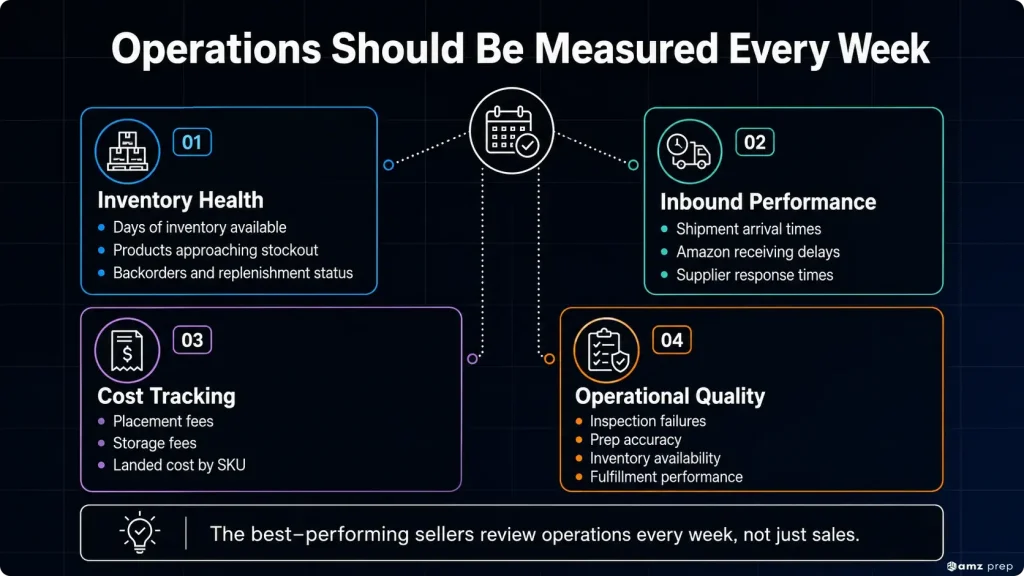
Many businesses review sales every day.
Far fewer review operations with the same discipline.
I think that should change.
Every week, I would want answers to questions like:
Are shipments arriving on time?
How many units failed inspection?
How quickly are suppliers responding?
Are receiving times improving or getting worse?
How many days of inventory do we actually have?
How much are placement fees costing?
Which products are generating the highest storage costs?
The businesses asking these questions regularly usually catch problems while they’re still small.
The businesses that don’t often discover problems after they’ve already become expensive.
The Sellers Who Win Usually Look Boring
One thing I’ve noticed over the years is that the strongest Amazon businesses often look surprisingly ordinary from the outside.
They aren’t chasing every trend.
They aren’t changing strategy every month.
They’re simply consistent.
Products arrive on time.
Listings stay updated.
Inventory remains healthy.
Customers receive orders quickly.
Problems get solved before they grow.
There isn’t anything exciting about that.
But there doesn’t need to be.
Consistency scales.
Chaos doesn’t.
Production schedules also need to account for blank sailings, which can delay containers even after they’ve left the factory.
The Real Lesson Behind Amazon’s Operational Changes
When I step back and look at every logistics update this year, I don’t see Amazon making life harder for sellers.
I see Amazon raising the standard.
The businesses with strong systems will probably continue growing.
The businesses relying on manual work, outdated processes, or constant last-minute decisions will find each year a little more difficult than the last.
Operations used to support the business.
Today, operations are the business.
The companies that recognize that shift early will have a significant advantage over the next few years.
In the next section, I’ll look at another area where Amazon quietly raised expectations: account health, customer service, Buy Box performance, Seller Fulfilled Prime, and the changes that could affect visibility and sales long before a seller realizes there’s a problem.

Arishekar N is a Vice President (VP) of Marketing at AMZ Prep, specializing in ecommerce fulfillment and Amazon logistics strategies with a proven track record of driving growth for e-commerce businesses. He is a strategic leader with extensive expertise in marketing, e-commerce operations, SEO & advertising, and branding.
Stay updated on his latest insights by following him

















Comments