
Amazon AWD looked like the perfect solution when it launched. Bulk storage and distribution at lower rates than FBA. Automatic replenishment to fulfillment centers. No placement fees. Finally, a way to avoid the constant cash flow squeeze of FBA storage limits for every Amazon seller.
Then sellers started using it.
Many sellers are now seeking an Amazon AWD alternative that offers the same cost benefits without the operational challenges.
Last Q4, we watched brands pull their entire inventory out of AWD after transfer times hit 40+ days. Listings got suppressed. They lost Buy Box. West Coast facilities stopped accepting shipments without explanation.
One client emailed us at 11 PM on a Sunday: “My inventory has been sitting in AWD for 6 weeks. Amazon won’t tell me when it’ll transfer to FBA. I’m about to lose $180K in holiday sales.”
We got their inventory into FBA in 4 days using our middle-mile network. They saved 26.4% compared to what they were paying AWD.
This keeps happening. AWD sounds great on paper, but the execution is costing sellers money, time, and sales velocity. Here’s the real breakdown of Amazon AWD vs middle-mile logistics with actual numbers, not Amazon’s marketing.
Our founder Blair Forrest explains the cost breakdown in detail here:
What Amazon AWD Actually Is (And What They’re Not Telling You)
Amazon Warehousing and Distribution is Amazon’s bulk storage FBA replenishment program. Amazon changed AWD product eligibility, more sellers can now use the program for a wider range of inventory, making it important to understand where AWD fits within your fulfillment strategy. Amazon AWD is primarily designed as a low-cost bulk storage solution that Amazon provides to help sellers manage their supply chain more efficiently. The pitch is simple:
- Send large quantities to AWD facilities (cheaper storage than FBA)
- AWD will automatically replenish to FBA as your inventory sells
- No placement fees because Amazon handles distribution
- Lower storage costs than traditional FBA
Sounds perfect, right?
How AWD works: You send inventory directly to Amazon’s warehouse facilities, and AWD offers automated transfers to Amazon’s fulfillment centers based on your stock levels. In theory, this comprehensive fulfillment solution eliminates the need to monitor FBA inventory constantly.
Here’s what they don’t mention in the sales pitch:
- Transfer times from AWD to FBA are unpredictable (we’ve seen 7 days to 40+ days)
- You lose visibility once inventory enters AWD
- No control over replenishment timing
- West Coast AWD facilities have chronic capacity issues
- Support is almost non-existent when things go wrong
- If transfers get delayed, your listings can go out of stock with no warning
Amazon built AWD to solve their logistics problems, not yours. They want centralized bulk storage to optimize their network. You’re left hoping they’ll move your inventory fast enough to keep your listings live.
Amazon AWD pricing Breakdown (The Real Numbers)
Understanding the full scope of Amazon AWD pricing requires looking beyond the published rate card.
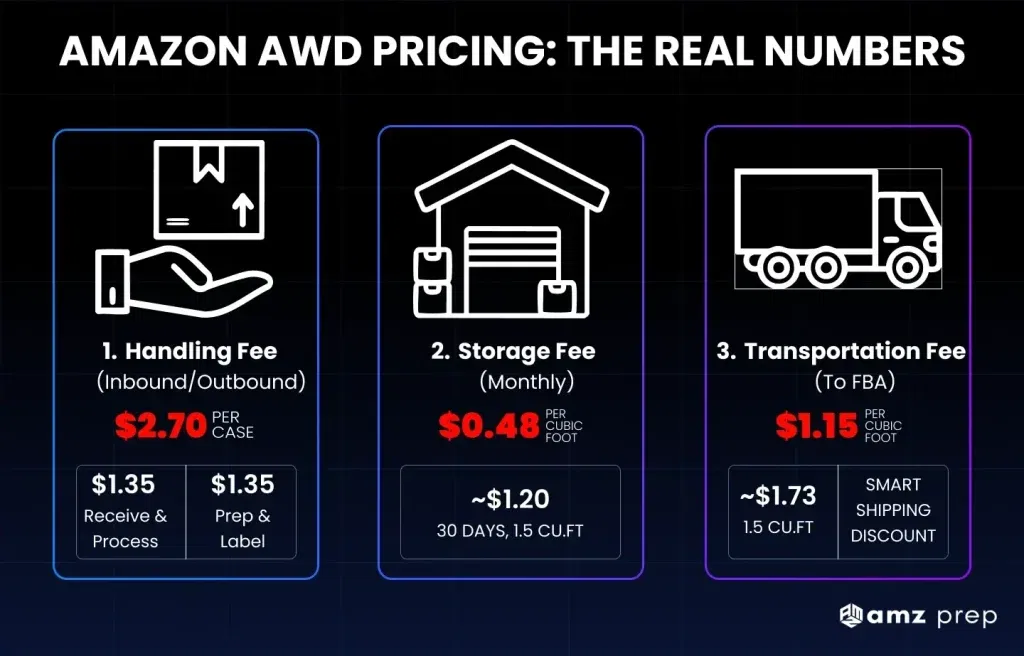
1. Inbound/Outbound Handling Fee: $2.70 per case
- $1.35 to receive and process the case into AWD
- $1.35 to prep and label for FBA transfer
What this means: For a shipment of 100 cases, you’re paying $270 just for handling.
2. Storage Fee: $0.48 per cubic foot (prorated daily)
On average, this works out to $28-$35 per pallet per month, depending on how you stack your cases.
Sounds cheap compared to FBA storage, right? It is. But only if Amazon actually moves your inventory to FBA before you need it. Unlike long-term storage fees in traditional fulfillment by Amazon warehouses, AWD’s rates remain consistent but transfer delays can negate any savings.
3. Transportation Fee: $1.15 per cubic foot
This is Amazon’s “middle mile” fee to move inventory from AWD to FBA fulfillment centers.
For a standard case (1.5 cubic feet), that’s about $1.73 in transportation alone.
Smart Shipping Discount
If you enable “Smart Shipping” (which gives Amazon full control over replenishment timing), they’ll discount the transportation fee by about 15%.
The catch? You lose all control. Amazon decides when to replenish. If they’re slow, your listing goes out of stock. If they’re too aggressive, you burn through FBA fees.
Total AWD Cost Per Case (Example)
Let’s say you have a product that’s 1.5 cubic feet per case:
- Inbound/Outbound: $2.70
- Storage (30 days): ~$1.20
- Transportation: $1.73
- Total: $5.63 per case
That doesn’t include your freight to get inventory into AWD in the first place.
The Hidden Costs of AWD (What You’re Not Calculating)
The Amazon AWD pricing above is just what AWD charges. Here are the costs they don’t list:
1. Stockout Risk from Delayed Transfers
When AWD transfers take 3-6 weeks instead of 3-6 days, you lose sales. We’ve seen brands lose $50K-$200K+ in a single month from AWD-induced stockouts.
The math: If you’re using Amazon to do $500K/month in sales and AWD delays cause a 2-week stockout, you just lost $250K in revenue. No amount of storage savings makes up for that.
2. Lost Buy Box Performance
Amazon’s algorithm punishes stockouts. Even after you restock, it can take weeks to fully recover your Buy Box percentage. During that time, your competitors are eating your lunch.
3. Dead Inventory Sitting in AWD
We’ve seen sellers with inventory stuck in AWD for months. Amazon won’t transfer it. Amazon won’t let you pull it out easily. It just sits there, accruing storage fees and tying up cash.
One seller had $80K in inventory sitting in an AWD warehouse for 4 months. Amazon kept saying “processing delays.” No ETA. No resolution. This is where AWD compared to a responsive 3PL fulfillment service shows its weaknesses.
4. Zero Flexibility for Other Channels
AWD only works for FBA. If you want to fulfill Shopify orders, Walmart, TikTok Shop, or any other sales channels, that inventory is locked in Amazon’s fulfillment system. an increasing concern as platforms change their fulfillment rules, such as when TikTok seller shipping ends Your Amazon store might thrive, but besides Amazon, you’re limited.
Middle-mile logistics gives you flexibility. We can route inventory to FBA, hold it for DTC fulfillment, or split shipments however you need.
Understanding AWD and FBA: How the Program Integrates with Seller Central
For sellers managing their operations through Amazon Seller Central, understanding how Amazon Warehousing and Distribution integrates with FBA is crucial. When you send your SKU to FBA through AWD, you’re essentially adding an extra step to your supply chain.
Here’s the process:
- You ship inventory to an Amazon fulfillment center designated for AWD
- AWD stores your products at lower rates than standard FBA storage
- As your FBA inventory sells down, AWD removes products from bulk storage and transfers them
- Products are sent from the AWD facility to individual Amazon fulfillment centers near customer demand
Amazon offers visibility through Seller Central, but the data is often delayed by 24-48 hours. You can’t see real-time transfers or get accurate ETAs on when products will arrive at FBA centers.
What FBA offers that AWD doesn’t: immediate availability, predictable stock levels, and direct control over your inventory management. When using FBA directly, you know exactly where your products are and when they’ll be available for sale.
How Middle Mile 3PL Warehouse and Fulfillment Pricing Works
Our middle-mile logistics acts as an optimized FBA replenishment program that gives you control over timing and visibility, and when paired with a Middle Mile Audit Tool, sellers can identify bottlenecks and improve replenishment efficiency. As a 3PL specializing in Amazon FBA logistics, we’ve built our fulfillment service around what sellers actually need: speed, visibility, and flexibility.
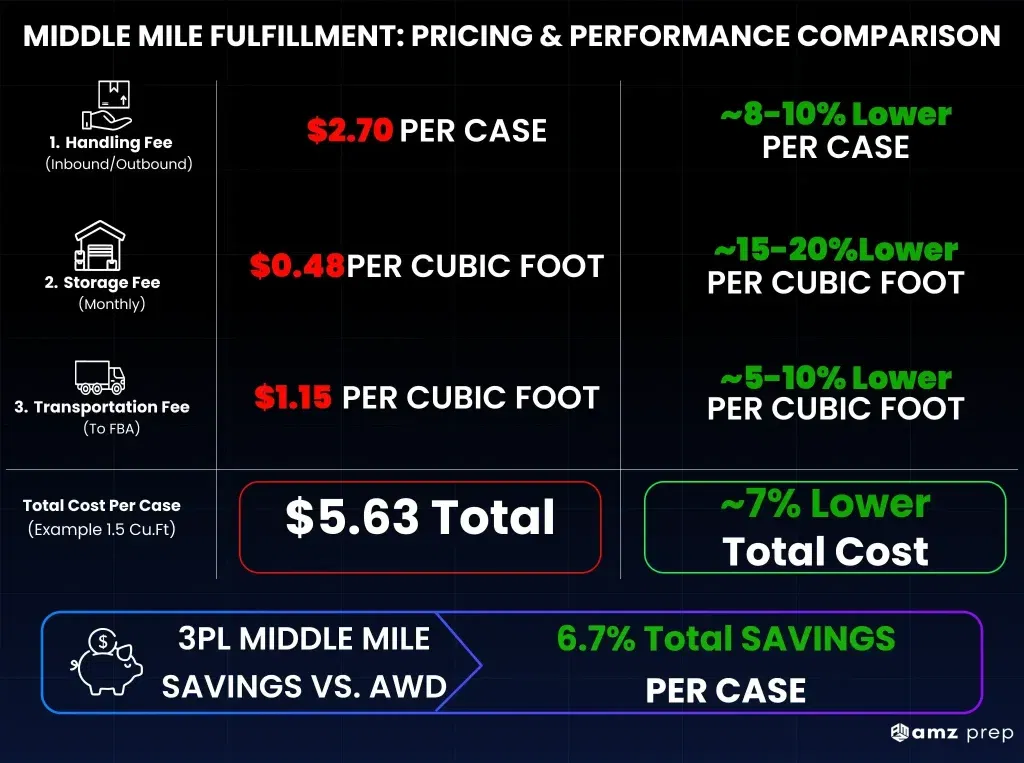
1. Inbound/Outbound Handling: Comparable to AWD
We charge a per-case fee to receive, process, and prep your inventory. Our FBA prep services include all necessary labeling, packaging, and compliance checks. Pricing depends on volume, but we’re competitive with (and often cheaper than) AWD’s $2.70 per case.
2. Storage: Lower Than AWD
Our storage rates are structured to beat AWD, especially for fast-moving inventory. We’re not trying to warehouse your products for months, we’re built for rapid throughput. Our warehouse management system tracks your stock levels in real-time, giving you visibility that Amazon operations can’t match.
Average storage cost: $20-$30 per pallet per month (vs. AWD’s $28-$35).
3. Transportation to Amazon FCs: $1.15-$1.50 per cubic foot
Similar to AWD’s middle-mile fee, but with two key differences:
- We’re faster. Average delivery to FBA: 2-6 days (vs. AWD’s 7-40+ days)
- We give you visibility. You know exactly when shipments are picked up, in transit, and delivered to Amazon’s fulfillment centers.
4. No Placement Fees
Just like FBA, you avoid Amazon’s placement fees entirely. We handle the FC distribution for you using our advanced warehouse management technology.
Total Cost Per Case (Example)
Using the same 1.5 cubic foot case:
- Inbound/Outbound: $2.50
- Storage (30 days): ~$1.00
- Transportation: $1.75
- Total: $5.25 per case
Savings vs. AWD: $0.38 per case
That might not sound like much, but on a 10,000-unit shipment, that’s $3,800 in savings. Over a year, it adds up.
Why Sellers Are Switching from AWD to Middle Mile
The cost savings matter, but that’s not why most sellers switch to an Amazon AWD alternative. Here’s what we hear most often:
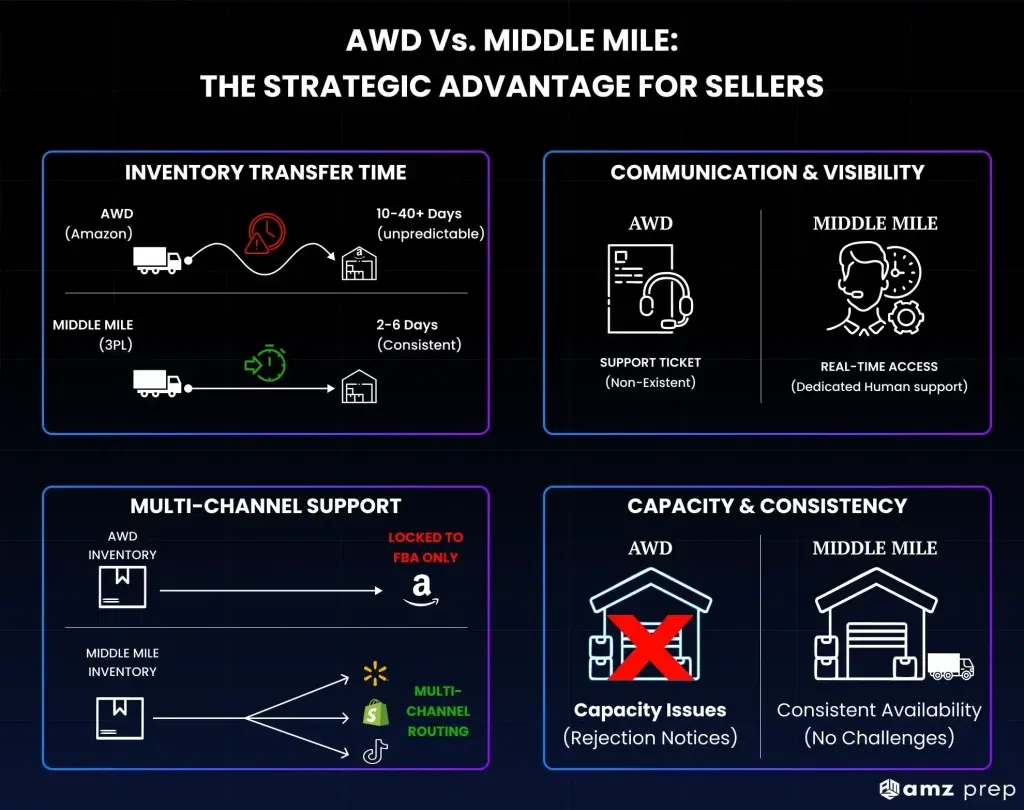
1. Speed (AWD is a Black Hole for Inventory)
AWD average transfer time: 10-40+ days (unpredictable)
Our average delivery time: 2-6 days (consistent)
When you’re managing cash flow and restock planning, predictability matters more than saving $0.50 per case. If AWD takes 6 weeks to transfer and we take 4 days, you just saved 38 days of potential stockout risk. Our FBA inbound process is simplified to get your products selling faster.
2. Transparency (AWD Support is Non-Existent)
Try getting a straight answer from Amazon about where your AWD inventory is. Good luck.
We give you:
- Real-time shipment tracking through our warehouse management system
- Delivery confirmations to each FC
- A dedicated Slack channel or email thread with 60-minute response time
- Actual humans who know your account
3. Flexibility (AWD Only Works for FBA)
If you sell on Shopify, Walmart, TikTok Shop, or any other channel, AWD inventory is locked up. You can’t pull it out for DTC orders without going through Amazon’s slow transfer process. This is one of the major limitations when comparing alternatives to Amazon AWD.
Our middle-mile network supports multi-channel fulfillment. We can route inventory to FBA, hold it for DTC, or split shipments however you need across multiple sales channels. Our comprehensive fulfillment approach means your storage and fulfillment strategy works for your entire business, including cases where you need to import supplements to Canada, not just your Amazon store.
4. Reliability (AWD Has Capacity Issues, Especially on the West Coast)
During Q4 last year, multiple West Coast AWD facilities stopped accepting shipments. Sellers got rejection notices with no alternative options.
We don’t have that problem. If one of our facilities hits capacity, we route to another. You don’t get stuck with inventory sitting on a pallet in your warehouse.
Case Study: How ANS Performance Achieved 98% In-Stock Rate After Switching from Traditional 3PL
ANS Performance, a Toronto-based supplement brand, faced the exact challenges that drove sellers to consider AWD: high shipping costs, inconsistent stock levels, and missed SLA shipment times.

After struggling with their previous 3PL, they switched to AMZ Prep’s middle-mile network. The results:
- 98% in-stock rate across three fulfillment centers
- 25% reduction in fulfillment costs
- 350% improvement in on-time shipments
“At first, Amazon was a bit of a nightmare. Between the inventory limits, third-party re-sellers and advertising costs rising, scaling it seemed difficult.” – Shetal Shah, ANS Performance
By using AMZ Prep’s multi-facility network instead of relying on AWD’s unpredictable transfer times, ANS Performance maintained consistent inventory levels across Amazon while reducing costs.
The Key Differences Between Amazon AWD vs 3PL Middle Mile:
Here’s when each option makes sense:
Use Amazon AWD if:
- You’re okay with unpredictable transfer times
- You only sell on Amazon (no other channels)
- You have high tolerance for inventory sitting in limbo
- You don’t need fast replenishment cycles
- You’re willing to gamble on Amazon’s infrastructure during peak season
Use 3PL Middle Mile Logistics if:
- Speed matters (you need inventory in FBA within days, not weeks)
- You value transparency and real-time tracking
- You sell on multiple channels (FBA + Shopify/Walmart/TikTok)
- You need a responsive support team
- You want to eliminate stockout risk from slow transfers
- You’re shipping 5+ pallets per month to Amazon
Cost Calculator: Amazon AWD vs Middle Mile
Let’s compare the total cost for a typical shipment in this Amazon AWD vs middle mile analysis.
Scenario: 1,000 cases, 1.5 cubic feet per case, 30 days of storage
Amazon AWD:
- Inbound/Outbound: $2,700 ($2.70 × 1,000)
- Storage: $1,200 ($0.48/cu ft × 1,500 cu ft)
- Transportation: $1,725 ($1.15/cu ft × 1,500 cu ft)
- Total: $5,625
- Plus: Risk of 21-40 day delays and potential stockouts
AMZ Prep Middle Mile:
- Inbound/Outbound: $2,500 ($2.50 × 1,000)
- Storage: $1,000 (lower rate for fast throughput)
- Transportation: $1,875 ($1.25/cu ft × 1,500 cu ft)
- Total: $5,375
- Plus: 2-6 day delivery, real-time tracking, multi-channel flexibility
Savings: $250 per shipment
On 12 shipments per year, that’s $3,000 in direct cost savings, plus the value of avoiding stockouts and maintaining Buy Box performance.
How to Switch from AWD to Middle Mile (Step-by-Step)
If you’re currently using AWD and want to test our network:
Step 1: Get a Cost Comparison
Email your current shipment details to info@amzprep.com:
- Average cases per shipment
- Case dimensions and weight
- Current AWD costs (if you have them)
- Shipping origin location
We’ll send back a detailed cost comparison within 48 hours.
Step 2: Run a Trial Shipment
We’ll handle one shipment through our network while you keep AWD running. You compare:
- Speed (AWD transfer time vs. our delivery time)
- Cost (all-in pricing)
- Visibility (tracking and communication)
Step 3: Transition Your Inventory
Once you see the difference, we can coordinate a full transition:
- Redirect your inbound freight to our facilities
- Set up your Amazon shipment plans to route through us
- We handle the FC sortation and delivery
No long-term contracts. No setup fees. No risk.
The Bottom Line: AWD vs. Middle Mile
Amazon AWD sounds great until you actually use it. The pricing is competitive, but the execution is costing sellers real money through slow transfers, stockouts, and complete lack of visibility.
We built our middle-mile network specifically because we kept seeing sellers get burned by AWD. As an Amazon AWD alternative, our model gives you the same cost benefits (no placement fees, bulk replenishment) with:
- Speed: 2-6 days vs. 10-40+ days
- Transparency: Real-time tracking and responsive support
- Flexibility: Multi-channel fulfillment, not just FBA
- Reliability: No capacity rejections, no surprise delays
If you’re considering AWD or already using it and frustrated with the results, let’s run the numbers.
Get your free cost comparison: Email your shipment details to info@amzprep.com
Or learn more about our middle-mile program: Middle Mile Logistics FBA Fast Track
Related Reading
Looking for more ways to optimize your FBA logistics and cut costs?
- How to Avoid Amazon Placement Fees (Without Slowing Down Your Inbounds) – Our complete guide to eliminating placement fees while speeding up inbound times.

Arishekar N is a Vice President (VP) of Marketing at AMZ Prep, specializing in ecommerce fulfillment and Amazon logistics strategies with a proven track record of driving growth for e-commerce businesses. He is a strategic leader with extensive expertise in marketing, e-commerce operations, SEO & advertising, and branding.
Stay updated on his latest insights by following him
















Comments