
Your profit margins aren’t lost in sales but they are lost in fulfilllment.
If you’re an Amazon seller, chances are you’re silently bleeding thousands of dollars every month on logistics without even realizing it. From oversized packaging and inefficient fulfillment zones to inflated international shipping and hidden tariff costs, most shipping strategies are full of avoidable inefficiencies.
Many sellers spend thousands each month on logistics, unaware that their current strategy is not cutting it. In an environment where competition is fierce and customer expectations are sky-high, optimizing your shipping setup can lead to 20% to 40% in cost savings and a substantial lift in customer satisfaction.
This isn’t just for small-scale sellers. We spoke to an Amazon brand doing over $500M in revenue, shipping 12,000+ orders monthly to Canada and over 200,000 in the U.S. They were unknowingly paying $25- $30 per Canadian parcel with 5- 7 day delivery times.
By restructuring their shipping strategy, they reduced delivery time to 2- 3 days, slashed costs to $8- $12, and boosted revenue by $270,000 per month.
Let’s break down how you can do the same and gain clarity on all about how to reduce Amazon shipping costs.
Signs You’re Overpaying on Shipping Without Realizing It
Before trying to solve the problems, let’s find out if you are in the wrong at all.
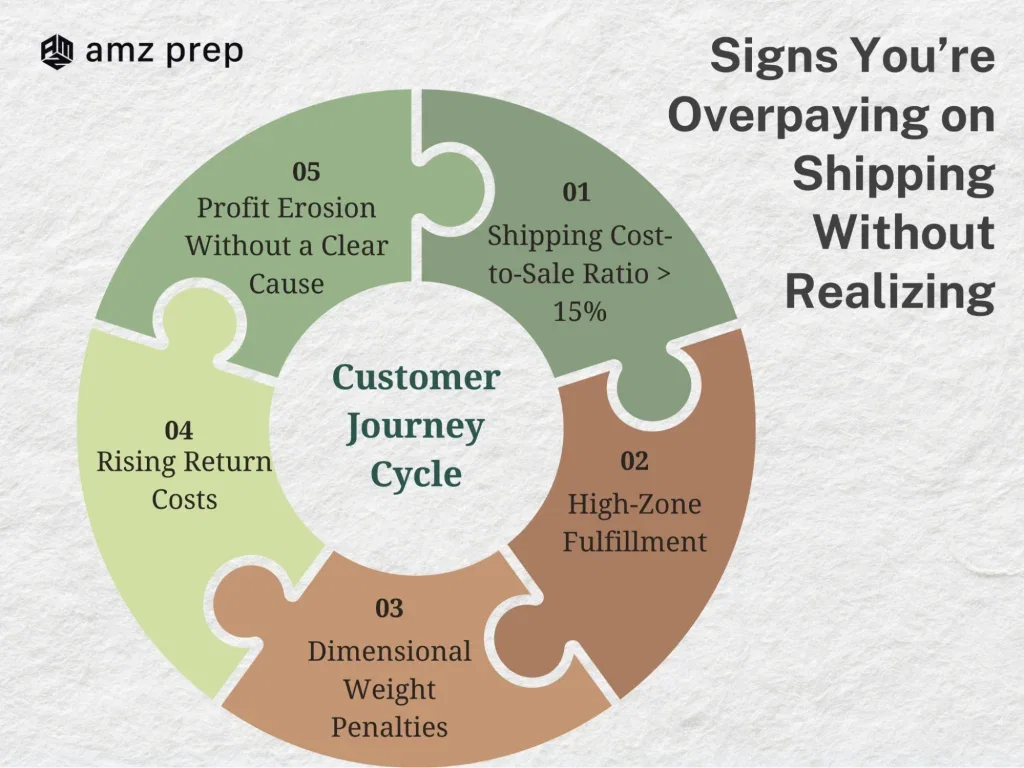
1. Shipping Cost-to-Sale Ratio > 15%
If your shipping costs are more than 15% of your average order value (AOV), you’re in dangerous territory. For a $50 product, anything above $7.50 in shipping is cutting deeply into your margins.
2. High-Zone Fulfillment
Shipping from California to New York? That’s a Zone 8 shipment. It could cost you nearly double compared to fulfilling from a closer warehouse.
3. Dimensional Weight Penalties
Due to dimensional weight pricing, you might be billed for 8 lbs even if your product only weighs 2 lb. The formula: (L x W x H) / 139. Always calculate for your own.
Check out our Dimensional Weight Calculator that will help you choose the right carrier avoiding any overpaying!
4. Rising Return Costs
Returns routed to one centralized warehouse can increase costs quickly. Amazon return label fees range from $3.99 to $7.99, and customer complaints often follow slow return processing.
Suggested Read: Top 10 Amazon Return Reasons and How to Avoid Them as a Seller
5. Profit Erosion Without a Clear Cause
Look deeper into your shipping invoices. Fuel surcharges, residential delivery fees, and broker handling on international shipments can quietly eat up your margins.
11 Ways to Reduce Amazon Shipping Costs as a Seller
Find the best 11 ways to reduce Amazon shipping costs and drastically improve your profit margin!
1. Optimize packaging materials and dimensions
Packing dimensions and materials used can heavily influence the costs you incur in storage fees. Amazon charges you based on the dimension and weight of your final package, even if your actual product is way smaller and lighter.
Switch to materials like corrugated plastic or air pillows instead of cardboard and paper. Even a few ounces can push you into a lower tier.
Shrinking a box from 10″x8″x6″ to 9″x7″x5″ can drastically reduce dimensional weight from 8 lbs to 6 lbs, saving $2.40 per shipment, thus reducing storage costs and consignment shelf space.
You can use packaging dimension optimization software or work with a 3PL provider to identify opportunities to reduce height, width, and depth without compromising product protection.
2. Bundle products strategically
When you sell items individually, each SKU adds to your storage footprint, handling cycles, and per-unit prep costs. Over time, this clutters your inventory flow and eats into your margins.
Bundling allows you to reduce the number of shipped parcels and packaging, which will lower cost of fulfillment and increase AOV. Fewer shipments mean lower fulfillment fees, faster shipping, and minimal prep costs.
Each individual item has a per-unit handling cost. By bundling lightweight items together, you can move from multiple small standard-size fees to a single large standard-size fee, often resulting in net savings.
Suppose you sell a spoon set with a stand. Packing them all individually would add to the number of units that will be charged separately. Packing them all together would mean, you pay a consolidated amount for one single package along with minimal prep cost.
3. Send shipments in bulk and use Subscribe and Save
Bulk shipments often mean less frequent shipments. Consolidate inventory shipments to Amazon every 2 months rather than every 2 weeks to save up on fees.
In order to help with inventory planning and relevant bulk shipment planning, you can use Amazon’s Subscribe and Save (SNS) program. This not only boosts customer retention but, smoothens demand forecasting and inventory planning, which reduces shipping volatility.
For example, if each small shipment costs $120 in total logistics (freight + handling) and you send 2 per month, that’s $240/month. Consolidating into one larger shipment at $150 saves you $90/month, or over $1,000 per year.
This predictability minimizes per-order shipping expenses and improves logistics efficiency, especially when multiple subscription items are shipped together on a recurring schedule.
4. Use FBA inventory placement (Fulfillment by Amazon) and utilize regional fulfillment,
Most often, sellers aren’t aware of where their orders are coming from. Always deeply analyze your order demographic data through brand analytics to find out who your customers are and where they predominantly come from.
This is where Amazon’s Inventory Placement Service (IPS) comes in. By allowing Amazon to distribute your inventory across fulfillment centers closer to your customers, you can drastically reduce multi-zone shipping costs. In fact, sellers who opt into IPS save an average of 25% on cross-zone fulfillment expenses.
Even more, by storing inventory near high-demand regions, you achieve faster delivery and lower last-mile costs. Techniques like zone-skipping shipping in bulk to regional hubs and injecting into local delivery networks help eliminate long-haul zone charges.
This data can help you target your customers well through PPC ads as well as social media ads as well for a successful full-funnel marketing strategy.
5. Work with trusted 3PLs
3PLs charge lower pick and pack fees when compared to Amazon FBA. If you could get the same quality and efficiency as Amazon FBA and still cut down on a few dollars to get the same job done, considering a 3PL is not a bad idea at all.
Third-party logistics providers like AMZ Prep can offer better-negotiated carrier rates, localized fulfillment, and specialized packaging to align with your brand requirements. For smaller sellers not yet ready for a full 3PL contract, small business shipping services offer a lighter-weight entry point with many of the same carrier savings.
Additionally, AMZ Prep supports specialized packaging tailored to your brand identity, from eco-friendly materials to compact, dimensional-weight optimized parcels. This directly reduces dimensional weight surcharges, pick/pack fees, and prep costs often delivering up to 20% savings on fulfillment operations.
6. Adopt Amazon’s Frustration-Free Packaging
Amazon’s Frustration-Free Packaging is a program designed for e-commerce brands. This program is all about ensuring packaging is compact, recyclable, and easy to open, which can reduce shipping weight and cost.
Enrollment is typically open to brand owners and vendors who meet Amazon’s testing standards like ISTA-6A, and products must be able to ship without an Amazon overbox. FFP can lower dimensional weight charges which will ultimately minimize the costs associated with shipping.
Additionally, products in this program often see a higher Buy Box win rate and better review potential due to improved customer satisfaction which can have a positive impact on your organic product ranking as well as seller ranking.
7. Consider order consolidation
Now, this is a smart tactic that not many sellers utilize. You can always encourage customers to buy more in a single order through threshold-based promotions.
You can offer multipacks, combos, and variations to entice your customers into adding more than one product into their carts. This does more than just improve your Average Order Value (AOV).
How, you ask? A 3-product order costs 38% less to ship than three single-product orders.
Apart from this, you can offer free shipping over $49. Amazon will consolidate these items into a single shipment, lowering per-unit shipping costs.
8. Track shipping KPIs and analytics
You won’t know what needs fixing unless you track everything. Regularly monitor the money that’s coming in and the money that’s going out. And, when you are doing that, you also need to know the shipment that’s getting shipped successfully and getting tracked into the total number of units on Amazon Seller Central.
Often, you may send 450 units to Amazon’s fulfillment center but only 442 units would be reflecting. But you paid for all 450 units to be shipped. These types of issues are often categorized as shipment exceptions – delayed, lost, or damaged inventory during transit or intake. Hence, tracking your shipment on a granular level is the only way out of any such accidental discrepancies.
Monitoring shipment reconciliation ensures you’re not losing inventory due to fulfillment center errors, damages, or misplacements. Regularly cross-check inbound shipments against what Amazon actually receives and logs.
Track your shipping costs to the percentage of revenue which should ideally be less than 15%.
Check your dimensional costs and where you can cut down on that, return charges and delivery time by zones to always know the next move to take.
This will help you forecast demand and optimize inventory restocking with machine learning models.
9. Fulfill locally for International customers,
One of the common mistakes sellers make is set up Global selling on Amazon but choose to ship the products directly from their home country. This is like setting yourself up for losses.
Instead of shipping every international order individually from your home base, which incurs high shipping fees, customs delays, and duties, you bulk ship inventory in advance to a local warehouse or 3PL in the destination country.
This allows for faster, cheaper, and smoother last-mile delivery.
Say for example, instead of fulfilling each UK order from the U.S., you can bulk ship inventory to a 3PL in Birmingham. Originally, each international order cost around $26–$32 due to high shipping fees, customs duties, and VAT. After shifting to local fulfillment, the per-order cost dropped to just $4.50–$6. Delivery time also improved from 7–10 days to 1–2 days, saving over $20 per order and significantly boosting customer satisfaction.
10. Reduce Shipping Rate When Purchasing from Suppliers (B2B)
Shipping costs don’t just apply when you sell to customers. They also apply when you purchase inventory from your supplier. If you frequently order small quantities, you’re likely overpaying for per-unit shipping, customs, and handling.
Instead, consolidate your supplier orders into bulk shipments to reduce cost per unit. This further gives you access to cheaper freight options like Full Container Load (FCL) or consolidated sea freight.
For example, if you’re sourcing goods from China, your shipping costs will reduce from $2.40/unit to $1.10/unit by switching from weekly air shipments to monthly sea freight. Over 3,000 units, that’s $3,900 saved per shipment.
Bonus: Bulk imports often qualify for lower tariffs and avoid per-parcel brokerage fees, helping you cut costs even before your inventory hits Amazon.
Suggested Read: How to Find the Best Amazon FBA Wholesale Suppliers
11. Stage inventory locally to reduce tariffs
Tariffs are taxes that countries charge on goods imported from other countries. They increase the total cost of shipping products across borders. Tariffs can add up to 10- 30% to your cost depending on the category.
To better understand the exact duties you might incur, you can use our Reciprocal Tariff Calculator — a simple tool to estimate your tariff costs upfront.
For sellers, this means that shipping individual packages internationally can lead to higher costs, due to high duties and brokerage.
While, importing inventory to the local FCs and storing it locally can reduce or avoid these extra fees.
Let me tell you how.
A U.S. based apparel brand selling into Germany discovered that shipping individual parcels directly to customers triggered 12-17% in import duties plus $7- $13 in brokerage fees per order. On a $60 product, that meant $7.20- $10.20 in tariffs alone, per shipment.
By switching to bulk importing inventory into a German 3PL, they qualified for a reduced bulk tariff rate of 8%, with no per-order brokerage fees.
Old model (per parcel):
$60 x 15% avg. duty = $9
$10 avg. brokerage = $19 total per order
New model (bulk import):
$60 x 8% duty = $4.80 per unit
negligible bulk brokerage = $5 savings per order
So, on 2,000 orders/month, that translated to $10,000+ in monthly savings, just by staging inventory locally in Germany.
Hence, evaluate tariff structures and duties by country. Use HS codes to determine the best route between your shipping options.
Conclusion
I hope you found your answers to how to reduce Amazon shipping costs. Remember that shipping optimization boosts your customer satisfaction, lowers returns, improves delivery speeds, and significantly enhances margins.
By diagnosing inefficiencies and systematically applying these 16 strategies, Amazon sellers like you can experience:
- 20- 40% reduction in shipping costs
- 10- 25% faster delivery
- Up to 19% increase in logistics efficiency
From smarter packaging and regional fulfillment to predictive demand modeling and tariff savings, each step you take brings measurable returns.
Don’t wait until your margin reports scream for help. Because the sooner you fix shipping, the faster everything else grows.
Start optimizing today!
FAQs
What percentage of revenue should I spend on shipping costs?
Successful Amazon sellers typically keep logistics expenses between 10-15% of revenue. If you’re spending over 20%, your fulfillment strategy needs optimization.
How quickly will I see cost savings from new shipping strategies?
Most strategies show results within 30-60 days. Packaging and regional fulfillment changes provide immediate savings, while international fulfillment setup takes 2-3 months.
What hidden costs should I watch for when reducing shipping expenses?
What hidden costs should I watch for when reducing shipping expenses?
Watch for increased storage fees with bulk shipments, 3PL prep charges, customs broker fees, and potential stockout costs from reduced shipment frequency.
When should I switch from FBA to a 3PL provider?
Consider 3PLs if you ship 500+ units monthly or have oversized/specialized products. Compare total costs including setup fees and factor in Prime eligibility value.
What tools help track shipping performance beyond Seller Central?
Use inventory software like RestockPro, shipping comparison tools like ShipStation, and customs calculators like Flexport for deeper optimization insights.

Blair Forrest is the Founder of AMZ Prep, one of North America’s fastest-growing third-party logistics and fulfillment networks, built entirely without outside capital since 2016. Under his leadership, AMZ Prep has scaled to 50+ fulfillment centers across 6 countries, processing over 10 million plus units monthly and powering $2 billion+ in annual GMV for more than 5,000 brands worldwide including 437, Silverts, Saltyface, Unilever, Duracell, and JBL. A recognized authority in eCommerce logistics, Amazon FBA strategy, and supply chain optimization, Blair has helped thousands of sellers and brands master their fulfillment operations from first shipment to enterprise scale. He regularly consults on FBA prep, multi-channel fulfillment, last mile delivery, international expansion, and cost reduction strategies that save brands 20–40% compared to traditional 3PL providers. Blair’s insights on Amazon logistics, 3PL operations, and eCommerce growth are widely cited across the industry. Through AMZ Prep’s content, guides, and resources, he continues to share battle-tested strategies drawn from managing one of the largest independently owned fulfillment networks in North America.
















Helpful reminder to look at both speed and cost when choosing carriers.
I liked the cost‑saving strategies explained in an easy‑to‑understand way.
Simple steps that any Amazon seller can start using right away.
Good overview of tactics to lower fulfillment and shipping costs.
I liked the focus on minimizing thawing and spoilage risks.
Great tips for cutting down shipping expenses without sacrificing service.
The suggestions for carrier comparison really helped me rethink my strategy.
Practical suggestions that make a real difference in shipping budgets.
Useful ideas for evaluating shipping options and reducing rates.
Clear and practical advice on optimizing package sizes to save money.