

Your EDI vendor says everything is compliant and the documents are flowing through just fine. But you’re still getting chargebacks from retailers. Why? Well?
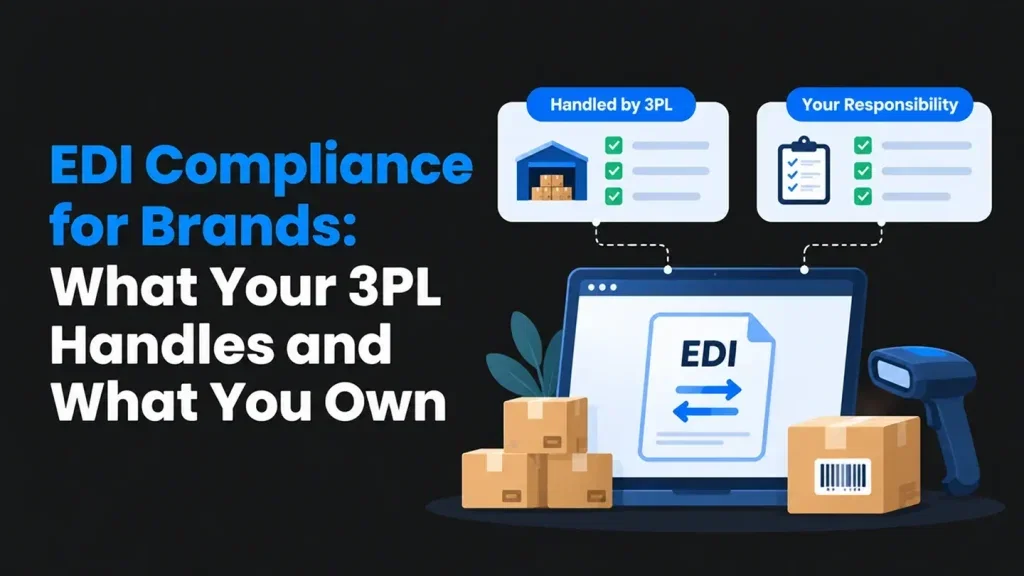
Well, EDI compliance is more than simply sending the right documents. You also need to ensure they get to the retailer on time and that the product details, quantities and shipping information match what arrives at the warehouse.
And in this context, your fulfillment operations are also important.
In this blog, we will discuss what EDI compliance is, what documents are required for retail orders, and how the responsibilities are divided between your business, EDI provider, 3PL, and retailer. We’ll also cover what to look for in a 3PL for retail fulfillment.
Key Takeaways
- EDI compliance means sending the right documents to retailers at the right time and making sure the data matches what you’ve actually shipped.
- You are not fully compliant necessarily just because you send EDI documents. You also need to ensure that your warehouse labels, cartons and pallets match the details in your Advance Ship Notice (ASN).
- EDI compliance involves lots of teams. Your brand handles the relationship with the retailer, your EDI provider manages the document exchange and your 3PL ensures the physical shipment matches the data provided.
- Before choosing a 3PL, ask how they create ASNs, who manages the retailer’s routing guide, who schedules delivery appointments, and who’s responsible for costs when warehouse mistakes lead to chargebacks.
What is EDI compliance?
EDI compliance simply means communicating digitally with your retail partners in the format they want, when they want, with the right order and shipment details.
Most big retailers use EDI, or electronic data interchange, to send purchase orders, shipping notices and invoices to their suppliers.
For example, if you’re selling products to a large retailer, a notice of incorrect shipment or missing a document deadline could mean chargebacks.
Retailers can deduct these from your payments and repeated mistakes can also impact your supplier scorecard. This could mean fewer or smaller purchase orders over time.
Now, there’s also a difference between EDI capability and EDI compliance.
EDI capability means your system can send and receive the documents you need. Meanwhile, EDI compliance is making sure those documents are accurate, are sent on time and match the products your warehouse actually ships.
So your EDI provider helps you exchange documents, but your warehouse team plays a big part in making sure everything matches before the shipment heads to the retailer.
Which EDI documents does a retail order use?
These are the documents you are most likely to meet. Not every retailer uses all of them; each retailer’s EDI implementation guide lists the ones it requires.
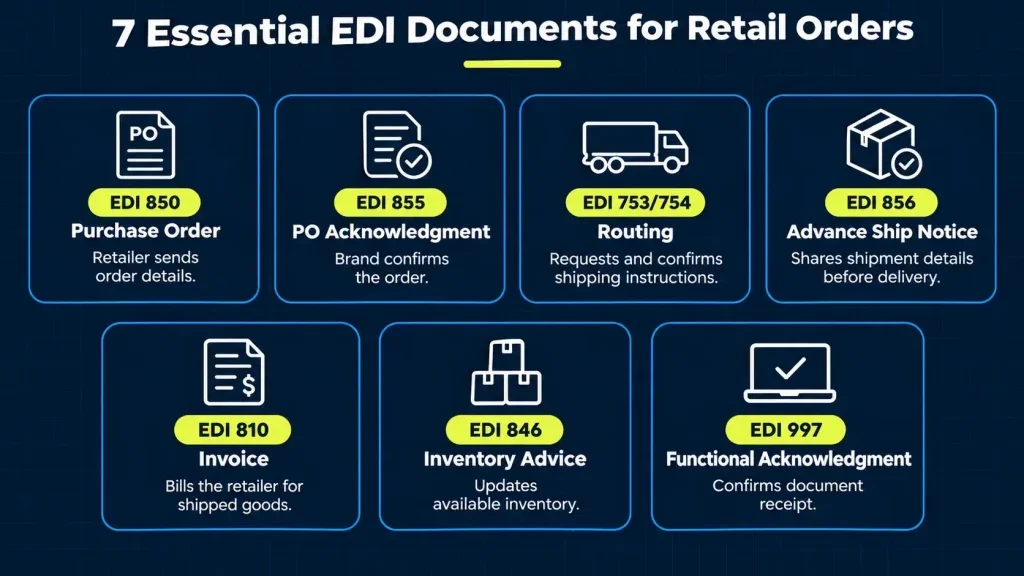
| Document | Name | Sent by | When | What goes wrong if it fails |
|---|---|---|---|---|
| 850 | Purchase order | Retailer to brand | When the retailer orders | Missed or mis-keyed POs ship the wrong quantities |
| 855 | PO acknowledgment | Brand to retailer | Within the retailer’s deadline after the PO | A late or missing acknowledgment can count as a compliance violation |
| 753 / 754 | Routing request and routing instructions | Brand to retailer, then retailer to brand | Before a retailer-routed (collect) load ships | Freight moves with a carrier the retailer did not approve |
| 856 | Advance ship notice (ASN) | Brand, using warehouse shipment data | When the shipment leaves, before it arrives | A late or mismatched ASN triggers chargebacks and slows receiving |
| 810 | Invoice | Brand to retailer | After the shipment | Quantities that differ from the ASN lead to held or short payments |
| 846 | Inventory inquiry / advice | Brand to retailer | On the retailer’s schedule, common in drop-ship programs | Stale stock data leads to oversold or cancelled orders |
| 997 | Functional acknowledgment | Whoever receives a document | Shortly after each document arrives | No acknowledgment means the sender cannot prove the document was received |
There are also two EDI documents that are used between your business and your warehouse, not directly with the retailer.
If your 3PL uses EDI instead of an API, you’ll send a 940 warehouse shipping order whenever you need to fulfill a retail order. When the order is shipped, your 3PL returns a 945 warehouse shipping advice confirming what was actually shipped.
What is important here is document 945. It has the actual shipment details in it so you should use that information to prepare your Advance Ship Notice (ASN) and invoice. This ensures the documents you send to the retailer match what left the warehouse.
Who owns each step: brand, EDI provider, 3PL or retailer?
This is where most compliance problems hide. Each step has one owner, and when nobody is sure who that is, the step slips.
| Step | Owned by | Supported by | What goes wrong when it slips |
|---|---|---|---|
| Trading-partner setup and testing | Brand | EDI provider maps the documents; the retailer certifies them | Orders cannot flow until testing passes |
| PO receipt and acknowledgment (850, 855) | Brand | EDI provider translates the PO and passes it to the 3PL | Late acknowledgments and missed ship windows |
| Item and pack data (GTINs, case packs) | Brand | 3PL checks it against what arrives at receiving | Wrong pack data means wrong labels on every carton |
| Picking, packing and GS1-128 carton labels | 3PL | Brand supplies GS1 company prefix and label data | Mislabeled or unscannable cartons |
| Pallet build to the routing guide | 3PL | Retailer publishes the guide | Refused loads at the dock |
| Advance ship notice (856) | 3PL builds the shipment data | EDI provider transmits it for the brand | ASN does not match the load |
| Routing request and delivery appointment | Brand or 3PL, depending on freight terms | Retailer issues routing and appointments | Missed delivery windows |
| Invoice (810) | Brand | EDI provider transmits; 3PL supplies shipped quantities | Short payments |
| Chargeback review and disputes | Brand | 3PL supplies shipment records | Invalid deductions go unchallenged |
Key Takeaway
EDI compliance is a shared job. The brand owns the relationship and the paperwork, the EDI provider moves the data, and the 3PL owns the physical truth that the data has to describe.
What is an EDI 856 ASN, and why does it cause so many chargebacks?
The EDI 856 advance ship notice (ASN) informs the retailer what to expect in a shipment ahead of its arrival. This covers the purchase orders, the pallets, the cartons and the products within each carton.
Each carton also carries an 18-digit SSCC (serial shipping container code) on its GS1-128 label. This helps the retailer to scan and identify cartons without having to manually count everything.
But ASN details should match the actual shipment.” Say your ASN calls for 40 cartons, but the retailer receives 38; that’s a mismatch. Even if your truck is on time, you could still be charged a chargeback.
One common reason for this is creating the ASN based on purchase order vs. what actually shipped.
A purchase order only reflects what the retailer ordered, not what your warehouse packed. Therefore, your ASN may have inaccurate information if two cartons were missed in picking, held back due to damage, or shipped separately.
You can avoid this by creating the ASN based on your actual warehouse scan data cartons scanned onto pallets, pallets loaded onto trucks. This is how we generate ASNs through our B2B fulfilment services.
Key Takeaway
An ASN copied from the purchase order describes what was ordered. An ASN built from scanned cartons describes what shipped. Retailers fine the difference.
How do you become EDI compliant? A 6-step checklist
Whether you’re setting up EDI for the first time or trying to avoid repeated retailer chargebacks, here are six steps you should follow:
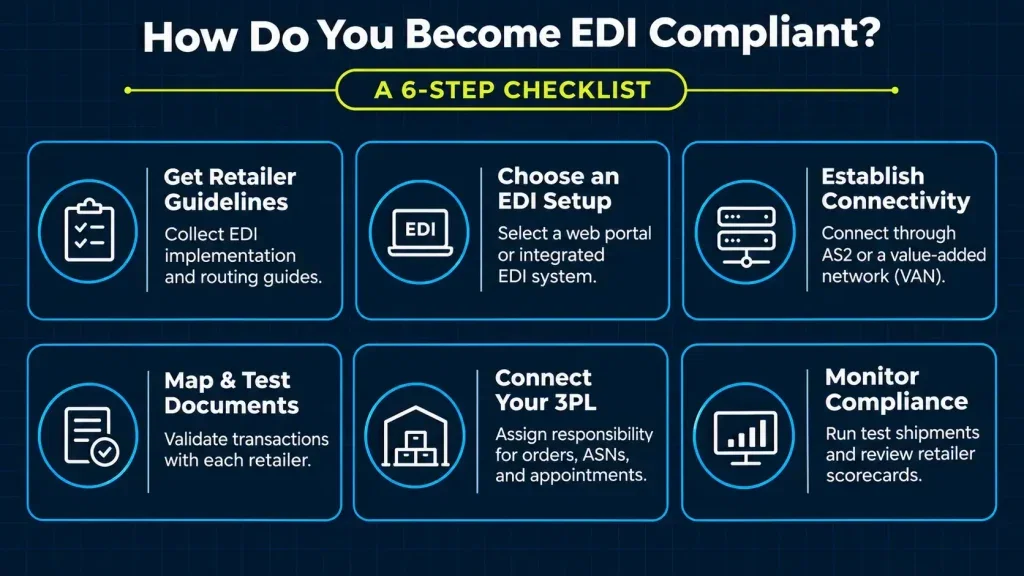
Get both guides from your retailer
Ask for the EDI implementation guide, which explains document formats and deadlines, and the routing guide, which covers labeling, pallets, and shipping requirements.
Choose your EDI setup
If you’re working with only a few retailers and handling fewer orders, a web-based EDI portal may be enough. As your business grows, you can integrate EDI with your ERP or ecommerce platform.
Set up connectivity
Your EDI provider will help you connect with each retailer, usually through AS2 or a value-added network (VAN).
Map and test with each retailer
Before you start processing live orders, you’ll need to test and certify the required documents. Keep in mind that testing can take longer than the initial setup.
Connect your 3PL and assign responsibilities
Make sure everyone knows how purchase orders reach the warehouse, who creates and sends the ASN, and who schedules delivery appointments. It’s better to have these responsibilities documented.
Run a test shipment and check your scorecard
Once everything is set up, test the process with a shipment. Review the first few deliveries and any deductions to identify and fix issues early.
Routing guides: the half of compliance that is not EDI
A retailer’s routing guide covers everything EDI does not:
- Carton labels: which label, where on the carton, and how far from the edges.
- Pallets: pallet type (often a 48 x 40 inch GMA or CHEP pallet), maximum height and weight, no overhang, and pallet label placement.
- Delivery: must-arrive-by dates, appointment rules and approved carriers.
- Appointments: booked in the retailer’s own portal, such as Target’s Partners Online.
Amazon runs its own version of these rules for 1P vendors and FBA inbound shipments; our guide to Amazon barcode requirements covers its label specs.
Guides change, so someone has to own them. Ask your 3PL who reads each retailer’s guide and how changes reach the people building pallets. Our pallet calculator helps plan loads against height and weight limits before they reach the dock.
How do you choose a 3PL for EDI orders?
Ask every provider on your shortlist these five questions, and ask for a completed shipment to your retailer as proof:
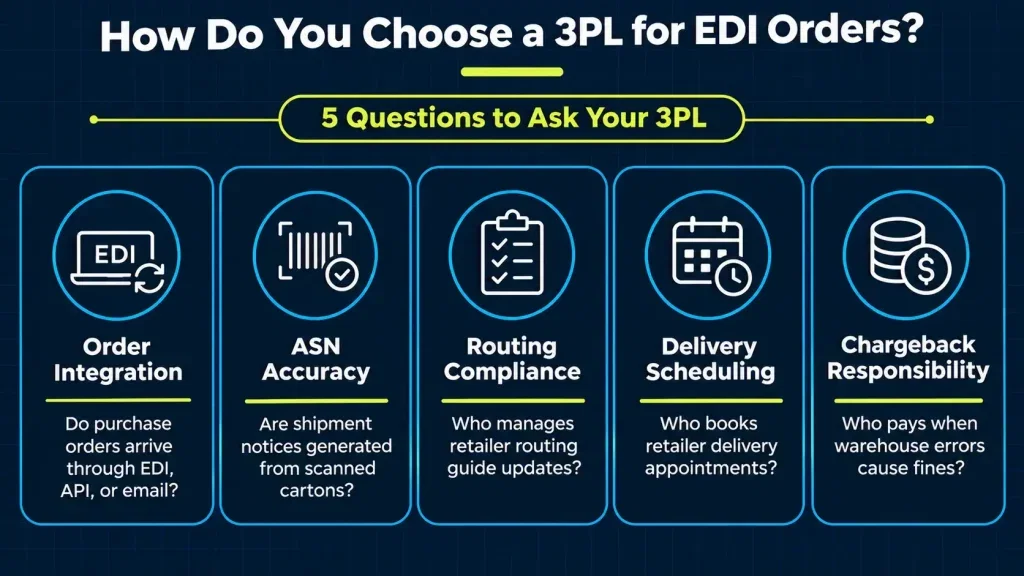
- How do purchase orders reach the warehouse: through my EDI provider, by API or by email?
- Is the ASN built from the purchase order or from scanned cartons?
- Who reads and updates each retailer’s routing guide?
- Who books delivery appointments in the retailer’s portal?
- If the warehouse causes a chargeback, who pays?
Then match the partner to where you are:
- Already set up with an EDI provider such as SPS Commerce or CommerceHub: you need a 3PL that connects to that account and acts on the POs. AMZ Prep connects to both, and if a retailer deducts for an error our warehouse made, we credit it. See our integrations.
- Not on EDI yet: start with a full-service EDI provider, such as SPS Commerce, TrueCommerce or Orderful, and set up testing with your first retailer before choosing a warehouse.
- Running a large national program: contract logistics providers with in-house EDI teams may suit a dedicated operation better than a shared warehouse.
Selling to Amazon as a vendor? Amazon 1P uses many of the same documents with its own rules. See Amazon Vendor Central fulfillment. And if you are still working out what changes when a retailer becomes your customer, start with what B2B fulfillment is.
Frequently asked questions
What does EDI compliant mean?
Being EDI compliant means sending and receiving every document a retailer requires, in its format and on its schedule, with data that matches the actual shipment. Sending documents is capability; matching the shipment is compliance.
Is EDI required to sell to Walmart or Target?
Yes, most large retailers like Walmart and Target require suppliers to send purchase orders, shipping notices, and invoices electronically. Smaller suppliers can use a web-based EDI service instead of setting up their own system.
What is the difference between an ASN and a packing slip?
An ASN is an electronic document you send to the retailer before delivery, showing the pallet and carton details. A packing slip is a paper document included with the shipment. Retailers use the ASN to check incoming shipments.
Does anyone still use EDI?
Yes, EDI is still widely used by major retailers, distributors, and Amazon Vendor Central to exchange purchase orders, shipping notices, and invoices. Although APIs are available, many large retailers still rely on EDI.
How long does a retailer EDI setup take?
It depends on the retailer you’re working with. While document mapping may not take much time, testing and certification can take longer. So, it’s better to start the process before your first order is ready to ship.

Chadwick Collins is an Enterprise Fulfillment Consultant at AMZ Prep, where he partners with high growth ecommerce brands to design and scale Amazon first logistics strategies. He brings extensive experience in freight, supporting brands across domestic and cross border transportation, routing optimization, and cost control.
At AMZ Prep, Chadwick works closely with enterprise clients to improve inventory flow, reduce landed costs, and accelerate delivery performance across North America. His expertise spans FBA, DTC, and B2B fulfillment, with a strong focus on aligning freight strategy with overall supply chain efficiency. He helps brands navigate complex logistics challenges while turning operations into a competitive advantage.


Comments