

You just landed your first wholesale account. Maybe it is a regional grocery chain, an independent boutique ordering through Faire, or a buyer at a big-box retailer. The product is the same one you ship to Shopify customers every day. The way it has to leave the warehouse is not.
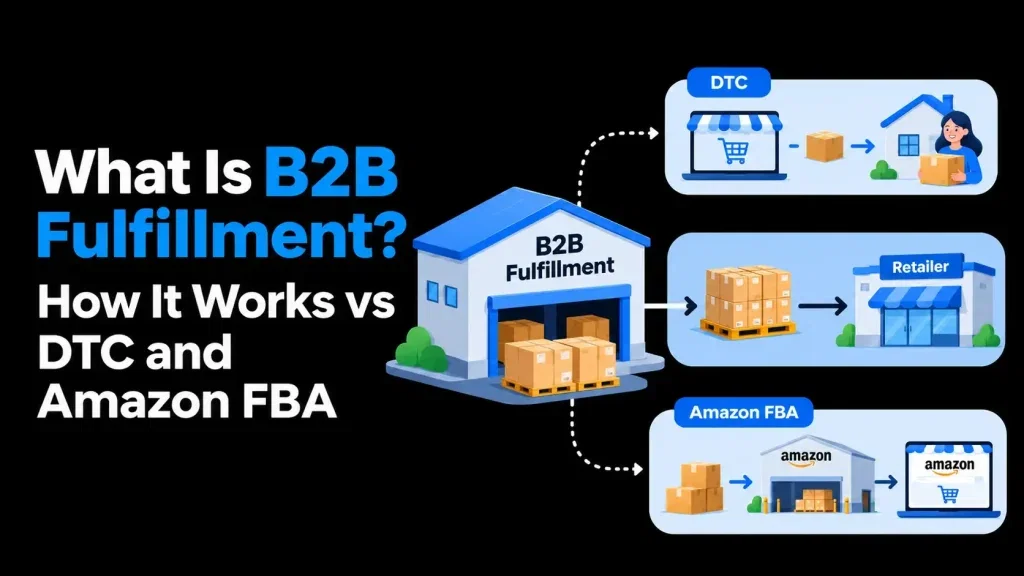
This guide explains what B2B fulfillment is, how a retail order moves from purchase order to receiving dock, how it differs from DTC and Amazon FBA, and how to tell whether one fulfillment partner can run all three.
Key Takeaways
- B2B fulfillment ships cases and pallets to retailers, distributors and wholesale buyers against a purchase order, with labels and documents the buyer specifies.
- A retail order runs through seven steps, from the EDI 850 purchase order to the 810 invoice, and most fines start with data that does not match the load.
- B2B, DTC and Amazon FBA differ in order size, labels, shipping mode and what a mistake costs, but one 3PL can run all three from one inventory pool.
- Choose a partner by fit: omnichannel 3PLs for growing brands, contract logistics for national store programs, a broker for a few pallets a year.
What is B2B fulfillment?
B2B fulfillment is the process of storing, picking, labeling and shipping inventory to other businesses, such as retailers, distributors and wholesale buyers, against a purchase order. Orders move in cases and pallets rather than single units, and each buyer sets rules for how the shipment must be labeled, documented and delivered.
The buyers on the other end usually fall into one of five groups:
- Big-box and grocery retailers are replenishing their distribution centers or stores.
- Independent retailers ordering smaller case quantities through wholesale marketplaces such as Faire.
- Distributors that resell to stores in a region or category.
- Amazon as a buyer, through Vendor Central purchase orders. See Amazon Vendor Central fulfillment for how those differ.
- Retailer drop-ship programs, where a retailer sells your product online and you ship to its customer under its rules.
Wholesale and B2B are often used interchangeably, but they describe different things. Wholesale is how you sell: at a trade price, in bulk, to a business. B2B fulfillment is how that order physically gets to the buyer.
How does B2B fulfillment work?
Every retail order follows roughly the same seven steps. The EDI document numbers in brackets are the standard ones most large retailers use.
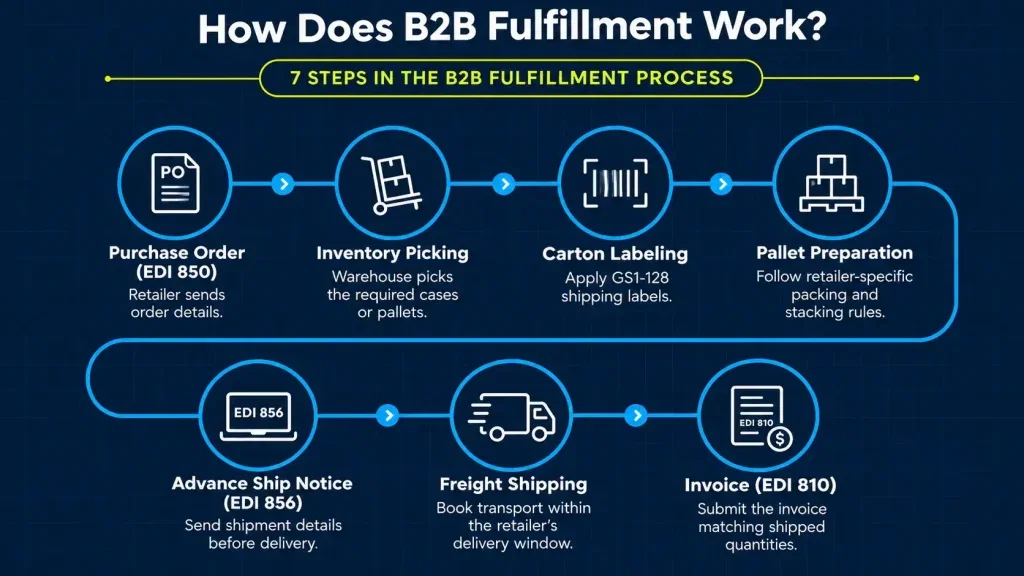
The purchase order arrives (EDI 850)
Large retailers send it electronically through EDI. Smaller buyers may use a supplier portal, a wholesale marketplace or email.
Inventory is allocated and picked by pack
The order asks for each, inner packs, master cases or full pallets, and the warehouse picks in exactly that unit.
Cartons are labeled
Most retailers require a GS1-128 shipping label, carrying an SSCC serial number, on every carton, in a position their routing guide specifies.
Pallets are built to the routing guide
The guide sets the pallet type, maximum height and weight, stacking pattern, overhang and pallet label rules.
The advance ship notice is sent (EDI 856)
The ASN tells the retailer exactly which cartons and pallets are on the truck before it arrives. It has to match the physical load.
Freight is booked inside the delivery window
On a collect order the retailer chooses and pays the carrier; on a prepaid order the brand does. Either way the load must arrive by the must-arrive-by date, often with a booked appointment.
The invoice is sent (EDI 810)
Invoice quantities should match the ASN, and the retailer pays on its agreed payment terms.
Retailers grade all of this with one measure: OTIF, or on time, in full. A shipment that arrives late, early, short or with paperwork that does not match counts against you, and repeated misses lead to fines and a lower supplier score.
Key Takeaway
In B2B, the paperwork is part of the product. A shipment that is physically perfect can still be fined if its labels, ASN or delivery time do not match what the retailer expected.
A B2B fulfillment example: one retail PO from start to finish
Here is how a typical first retail order moves, using an illustrative granola brand that sells on Shopify and Amazon and has just been picked up by a regional grocery chain.
- Monday: the grocer sends a purchase order through EDI for 240 cases of granola, 12 bags per case, to its distribution center, with a must-arrive-by date the following Monday.
- Monday: the brand’s EDI provider passes the PO to its 3PL. The 3PL checks stock: the same on-hand inventory also feeds Shopify and Amazon, so 240 cases are reserved for the retail order.
- Tuesday: the warehouse picks 240 full cases, prints a GS1-128 label for each one and builds four pallets to the grocer’s height and weight limits.
- Wednesday: cartons are scanned onto pallets and pallets onto the truck. The scan shows 238 cases, because two were crushed and held back. The ASN goes out listing 238, not 240.
- Wednesday: the load leaves on an LTL carrier the grocer approved, with a bill of lading and a booked delivery appointment.
- Friday: the distribution center scans the pallets. They match the ASN, so the load is received without a manual count.
- Following week: the brand invoices for 238 cases. Invoice, ASN and receipt all agree, so it is paid on the grocer’s terms with no deduction.
Now run the same order with one change: the ASN is copied from the purchase order and says 240. The dock counts 238, the shipment no longer matches its paperwork, and the grocer deducts a chargeback from the invoice. On a $12,000 order, even a 3% fine is $360, and that is before the two missing cases are disputed.
Key Takeaway
The two crushed cases were not the problem. Sending an ASN that did not match them was.
B2B vs DTC vs Amazon FBA: what changes in the warehouse?
The same SKU can leave the same warehouse three different ways in one afternoon. This is what changes between them.
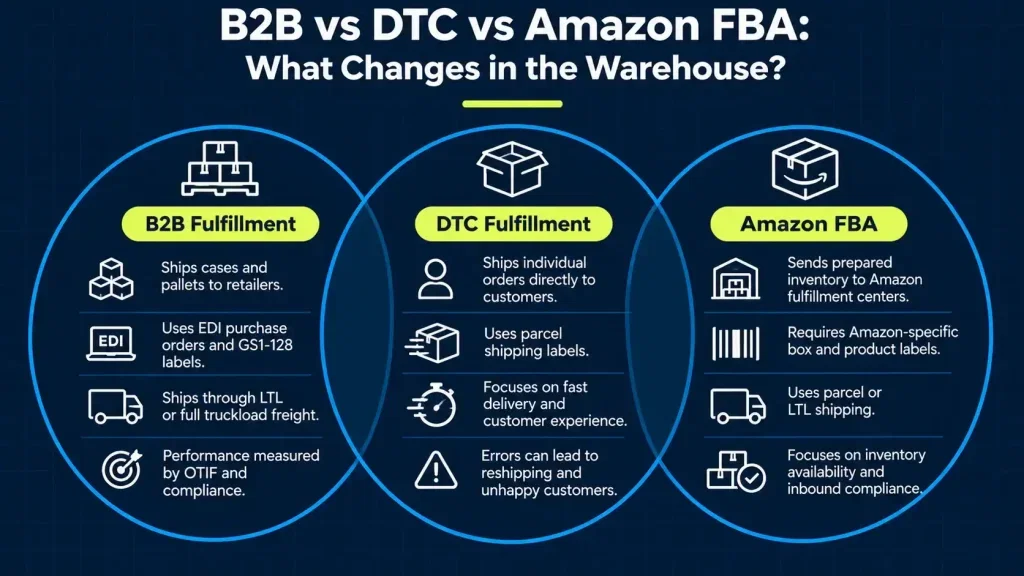
| B2B and retail | DTC (B2C) | Amazon FBA | |
|---|---|---|---|
| Who orders | A retailer, distributor or wholesale buyer | An individual shopper | You send stock to Amazon; Amazon ships each customer order |
| Order size | Cases and pallets | 1 to 3 units | Cases or pallets of prepped units |
| Where orders come from | EDI purchase orders, supplier portals, Faire | Shopify or marketplace checkout | Shipments you create in Seller Central |
| Packaging | Retail-ready cartons, no marketing inserts unless requested | Branded mailer and inserts | Amazon prep: barcode labels, bags or bubble wrap where required |
| Labels | GS1-128 carton labels and pallet labels | Parcel carrier label | FBA box labels and, where required, unit barcodes |
| Shipping mode | LTL, full truckload or retailer-routed freight | Parcel carriers | Small parcel or LTL into Amazon fulfillment centers |
| Timing | Ship and arrive inside windows the retailer sets | Ship the same day | Arrive before you run out of stock |
| Cost of a mistake | A chargeback, a refused load or a lost reorder | A reship and an unhappy customer | Receiving delays, extra prep fees or stranded inventory |
| What success is measured by | On time, in full (OTIF) and compliance scorecards | Delivery speed and the customer’s experience | Staying in stock and clean inbound shipments |
For most growing brands the question is not which model to use, it is how to run all three without splitting inventory. That is where the choice of partner matters, and where DTC fulfillment and FBA prep services have to work from the same stock as your retail orders.
Why is B2B fulfillment harder than it looks?
Three things catch brands out on their first retail accounts.
- Every retailer has its own routing guide. Label placement, pallet specs, carrier rules and documents differ between retailers, and guides change. Someone has to own them.
- Delivery windows run both ways. The must-arrive-by date is the last day a load is accepted without penalty, and many retailers also refuse loads that arrive early.
- Chargebacks add up quietly. Retailers deduct fines from what they pay you, often weeks after the shipment.
The scale surprises most brands. In a January 2026 interview, Jon Allen, CEO of the Woodridge Group in Bentonville, said holiday deductions and chargebacks can cut into profits by up to 15% of gross sales, and that many consumer brands find 10 to 20% of their deductions are invalid but rarely challenged (Talk Business and Politics, January 2026).
Most of the valid ones start with data, not the truck. If the ASN says 40 cartons and the receiving dock counts 38, the shipment is out of compliance even though it arrived on time. That is why an ASN should be built from the cartons actually scanned onto each pallet, not copied from the purchase order.
Can one 3PL handle B2B, DTC and Amazon FBA?
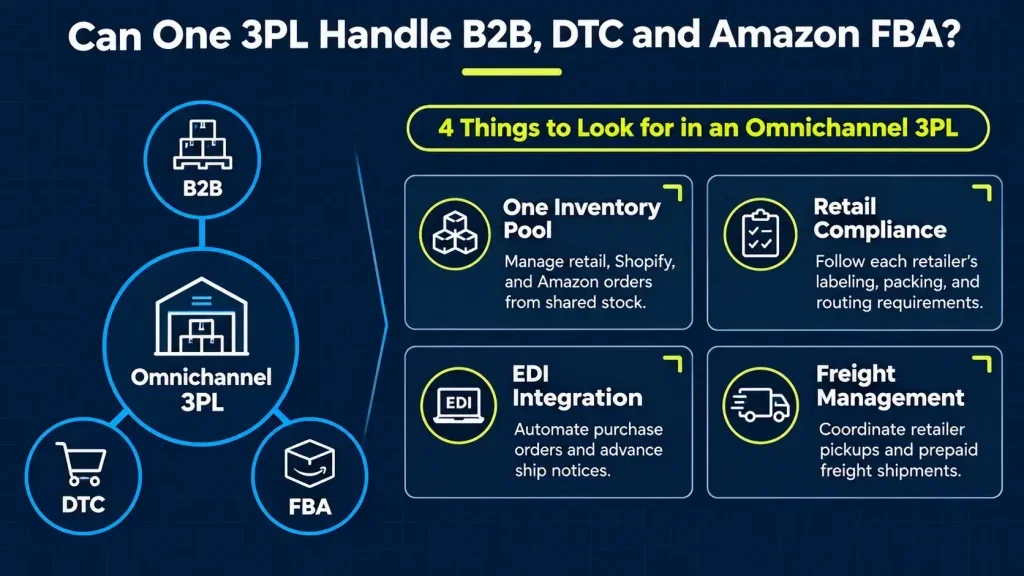
Yes, and for a brand selling in all three places it is usually simpler than running three warehouses. But B2B has to be a real workflow, not an add-on to a parcel operation. Look for four things:
- One inventory pool. Retail POs, Shopify orders and Amazon replenishment draw from the same on-hand stock, so nothing is oversold or stranded.
- A routing-guide workflow for retail. Retail orders follow each retailer’s rules, separately from FBA prep and DTC packing.
- EDI, not email. Purchase orders reach the warehouse from your EDI provider or by API, and ASNs go back the same way.
- A freight desk. The 3PL can request retailer-routed pickups and quote prepaid freight. Our guide to LTL vs FTL shipping explains which suits which order size.
Red flags: POs forwarded by email, ASNs typed from the purchase order, nobody named as the owner of each retailer’s routing guide, and no written answer to who pays when the warehouse causes a chargeback.
AMZ Prep runs Amazon, DTC and retail orders from one inventory pool across 50+ fulfillment centers in 6 countries. Our B2B fulfillment services connect to your EDI provider, build ASNs from scanned cartons and include retail display assembly when a PO calls for it.
Which type of fulfillment partner fits your brand?
There is no single best B2B fulfillment provider. The right fit depends on where your volume goes.
- DTC-first brands adding retail or wholesale accounts: an omnichannel 3PL that runs DTC, FBA and retail from one inventory pool, such as AMZ Prep, ShipBob or ShipMonk. Compare how each one builds ASNs and who owns your routing guides.
- Brands selling mainly to Amazon as a vendor: a 3PL with Vendor Central experience, since Amazon’s 1P rules differ from other retailers’. Our guide to Amazon 1P vs 3P covers the trade-offs.
- National store programs replenishing many distribution centers: contract logistics providers such as Ryder or GEODIS, which often run dedicated sites for large accounts.
- Brands shipping a few wholesale pallets a year and no parcel orders: a freight broker and your own dock may cost less than a 3PL.
Before you scale into retail, it is worth checking which accounts actually make money. Our free retail playbook shows how one brand decided that on its way into more than 15,000 stores.
Frequently asked questions
Is wholesale the same as B2B?
Not exactly. Wholesale describes how you sell, at a trade price and in bulk to a business. B2B fulfillment describes how that order is picked, labeled and shipped. Every wholesale order needs B2B fulfillment, but B2B also covers distributors and drop-ship programs.
Do I need EDI to sell to retailers?
Most large retailers require EDI for purchase orders, advance ship notices and invoices. Smaller retailers and wholesale marketplaces such as Faire usually do not, which is why many brands start there before adding big-box accounts.
What is a routing guide?
A routing guide is a retailer’s rulebook for suppliers. It sets label placement, pallet specifications, carrier and appointment rules, required documents and the fines for getting them wrong. Each retailer publishes its own, and they change over time.
What does OTIF mean in B2B fulfillment?
OTIF stands for on time, in full. It measures whether a supplier’s shipment arrived inside the retailer’s delivery window with the full quantity ordered. Retailers use it to score suppliers, and many fine shipments that miss it.
Is retailer drop-ship B2B or B2C fulfillment?
It is both. The order comes from a retailer and follows its rules, like B2B, but ships as a single parcel to a shopper, like B2C. Treat it as B2B for documents and labels, and as DTC for packing and speed.

Chadwick Collins is an Enterprise Fulfillment Consultant at AMZ Prep, where he partners with high growth ecommerce brands to design and scale Amazon first logistics strategies. He brings extensive experience in freight, supporting brands across domestic and cross border transportation, routing optimization, and cost control.
At AMZ Prep, Chadwick works closely with enterprise clients to improve inventory flow, reduce landed costs, and accelerate delivery performance across North America. His expertise spans FBA, DTC, and B2B fulfillment, with a strong focus on aligning freight strategy with overall supply chain efficiency. He helps brands navigate complex logistics challenges while turning operations into a competitive advantage.


Comments