
Ever wondered what drives your Amazon business?
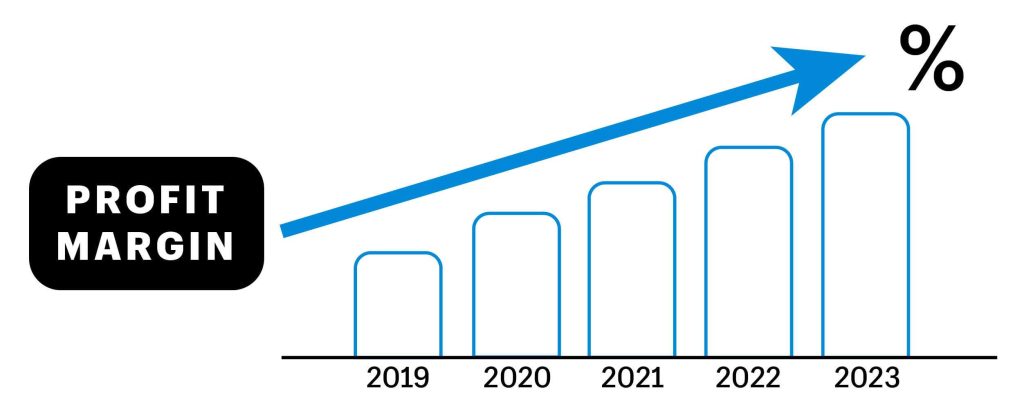
Well, it’s two factors — Amazon profit margin and revenue.
While that’s true, there’s a catch!
Even though your sales are skyrocketing on Amazon and your brand is performing pretty well, it doesn’t mean your business is profitable.
Why?
Because revenue is more like a vanity criterion, so even if you’re growing every month, it doesn’t mean you are turning profitable.
The reality? Well, most ecommerce businesses struggle with their Amazon profit margin in spite of high revenue.
And as an Amazon seller, battling against other Chinese sellers might be a downhill battle. No wonder most Amazon businesses that make 6- or 7-figure revenue have less profits.
But what if we tell you that a solid strategic execution could help your business remain profitable.
Yes, that’s right!
With that said, let’s understand what Amazon profit margin is, what is the FBA Amazon profit margin, how to calculate Amazon profit margin, the various ways to increase amazon profit margin, and more. If you want to ease your hustle when selling on Amazon, try our free Amazon FBA Calculator to estimate your profits and fees.
What is an Amazon Profit Margin?
An Amazon profit margin is the percentage of profit made on each sale. The higher the Amazon profit margin, the better the business.
The Amazon profit margin is the money you earn after deducting costs from the revenue. Simply put, it is the amount of money you make on each sale. A high Amazon profit margin means that you’re making a lot of money off each sale, while a low Amazon profit margin means that you’re making little money off each sale.
For example, if you sell a product for $100 and have $30 in costs linked with that sale, your Amazon profit margin would be $70.
The Amazon profit margin is calculated by dividing the total revenue by the total cost of goods sold (COGS). For example, if you sell an item for $100 with $50 in COGS, your profit margin would be 50%.
What is the Amazon Profit Margin for Amazon FBA?
The simple answer is that it depends on the product, but most Amazon sellers have an Amazon profit margin of 15% – 20%, depending on the category they are selling into. While a margin of 20% or higher is great for an e-commerce business, anything less than 5% is unsustainable.
By default, Amazon profit margin is 20% (you can change this in your account settings). This means that if you sell your product for $100, Amazon will take $20 and give you $80. If you sell it for $200, they’ll take $40 and give you $160.
A good Amazon profit margin is a balance between generating enough income to cover your expenses and reinvesting into your business. It’s a delicate balance and one that you’ll need to learn to navigate as you grow your business.
Generally, the more you invest in your product or service, the higher your Amazon profit margin will be — at least for a while. But if you’re spending more money than you’re making, something needs to change.
What is a Good Amazon Profit Margin on Amazon FBA?
The short answer is that there is no magic formula to determine a good Amazon profit margin. The longer answer is that it depends on many factors, including your product and its competition, how you source the product, how much you sell it for, etc.
For Amazon FBA sellers, the Amazon profit margin is the difference between what it costs to buy a product and what you can sell it for.
The Amazon profit margin on any given product depends on several factors:
- Amazon FBA fees: Amazon charges a fee for selling items through its platform. This fee varies based on your total monthly sales and the category of product you’re selling. For example, if you’re selling electronics, your products will have a higher fee than if you were selling books or DVDs. The longer you’ve been selling with them, the lower your fee will also be.
- Shipping costs: The price of shipping can vary depending on how much product weight (in pounds) is being shipped or where it’s going. For example, if you’re sending one item to California from New York City, your shipping costs may be less than if you were sending 500 items to Alaska from Florida.
- Product margins: The average profit margins for Amazon sellers vary by category, but they tend to be higher in categories like home goods or fashion than they are in categories like jewelry or watches because those types of products generally have lower margins than others.
How to Calculate Profit Margins for Amazon FBA
Profit margins are calculated by dividing your gross profit by your net sales and multiplying by 100. Gross profit is calculated by subtracting all expenses from sales (also known as revenue).
The formula to calculate gross profit is:
Gross Profit = Revenue – COGS (Cost of Goods Sold)
For example, if you sell $10000 worth of products and have $2000 worth of COGS (costs associated with those products), your gross profit would be $8,000 ($10000 – $2000).
You can calculate profit margins in two ways:
- Gross profit margin
- Net profit margin
Amazon sellers must know their net profit margin since it will help them determine whether or not they should continue listing products on Amazon or look elsewhere.
The formula to calculate gross profit margin is:
Gross Profit Margin = Revenue – COGS (Cost of Goods Sold) / Revenue
The formula to calculate net profit margin is:
Net Profit Margin = (Revenue – Expenses) / Revenue
Net profit margin is the difference between revenue and expenses expressed as a percentage of revenue. So if you made $10 million in sales with $1 million in expenses, your net profit margin would be 10%. If you made $1 million in sales with $100,000 in expenses, you’d also have a 10% net profit margin.
How to Improve Profit Margins on Amazon
Amazon is a great place to sell your products, but if you want to make the most money, there are a few things you need to do. Knowing how much money you can make on Amazon before you start selling is important. That way, you won’t be disappointed when you see that your profit margins aren’t as high as expected.
1. Sell high-quality products
Sell products that are in demand and have a high-profit margin. You can use the Amazon Best Sellers Rank or the Unit Sales rank to see what products sell well on Amazon. This is an excellent way to find out what people want because if something sells well, it means that people are buying it.
Pro Tip: Use an Amazon BSR sales estimator to find pricing sweet spots, track competitor rankings, and forecast demand more accurately.
2. Use Fulfillment by Amazon (FBA)
Fulfilling your products through FBA allows you to send your inventory to an Amazon warehouse and have them ship it for you, so you don’t need to worry about how to store and ship your items yourself. This can save time and money in the long run.
3. Track your sales data
Amazon provides sales data for each item so sellers like you can understand how their product is doing over time. You’ll be able to see how many units have been sold per day/week/month, along with any available reviews for that item! It’s also important to understand the distinction between amazon ratings vs reviews, as both influence customer perception and can impact buying decisions differently. In addition, staying updated with Amazon’s platform changes, such as the December 2025 updates to fees and fulfillment policies, helps sellers adjust pricing strategies before profit margins are affected.
4. Look at your costs
The cost of your products can significantly impact your profit margin on Amazon. If you’re selling in bulk quantities, it’s essential to know how much each unit will cost so you can price accordingly and still make a profit once everything is said and done. If you’re selling smaller quantities (like one unit), include shipping costs in your pricing model to let your customers know about hidden fees or charges when they buy from your store.
5. Reduce shipping costs
Shipping costs make up a large portion of any seller’s overall cost of goods sold (COGS). An excellent way to reduce shipping costs is by getting free shipping labels from UPS or FedEx and printing them yourself at home or work (if your company has a printer). Another option is to use a service like ShipStation or Amazon FBA Labeler (which allows you to create custom labels directly from Amazon Seller Central). This can save you hundreds per month in shipping costs.
6. Price your products competitively
You should never try to price your products too high or too low. The right balance between the two will help you earn more profit. You should always ensure that your prices are equal to those of your competitors or lower than their prices when they’re not selling their products at a discount. You also need to keep track of any price changes and adjust accordingly within a few days so that you don’t lose out on sales because of higher prices or vice versa.
7. Use auto-replenishment
If you sell an item that is frequently purchased together with other items, then setting up an auto-replenishment program is a great way to increase your profit margin by encouraging customers to buy multiple things at once. This also saves time for both yourself and your customers since there’s no need for them to place two separate orders.
8. Increase your sales velocity
The more often you sell something, the less it costs you per unit sold. If you can move more products by lowering your average sale price or increasing discounts, your overall profit will go up.
9. Add new items
Adding new items increases the likelihood that someone who bought one item will buy another later (assuming they’re suitable matches). If you have a lot of products already selling well, adding some niche items may help boost profits even further.
Is Amazon FBA profitable?
Ideally, yes, Amazon FBA is profitable. However, the answer to the question of whether Amazon FBA is profitable or not depends on who you are, what you’re selling, and what your goals are.
Amazon FBA allows you to sell your products on Amazon and make a profit.
You can sell products on Amazon in two ways:
- Sell your own inventory. This is called retail arbitrage. You buy items at wholesale prices and then sell them at retail prices.
- Sell other people’s stuff (known as dropshipping). This is where you host someone else’s products on your website but don’t store any of it yourself. You link to their product pages on Amazon and take a cut of the sale price when someone purchases from you.
While most sellers on Amazon using FBA make money, there are some things you need to know before starting an FBA business.
Here are some of the most important things to know before selling on Amazon FBA:
- You will pay fees to sell on Amazon. These fees include the listing fees, storage fees, and other charges associated with selling your products on Amazon. These costs tend to be less than what you would pay at eBay or other online marketplaces.
- Amazon charges for shipping for all items sold through FBA. This means that if you sell something through FBA, there is no shipping cost for your customer when they receive their item from Amazon. This makes it easy for them to buy from you because they don’t have to worry about paying extra for shipping when ordering from you as opposed to another seller who may not offer free shipping (some sellers offer free shipping but charge more for their items).
Conclusion
When it comes to increasing your profit margins on Amazon FBA, consider what you are doing, why you are doing it, and how you can boost your business growth over time.
Know that there isn’t any secret formula to it. It all boils down to your business and depending on which a healthy profit margin could be anywhere from as low as 0.05% to as high as 90%. Rather than focusing on your target profit margins, see what profitable products to use to grow your business.

Blair Forrest is the Founder of AMZ Prep, one of North America’s fastest-growing third-party logistics and fulfillment networks, built entirely without outside capital since 2016. Under his leadership, AMZ Prep has scaled to 50+ fulfillment centers across 6 countries, processing over 8 million units monthly and powering $2 billion+ in annual GMV for more than 5,000 brands worldwide including 437, Silverts, Saltyface, Unilever, Duracell, and JBL. A recognized authority in eCommerce logistics, Amazon FBA strategy, and supply chain optimization, Blair has helped thousands of sellers and brands master their fulfillment operations from first shipment to enterprise scale. He regularly consults on FBA prep, multi-channel fulfillment, last mile delivery, international expansion, and cost reduction strategies that save brands 20–40% compared to traditional 3PL providers. Blair’s insights on Amazon logistics, 3PL operations, and eCommerce growth are widely cited across the industry. Through AMZ Prep’s content, guides, and resources, he continues to share battle-tested strategies drawn from managing one of the largest independently owned fulfillment networks in North America.

















Practical profit-boosting tips that I can apply immediately.
Easy-to-understand strategies that make sense for small sellers.
Useful suggestions for improving listing performance and profitability.
This guide offered fresh ideas to increase margins without cutting quality.
Helpful reminder to focus on both revenue and cost control.
Clear and concise tips that helped me rethink my product pricing.
The breakdown of pricing and cost factors was very helpful.
Simple and actionable advice that any seller can start using right away.
I liked the practical strategies for increasing profit margins without overcomplicating things.
Great tips on optimizing costs and boosting profitability on Amazon.