A new ASIN launch timeline for overseas production shipped by ocean runs 16 to 18 weeks. That clock starts at the artwork brief and stops when the listing is buyable.
Air freight brings it closer to 13 or 14 weeks. Stock already in North America can launch in 4 to 6 weeks.
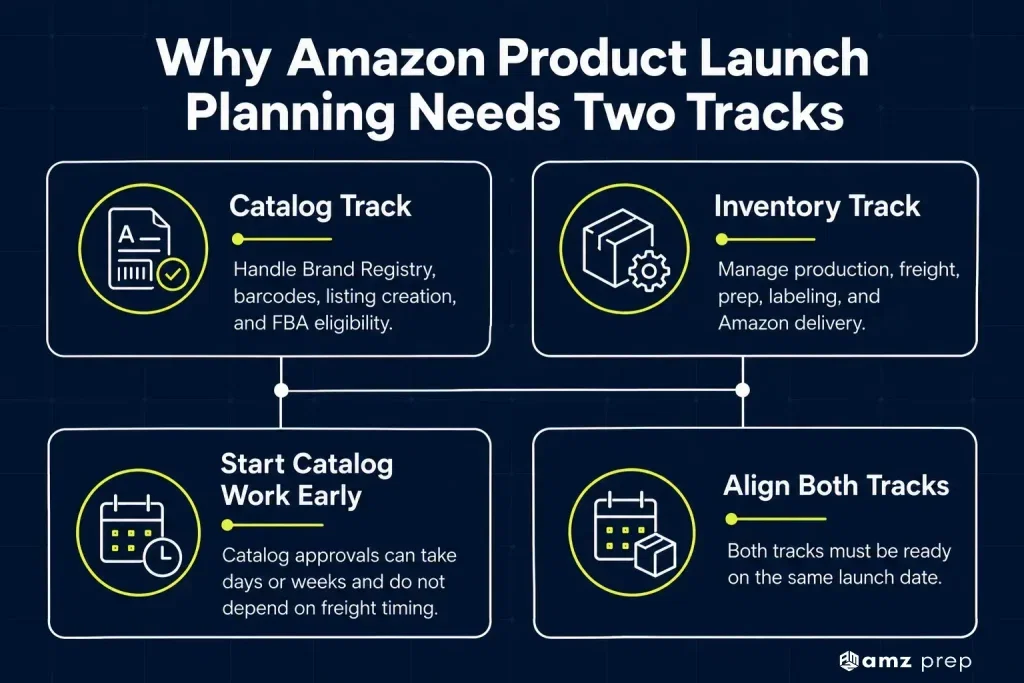
Every launch runs on two tracks that have to finish on the same day. The catalog track covers Brand Registry, the barcode, the listing and FBA eligibility. The inventory track covers production, freight, prep and check-in.
At AMZ Prep, we prep and ship launch inventory into FBA every week. The delays I see most often start on the catalog side, well before a carton moves. This Amazon product launch timeline works backward from launch day and builds in the 2026 rule changes.
Why Amazon Product Launch Planning Needs Two Tracks
A container reaches the prep center on schedule, and the units are labeled within days. Then the new ASIN won’t load in Send to Amazon, because its dangerous goods review is still open.
Freight was on time. The launch moved anyway.
That gap sits behind a lot of Amazon product launch planning. Inventory is easy to watch, since every container and LTL PRO number can be tracked. The catalog track is quieter, and most of its steps have no fixed duration.
Brand Registry verification, the barcode decision and FBA eligibility can each take days or weeks. None of them waits on freight. So I start the catalog track first, and I treat it as the one with less certainty.
The trade-off is cash. Starting early means paying for a trademark filing and GS1 barcodes before production is confirmed. For a planned launch, I think that’s money well spent.
Week-by-Week New ASIN Launch Timeline for Ocean and Air Freight
The table assumes overseas production, ocean freight and a brand selling under its own Brand Registry. Weeks count down to launch day, when the listing is buyable and ads can start.
| Weeks before launch | Catalog track | Inventory track |
|---|---|---|
| 18 to 16 | Apply for Brand Registry, buy GS1 barcodes, choose the barcode path | Brief packaging artwork with barcode placement locked |
| 16 to 14 | Create the ASIN and variation family, upload safety documents if needed | Pre-production samples and approval |
| 14 to 10 | Build listing copy, images and A+ content | Production run |
| 10 to 9 | Confirm New Selection enrollment and launch pricing | Pre-shipment inspection and freight booking |
| 9 to 3 | Test the ASIN in a draft Send to Amazon plan | Ocean freight, customs and delivery to the prep center |
| 3 to 0 | Queue ads, coupons and Vine for go-live | Prep, labeling, transit to Amazon and check-in |
Three weeks out, the inventory should be at the prep center and the catalog work should be done. From here, the Amazon FBA shipping timeline runs in days.Ocean freight from Asia to a North American prep center often runs 4 to 6 weeks door to door. That includes port time, customs and drayage. The 6-week slot above holds that range with a little room.
Air freight usually lands in 5 to 10 days. That pulls the whole plan to about 13 or 14 weeks.
The production slot is the one I’d question first. Four weeks is a common estimate for a first run, but a new factory can stretch it. If the supplier gives a range, plan to the long end.
Catalog Track: Brand Registry, Barcodes and FBA Eligibility
Three decisions on this track shape the rest of the plan. Each one is cheaper to settle at week 18 than at week 6.
Amazon Brand Registry for New ASINs
Amazon Brand Registry for new ASINs starts with a trademark. Amazon now accepts pending trademark applications from supported IP offices. A brand doesn’t need a registered mark to enroll.
The step that holds launches is the verification code. Amazon sends it to the correspondent email on the trademark record, often your attorney’s inbox. Agree on who forwards the code before you apply.
Enrollment in Amazon Brand Registry also opens A+ content, Vine and the New Selection benefits. It decides your barcode options too. So it sits at the very start of the plan.
New ASIN Barcode Requirements Since Commingling Ended
Amazon ended commingling in its US fulfillment centers on March 31, 2026. That changed the new ASIN barcode requirements for every launch since. The rule now depends on your role in Brand Registry.
- A Brand Representative with a valid GTIN can ship on the manufacturer barcode (UPC, EAN, JAN or ISBN). Those units stay tracked to your account.
- Resellers, and any seller without the Brand Representative role, need an Amazon barcode (the FNSKU) on every unit.
- GTIN-exempt products need an FNSKU, even for brand owners.
Brands that also resell other labels should map each SKU to its path. The end of commingled inventory treats the two roles differently.
Buy your GTINs from GS1 either way. Amazon checks product IDs against GS1 records, and a code that doesn’t match can hold up listing creation.
Then decide the barcode path before the artwork brief, since it sets what prints on the box. Changing it after proofs means another proof cycle, often 1 to 3 weeks. Size, contrast and placement rules for Amazon barcode labels apply to the packaging print as well.
For a brand owner with a clean GTIN, I’d print the UPC on the packaging and skip stickers. It removes a prep step from every unit.
One caveat. Dangerous goods, topicals and some consumables can still require an Amazon barcode. Check the setting on each new ASIN.
Why a Live Listing Can Still Be Blocked From FBA Inbound
A listing can be live on Amazon and still blocked from inbound. In my experience, this costs more launch days than freight does. The common holds on a new ASIN are:
- A dangerous goods review that needs a safety data sheet or exemption sheet
- Category or brand approval for gated products
- Seasonal limits on meltable items such as chocolate and gummies
- Missing or rejected dimensions and weight
Meltables deserve their own check, since thousands of ASINs flagged as meltable face date windows for inbound.
Once the listing is live, start a draft Send to Amazon plan with the new ASIN. If it loads, delete the draft. If it doesn’t, you still have weeks to clear the hold.
Do this at least four weeks before launch.
Amazon FBA Launch Preparation, From Factory to Prep Center
The inventory track is longer, about 15 weeks of the plan. It’s also the more predictable one.
What to Check in the First Production Run
A first production run has more unknowns than a reorder. New tooling, new packaging and the first print of the barcode all arrive at once.
Amazon FBA launch preparation starts at the factory. Carton markings, case pack quantity and carton dimensions all feed the Send to Amazon plan later. Keep cartons inside Amazon’s weight and size limits, so nothing gets repacked on arrival.
Book a pre-shipment inspection at origin, and ask the inspector to scan sample retail barcodes against the ASIN. A wrong barcode found at the factory costs a day. Found later, it costs a relabel pass.
Ocean or Air Freight for a New ASIN Launch?
Ocean is the default for most launches because the landed cost per unit is lower. Air has a place too. Some brands fly a first wave sized to the launch window, then send the balance by sea.
That split buys time, but it isn’t free. It adds a second customs entry and a second receiving event at the prep center. A forwarder that handles international freight can book both legs to the same delivery address.
If the SKU also sells on Shopify or Walmart, land the full order at one prep center. Split it there. One inbound is easier to plan than three.
Amazon FBA Prep Timeline and FNSKU Labeling Requirements
Since January 1, 2026, Amazon no longer offers prep or item labeling for FBA shipments in the US. Every unit has to arrive ready. Units that arrive without the required prep or labels lose reimbursement eligibility if they’re damaged or lost.
The Amazon FBA prep timeline for a launch is short once stock is on the dock. It’s usually a matter of days, not weeks. FBA prep at a partner covers labeling, poly bagging and bundling in one pass.
The Amazon FNSKU labeling requirements come from Amazon’s FBA labeling guide:
- Labels 1 to 2 inches tall and 2 to 3 inches wide
- Black print on non-reflective labels with adhesive backing, with Amazon recommending laser printing at 300 DPI
- A scannable barcode, the FNSKU, the product title and the condition
- Placement on a smooth, flat surface, never a corner or curve
- Any original UPC or EAN covered, so it can’t be scanned by mistake
- Transparency codes left uncovered
Amazon doesn’t accept damaged or photocopied labels. The Seller Central steps to create and print FNSKU labels are the same for new and existing ASINs.
My advice for a launch: scan a sample of labeled units against the shipment plan before cartons close. A wrong FNSKU is a quick fix at that point.
Amazon FBA Shipping Timeline for the Final 21 Days
| Days before launch | Step | What happens |
|---|---|---|
| 21 | Receive at the prep center | Count against the PO, check barcodes, confirm the ASIN has no open holds |
| 20 to 19 | Prep and labeling | Bagging, bundling, FNSKU labels if needed, carton build |
| 18 | Build the Send to Amazon plan | Enter box contents and dimensions, choose a placement option |
| 17 | Print labels and book the carrier | Box labels on every carton, pallet labels for LTL or FTL |
| 16 | Carrier pickup | Confirm tracking shows in Seller Central |
| 16 to 11 | Transit and delivery | Split shipments reach different FCs on different days |
| 11 to 1 | Check-in and receiving buffer | Units become available as each FC scans them in |
| 0 | Launch | Listing buyable, ads and Vine switched on |
The full Send to Amazon workflow runs six steps, from quantities to tracking. Two choices in it matter most for a launch.
Placement comes first. Amazon updated inbound placement fees on January 15, 2026.
A minimal split to one location carries a fee. An Amazon-optimized split to four or more locations carries none. An inbound placement fee calculator prices each option per unit.
For a launch, the optimized split has a second upside. The listing can go live when the first FC receives, while other boxes are still in transit. The catch is more deliveries to track in the final week.
Quantity is the second choice. FBA capacity limits are set monthly by storage type and measured in cubic feet. Size the first wave to the limit for the month your units land.
Pallet shipments also need pallet labels on all four sides.
Amazon FBA Shipment Check-In Time and the Receiving Buffer
Amazon doesn’t guarantee a receiving date for any single shipment. That’s the reason the final week of the plan is a buffer.
In Seller Central, a shipment moves from Shipped to In transit, Delivered, Checked-in, Receiving and Closed. Checked-in means the FC logged the delivery, and Receiving means units are being scanned into stock. Units go live as they’re scanned, so a shipment can start selling before it closes.
For Amazon FBA shipment check-in time, I size the buffer to the season. Outside peak, one to two weeks from delivery to fully received stock covers most standard shipments. From October on, I’d add another week.
The Q4 prep timeline maps the peak-season cutoffs in more detail.
A faster inbound shortens the wait. Our Middle Mile program rides on the FBA truck volume we already send. Inbound typically lands in 2 to 4 days.
WOOF, a pet brand we work with, moves stock from our facility into Amazon in 3 to 5 days. Its placement fees on that flow are zero.
Speed narrows the buffer. It doesn’t remove it. A new ASIN’s first shipment can still meet a hold unrelated to the truck.
When to Land Your First Wave for FBA New Selection
A brand lands its first wave six weeks before launch, just to be safe. That’s six weeks of New Selection benefits used before a single sale.
Amazon expanded the FBA New Selection program on July 30, 2026. It covers branded parent ASINs with no FBA receiving history from any seller. The main benefits, which require Brand Registry, are:
- Free monthly storage on the first 200 units for 120 days
- Waived returns processing and liquidation fees on those units
- Referral fees capped at 10% on units 1 to 100 and 5% on units 101 to 200
- Coupon and Vine fee credits in the first 60 days
The 120-day clock starts at the first inventory received date, not the listing date. Enrollment has to be confirmed before that first receipt. Amazon set October 31, 2026 as the date for confirming enrollment, and later launches need it to qualify.
So land the first wave in the final one to two weeks. Hold the balance at the prep center and send it in on a weekly drip-feed. Cut it too close and launch day moves, so the check-in buffer still applies.
6 Common Reasons New ASIN Launch Dates Slip
Most launch delays are small on their own. They add up when two land in the same week.
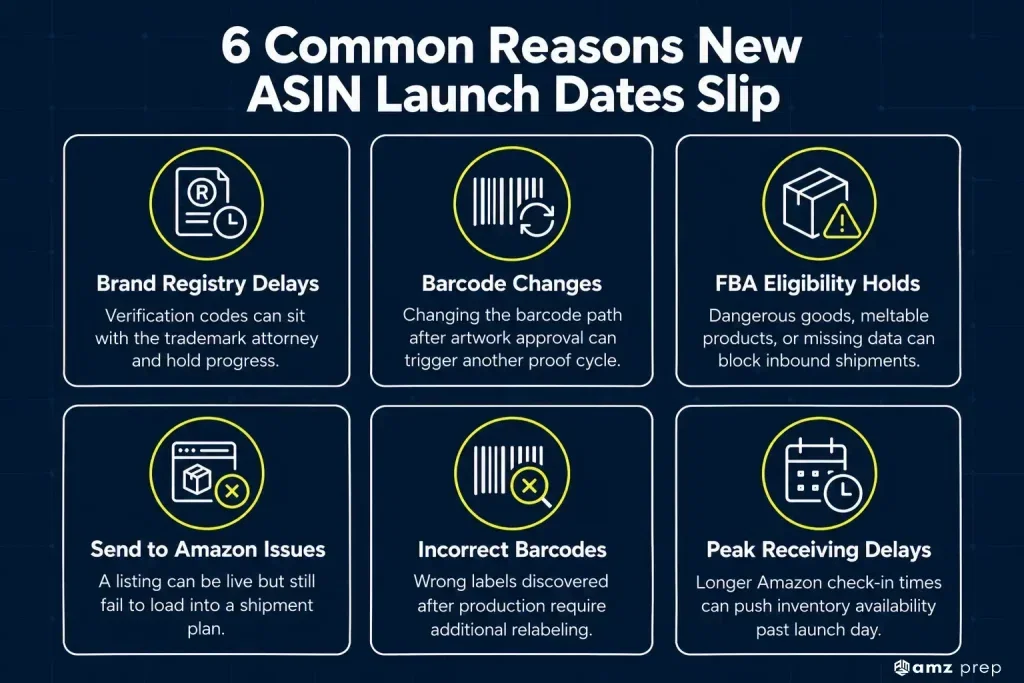
| Where it moves | Track | Typical delay | How to hold the date |
|---|---|---|---|
| Brand Registry code sits in an attorney’s inbox | Catalog | Days to weeks | Name who forwards the code before you apply |
| Barcode path changes after artwork proofs | Catalog | One proof cycle, often 1 to 3 weeks | Decide the barcode path at week 18 |
| Dangerous goods or meltable hold on the new ASIN | Catalog | Days, sometimes longer | Upload safety documents when you create the ASIN |
| Listing live but blocked in Send to Amazon | Catalog | Days | Test a draft plan four weeks out |
| Units reach the prep center with the wrong barcode | Inventory | One relabel pass | Scan sample units at origin inspection |
| Peak-season receiving runs long | Inventory | Varies by FC and week | Add a week to the check-in buffer from October |
If I could settle only one of these early, it would be the barcode path. It touches both tracks. It’s also the cheapest to fix at week 18.
New Amazon ASIN Launch Checklist
This new Amazon ASIN launch checklist follows the same order as the timeline. It works as a short answer to how to launch a new ASIN on Amazon from the operations side.
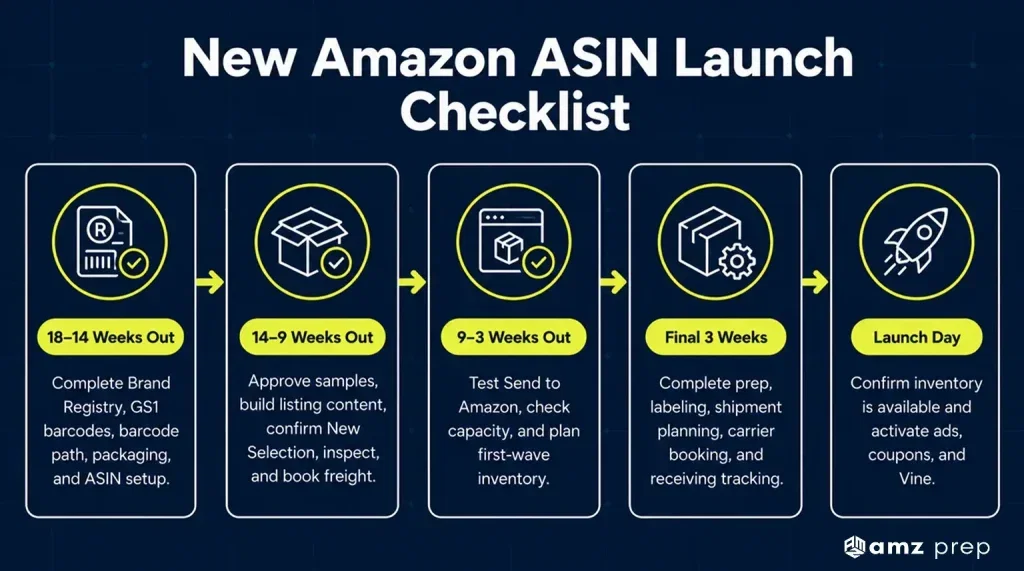
18 to 14 Weeks Out: Brand Registry and Barcodes
- Trademark filed and Brand Registry application submitted
- Owner of the verification code agreed with your attorney
- GS1 barcodes bought for every child ASIN
- Barcode path chosen: manufacturer barcode or FNSKU
- Packaging artwork briefed with barcode placement
- ASIN and variation family created, with safety documents uploaded if needed
14 to 9 Weeks Out: Samples, Listing and Freight
- Samples approved against final artwork
- Listing copy, images and A+ content built
- New Selection enrollment confirmed
- Pre-shipment inspection booked, with a barcode scan check
- Freight booked to the prep center
9 to 3 Weeks Out: Eligibility and Capacity Checks
- Draft Send to Amazon plan tested with the new ASIN
- Capacity limit checked for the month units land
- Launch quantity split between the first wave and prep center stock
Final 3 Weeks: Prep, Labels and Receiving
- Units counted and inspected at the prep center
- Units labeled to Amazon’s FNSKU spec, or confirmed on the manufacturer barcode
- Placement option chosen and Send to Amazon plan built
- Box and pallet labels printed, carrier booked
- Receiving tracked daily until units show as available
- Ads, coupons and Vine set to start on launch day
Frequently Asked Questions
How long does it take to launch a new ASIN on Amazon?
Plan 16 to 18 weeks from artwork brief to a buyable listing for overseas production shipped by ocean. Air freight brings that to about 13 to 14 weeks. Stock already in North America can launch in 4 to 6 weeks.
What is the Amazon FBA product launch timeline?
It’s two tracks that finish on one launch date. The catalog track covers Brand Registry, barcodes, the listing and FBA eligibility. The inventory track covers production, freight, prep, transit and check-in.
What steps are involved in preparing a new ASIN for Amazon FBA?
Enroll in Brand Registry, choose a barcode path and create the listing. Then confirm the ASIN is eligible to send. Prep and label units to Amazon’s spec, build a Send to Amazon plan and ship.
How long does Amazon FBA shipment check-in take?
Amazon doesn’t guarantee a receiving date. Outside peak, plan one to two weeks from delivery to fully received stock, longer in Q4. Units go live as they’re scanned, so a shipment can sell before it closes.
What are the FNSKU labeling requirements for a new ASIN?
Labels measure 1 to 2 inches tall and 2 to 3 inches wide. Each needs a scannable barcode, the FNSKU, title and condition, placed flat over any original barcode. Brand owners with valid GTINs may not need one.

















Comments