
A bill of lading is a legal document a carrier issues to a shipper when goods are loaded for transport. It does three jobs at once. It is a receipt for the goods, a contract of carriage between the shipper and the carrier, and a document of title that shows who owns the cargo.
Every freight shipment moves with one. It travels with the goods and protects both sides if a claim comes up later.
I have watched loads sit on a dock for two days over a missing signature. I have watched a damage claim collapse because the piece count was wrong. Most operators handle these documents every week without checking what each field controls.
This guide covers what a bill of lading does, the main types of bill of lading, who issues a bill of lading, and how to fill out a bill of lading without creating problems later.
What a Bill of Lading Does
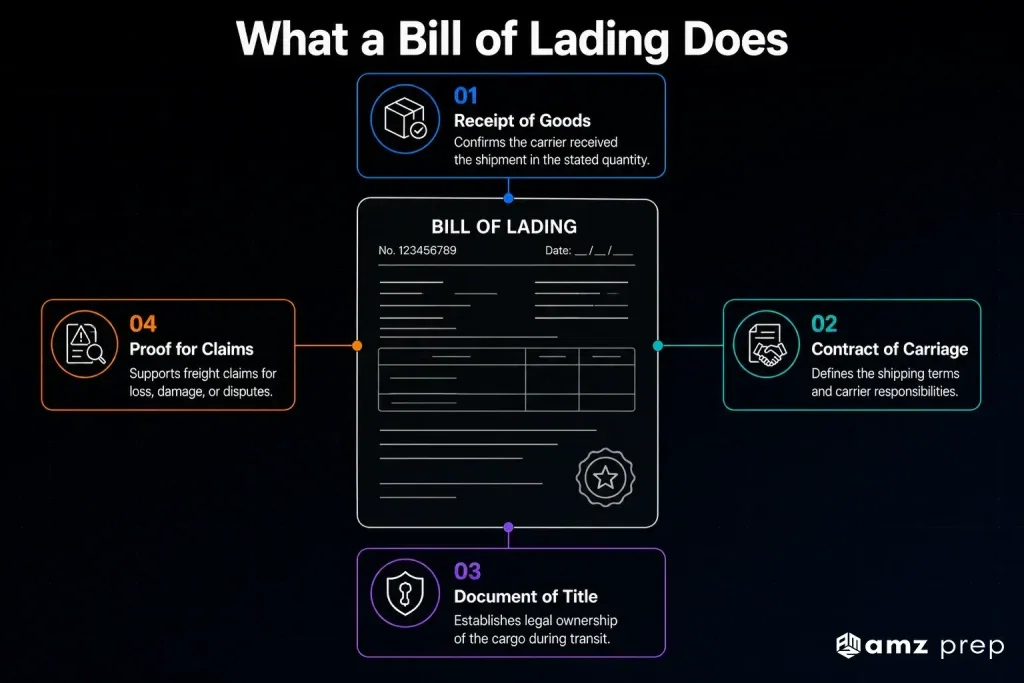
The bill of lading definition comes down to three separate functions. Each one matters on a different day of the shipment.
First, it acts as a receipt of the goods. When freight is loaded onto a truck or vessel, the carrier acknowledges receipt of the cargo. The signed document confirms the carrier received the goods in the stated type and quantity. This is your proof of shipment.
Second, it works as a contract between the shipper and the carrier. It sets the terms and conditions of the move. It sets what the carrier is responsible for while the freight is moving. If the freight is late or damaged, the terms written here decide who is liable.
Third, it is a legal document of title. It shows the title of the goods. Whoever holds the original can claim ownership of the cargo at the destination. This matters most in international trade, where the document controls who can release the cargo at the port.
Those three roles are why the document is important. One form carries the receipt, the agreement, and the ownership record for a single load.
Who Issues a Bill of Lading
The carrier issues the bill of lading. This is the party moving the freight, such as a trucking company, a shipping line, or a freight forwarder. For trucking shipments, a DOT number lookup can help verify a motor carrier’s identification and review its available safety information.
The shipper usually prepares the draft. The shipper lists the goods, the weight, and the destination. The document becomes valid once the carrier signs it after loading.
Three parties appear on nearly every bill of lading:
- Shipper: the party sending the goods
- Carrier: the party transporting them, and the one that issues the document
- Consignee: the party receiving the goods at the destination
There is a fourth party in many forms. The bill-to party pays the freight charges. It is often the shipper, but not always. On collect shipments it is the consignee. On third-party billing it is neither.
For ecommerce brands, a 3PL usually handles the paperwork on the shipper’s behalf. Many logistics providers prepare and file these documents as part of the shipping process. The brand never touches a blank form.
One point worth clarifying. A freight broker does not issue a bill of lading as the carrier. A broker arranges the move. The carrier that physically takes the freight is the one that signs.
Types of Bill of Lading
There are several types of bill of lading. The right one depends on how goods are being shipped and whether ownership needs to change hands in transit.
| Type | What it does | Transferable |
|---|---|---|
| Straight bill of lading | Ships to a named consignee only | No, non-negotiable |
| Order bill of lading | Ships “to order,” ownership can move | Yes, negotiable |
| Bearer bill of lading | Belongs to whoever physically holds it | Yes, negotiable |
| Ocean bill of lading | Covers sea freight in international trade | Depends on form |
| Sea waybill | Confirms a sea shipment without title transfer | No |
| House bill of lading (HBL) | Issued by a freight forwarder to the shipper | Depends on form |
| Master bill of lading (MBL) | Issued by the carrier to the forwarder | Depends on form |
| Through bill of lading | Covers multiple carriers or modes on one document | Depends on form |
| Air waybill (AWB) | Covers air freight | No, never negotiable |
| Electronic bill of lading | Digital version of any of the above | Same as paper form |
Straight, order, and bearer
A straight bill of lading is used for shipments sent directly to one buyer. It cannot be transferred. This is the common form for domestic freight and prepaid orders.
An order bill of lading is negotiable. The original can transfer ownership while the goods are still moving. Whoever holds the endorsed original owns the cargo.
A bearer bill of lading names no consignee at all. Physical possession is ownership. It is rare in ecommerce and carries obvious risk if the paperwork goes missing.
House vs master bill of lading
This one causes the most confusion in sea freight. When a forwarder consolidates several shippers into one container, two documents exist.
The shipping line issues the master bill of lading to the forwarder. The forwarder then issues a house bill of lading to each individual shipper. The HBL is what you receive. The MBL covers the whole container.
Cargo release at destination depends on both. If the forwarder has not settled with the line, the MBL is not released, and your HBL does not move the goods.
Clean vs claused
A clean bill of lading means the carrier accepted the goods with no visible damage or shortage noted. A claused bill of lading, sometimes called a dirty or foul bill, carries a notation about damaged packaging, short count, or wet cartons.
This distinction has real money behind it. Banks reject claused documents under a letter of credit. Buyers refuse them. If a driver writes an exception on your BOL at pickup, deal with it before the truck leaves.
Electronic bill of lading
The electronic bill of lading is a digital version that carries the same legal weight as paper. More shipping lines and freight platforms support it every year. Modern bill of lading software lets teams issue and track documents without printing anything.
Adoption is uneven. Confirm your carrier accepts an eBOL on that specific lane before you build a process around it.
The Three Bills of Lading People Ask About
When shippers ask about the three bills of lading, they usually mean the three that separate by negotiability.
- Straight bill of lading: non-negotiable, tied to one consignee
- Order bill of lading: negotiable, ownership can transfer to another party
- Bearer bill of lading: whoever physically holds it can claim the cargo
Straight, order, and bearer separate on one question. Can title move while the freight is in transit.
Some sources answer the same question with the three functions instead. Receipt, contract, and title. Both answers are correct. They just describe different things. The three functions apply to every BOL. The three types describe how ownership works.
What Goes on a Bill of Lading
Most forms share the same fields whether they are paper or digital. Each one controls something specific.
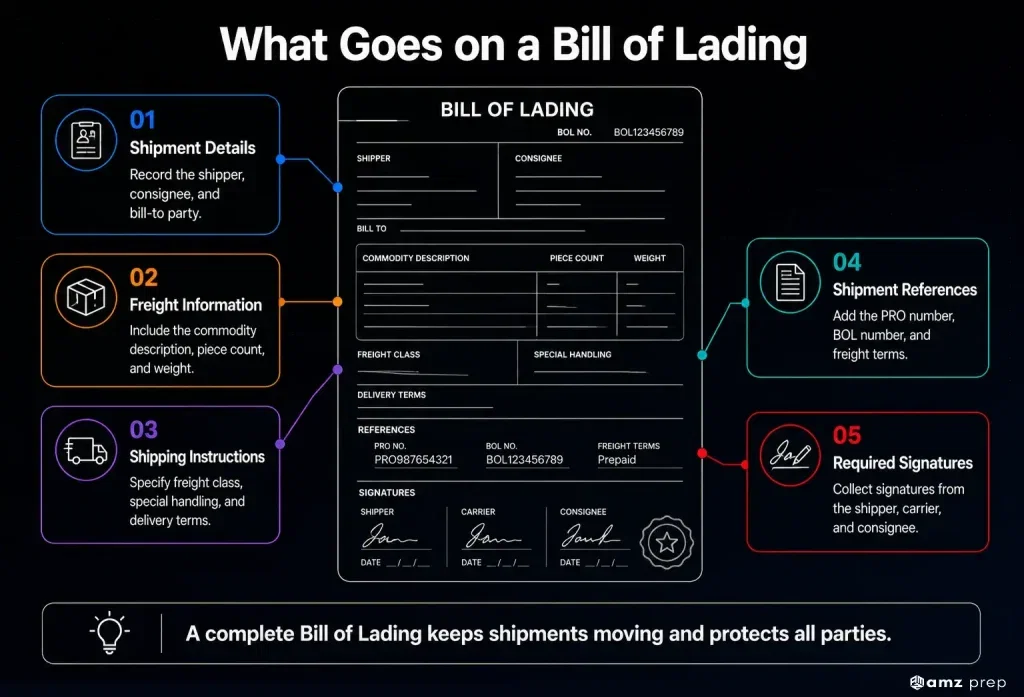
| Field | What it controls |
|---|---|
| Shipper | Legal name and pickup address |
| Consignee | Who receives the goods and where |
| Bill-to party | Who pays the freight charges |
| PRO number | Carrier tracking reference for the shipment |
| BOL number | Your internal reference for the load |
| Commodity description | What is actually in the shipment |
| NMFC code and freight class | Sets the rate on LTL freight |
| Piece count | Number of pallets, cartons, or handling units |
| Weight | Billable weight, verified before pickup |
| Declared value | Your ceiling on a loss or damage claim |
| Special instructions | Liftgate, appointment, limited access, inside delivery |
| Hazmat declaration | Required before the driver arrives, not after |
| Freight terms | Prepaid, collect, or third party |
| Signatures | Shipper, driver, and consignee at each stage |
The two fields that cost the most money when they are wrong are freight class and weight. Both get verified at the terminal. Neither gets verified by the driver at your dock.
How to Fill Out a Bill of Lading
Work top to bottom and confirm each field before the carrier signs.
Start with the shipper block. Full legal name, address, contact. Then the consignee, with the same detail. Name the carrier moving the freight, and identify the bill-to party if it is not you.
Next comes the freight itself. Describe the cargo in plain terms. List type and quantity, meaning how many pallets, cartons, or units, plus the packaging. Weight goes here too. Verify it before pickup, because a reweigh at the terminal means fees and delays.
For LTL freight, add the NMFC code and freight class. These drive the pricing directly. Confirm the class with a freight class calculator before booking rather than after the invoice arrives.
Note any special handling in the instructions field. Liftgate, appointment delivery, limited access, whatever the lane needs. Anything you leave off here shows up later as an accessorial charge.
Fill in the declared value. It sets your ceiling if goods are lost or damaged. If the freight is worth more than the carrier’s default liability, you need additional coverage rather than a higher number in that box.
Signatures close it out. The shipper, the driver, and the consignee each sign at their own stage of the move.
Check every field while the freight is still on your dock. A BOL with a wrong count is difficult to defend once a claim lands.
Bill of Lading Errors and What They Cost
This is the part most guides skip. Documentation errors are not a paperwork problem. They are a line item.
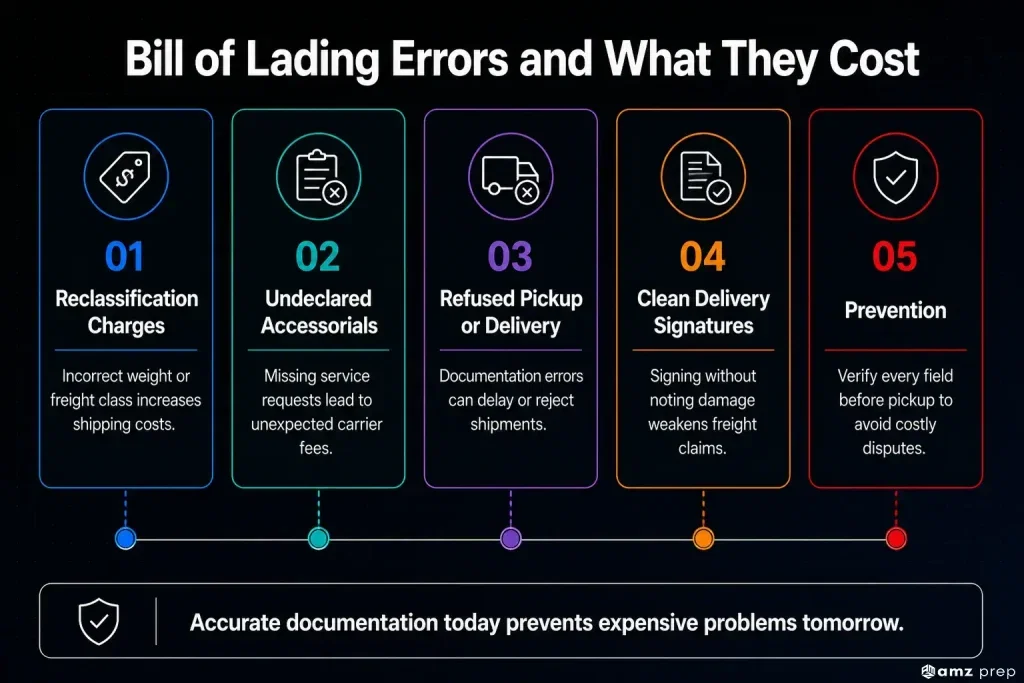
Reclassification charges
Carriers reweigh and measure freight at the terminal. If the actual dimensions or weight differ from the BOL, they reclassify. A one or two class error adds 15 to 30 percent to the invoice.
The adjustment lands at delivery, not at pickup. By then the freight has already moved and the charge is not negotiable. A regular freight bill audit catches these, though catching them after the fact is a recovery exercise rather than a prevention one.
Accessorial charges you did not declare
Every service the carrier performs that was not on the BOL becomes an accessorial. Liftgate, residential delivery, inside delivery, redelivery, limited access. These are among the most common freight accessorial charges and they turn a quoted rate into a larger invoice.
Declaring them upfront usually costs less than having the carrier add them at delivery.
Refused pickup or delivery
Terminals refuse freight for missing hazmat declarations, broken pallets, and counts that do not match the paperwork. A refusal at pickup means rebooking. A refusal at delivery means storage, redelivery charges, and a lane that has to start over.
Most of these trace back to pallet and packaging preparation that did not match what the BOL said.
Signing clean at delivery
This is the expensive one, and it is almost always avoidable.
When freight arrives damaged or short, the consignee has to note it on the delivery receipt before signing. Sign clean, and you have signed a document stating the carrier delivered the goods in good order. Concealed damage claims filed after a clean signature are difficult to win.
Train whoever signs at the receiving dock. Count the pieces. Look at the pallets. Write the exception on the paperwork before the driver leaves.
Bill of Lading vs Letter of Credit (BL vs LC)
The BOL and the letter of credit get confused because both appear in international trade paperwork. They do different jobs.
| Document | Purpose | Issued by |
|---|---|---|
| Bill of lading (BL) | Receipt, contract, and title for the shipment | The carrier |
| Letter of credit (LC) | Payment guarantee to the seller | A bank |
A bill of lading controls the goods. A letter of credit controls the money. In many cross-border deals, the seller must present the original bill of lading to the bank to trigger payment under the LC.
The two work together. One is a shipping document. The other is a financial instrument.
Bill of Lading vs Other Shipping Documents
Several documents travel with the same shipment. They are not interchangeable.
| Document | What it does | Legal weight |
|---|---|---|
| Bill of lading | Receipt, contract of carriage, title | Legally binding |
| Packing list | Itemizes what is inside each carton | Reference only |
| Commercial invoice | States value, origin, and buyer for customs | Basis for duty assessment |
| Delivery order | Instructs a warehouse to release goods | Operational instruction |
| Certificate of origin | Confirms where goods were manufactured | Determines tariff treatment |
Customs works from the commercial invoice. The carrier works from the bill of lading. Your warehouse works from the packing list. Getting them to agree with each other is most of the job.
Where the Bill of Lading Fits in Freight Into Amazon
For brands shipping into Amazon, the BOL is the first control point in the lane. It records what left your facility and what the carrier accepted. Everything downstream reconciles against it.
Four things matter more on an FBA inbound than on a standard B2B move.
The shipment ID has to appear on the BOL
Amazon’s shipment reference and PO number belong in the reference field. Without them, the load arrives at the fulfillment center with no way to connect it to your shipment plan.
Pallet count has to match the plan exactly
If the BOL says six pallets and the shipment plan says five, receiving flags it. That opens a reconciliation case, and inventory sits unavailable while it works through.
The delivery appointment ties back to the BOL
Amazon fulfillment centers require a booked appointment. The carrier books it against the BOL details. A mismatch pushes the load to the next available slot, which during Q4 can mean days.
A single-destination BOL creates placement fee exposure
Standard LTL books to one address. Amazon’s inbound placement system recommends distributing inventory across multiple fulfillment centers. Shipping to one location triggers placement fees of $0.27 to $1.58 per unit.
That last point is a routing decision, not a documentation one. Distributing inventory across Amazon’s recommended network in a single coordinated movement removes most of that exposure. AMZ Prep’s Middle Mile program routes inbound freight across five fulfillment centers on one movement, with receiving in 2 to 4 days.
Our freight team prepares and manages these documents as part of every inbound move. We run freight into Amazon across a network of 50+ fulfillment centers in 6 countries. The paperwork stays consistent from dock to FBA.
Conclusion
Freight moves faster when the documentation is right the first time. The fields that cost money are freight class, weight, and piece count. Those three get verified at the terminal whether you checked them or not.
More carriers and logistics providers are shifting to electronic bills of lading and connected documentation software. Standardizing the process now reduces dispute volume later. Confirm the fields before the driver arrives and match the type to the move.
Frequently Asked Questions
What is a bill of lading and its purpose?
It is a legal document the carrier gives the shipper when goods load. The purpose is threefold. It proves the carrier took the goods, sets the shipping contract, and shows who owns the cargo.
Who provides the bill of lading?
The carrier does. That means your trucking company, shipping line, or freight forwarder. In practice the shipper fills out the draft first. The carrier signs it once the freight is loaded and the count checks out.
What is LC and BL?
Two different documents. BL is the bill of lading, which covers the goods as a receipt, contract, and title. LC is a letter of credit from a bank. It guarantees the seller gets paid.
What are the three bills of lading?
Straight, order, and bearer are the three. A straight bill goes to one named consignee and cannot be transferred. An order bill is negotiable. A bearer bill belongs to whoever holds it.
Can I create my own bill of lading?
A shipper can prepare the draft and most do. It only becomes valid when the carrier signs it after loading. Carriers also accept their own standard forms, which is usually the simpler route.
What happens if a bill of lading is lost?
For a non-negotiable straight BOL, the carrier can usually release goods against proof of identity. For a negotiable original, the consignee typically needs a bank-backed letter of indemnity before release.
Is a bill of lading a legal document?
Yes, it is legally binding. Courts treat it as the title to the goods. It also proves the carrier took your cargo and it locks in the shipment terms both sides agreed to.
Why is it called lading?
Lading is an older English word for loading. The document originally recorded goods laded, or loaded, onto a ship. The term stayed in use as freight moved to trucks, rail, and air.
Why is a bill of lading important?
The document proves what was shipped and who owns it. It backs your claim if freight is lost or damaged. It also fixes the carrier’s responsibilities across the entire move.

Chadwick Collins is an Enterprise Fulfillment Consultant at AMZ Prep, where he partners with high growth ecommerce brands to design and scale Amazon first logistics strategies. He brings extensive experience in freight, supporting brands across domestic and cross border transportation, routing optimization, and cost control.
At AMZ Prep, Chadwick works closely with enterprise clients to improve inventory flow, reduce landed costs, and accelerate delivery performance across North America. His expertise spans FBA, DTC, and B2B fulfillment, with a strong focus on aligning freight strategy with overall supply chain efficiency. He helps brands navigate complex logistics challenges while turning operations into a competitive advantage.

















Comments