
eCommerce businesses have witnessed rapid growth in recent years. Consumers globally are doing most of their shopping online. Even as brick-and-mortar sales are recovering, e-commerce is here to stay.

In 2025, the user penetration will be 42.4% and is expected to reach 49.1% by 2029.
While this rapid growth is great for e-commerce businesses, the strain it’s putting on logistics companies can’t be ignored.
They tussle with complex consumer demands, increased competition, and rising costs.
Though e-commerce is the future of retail, the one thing that can trip up the entire business is logistics.
That’s because fulfillment is more than just packing items and sending them off. It’s about ensuring that items arrive on time and in good condition.
And that requires an entire supply chain infrastructure to support it.
What’s the issue?
Shipping can be a logistical nightmare for e-commerce sellers because there are multiple variables involved — from packaging costs to fuel prices to transportation costs.
And while some companies like FedEx and UPS offer services specifically designed for e-commerce sellers (like FedEx SmartPost), most of these services are meant for large businesses with high volumes of orders. Shopify merchants can access these and more. See the full list of carriers supported by Shopify natively.
But one way to reduce shipping costs is by implementing a flat rate shipping strategy.
It allows you to offer customers a predictable price for their orders, regardless of what they buy or where they live.
The benefit of this is that you give them confidence in their purchase price, which increases customer satisfaction and loyalty.
With that said, let’s understand flat-rate shipping in detail. Let’s dive right into it.
What is Flat Rate Shipping?
Flat rate shipping is a type of shipping that allows you to ship items to any location for a set price, regardless of their size or weight. Businesses that regularly ship packages, like Amazon, typically use this shipping method.
You don’t have to worry about calculating shipping costs with flat rate shipping. Instead, you can offer one flat rate for all orders within a specific size or weight range. You may even be able to charge more for larger packages if the package needs special handling or if there are multiple items in the order.
How does Flat Rate Shipping work?
The way flat rate shipping works is straightforward. You set a single price for each eligible product, and then customers are charged that price no matter how much their order weighs or how far it’s being shipped.
The idea behind this is to make things simple for customers and sellers alike.
For customers, it means they don’t have to worry about what size box they need to ship their item in; they pay one price no matter what.
For sellers, it means they don’t have to figure out what size box they need to ship each item in; they charge the same amount per package, no matter what.
Flat rate shipping is often used by retailers who want to offer free or low-cost shipping options to consumers but still make money on products that weigh less than a certain threshold.
Advantages of Flat Rate Shipping for eCommerce Businesses
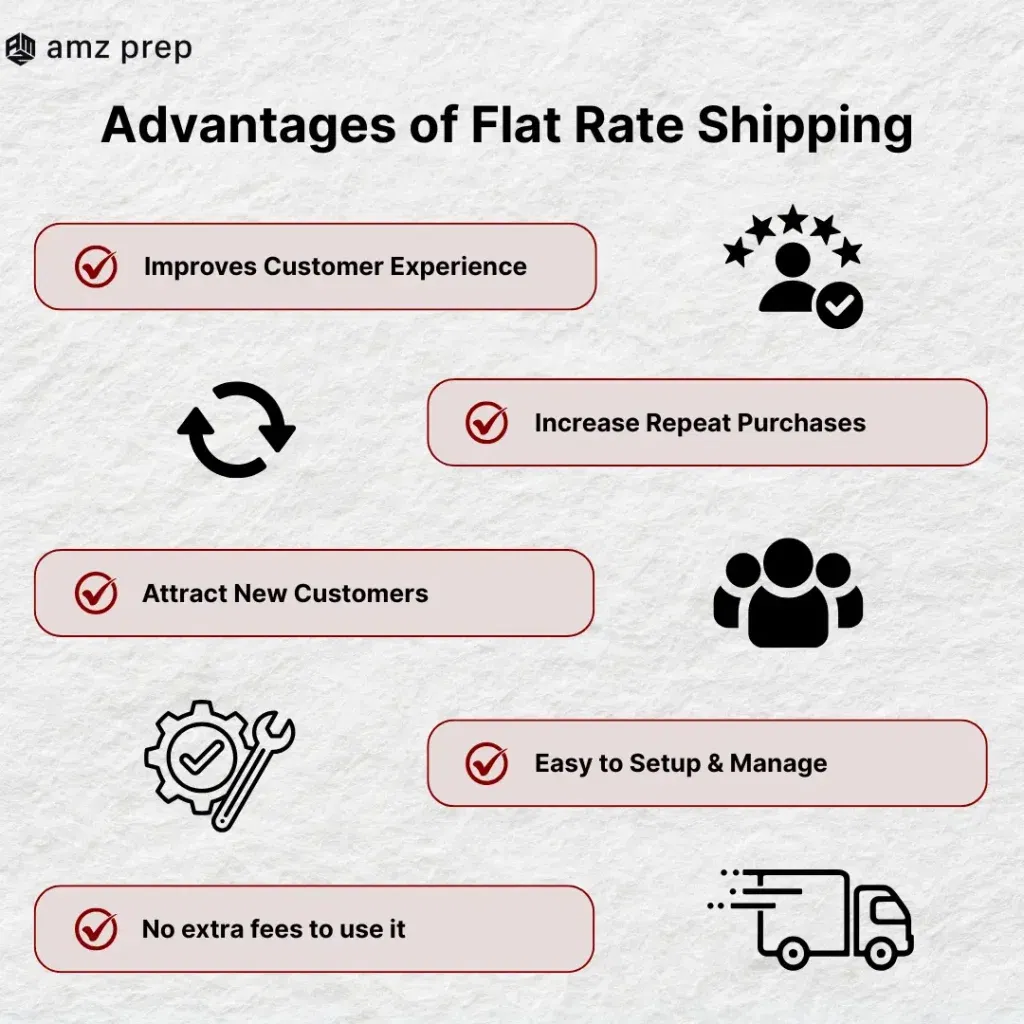
The perks of flat rate shipping are many. Here are a few to make a note of:
- Improves customer experience: A study by UPS showed that customers are more than twice as likely to buy from a merchant who offers free returns and flat shipping rates. Customer satisfaction also improves when there are no surprises in the shipping cost after they have made their purchase decision.
- Boosts sales: Flat shipping rates can boost your sales by up to 20%, giving you an advantage over your competitors. Shipping strategy plays a big role in customer purchasing decisions, especially when comparing standard shipping vs economy shipping methods for cost and delivery speed. Also, it helps increase repeat purchases by customers who had previously purchased from you.
- Cost-effective marketing strategy: You can offer free shipping as a marketing strategy to draw in new customers, but at the same time, it does not increase your costs substantially because you may already be paying for delivery services like UPS or FEDEX which charge per package instead of per order price like USPS does.
- Easy to set up and manage: With flat-rate shipping, you don’t have to worry about calculating shipping costs for each item in your store. Instead, you can set up one flat rate and use it for all of your products. This makes it much easier to track what you’re spending on shipping and avoid overcharging customers for their orders.
- No extra fees to use it: Some carriers charge additional fees for certain shipments (such as international orders), but if you use a flat rate method, those fees won’t apply. Your shipping costs will always be consistent no matter where your customers live or what they order from your store.
Disadvantages of Flat Rate Shipping
While flat rate shipping can be a great way to grow your sales and improve customer satisfaction, it’s not a one-size-fits-all approach.
Before you decide about it, you must understand its drawbacks too.
- Difficult to predict shipping costs: While the flat rate price is usually lower than other shipping methods, it doesn’t consider the weight of individual items. This means that if you sell items that are heavier than average, your shipping costs will go up.
- Low product diversity: Flat rate shipping only works if you have enough products in the same category to justify using it. If you don’t have enough products in a category, then customers may be disappointed because they can’t find what they’re looking for at the low cost they were promised.
- One way to avoid this problem is by offering multiple flat-rate shipping methods (e.g., ground, 2-day air). Another solution is to use weight-based shipping instead of price-based shipping.
- Isn’t always cheaper than other options: This is especially true if you need to send something that doesn’t fit into an envelope or box — like furniture or large appliances. In these cases, shipping via UPS Ground or FedEx Ground is likely cheaper than paying for the extra packaging materials needed for USPS Flat Rate Boxes or Envelopes.
- Doesn’t allow for customization based on size or weight: A large item may cost more than a smaller item simply because it has been shipped at a higher rate.
How Long Does Flat Rate Shipping Take
This is a good question and one that we hear often. The answer depends on several factors, including the size and weight of your package, how far you’re shipping it, and even the weather.
Guidelines For Average Flat Rate Shipping Times
Large packages (15 pounds or less) shipped within the contiguous United States: 2-7 business days.
Small packages (under 15 pounds) shipped within the contiguous United States: 5-8 business days.
All other destinations: 7–10 business days.
The shipping service you choose will determine how long it takes for your package to arrive.
The following is a breakdown of flat rate shipping times for some of the popular logistics services:
- UPS Ground: 3-5 business days (for orders under $100) and 1-3 business days (for orders over $100).
- FedEx Ground: 3-5 business days (for orders under $100) and 1-3 business days (for orders over $100).
- USPS Priority Mail: 2-3 business days.
- USPS Express Mail: 1-2 business days.
- Amazon: 3-5 business days for most orders within the continental United States, but it can take up to 7 business days depending on where you live and how quickly Amazon can get your package picked, packed, and shipped out with their carriers like UPS or USPS.
Note: If your shipment is large, the flat rate box will be too small to ship your items.
Therefore, you will need to use a larger box and pay more for shipping. This can be very expensive, depending on the weight of your shipment.
If you are sending just a few items, you can use the flat rate box without worrying about paying extra for your shipping costs.
One other factor for shipping:
Another factor in determining how long it takes for your package to arrive at its destination is where it is being sent from and where it is going.
For example, if you live in Canada and are sending something to Los Angeles (which is not very far away), then it should take about 2 days for your package to arrive at its destination.
However, if you are sending something from Canada to Brazil (which is quite far away), it could take up to 4 weeks for your package to arrive at its destination.
For U.S. domestic shipping, using express services like UPS Next Day Air Saver ensures your package arrives the very next business day
How Long Does Flat Rate Shipping Take
USPS Flat Rate takes anywhere between 3 to 10 days to deliver. It depends on how close you are to the post office and how busy they are.
The post office provides several different ways to ship packages, including First Class Mail and Priority Mail.
First Class Mail
First Class Mail is an economical option for sending lighter packages weighing less than 13 ounces (375 grams). It takes 2–5 business days for delivery, depending on the distance and location of the recipient.
Priority Mail
Priority Mail offers faster delivery times and costs more than First Class Mail. Priority Mail shipments are sometimes delivered within 2-3 days or overnight.
This option is best suited for time-sensitive deliveries or large items that need special handling or insurance coverage.
Parcel Box
Parcel Post flat rate boxes are ideal if you have a small number of packages to ship at once — up to 70 pounds per box, as long as each item weighs less than 20 pounds itself.
Parcel Post takes longer than other types of mail: 3-10 business days for delivery across the U.S. and longer if you’re shipping internationally (6-10 business days).
Keep in mind, delivery delays and disruptions, shipment exceptions, and blank sailing disruptions on international ocean routes can impact these estimated timelines. Here’s how to deal with carrier based shipment exceptions proactively.
Note: USPS handles the last-mile delivery of products shipped from Shein’s U.S. warehouse locations to customers across the American marketplace.
How to Ship Flat Rate Box?
Step 1. Find the right size box for your items. The smaller the item, the better it will fit in a flat-rate box. You can find all five sizes of flat rate boxes here.
Step 2. For best results, pack items tightly in the center of the box with no more than 2-inches between items on all sides of the package (including corners). If you need more room to pack tightly in the center, put heavier items toward the bottom so they are closer to your weight limit than lighter items on top (which could easily shift during transit).
Step 3. Write “This Side Up” on each side of your package and “FRAGILE” directly above “This Side Up” so that handlers know how to handle it properly at each step along its journey from origin to destination.
Step 4. Label your box with the contents, sender address, recipient address, zip code, and returns address, if applicable.
Step 5. Put your package in the box and close it securely with tape or staples.
Step 6. Take your package to your local USPS location or drop it off at an authorized shipping center such as UPS Store.
An Overview of USPS Flat Rate Box Sizes
USPS flat rate boxes are the perfect way to send heavier items in the mail. The boxes come in different sizes that range from large to super-large.
There are four different size options:
Small flat rate box (12 x 6 x 6 inches): This box can hold up to 20 pounds of materials and costs $5.15 to ship anywhere in the United States.
Medium flat rate box (12 x 12 x 6 inches): This is a larger version of the small flat rate box, holding up to 30 pounds of materials and costing $13.65 to ship anywhere in the United States.
Large flat rate box (19 x 12 x 8 inches): This is the largest flat rate box available, holding up to 70 pounds of materials and costing $17.90 to ship anywhere in the United States.
Super-sized flat rate box (19 x 12 x 12 inches): This oversized option holds up to 150 pounds of materials and costs $27.90 to ship anywhere in the United States.
Conclusion
The importance of flat-rate shipping is that it makes your business more appealing to customers.

Blair Forrest is the Founder of AMZ Prep, one of North America’s fastest-growing third-party logistics and fulfillment networks, built entirely without outside capital since 2016. Under his leadership, AMZ Prep has scaled to 50+ fulfillment centers across 6 countries, processing over 10 million plus units monthly and powering $2 billion+ in annual GMV for more than 5,000 brands worldwide including 437, Silverts, Saltyface, Unilever, Duracell, and JBL. A recognized authority in eCommerce logistics, Amazon FBA strategy, and supply chain optimization, Blair has helped thousands of sellers and brands master their fulfillment operations from first shipment to enterprise scale. He regularly consults on FBA prep, multi-channel fulfillment, last mile delivery, international expansion, and cost reduction strategies that save brands 20–40% compared to traditional 3PL providers. Blair’s insights on Amazon logistics, 3PL operations, and eCommerce growth are widely cited across the industry. Through AMZ Prep’s content, guides, and resources, he continues to share battle-tested strategies drawn from managing one of the largest independently owned fulfillment networks in North America.