
Let’s be direct. If you’re selling perishable or packaged pet products across multiple channels in North America, your cold chain is either your biggest competitive advantage or your biggest liability. There’s no middle ground.
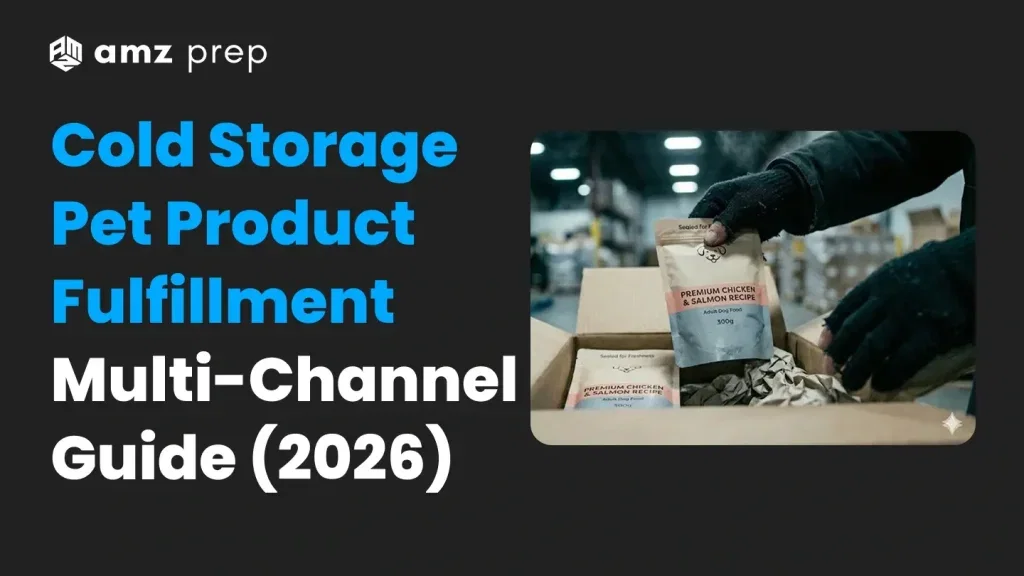
We’ve seen sellers build incredible products, grow loyal audiences, and pour money into ads, only to have one bad batch of spoiled refrigerated food unravel months of brand equity.
One week of negative reviews about warm gel packs follows a listing for a long time. In a category where pet owners are deeply invested in what their animals eat, that trust is genuinely hard to win back.
This guide covers everything from the moment your inventory arrives at our facility to the moment it reaches a customer’s door, and what happens when things don’t go as planned.
Choosing the Right Temperature Zone for Pet Product Storage
Before any conversation about operations, carriers, or channels, you need to be certain your product is in the right temperature zone.
This sounds basic. It isn’t.
We talk to sellers regularly who are paying for the wrong storage type, or worse, storing products in conditions that are slowly degrading over weeks without any obvious signs.
Frozen Storage
Frozen storage sits at minus 18 degrees Celsius and below. Raw pet food, BARF diet products, frozen treats, and raw meat-based toppers all live here. An unbroken frozen chain from manufacturer to customer is non-negotiable.
Refrigerated Storage
Refrigerated storage runs between 2 and 8 degrees Celsius, covering fresh pet food, wet food pouches, fresh-cooked meals, and prescription diets. This is the most demanding zone because a few degrees of drift matters in a way it simply doesn’t with dry goods.
Controlled Ambient Storage
Controlled ambient storage, between 15 and 25 degrees Celsius, handles premium dry kibble, freeze-dried food, and specialty treats that degrade under heat and humidity. If your 3PL is storing freeze-dried raw food next to plastic chew toys in an uncontrolled environment, that’s a quality problem waiting to surface.
Temperature-Sensitive Packaged Goods
Then there’s a fourth category that trips up a lot of sellers: temperature-sensitive packaged goods. Flea and tick treatments, probiotic supplements, soft chews, and certain vitamins don’t need refrigeration but are sensitive to heat and humidity extremes. Know the exact threshold for every SKU, in writing, from your manufacturer, before agreeing to any storage terms.
Storage Zones
Once you know which zone your products belong in, the next question is what happens to them inside the warehouse, and this is where most cold chain conversations fall apart. That’s where we’ll start.
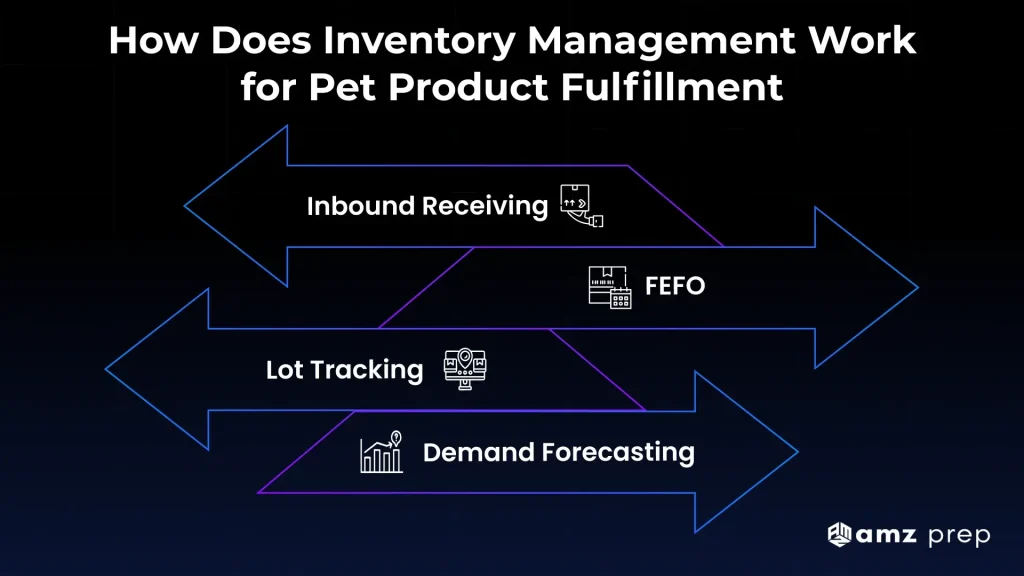
How Does Inventory Management Work for Pet Product Fulfillment
Sellers spend enormous energy thinking about packaging, carriers, and last-mile logistics. Those things matter.
But what happens inside the warehouse before a single order ships often determines whether your cold chain works or fails.
Inbound Receiving
Temperature verification happens at the dock door before unloading begins. Not after. Before.
If a pallet arrives at 12°C instead of 4°C, it goes into quarantine and we notify you before anything is put away. Lot numbers, expiry dates, and unit counts get captured via mobile scanning, not manual entry, because manual entry errors in lot tracking become real problems when a recall happens.
Hold your 3PL to a dock-to-cold-zone time under 30 minutes. Every minute on the dock is cumulative temperature exposure you can’t undo.
No documented SOP for this? That gap in discipline tends to show up everywhere else too.
FEFO
Standard warehouses use FIFO. For perishable pet products, you need FEFO: First Expired, First Out. If you’re unfamiliar with how traditional FIFO rotation works, here’s a clear explanation of the FIFO inventory method and why it falls short for perishable goods.
Without it, newer stock gets picked while older stock drifts toward expiry and becomes a write-off.
Set shelf life thresholds per SKU from day one: receive at 70%+ shelf life remaining, ship above 40 to 50% remaining, and auto-flag anything below that threshold for review.
Lot Tracking
Pet food recalls happen multiple times every year in North America. When one touches your products, the question isn’t whether you can respond.
It’s whether you can respond fast enough. A proper lot trace means every unit identified in storage and every shipped unit traced to a specific order, all of it in under two hours.
If your current setup can’t deliver that, address it before you need it.
Demand Forecasting
Forecasting errors in cold storage aren’t just annoying. They’re expensive. Overstock means spoilage and write-offs. Understock on a subscription SKU means churned customers at the worst possible moment.
Good cold chain forecasting draws from sell-through velocity, seasonal demand curves, shelf life windows by lot, and production lead times.
For a perishable product line, this isn’t a side feature. It’s central to how you protect margin.
Getting inventory right inside the warehouse is only half the equation. What happens across your sales channels is the other half, and every platform plays by different rules.
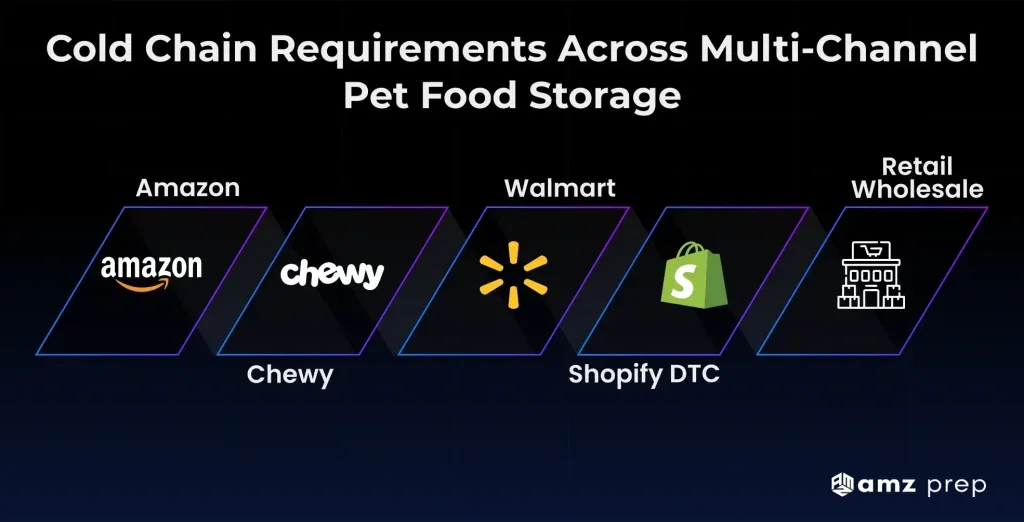
Cold Chain Requirements Across Multi-Channel Pet Food Storage
Each platform you sell on has its own SLA requirements, compliance expectations, and performance metrics. Getting all of them right from a single pool of temperature-controlled inventory requires the right architecture built before you scale.
The Integration
Real-time inventory sync across every channel is non-negotiable. If you’re running DTC, understanding which shipping carriers Shopify supports helps prevent downstream fulfillment issues.
When an Amazon SFP order arrives 20 minutes later, it draws from what’s actually available right now.
Whether this runs through your 3PL’s OMS, or direct API connections, you need a single source of truth across every channel.
Amazon
Amazon FBA doesn’t support perishable or refrigerated pet products, so your cold 3PL handles those SKUs as FBM or Seller Fulfilled Prime. If you’re weighing those models, this breakdown of FBA vs FBM fulfillment clarifies where each structure works best.
Confirm your cold fulfillment partner has documented FBA prep capability, not just cold storage capability. Amazon’s FBA packaging requirements and guidelines are highly specific, and cold products still need to meet labeling and prep standards.These are two different things.
For Seller Fulfilled Prime, weekend cold carrier pickup needs to be a confirmed, standing arrangement Many sellers underestimate how strict SFP metrics are. This comparison of SFP vs FBA performance requirements highlights the operational differences.
Chewy
Your 3PL needs EDI capability covering 850, 856, and 810 transactions.
A Chewy order that ships with a generic label is an immediate compliance failure, and their chargeback process is thorough. Sort out the EDI question before your first order ships, not after your first chargeback lands.
Walmart
Walmart FBM requires 95 percent or above on on-time shipment and valid tracking.
Cold carrier delays happen more than standard parcel delays, so your 3PL needs active carrier redundancy built in, if one carrier goes down in a region, they reroute without you having to get involved.
That has to be a standing operational capability, not something they figure out after a delay happens.
Shopify DTC
The right 3PL integration triggers the correct cold packaging profile automatically by SKU, destination zone, and season.
A refrigerated order going to Miami in July should not get the same packaging as the same order heading to Calgary in January.
Your checkout also needs to surface accurate delivery dates that account for cold shipping cutoffs. Customers who understand your shipping logic before they order have far lower support contact rates.
Retail Wholesale
Retail-compliant pallet builds, ASN generation, GS1 barcoding, and Certificate of Analysis documentation are standard expectations. For palletized outbound shipments, understanding LTL freight shipping requirements prevents costly compliance chargebacks.
Non-compliance chargebacks add up. If your cold 3PL has retail compliance capability, your wholesale channel runs from the same inventory pool as DTC and marketplace orders.
If not, you’re managing a separate logistics operation and the complexity compounds as you grow.
Inventory Allocation
Configure priority rules in your OMS before inventory gets tight, not after.
A practical 2026 framework: Amazon SFP first, Chewy dropship second, Shopify subscription orders third, standard one-time and Walmart FBM orders from whatever remains.
Without this logic in place, the system fills orders in the sequence they arrive, which almost never lines up with your actual business priorities.
With your channel architecture defined, the focus shifts back to what happens inside four walls, because the pick and pack operation is where channel promises are either kept or broken.
What Happens Inside the Warehouse to Fulfill Pet Products
Every minute your product spends outside a controlled temperature zone is exposure that accumulates and can’t be reversed.
Ask any 3PL you’re vetting what the maximum allowable time is for a refrigerated pet product to be outside temperature control during pick-pack.
Under 20 minutes for refrigerated, under 10 for frozen. No documented SOP with a specific time threshold is a warning sign worth taking seriously.
Channel-specific packaging
Channel-specific packaging profiles need to run automatically at the packing station based on channel, SKU, destination, and season.
DTC packaging is a brand moment as much as a cold chain function, get it right and customers leave five-star reviews that specifically mention quality and care of your pet food.
For Amazon SFP, cold packaging has to meet dimensional and weight standards to avoid surcharges.
For Chewy, the label format is non-negotiable.
For retail pallets, temperature logs and lot numbers on the pallet manifest are required.
Seasonal Packaging
A single packaging configuration won’t maintain temperature integrity across Miami in August and Minneapolis in January.
Seasonal profiles should adjust automatically in your 3PL’s OMS. None of this should require manual intervention from your side.
Kitting
Kitting in a cold environment is more operationally complex than ambient kitting because workers have limited time in cold zones and multi-component kits often span different temperature zones.
Have the cold kitting protocol and pricing conversation during onboarding, not after your first batch of welcome boxes ships missing the frozen component.
Once the package leaves the building, cold chain responsibility shifts to the last mile, and this stage carries its own set of risks that need to be designed around rather than reacted to.
Cold Logistics Across North America for Pet Product Fulfillment
Your 3PL should have negotiated rates with both FedEx Custom Critical and UPS Temperature True to route by cost, transit time, and destination zone rather than defaulting to a single carrier.
Regional cold carriers often beat national networks on speed and cost in specific lanes.
For bulk outbound to retail DCs, refrigerated LTL handles pallet-level shipments and your 3PL should manage carrier booking and temperature documentation.
Cross-border Canada-US shipments add customs documentation and a border dwell time that stresses your temperature window. Sellers should also understand how Delivered Duty Unpaid (DDU) structures impact customs clearance and transit timing.
Your 3PL needs active customs brokerage relationships to minimize that exposure.
Single Node
One cold storage location means every shipment to the opposite coast crosses multiple shipping zones, adding transit time, refrigerant cost, and temperature risk.
A distributed cold network lets you cut average shipping zones, lower refrigerant requirements, and improve delivery reliability all at once.
Ask any prospective 3PL how many cold-capable locations they operate and how cross-node inventory positioning works in practice.
Managing Shipping Cutoffs
Refrigerated shipments of pet food shouldn’t go out Thursday or Friday due to the risk of sitting in a carrier facility over the weekend.
Your 3PL’s dynamic cutoff calendar manages this, but the logic also needs to reach your customers at checkout. A brief explanation that cold shipments are held to protect freshness turns a confusing delivery date into a trust signal.
Executing all of this correctly also means operating within a clear regulatory framework.
Knowing what your 3PL must have in place is what keeps a compliance gap from becoming a regulatory problem.
What Compliance Is Required for Pet Product Fulfillment
Most sellers treat compliance as something to hand off and not think about. That’s a mistake.
United States
FDA registration is the baseline for any facility storing food products for US commerce. Confirm it’s current and ask to see the documentation.
FSMA’s Preventive Controls for Animal Food rule requires a written food safety plan covering hazard analysis, preventive controls, and corrective action procedures.
Ask for it. If they hesitate, pay attention to that reaction.
SQF Level 2 or 3 and BRC Storage and Distribution are the industry-standard third-party certifications, each requiring annual audits.
Ask for the last audit report, not just the certificate date. State feed regulations add another layer on top of federal ones. Don’t assume federal compliance covers everything.
Canada
CFIA traceability enforcement has strengthened and your lot tracking must meet the one-step-back, one-step-forward standard.
Verify that your 3PL’s WMS captures and maintains this data in a format that holds up to a CFIA traceability request.
Insurance and Liability
Who is financially responsible when a temperature excursion destroys a pallet of your inventory?
Most 3PLs accept liability only for documented equipment failures on their end. Get this spelled out in your service agreement before you sign, not during a dispute.
Your own product liability insurance also needs to cover cold chain failure scenarios by name. Have that conversation with your broker before you launch your first cold SKU, not after your first claim.
You’ve now got a picture of everything that needs to be in place.
Onboarding is where all of it actually gets built, and how that process goes largely determines your first 90 days.
What to Expect During Pet Product 3PL Onboarding
Onboarding with a cold 3PL is not like onboarding with a standard fulfillment partner. Every SKU’s cold zone, packaging profile, seasonal adjustments, and channel-specific requirements need to be defined in the OMS before anything goes live.
Packaging validation confirms your insulated box and gel pack configuration actually holds temperature for your specific SKUs(pet food) and transit zones.
Four to six weeks is a normal and appropriate timeline.
If a 3PL tells you they can have you live in a week, ask directly what’s being skipped. Rushed onboarding is one of the most consistent reasons cold chain partnerships fail in their first few months.
Even with the best onboarding, exceptions happen.
Here’s how to handle them without burning customer trust.
How Do Returns Work in Pet Product Fulfillment
Perishable Products
For perishable pet food products, a physical return is almost never the right answer.
The approach that works: no physical return required, the customer keeps or disposes of the product, and a refund or replacement is issued based on a photo and delivery confirmation.
Resolution within 24 hours turns a disappointed customer into a loyal one.
Packaged Non-Perishables
Standard returns work with a documented inspection process covering seal integrity, packaging damage, lot number, and remaining shelf life.
Product that clears all four checks goes back to sellable inventory. Everything else goes to quarantine for disposition.
Channel-by-Channel Return Policies
On Amazon, configure perishable listings as non-returnable and use the SAFE-T claim process when needed.
On Chewy, your defense against quality chargebacks is documentation: carrier tracking, temperature logs, and delivery confirmation available on demand.
On Walmart, keep cold chain documentation organized because their dispute process moves faster when you respond with real data.
On Shopify, state clearly at checkout that perishable items are non-returnable.
Setting that expectation before purchase does more to reduce disputes than any post-purchase resolution policy ever will.
Cold storage costs significantly more than ambient fulfillment, and sellers who manage it well build honest unit economics before they scale, not after.
How Much Does Cold Storage Really Cost for Pet Product Fulfillment
Cold storage costs significantly more than ambient fulfillment, and the sellers who manage this well build accurate per-channel unit economics before they scale.
Refrigerated storage runs $25 to $50 per pallet per month, frozen runs $35 to $65, versus $10 to $20 for ambient.
Cold pick-pack handling runs 20 to 40 percent higher, and packaging materials add $3 to $15 per order with seasonal variation.
Stress-test contract terms against your slow season numbers, not your peak projections.
Build a landed cost model per channel that includes storage, pick-pack, packaging, carrier cost by zone, and platform fees. Many sellers underestimate how quickly Amazon FBA fees or marketplace surcharges compound once cold handling is layered in.
It’s not uncommon to discover a SKU that looks profitable at marketplace pricing is actually margin-negative once cold shipping is fully loaded in.
Finding that out in a spreadsheet before launch is a lot less painful than finding it on a P&L six months into volume.
Everything in this guide, including the zones, the compliance requirements, the channel specifications, and the costs, comes back to one decision.
Choosing the Right Cold Storage Partner for Your Pet Product
Everything in this guide comes back to the partner you choose. Their operational quality is directly visible to your customers in every single order that goes out.
Certifications need to be current and third-party audited: SQF Level 2 or 3, BRC Storage and Distribution, active HACCP, and current FDA registration.
Ask for the last audit report, not just the certificate. That report tells you far more about how the operation actually runs than a plaque on the wall ever will.
Technology needs to cover a FEFO-capable WMS with lot tracking, IoT monitoring with seller-facing dashboards, real-time multi-channel OMS integration, and EDI capability.
Any of these missing and the gaps will eventually show up in your operations.
Backup systems must be documented and actually functional. Ask what happens when the frozen zone cooling unit fails at 2am on a Sunday.
How they answer that question tells you a lot about how the facility is really run.
Recall readiness should be demonstrable on the spot.
Ask them to walk you through a live lot trace and how they place a lot on hold remotely without waiting on a manual process.
Cold-capable nodes on both coasts are the minimum for national DTC distribution. Ask about pet product experience specifically.
General food cold storage and pet food cold storage are not the same thing. Ask for references from other pet product sellers, not just general food industry clients.
Final Thoughts
The premium pet food market is growing and the direction isn’t changing. Fresh, refrigerated, and frozen pet food is outperforming the overall category, pulling in more competition.
Cold chain execution is increasingly what separates brands that build something durable from those stuck cycling through the same operational headaches.
When the cold chain works, it compounds in your favor.
Customers who receive their pet’s food in perfect condition come back, subscribe, and write reviews that reinforce exactly the brand you’ve worked to build. When it fails, the visibility goes the other way just as fast.
Your fulfillment partner carries a real portion of your brand promise every single day.
The infrastructure you build now determines how far you can scale before the cold chain becomes the thing holding you back instead of the thing pushing you forward.
If you’re ready to map out what this looks like for your specific product mix and channel stack, we’re ready to walk through it with you.
Frequently Asked Questions
1. Does every pet product need cold storage?
No. Dry kibble, most treats, and non-perishable accessories don’t need refrigeration. Cold storage is specifically for raw food, fresh meals, wet pouches, prescription diets, and anything with a manufacturer temperature requirement. When in doubt, check the storage instructions from your manufacturer in writing.
2. What’s the difference between refrigerated and frozen storage for pet products?
Refrigerated storage runs between 2–8°C and covers fresh and wet food. Frozen storage sits at -18°C and below, handling raw food, BARF diets, and frozen treats. They’re separate zones with different cost structures, handling protocols, and packaging requirements.
3. Why can’t I use FBA for my refrigerated pet food?
FBA doesn’t support perishable or refrigerated products. If you’re selling fresh or frozen pet food on Amazon, it has to be fulfilled through FBM or Seller Fulfilled Prime via a cold-capable 3PL.
4. What does FEFO mean and why does it matter for pet food?
FEFO stands for First Expired, First Out. Unlike standard warehouses that rotate by arrival date, FEFO rotates by expiry date. Without it, newer stock gets picked while older inventory quietly approaches expiry and becomes a write-off.
5. How do I know if my 3PL is actually maintaining the right temperature?
Ask for IoT-enabled temperature monitoring with a dashboard, not just internal logs. You should be able to see real-time zone conditions yourself, not rely on someone to email you a report after a problem has already happened.
6. How much more expensive is cold storage compared to regular fulfillment?
Refrigerated storage typically runs $25–50 per pallet per month, frozen $35–65, versus $10–20 for ambient. Pick-pack handling also runs 20–40% higher, and cold packaging adds $3–15 per order depending on season and destination.
7. What certifications should a pet food cold storage 3PL have?
At minimum: current FDA registration, SQF Level 2 or 3 or BRC Storage and Distribution, and an active HACCP plan. Ask for the most recent third-party audit report – not just the certificate date. The report tells you far more than the plaque on the wall.
8. What happens if there’s a pet food recall and my product is affected?
A proper cold 3PL should be able to trace every affected unit in storage and every shipped unit back to a specific order in under two hours. If your current setup can’t do that, it’s worth addressing before you actually need it.
9. Can I ship refrigerated pet food on Fridays?
It’s generally not recommended. Refrigerated shipments sent Thursday or Friday risk sitting in a carrier facility over the weekend. A reliable cold 3PL manages dynamic cutoff calendars to prevent this and surfaces those cutoffs to customers at checkout.
10. How long does onboarding take with a cold storage 3PL for pet products?
Four to six weeks is a realistic and appropriate timeline. Every SKU needs its cold zone, packaging profile, and channel-specific requirements configured before going live. If a 3PL promises to have you live in a week, ask what’s being skipped.

Arishekar N is a Vice President (VP) of Marketing at AMZ Prep, specializing in ecommerce fulfillment and Amazon logistics strategies with a proven track record of driving growth for e-commerce businesses. He is a strategic leader with extensive expertise in marketing, e-commerce operations, SEO & advertising, and branding.
Stay updated on his latest insights by following him
















Comments