
I work with brands doing consistent weekly FBA replenishment, typically 5 to 15 pallets per shipment. They sit in the middle zone. Too much volume for a small parcel. Not enough to fill a full truckload.
Most of them are already using standard LTL carriers like Old Dominion or FedEx Freight when they come to us. The receiving timelines they describe are consistent: 15 to 30 days for check-in, placement fees accumulating on every inbound, and inventory sitting unavailable while demand continues.
Standard LTL freight shipping is the right tool for B2B deliveries, retail distribution, and general freight. For Amazon FBA inbound specifically, the standard model creates cost and speed problems that compound at volume.
This post covers what LTL freight shipping is, how it works, what it costs, and where it stops making sense for brands doing serious Amazon volume.
What Is LTL Freight Shipping?
LTL freight shipping is a transportation method where multiple shippers share space on one trailer. Each shipper pays only for the portion their freight occupies, not the full trailer.
Shipments typically weigh between 150 and 15,000 pounds and fit on 1 to 6 standard pallets. Instead of paying $2,000 to $5,000 for a dedicated truck, an LTL shipper pays $200 to $800 for their share of that trailer space.
The model works because carriers consolidate freight from multiple shippers heading in the same direction. A single pallet at 800 pounds exceeds what parcel carriers handle, but booking a full truckload for it wastes 95 percent of trailer capacity. LTL fills that gap.
LTL freight at a glance:
| Factor | LTL range |
|---|---|
| Weight | 150 to 15,000 lbs |
| Pallets | 1 to 6 standard pallets |
| Cost vs FTL | 60 to 80% lower for comparable loads |
| Transit time | 1 to 7 business days |
| Best use case | Mid-volume freight, B2B, retail distribution |
How LTL Freight Shipping Works
LTL freight does not travel directly from your warehouse to the destination. It moves through a network of regional terminals where it is sorted, consolidated with other freight, and transferred onto outbound trailers.
Here is how a standard LTL shipment moves from pickup to delivery:
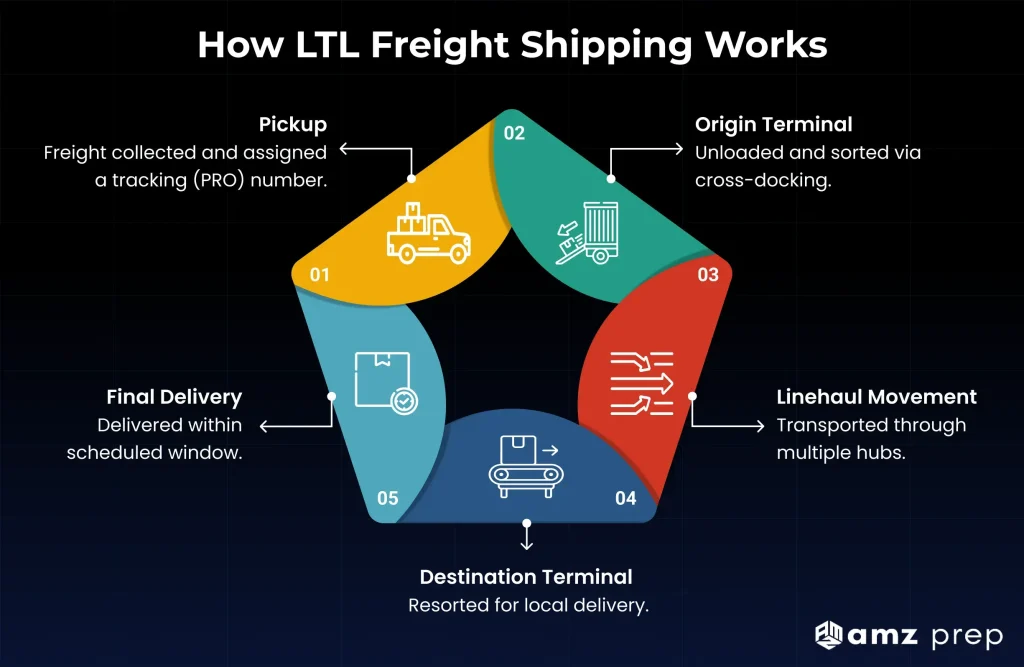
Pickup: A local driver collects your palletized freight and issues a PRO number for tracking. The freight goes to the nearest terminal first, not to the final destination.
Origin terminal: At the terminal, your pallets are sorted by destination region and cross-docked onto an outbound trailer with other shipments heading the same direction.
Linehaul: The trailer moves between regional hubs. Cross-country shipments typically pass through 3 to 5 terminals before reaching the destination region. Each terminal adds 4 to 12 hours to the total window.
Destination terminal: Freight is sorted again and loaded onto a local delivery truck.
Delivery: The driver delivers within the agreed appointment window.
Every terminal transfer adds handling time and damage exposure. For retail or B2B delivery, that tradeoff is acceptable. For Amazon FBA inbound, each extra handling point extends the time between your inventory leaving the warehouse and becoming available for sale.
How Long Does LTL Freight Shipping Take?
LTL freight shipping transit time ranges from 1 to 7 business days depending on distance and service level.
| Route | Standard transit |
|---|---|
| Regional (0 to 500 miles) | 1 to 3 business days |
| Mid-range (501 to 1,000 miles) | 3 to 5 business days |
| Cross-country (1,000+ miles) | 5 to 7 business days |
Expedited LTL reduces transit by 1 to 2 days at a 30 to 50 percent premium over standard rates.
Transit Time vs Receiving Time for Amazon FBA
Transit time is only part of the timeline. For Amazon FBA, the larger delay happens after delivery.
Once an LTL carrier drops freight at an Amazon warehouse, it enters the receiving queue. Standard LTL freight shipments average 15 to 30 days for check-in. During the Q4 peak season, that number extends to 45 days or longer.
This receiving delay creates two direct costs for Amazon sellers:
Placement fees
Amazon charges $0.27 to $1.58 per unit when inventory ships to fewer distribution points than their recommended network. A standard LTL shipment goes to one warehouse.
Splitting inventory across multiple fulfillment centers requires separate bookings or a different inbound model. Brands sending 10,000 units per week at the low end of the placement fee range are paying $2,700 per shipment in fees on top of their freight cost.
Delayed revenue
Inventory in the receiving queue is not available for sale. A brand moving 100 units daily at $30 average order value loses $60,000 in available revenue for every 20 days inventory sits in queue. At $10M to $50M in annual Amazon revenue, this is not a minor variance. It is a recurring operational cost.
How LTL Freight Rates Are Calculated
LTL freight rates are based on six factors. Knowing each one avoids invoice surprises after delivery.
Distance
Longer lanes cost more, though the relationship is not linear. Carriers price based on established routes and lane density, so cross-country rates sometimes land closer to mid-range than expected.
Weight
Carriers bill whichever is higher between actual weight and dimensional weight. Dimensional weight is calculated as length × width × height divided by 139. A light but bulky shipment often bills at dimensional weight.
Freight class
The NMFC system assigns 18 classes from 50 to 500 based on density, stowability, handling requirements, and liability. Lower class numbers mean lower rates. A misclassification of one or two freight classes adds 15 to 30 percent to the invoice. Use AMZ Prep’s freight class calculator to confirm your class before booking.
Accessorial fees
Liftgate delivery, inside delivery, residential delivery, detention, and redelivery are some of the common freight accessorial charges that carriers add on top of the base rate. These turn a $400 quote into a $650 invoice consistently.
Fuel surcharge
Applied weekly as a percentage of the base rate based on the DOE diesel index. This fluctuates and is not included in the initial quote.
Special handling
Hazmat, temperature-controlled, and oversized freight carry flat per-shipment fees.
Estimated LTL cost ranges:
| Pallets | Weight | Estimated cost |
|---|---|---|
| 1 pallet | 300 to 500 lbs | $150 to $300 |
| 2 to 3 pallets | 1,000 to 2,000 lbs | $350 to $600 |
| 4 to 6 pallets | 3,000 to 5,000 lbs | $600 to $1,200 |
Actual rates vary by lane, carrier, freight class, and week. These figures are starting points for planning, not guaranteed quotes.
How Do You Reduce LTL Freight Shipping Costs?
Four levers move LTL cost the most. Confirm freight class before booking, because a one or two class error adds 15 to 30 percent to the invoice. If you’re sourcing transportation through a third party, understanding freight forwarder vs freight broker can also help you choose the right logistics partner and avoid unnecessary costs. Consolidate shipments to lower cost per pallet. Negotiate accessorials out of the base quote. Choose regional carriers on in-zone lanes to skip terminal transfers.
For Amazon FBA, the freight rate is rarely the biggest number. Placement fees are. Distributing inventory across Amazon’s recommended network in one consolidated inbound removes most of that cost. AMZ Prep’s Middle Mile program does exactly that, running inbound receiving in 2 to 4 days.
LTL vs FTL vs Parcel: Which Method Fits Your Volume
Use LTL for 1 to 6 pallets, roughly 150 to 15,000 lbs. Use FTL for 7 or more pallets or full trailer loads. Use parcel for anything under 150 lbs. For comparable mid-volume freight, LTL runs about 60 to 80 percent cheaper than FTL. FTL moves faster and gets handled fewer times.
| Factor | Parcel (SPD) | LTL | FTL |
|---|---|---|---|
| Weight | Under 150 lbs | 150 to 15,000 lbs | 15,000 lbs+ |
| Pallets | None | 1 to 6 | 7+ |
| Cost structure | Per package | Per pallet/weight | Per mile |
| Amazon receiving | 3 to 7 days | 15 to 30 days | 15 to 30 days |
| Placement fee risk | Lower | Higher | Higher |
| Best for | Low-volume replenishment | Mid-volume B2B and retail | High-volume inbound |
For a full decision framework on LTL versus FTL specifically for Amazon sellers, see the LTL vs FTL shipping guide.
Top LTL Freight Carriers in 2026
Carrier selection depends on your lane, freight type, and service priority. National carriers offer broader coverage with more terminal touches. Regional carriers deliver faster within their zones.
National LTL Carriers
FedEx Freight
Largest LTL network in North America. 400+ service centers. Two tiers: Priority (1 to 3 days, guaranteed) and Economy (3 to 6 days). Best for time-critical freight across broad geography.
Old Dominion Freight Line
Highest on-time performance and lowest claims ratio among national carriers. Rates run 10 to 15 percent above competitors. Lower damage rates offset the premium for high-value shipments.
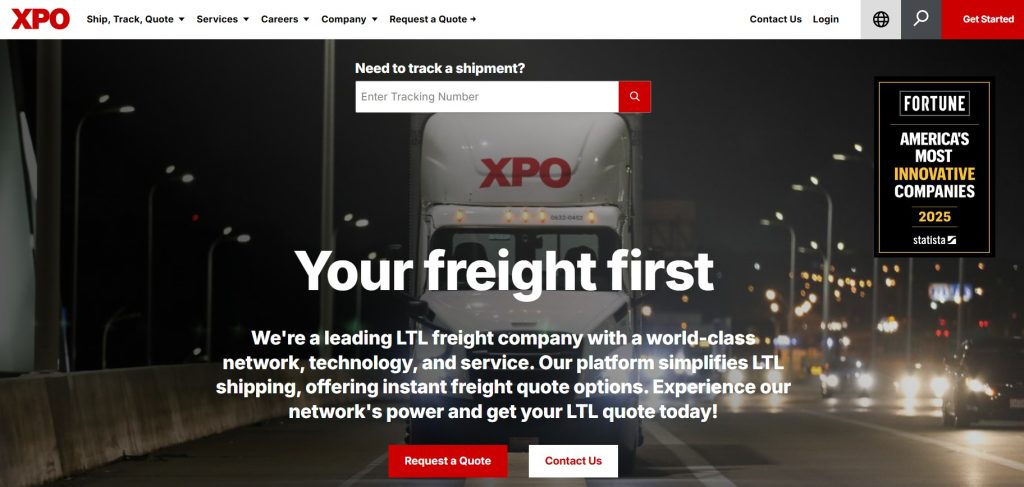
XPO Logistics
290+ terminals with API and EDI integration for automated booking and tracking. Best for high-volume shippers running multi-lane freight programs that need real-time visibility.
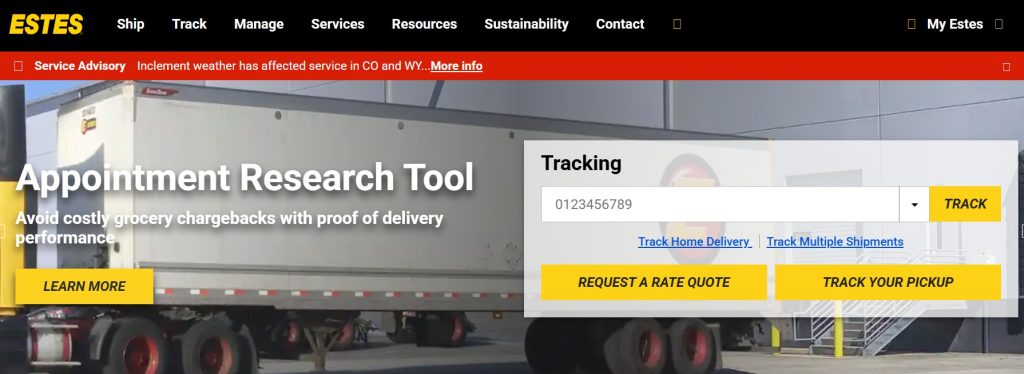
Estes Express Lines
250+ terminals with cross-border service to Canada and Mexico. Handles hazmat, temperature-controlled, and time-definite freight. Best for specialized handling requirements.
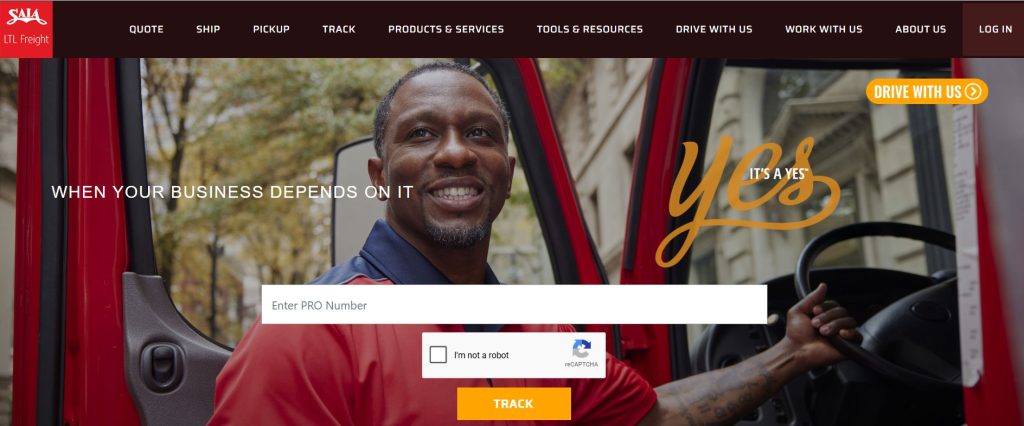
Saia
190+ terminals focused on heavyweight and oversized freight. Best for industrial products and pallets outside standard 48×40 dimensions.
Regional LTL Carriers
Regional carriers run tighter terminal networks within specific geographic zones. Fewer transfers mean faster transit and lower damage rates for in-region freight.
| Carrier | Zone | Strength |
|---|---|---|
| Southeastern Freight Lines | Southeast US | Next-day on most intra-regional lanes |
| Dayton Freight | Midwest | High on-time rate, strong customer service |
| PITT OHIO | Mid-Atlantic and Great Lakes | Multi-modal, LTL plus truckload |
Regional carriers work well for brands with concentrated shipping lanes. Freight outside their coverage zone requires a national carrier or broker.
Where Standard LTL Breaks Down for Amazon FBA Inbound
Standard LTL freight shipping is built for general commercial freight. For Amazon FBA inbound specifically, three structural limitations affect brands at scale.
Single-destination delivery
Standard LTL books to one address. Amazon’s inbound placement system recommends distributing inventory across multiple fulfillment centers. Delivering to one location triggers placement fees of $0.27 to $1.58 per unit on every shipment.
Receiving queue position
Amazon receives and processes shipments based on its own prioritization. Standard LTL shipments average 15 to 30 days before inventory is live. Brands like Huel that moved from standard LTL to AMZ Prep’s inbound program saw check-in times drop from 20+ days to 3 to 5 days.
No prep integration
LTL carriers move freight. They do not label, poly-bag, bundle, or create Amazon shipment plans. A brand using standard LTL for FBA inbound still manages the prep step separately, adding time and coordination overhead.
For a closer look at how these breakdowns play out in practice and how to decide between LTL and FTL for your next inbound shipment, watch the walkthrough below
AMZ Prep’s Middle Mile Program
AMZ Prep’s Middle Mile program addresses the placement fee and receiving delay problems that standard LTL creates for Amazon sellers.
Inventory moves to the nearest AMZ Prep location, where it is prepped, labeled, and routed across five fulfillment centers in a single coordinated movement. Inbound receiving runs 2 to 4 days versus the 15 to 30 days standard LTL averages.
Placement fee exposure drops because inventory is distributed across Amazon’s recommended network from the start. WOOF, a pet brand shipping direct from China, runs a consistent 3 to 5 day inbound cycle through Middle Mile with zero placement fees on FBA inbounds.
For brands doing 300 or more orders per month and shipping 5 or more pallets weekly, the per-unit cost difference between standard LTL and Middle Mile consolidation compounds quickly at scale. The full breakdown of what avoiding Amazon placement fees saves is here.
LTL Freight Shipment Requirements
These are the operational requirements that affect cost and receiving outcomes. Brands managing weekly FBA replenishment at scale typically have these in place, but they are worth confirming before switching carriers or lanes.
Pallet standards
48×40 GMA pallets in good condition. No broken boards, no protruding nails. Damaged pallets are refused at terminals.
Load stability
Heavier items on the bottom. Pallets that shift in transit are the leading cause of LTL damage claims. A stable pallet with proper weight distribution avoids this entirely.
Stretch wrap
Minimum 4 passes at the base and 4 at the top. Wrap the load to itself first, then anchor to the pallet. Wrapping load directly to pallet creates instability on uneven terminal floors.
Labels
One BOL label per pallet on the long side facing outward. Include shipper name, consignee, PRO number, and freight class. Missing labels cause terminal delays that add 24 to 48 hours to transit.
Bill of Lading
A Bill of Lading, or BOL, is the legal document listing commodity, weight, freight class, and piece count. Complete it before the driver arrives, including any hazmat declarations. An inaccurate BOL results in reclassification charges at delivery, not at pickup.
Overhang
Nothing beyond the 48×40 pallet footprint. Overhang triggers overlength surcharges and can result in shipment refusal at terminals.
Freight Class Reference for Common Amazon Product Categories
What Is Freight Class in LTL Shipping?
Freight class is an NMFC rating with 18 classes from 50 to 500. It is set by density, stowability, handling, and liability. Class 50 is the densest and cheapest to ship. Class 500 is the lightest and costs the most. A one or two class error adds 15 to 30 percent to the invoice.
| Product category | Typical freight class | Notes |
|---|---|---|
| Health supplements, palletized | 70 to 92.5 | Density dependent |
| Apparel, boxed and palletized | 100 to 125 | Bulky relative to weight |
| Electronics, crated | 70 to 85 | High value, lower class |
| Beauty products, palletized | 92.5 to 110 | Varies by density |
| Pet products, palletized | 70 to 85 | Dense, favorable class |
| Toys and games | 85 to 100 | Light relative to volume |
| Sporting goods | 92.5 to 125 | Shape and stowability dependent |
Use AMZ Prep’s freight class calculator to confirm before booking. Carriers reclassify at delivery based on actual dimensions and weight, not what was declared at booking.
Conclusion
Standard LTL freight shipping works well for B2B deliveries, retail distribution, and freight that is not time-sensitive. For Amazon FBA inbound, the receiving delays and placement fee exposure it creates become a recurring cost that compounds at volume.
Brands shipping 5 or more pallets weekly to Amazon FBA have better options than booking standard LTL and waiting 30 days for check-in. The math on avoiding Amazon placement fees alone often covers the cost of a consolidated inbound program.
If your current inbound model is producing 15 to 30 day check-in times, the Middle Mile program is worth a direct comparison against what you are paying now.
Frequently Asked Questions
How much does LTL freight shipping cost?
LTL freight shipping costs $150 to $1,200 per shipment for most Amazon sellers. A single pallet runs $150 to $300. Four to six pallets run $600 to $1,200. Freight class, lane, and accessorials move the final number.
What is the weight limit for LTL freight?
LTL freight covers shipments from 150 to 15,000 pounds, or 1 to 6 standard pallets. Anything under 150 pounds ships as parcel. Anything above 15,000 pounds or filling a full trailer moves as FTL.
How long does LTL freight shipping take?
LTL freight transit runs 1 to 7 business days by distance. Regional lanes take 1 to 3 days. Cross-country takes 5 to 7. For Amazon FBA, add 15 to 30 days for warehouse check-in.
Is LTL cheaper than FTL?
LTL is about 60 to 80 percent cheaper than FTL for comparable mid-volume freight. You pay only for the trailer space you use. FTL costs more but moves faster and gets handled fewer times.
What are accessorial fees in LTL freight?
Accessorial fees are charges for services beyond standard dock-to-dock delivery. Common ones include liftgate, residential delivery, inside delivery, detention, and redelivery. They are added on top of the base rate and often raise the final invoice.
What causes LTL reclassification charges?
Reclassification happens when a carrier weighs and measures freight at delivery and finds it differs from the Bill of Lading. A wrong freight class or inaccurate BOL triggers the adjustment. It adds 15 to 30 percent to the invoice.
Do LTL carriers require a delivery appointment?
Most LTL carriers deliver within an agreed appointment window, especially for commercial and Amazon warehouse deliveries. Amazon FBA inbound requires a booked delivery appointment. Missing or late appointments can push the shipment into the next available slot.

Chadwick Collins is an Enterprise Fulfillment Consultant at AMZ Prep, where he partners with high growth ecommerce brands to design and scale Amazon first logistics strategies. He brings extensive experience in freight, supporting brands across domestic and cross border transportation, routing optimization, and cost control.
At AMZ Prep, Chadwick works closely with enterprise clients to improve inventory flow, reduce landed costs, and accelerate delivery performance across North America. His expertise spans FBA, DTC, and B2B fulfillment, with a strong focus on aligning freight strategy with overall supply chain efficiency. He helps brands navigate complex logistics challenges while turning operations into a competitive advantage.






Comments