
August brought several Amazon policy, fee, catalog, and fulfillment updates that US and Canadian sellers need to account for as they prepare for the final months of 2026. Several of these changes affect Q4 profitability, inventory planning, listing management, and fulfillment operations.
For sellers, the timing is important. September is the point when many businesses are finalizing holiday inventory, promotional budgets, inbound plans, and fulfillment capacity. Changes introduced or clarified in August can therefore have a direct impact on how sellers prepare for the October through December peak period.
This guide covers the key Amazon seller updates from August 2026 and explains what they mean for businesses selling in the US and Canada, including changes to fulfillment fees, inventory, product titles, FBA preparation, Seller Fulfilled Prime, Featured Offer eligibility, and Amazon’s seller agreements.
TL;DR
- Amazon’s 2026 holiday peak fulfillment surcharge begins October 15 and runs through January 14, with an average surcharge of approximately $0.32 per unit.
- The peak surcharge is applied on top of Amazon’s existing 3.5% fuel and logistics surcharge for affected fulfillment programs.
- Amazon has moved most US and Canadian product titles toward a 75-character Item Name limit, with a separate 125-character Item Highlights field.
- Amazon no longer provides FBA prep and item-labeling services in the US or Canada, making external prep and quality-control processes more important.
- Seller Fulfilled Prime requirements have become stricter, including a 75% two-day delivery threshold for standard-size products.
- Sellers should use September to review Q4 pricing, inventory, listings, fulfillment capacity, and compliance before peak-season costs and demand increase.
Understanding the August 2026 Amazon Updates
Amazon’s August updates covered several parts of the seller ecosystem, from fulfillment costs and inventory management to catalog requirements and seller policies.
Some changes apply broadly to FBA sellers, while others are more relevant to businesses using Seller Fulfilled Prime, Multi-Channel Fulfillment, advertising, or specific catalog workflows. The operational impact therefore depends on how a business sells and fulfills its products.
The timing also matters. Several of the changes discussed in August become more important as Q4 approaches, particularly the holiday fulfillment surcharge, storage costs, inbound planning, inventory thresholds, and SFP delivery requirements.
For this reason, September is an appropriate time for sellers to review these changes against their current operating plans.
FBA remains the dominant fulfillment model for Amazon sellers. For more context, see our breakdown of the percentage of Amazon sellers using FBA and how FBA compares with FBM and 3PL fulfillment.
What Were the Biggest Amazon Seller Changes in August 2026?
The major updates can be grouped into six areas: fees and profitability, inventory, listings and catalog management, contracts and compliance, fulfillment programs, and advertising.
| Area | August 2026 Update | Why It Matters |
|---|---|---|
| Q4 fulfillment | Average $0.32/unit holiday peak surcharge | Higher fulfillment costs during Q4 |
| Fuel and logistics | Existing 3.5% surcharge continues | Additional pressure on margins |
| Product titles | 75-character Item Name limit | Sellers may need to restructure listing content |
| Item Highlights | 125-character field | Additional space for product information |
| FBA preparation | Prep and labeling services ended in US and Canada | More responsibility for sellers and 3PLs |
| Low inventory | Fee tied to less than 28 days of supply | Replenishment planning becomes more important |
| BSA | Restrictions on transfers and pledging rights | Financing and account structures may require review |
| Featured Offer | Eligibility gate being removed | More offers may compete for placement |
| SFP | Delivery thresholds increased | More fulfillment coverage may be required |
| Advertising | FTC and 22 states filed lawsuit | Increased scrutiny around advertising auctions |
The important point is not that every change affects every seller. Instead, businesses should identify which changes apply to their fulfillment model and product portfolio.
Amazon Q4 Fulfillment Fees: What Changed?
Holiday Peak Fulfillment Surcharge
One of the most important August updates for Q4 planning is Amazon’s 2026 holiday peak fulfillment surcharge.
The surcharge applies from October 15, 2026 through January 14, 2027. The average surcharge is approximately $0.32 per unit, although the actual amount varies by size and weight band.
The surcharge is based on the ship date rather than the order date. It applies to FBA, Remote Fulfillment with FBA, Multi-Channel Fulfillment, and Buy with Prime, and is added on top of the existing 3.5% fuel and logistics surcharge.
For sellers, the practical issue is margin planning. A SKU that is profitable under normal fulfillment costs may have a different contribution margin during the holiday period.
Businesses should therefore update Q4 SKU economics before finalizing pricing, promotional discounts, or advertising budgets.
Holiday Deal Fees
Amazon confirmed that 2026 holiday promotional fees for Best Deals, Lightning Deals, and Prime Exclusive Discounts will remain at prior-year levels for Prime Big Deal Days and the Black Friday/Cyber Monday period.
While this provides more predictability around promotional fees, sellers should still calculate the full cost of running a promotion.
Fulfillment, advertising, storage, returns, and inventory costs can all affect whether a promotion remains profitable.
Amazon Storage Fees and Inventory Costs

Storage costs become particularly relevant as sellers build inventory ahead of Q4.
For US FBA inventory, the 2026 monthly storage rates listed in the August guidance are:
| Product Type | January–September | October–December |
|---|---|---|
| Standard-size | $0.78/cu. ft. | $2.40/cu. ft. |
| Oversize | $0.56/cu. ft. | $1.40/cu. ft. |
Amazon also applies a storage utilization surcharge when specific account age, volume, and utilization conditions are met. The surcharge increases at higher utilization levels.
For sellers planning September and October inbound shipments, the question is not simply how much inventory is needed.
Businesses should also consider how quickly that inventory is expected to sell and whether holding additional units creates unnecessary storage exposure.
Low-Inventory-Level Fee: The 28-Day Threshold
Amazon’s Low-Inventory-Level Fee continues to be an important consideration for sellers managing fast-moving products.
The fee can apply when both the trailing 30-day and 90-day historical days-of-supply measures fall below 28 days at the FNSKU level.
The 2026 rates cited in the August guidance range from approximately $0.32 to $1.11 per unit for standard-size products and can reach approximately $2.09 for bulky products.
This makes September inventory planning particularly important.
Sellers should identify high-volume SKUs that regularly approach the 28-day threshold and review replenishment schedules before Q4 demand increases.
Inbound Placement Fees
Amazon’s inbound placement fees continue to vary depending on how inventory is distributed across fulfillment center locations.
| Placement Approach | Indicative Fee |
|---|---|
| Optimized, 5+ locations | $0.00 |
| Partial split, 3–4 locations | $0.27–$1.10/unit |
| Minimal split, 1–2 locations | $1.50–$6.50/unit |
The actual cost varies by product size and placement configuration. Sellers should compare placement fees with inbound freight costs and the potential operational benefits of distributing inventory across Amazon’s network.
For Q4, this comparison becomes more important because inventory positioning can influence both transportation costs and delivery performance.
Amazon’s evolving inbound network also makes it important for sellers to understand Amazon RDCs and FBA inbound facilities, particularly when planning Q4 inventory movements.
Amazon Returns Processing Fees
Returns can also have a meaningful impact on SKU profitability.
Amazon’s returns processing fee applies to ASINs whose return rates exceed category-specific thresholds. Apparel and shoes are treated differently, with the fee applying to every return.
The August guidance cites examples ranging from approximately $1.78–$2.21 for small standard products to $6.74 or more for bulky products.
Businesses should therefore evaluate return rates alongside product margins.
For high-return ASINs, sellers should consider the combined effect of return processing fees, refund administration, lost outbound revenue, and potential inventory losses.
Amazon FBA Prep Services: What Sellers Need to Know

Amazon’s FBA prep and item-labeling services ended in the US on January 1, 2026 and in Canada on July 1, 2026.
Non-compliant shipments can result in unplanned prep fees and potential inbound defect fees. The August guidance cites unplanned prep fees of approximately $0.40–$1.80 per unit.
This means sellers need to have their own preparation processes in place before inventory reaches Amazon.
For businesses working with manufacturers, prep centers, or 3PL providers, September is a useful time to review labeling, carton preparation, inspection, and quality-control procedures before Q4 volumes increase.
Amazon Listing Updates: 75-Character Titles
Amazon’s product title requirements were another major catalog development during July and August.
The Item Name field is generally limited to 75 characters, including spaces, across most categories in the US and Canada. Amazon also provides a 125-character Item Highlights field. Both fields are searchable.
Amazon began displaying Item Highlights below the title on desktop and mobile starting August 10.
Existing over-length titles can remain active while Amazon rolls out AI recommendations. Brand-registered sellers receive a 14-day review window before AI edits apply.
What Should Sellers Do About the 75-Character Limit?
Businesses should review listings with Item Names longer than 75 characters and determine which information should remain in the title.
Secondary keywords, product benefits, and supporting information can be moved into Item Highlights where appropriate.
For individual listings, Amazon provides the following workflow:
Manage All Inventory → Edit → View Enhancements
For bulk changes, sellers can use the category listing report and update the relevant Title and Item Highlights fields before re-uploading.
September is a practical time to complete this catalog review before Q4 traffic increases.
AI-Generated People in Amazon Images
Amazon also introduced a metadata requirement for product images and A+ Content videos featuring photorealistic AI-generated people.
Qualifying assets must include the keyword contains-synthetic-performer in the XMP dc:subject field before upload. The requirement became effective July 27, 2026, with enforcement guidance continuing into August.
Real people, non-photorealistic figures, and images without people are exempt according to the source.
Brands using AI-generated lifestyle imagery should therefore add an asset review step to their content workflow.
Amazon Business Solutions Agreement Changes
Amazon’s updated Business Solutions Agreement introduced restrictions effective August 24, 2026.
The updated BSA prohibits transferring rights or obligations under the agreement and pledging those rights, including future Amazon disbursements, as collateral.
The change may be relevant to businesses involved in account-sale structures or financing arrangements based on Amazon receivables.
Businesses using these structures should review existing agreements and determine whether updates are required.
Featured Offer Eligibility Changes
Amazon began removing the separate seller-eligibility gate for the Featured Offer, commonly known as the Buy Box, in July 2026.
The rollout is expected to continue through the end of 2026. Under the new model, offers can be considered while Amazon continues evaluating factors such as competitive pricing, delivery speed, seller performance, fulfillment reliability, and customer experience.
The change may increase competition for Featured Offer placement.
Sellers should therefore monitor Featured Offer percentage alongside pricing, delivery promises, Order Defect Rate, late shipment performance, and conversion.
Winning the Featured Offer should also be evaluated against profitability. Lowering prices simply to improve placement may not make sense if the resulting margin is unsustainable.
Seller Fulfilled Prime Requirements
Amazon increased several Seller Fulfilled Prime delivery-speed thresholds in 2026.
For standard-size products, the requirements include:
- 1-day delivery: 40%
- 2-day delivery: 75%
- 5-day delivery: 90%
For oversize products:
- 1-day delivery: 15%
- 5-day delivery: 80%
For extra-large products:
- 2-day delivery: 25%
- 5-day delivery: 60%
SFP also requires weekend fulfillment and approximately 93.5% on-time performance, with weekly performance reviews.
The increase in the standard-size two-day requirement from 70% to 75% makes fulfillment coverage particularly important heading into Q4.
Businesses using SFP should review shipping templates, warehouse coverage, carrier performance, and weekend staffing before holiday order volumes increase.
Sellers may also need to evaluate overnight shipping options when standard carrier services cannot consistently meet tighter delivery promises.
Q4 Amazon Inbound Deadlines
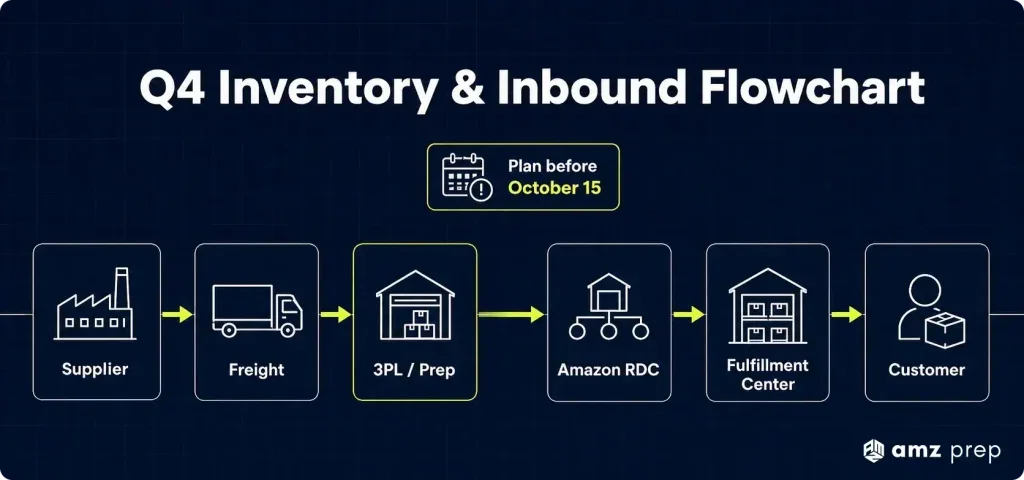
Amazon has published Q4 2026 inbound cutoffs for Prime Big Deal Days and Black Friday/Cyber Monday.
Because the holiday peak fulfillment surcharge begins based on ship date on October 15, late inbound shipments can affect both inventory availability and the timing of peak-season costs.
This makes September an important planning window.
Businesses should coordinate supplier production, freight, prep, appointments, and Amazon receiving timelines rather than waiting until October to move Q4 inventory.
Amazon Advertising: FTC and State Lawsuit
On August 31, 2026, the Federal Trade Commission and 22 states filed a lawsuit against Amazon concerning its advertising auctions.
The complaint alleges that Amazon used an undisclosed “soft reserve price” in advertising auctions since 2019 and claims approximately $20 billion in additional charges across approximately 1.2 million advertisers.
There is no immediate advertising-setting change identified in the August update.
However, advertisers running Sponsored Products or Sponsored Brands at scale may want to monitor CPC, ACoS, bid changes, and auction-level reporting.
The longer-term implications will depend on how the legal proceedings develop.
Which Amazon Updates Should Sellers Prioritize?
Not every August update will have the same impact on every business.
Rather than responding to every policy change equally, sellers should prioritize the areas that align with their fulfillment model, product characteristics, sales volume, and Q4 plans.
| Seller Type | Priority Areas |
|---|---|
| FBA seller | Peak fees, storage, inventory, prep, inbound placement |
| MCF seller | Peak fulfillment costs, inventory, fulfillment economics |
| SFP seller | Delivery thresholds, weekend fulfillment, carrier coverage |
| High-return seller | Return thresholds and SKU profitability |
| Brand-registered seller | Titles, Item Highlights, AI recommendations |
| AI-generated content user | Synthetic-person metadata requirements |
| Seller using Amazon-backed financing | BSA restrictions |
| High-spend advertiser | Advertising auction developments |
The right priority depends on where the greatest financial or operational exposure exists.
For an FBA seller preparing for Black Friday, for example, peak fulfillment fees and inventory planning may require immediate attention. An SFP seller may instead need to focus on delivery coverage and weekend capacity.
What Should Amazon Sellers Do in September 2026?
Review Q4 SKU Economics
Recalculate contribution margins using the applicable holiday fulfillment surcharge and existing fuel and logistics costs.
Promotional and advertising budgets should be evaluated against the updated fulfillment economics rather than historical Q4 performance alone.
Review Inventory Levels
Check key SKUs against the 28-day Low-Inventory-Level Fee threshold and review expected Q4 demand.
At the same time, avoid building more inventory than the business can reasonably sell without creating unnecessary storage exposure.
Audit Product Listings
Review titles exceeding 75 characters and determine which information should move into Item Highlights.
Brand-registered sellers should also monitor AI recommendations and review proposed changes within the applicable review window.
Review FBA Preparation
Confirm that suppliers, prep centers, and 3PLs are following current FBA preparation and labeling requirements.
This is particularly important for businesses expecting higher inbound volumes during Q4.
Validate SFP Capacity
SFP sellers should check delivery templates against the updated thresholds and confirm that weekend fulfillment capacity is sufficient.
Carrier performance should also be reviewed before peak volumes begin.
Review Returns
Identify ASINs with high return rates and calculate the potential impact of return processing fees on contribution margin.
Where appropriate, businesses can investigate whether product information, packaging, product quality, or listing content is contributing to elevated returns.
Monitor Advertising
Review CPC and ACoS trends against bid changes and campaign adjustments.
Keeping consistent performance records can help businesses identify meaningful changes in advertising economics over time.
September 2026 Amazon Seller Checklist
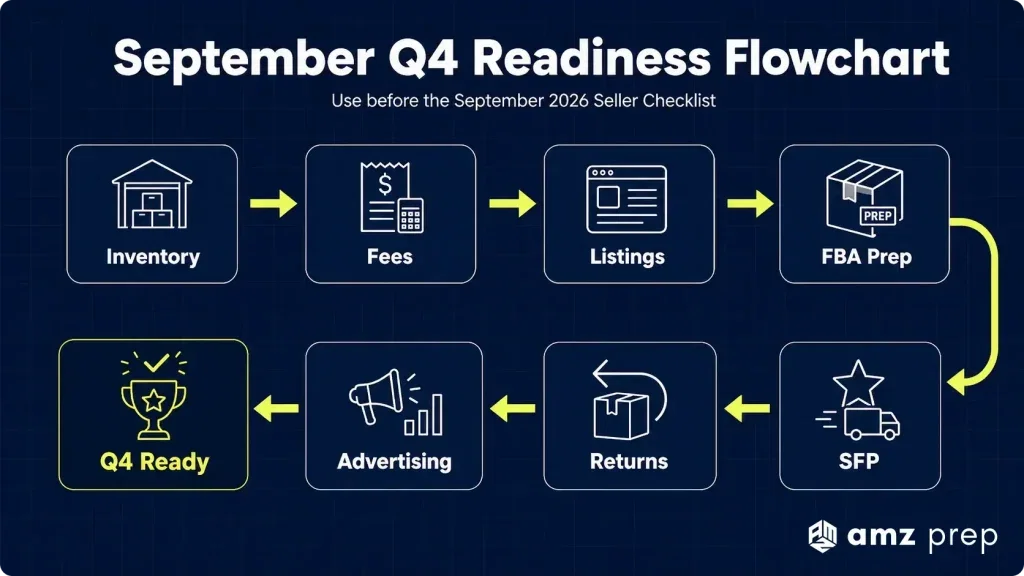
Before Q4 begins, sellers should:
- Recalculate Q4 SKU margins using applicable peak fulfillment fees.
- Include the 3.5% fuel and logistics surcharge where applicable.
- Review inventory against the 28-day Low-Inventory-Level Fee threshold.
- Evaluate storage utilization and aged inventory.
- Audit Item Names exceeding 75 characters.
- Populate Item Highlights where appropriate.
- Review AI-generated title recommendations.
- Audit AI-generated lifestyle and A+ assets for synthetic-person metadata requirements.
- Confirm FBA prep and labeling procedures with suppliers and 3PLs.
- Review BSA-related financing and account-transfer agreements.
- Check SFP delivery coverage against updated thresholds.
- Confirm weekend fulfillment capacity.
- Review Q4 inbound deadlines.
- Analyze return rates and potential return processing fees.
- Monitor advertising performance and maintain relevant reporting.
These changes are also easier to understand when sellers consider the differences between Amazon 1P vs. 3P selling models, particularly how Amazon works with first-party and third-party sellers.
Conclusion
August 2026 brought several Amazon changes that sellers should account for as they enter the final planning period before Q4. The most immediate areas include holiday fulfillment costs, inventory levels, listing requirements, FBA preparation, and Seller Fulfilled Prime performance.
There is no single update that affects every Amazon seller in the same way. The financial and operational impact depends on fulfillment method, product size, inventory levels, return rates, sales volume, and the programs a business uses.
For sellers, September is the time to turn these updates into operational decisions. Reviewing Q4 margins, inventory, catalog content, preparation processes, fulfillment capacity, and promotional plans now can help identify potential issues before peak-season demand and costs increase.
Frequently Asked Questions
What were the biggest Amazon seller updates in August 2026?
The major August updates covered Q4 fulfillment fees, inventory thresholds, listing requirements, FBA preparation, the Business Solutions Agreement, Featured Offer eligibility, Seller Fulfilled Prime, and advertising.
When does Amazon’s 2026 holiday fulfillment surcharge begin?
The holiday peak fulfillment surcharge begins October 15, 2026 and runs through January 14, 2027. The average surcharge is approximately $0.32 per unit and is based on ship date.
What is Amazon’s new product title limit?
The Item Name field is generally limited to 75 characters, including spaces, across most categories in the US and Canada.
What is Amazon Item Highlights?
Item Highlights is a separate 125-character field that provides additional space for product information. Amazon began displaying the field below the product title on desktop and mobile starting August 10, 2026.
Does Amazon still provide FBA prep services?
No. Amazon’s FBA prep and item-labeling services ended in the US on January 1, 2026 and in Canada on July 1, 2026.
What is the Low-Inventory-Level Fee threshold?
The fee can apply when both the trailing 30-day and 90-day historical days-of-supply measures are below 28 days at the FNSKU level.
Did Amazon change Seller Fulfilled Prime requirements?
Yes. For standard-size products, the two-day delivery threshold increased to 75%. SFP also requires weekend fulfillment and approximately 93.5% on-time performance.
Did Amazon change Featured Offer eligibility?
Amazon began removing the separate seller-eligibility gate for the Featured Offer in July 2026. The rollout is expected to continue through the end of 2026.
What changed in Amazon’s Business Solutions Agreement?
Effective August 24, 2026, Amazon’s updated BSA prohibits transferring rights or obligations under the agreement and pledging those rights, including future Amazon disbursements, as collateral.
Did Amazon change its advertising system in August?
The August update did not identify an immediate change to advertising settings. However, the FTC and 22 states filed a lawsuit against Amazon on August 31 concerning alleged practices involving advertising auction pricing.

Arishekar N is a Vice President (VP) of Marketing at AMZ Prep, specializing in ecommerce fulfillment and Amazon logistics strategies with a proven track record of driving growth for e-commerce businesses. He is a strategic leader with extensive expertise in marketing, e-commerce operations, SEO & advertising, and branding.
Stay updated on his latest insights by following him







Comments