
Amazon Employee Count by Year (2010-2025)
The total number of Amazon employees has grown from 33,700 in 2010 to 1.58 million by the end of 2025. The Amazon headcount doubled between 2019 and 2021 during the pandemic hiring surge. Since then, the Amazon workforce size has stabilized. The company reduced headcount in 2022 and 2023 before resuming modest growth.

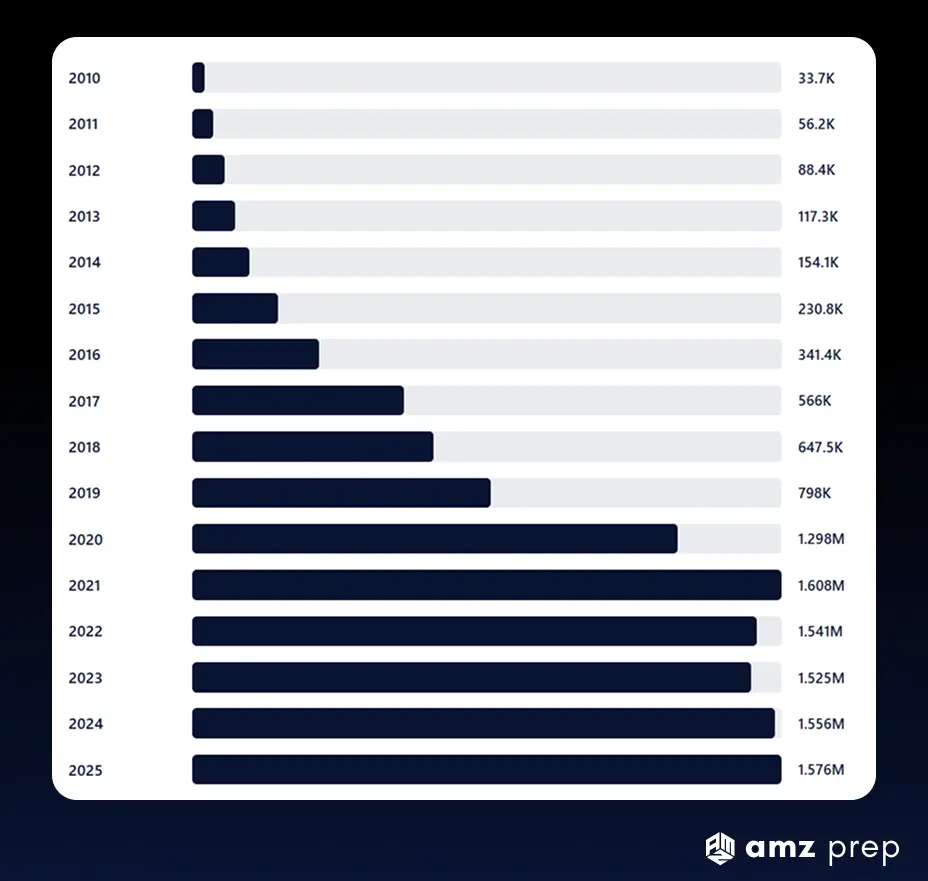
| Year | Employee Count | YoY Change % | Key Insight |
|---|---|---|---|
| 2010 | 33,700 | N/A | Pre-cloud era operations only |
| 2015 | 230,800 | 0.23 | AWS business launches |
| 2019 | 798,000 | 0.05 | Pre-pandemic baseline |
| 2020 | 1,298,000 | 0.627 | COVID-19 demand surge |
| 2021 | 1,608,000 | 0.239 | Peak workforce (post-peak hiring) |
| 2022 | 1,541,000 | -4.20% | Corporate layoffs begin (18K cut) |
| 2023 | 1,525,000 | -1.00% | Continued restructuring (9K+ cut) |
| 2024 | 1,556,000 | 0.02 | Stabilization after cuts |
| 2025 | 1,576,000 | 0.013 | Modest growth resumes |
How Many Amazon Employees Work in Each Department?
The Amazon corporate employee count reaches roughly 350,000 workers across technology, management, and administrative roles. Operations and fulfillment roles account for 65% of all employees, or about 1,025,000 people. How many corporate employees does Amazon have? Approximately 22% of the total workforce holds corporate positions. The rest work in Whole Foods, physical retail, and logistics support.
| Department | Estimated Employees | Share of Workforce | Key Roles |
|---|---|---|---|
| Operations & Fulfillment | 1,025,000 | 65% | Warehouse workers, pickers, packers, logistics coordinators |
| Corporate & Technology | 350,000 | 22% | Software engineers, product managers, finance, HR, leadership |
| Whole Foods & Retail | 100,000 | 6% | Supermarket associates and store managers |
| AWS (Included Above) | 100,000+ | Included in Corporate Segment | Cloud engineers and data center specialists |
| Delivery & Logistics | 100,000 | 7% | Delivery drivers, route planners, last-mile operators |
Amazon Employees by Country
How many employees does Amazon have in the US? Approximately 1,100,000 workers are based in the United States, representing 70% of the total Amazon employee count. How many employees does Amazon have worldwide? The remaining 476,000 employees work across 25+ countries. India ranks second with 100,000 employees (6.4%), followed by the United Kingdom and Germany.
| Country | Employees | % of Total | Notes |
|---|---|---|---|
| United States | 1,100,000 | 70% | Headquarters: Seattle, WA. Largest concentration of facilities. |
| India | 100,000 | 6.40% | Fast-growing tech hub for corporate roles and customer service. |
| United Kingdom | 75,000 | 4.80% | European headquarters, fulfillment, and corporate offices. |
| Germany | 60,000 | 3.80% | Major EU fulfillment operations. Part of Amazon.de platform. |
| Canada | 25,000+ | 1.60% | Note: AMZ Prep operates warehouses and prep centers across Canada. |
| Rest of World | 216,000 | 13.40% | Includes Japan, Mexico, Brazil, France, Spain, and 20+ other |
Amazon Fulfillment Centers and Warehouse Count
Amazon operates the largest logistics network in the world. The company maintains approximately 1,200 facilities worldwide, including 350 fulfillment centers. The United States alone hosts 600 facilities, with 150 specifically designated as fulfillment centers. California, Texas, and New Jersey lead in facility concentration.
| Infrastructure Metric | Count | Details |
|---|---|---|
| Total Facilities Worldwide | 1,200+ | Fulfillment centers, sort centers, delivery stations, and regional hubs |
| Fulfillment Centers | 350 | Large-scale warehouses where products are stored, packed, and shipped |
| US Facilities | 600+ | More than half of Amazon’s global network is located in the United States |
| Robots Deployed | 1,000,000+ | Autonomous units handling roughly 75% of delivery volume |
Top US States by Fulfillment Center Count
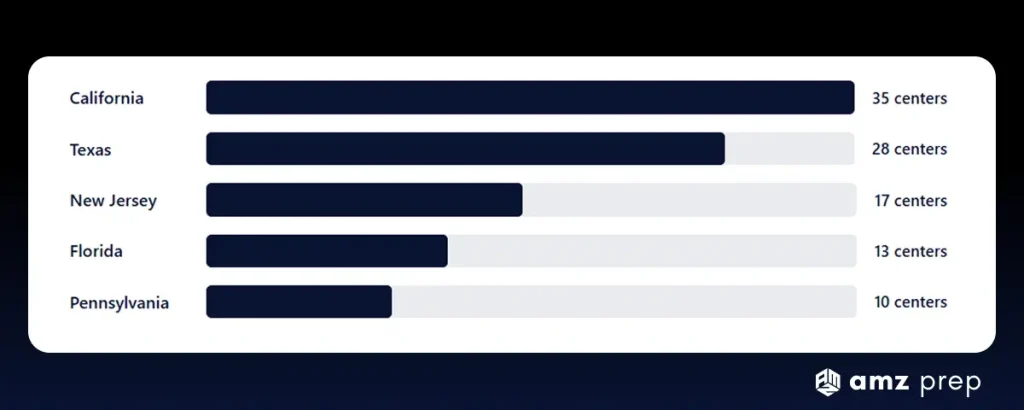
Amazon concentrates fulfillment operations in key logistics hubs. California leads with 35 fulfillment centers, followed by Texas with 28 and New Jersey with 17. These states offer strategic advantages including access to major population centers and transportation networks.
Future Expansion Plans
Amazon announced a $15 billion expansion plan to open 80 new facilities in 2025 and 2026. The company targets underserved regions to improve delivery speed and reduce shipping costs. This expansion will create approximately 100,000 new jobs across the network.
Sellers relying on FBA don’t need to build their own warehouse infrastructure. Third-party logistics providers like AMZ Prep offer FBA prep services to handle packaging, labeling, and inventory management.
Amazon Revenue Per Employee
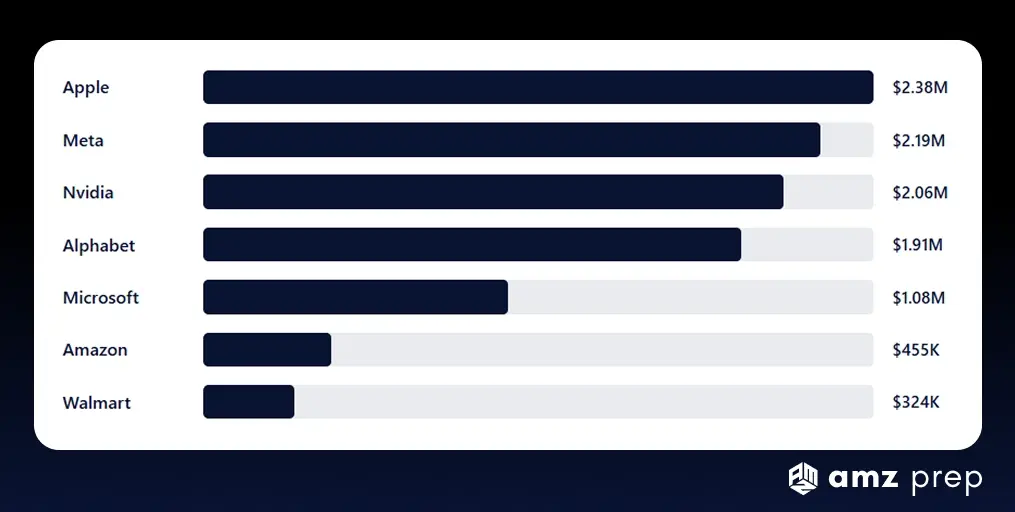
Amazon generates approximately $455,000 in revenue per employee annually. This is significantly lower than comparable tech companies like Apple or Meta. The difference reflects Amazon’s capital-intensive logistics business model. Retailers like Walmart generate even less revenue per employee at $324,000, confirming that warehouse-based operations produce lower per-employee revenue.
Why is Amazon’s revenue per employee lower? The company operates a highly labor-intensive fulfillment network requiring hundreds of thousands of warehouse workers. These roles are essential but generate less individual revenue than software engineers or data scientists. Amazon’s profit margins remain strong despite lower per-employee revenue because the company operates at scale. A 1% margin on trillions in revenue produces substantial profits.
Sellers can improve profitability by outsourcing fulfillment operations. Working with eCommerce order fulfillment specialists eliminates the need to hire your own warehouse team. This allows you to scale without the overhead of direct labor costs.
How Much Do Amazon Employees Make?
How much do Amazon warehouse employees make? Warehouse workers earn $18 to $24 per hour, with total compensation averaging $29 per hour including benefits. Corporate employees earn significantly more. Senior engineers command $350,000 to $500,000+ annually including equity and bonuses. The gap between warehouse and corporate pay runs 4 to 5x on average.
| Position | Hourly / Annual | Total Compensation | Details |
|---|---|---|---|
| Warehouse Associate | $18-$24/hr | $37K-$50K/yr | Entry-level picker, packer, or stower. Includes benefits and shift differentials. |
| Delivery Driver | $19-$25/hr | $40K-$52K/yr | Amazon Flex and DSP drivers. Vehicle provided or reimbursement included. |
| L4 SDE (Entry Level) | N/A | $120K-$160K | Base salary, sign-on bonus, and stock options (4-year vest). |
| L5 SDE (Mid-Level) | N/A | $180K-$250K | Base salary $130K-$160K plus bonus and equity. |
| L6 Senior SDE | N/A | $350K-$450K | Base $180K-$220K plus substantial bonus and equity packages. |
| Principal Engineer (L7+) | N/A | $500K+ | Base $250K-$350K plus equity representing millions over time. |
Amazon’s compensation strategy emphasizes equity over base salary for corporate roles. This aligns employee interests with long-term company success. The company’s stock performance directly impacts total compensation for technical and management staff.
Is Amazon Laying Off Employees? Restructuring Timeline (2022-2026)
Yes, Amazon is laying off employees in corporate roles. The company eliminated roughly 30,000 corporate positions between October 2025 and May 2026. Why is Amazon laying off 30,000 employees? CEO Andy Jassy cited AI-driven efficiency gains, bureaucracy reduction, and flattening management layers. Warehouse and fulfillment operations remained largely unaffected.
- November 2022
CEO Andy Jassy announces 18,000 corporate layoffs (10% of corporate headcount). Focus on reducing management roles and slowing hiring.
| Date | Workforce Update | Details |
|---|---|---|
| November 2022 | 18,000 Corporate Layoffs | CEO Andy Jassy announced major job cuts focused on reducing management roles and slowing hiring |
| January 2023 | 9,000 Additional Job Cuts | Second round of layoffs targeting AWS and international operations |
| October 2025 | 14,000 Corporate Positions Eliminated | Amazon shifted toward AI-driven operations and reduced middle management |
| January 2026 | 16,000 Additional Role Eliminations | Corporate role reductions continued through Q1, with voluntary severance offered |
| Total 2025–2026 | Approximately 30,000 Positions Eliminated | Combined workforce reductions across two fiscal years |
Amazon’s restructuring reflects broader industry trends. Automation, artificial intelligence, and efficiency-focused leadership drove the reductions. The company eliminated redundant roles, consolidated duplicate functions, and accelerated the shift toward autonomous systems. Warehouse operations remained stable, but the company deployed 1 million robots to reduce labor demands in fulfillment centers.
Amazon Hiring Plans for 2026 and Beyond
Despite recent layoffs, Amazon plans significant hiring in 2026. The company announced plans to hire 11,000 software engineers and interns specifically. This represents Amazon’s ongoing commitment to automation and AI development. Warehouse hiring will continue for permanent and seasonal roles, but growth slows as automation increases.
| Metric | 2026 Estimate | Details |
|---|---|---|
| Engineering Hires (2026) | 11,000 | Software engineers, ML engineers, and recent graduates hired through internship programs |
| Capital Expenditure | $200B+ | Investment focused on AI infrastructure, robotics, and fulfillment automation |
| Automation Target | 75% | Robots expected to handle roughly 75% of delivery volume by 2026 |
| Job Replacement Risk | 600,000 | Analysts estimate automation could replace up to 600K warehouse jobs by 2033 |
Amazon’s hiring strategy prioritizes high-skill technical roles over warehouse positions. The company invests heavily in robotics, machine learning, and autonomous systems. These investments reduce the need for manual warehouse labor over time. Warehouse hiring focuses on temporary and seasonal positions rather than permanent roles.
Sellers can future-proof their operations by partnering with logistics providers. Using FBA prep services eliminates exposure to warehouse labor volatility. Third-party prep centers handle scaling challenges without the overhead of direct hiring.
What Amazon’s Workforce Means for eCommerce Sellers
Amazon’s 1.58 million employees support operations for over 5 million marketplace sellers. The company’s massive logistics network enables sellers to reach customers in 2-3 days or less. This infrastructure would cost individual sellers billions to replicate independently.
Key Takeaways for Sellers
Scalability without headcount: Sellers using FBA don’t hire warehouse staff directly. Amazon’s fulfillment network handles inventory storage, picking, packing, and shipping. This allows sellers to scale operations without proportional increases in headcount.
Automation benefits: As Amazon deploys 1 million+ robots, fulfillment costs decline. These savings eventually reduce FBA fees, benefiting sellers. Automation also improves fulfillment speed and accuracy.
Competitive advantage: Amazon’s logistics infrastructure gives marketplace sellers a massive competitive advantage. Sellers can offer Prime-eligible delivery without their own warehouses. This converts browsers into buyers more effectively than non-Prime options.
Labor cost insulation: Sellers are insulated from warehouse labor inflation and unionization pressures. Amazon manages labor costs and negotiations directly. Sellers benefit from these economies of scale.
Using Third-Party Prep Centers
Sellers not yet using FBA can improve profitability through third-party prep services. Find a prep center near you to handle product labeling, packaging, and warehouse logistics. This hybrid approach offers flexibility while reducing fulfillment costs.
Use AMZ Prep’s FBA profitability calculator to model the financial impact of outsourcing fulfillment. The calculator shows how FBA fees compare against in-house or prep center costs.
Frequently Asked Questions
How many people work for Amazon in 2026?
Amazon employs 1,576,000 people as of December 2025, its latest reported figure. The company plans to hire 11,000 engineers in 2026 while reducing 30,000 corporate roles. Net headcount will likely remain stable or decline slightly in 2026.
How many Amazon warehouses exist worldwide?
Amazon operates approximately 1,200 facilities globally. About 350 of these are large-scale fulfillment centers where products are stored and shipped. The remaining facilities include sort centers, delivery stations, and regional hubs. The US alone hosts 600 facilities.
What is the average Amazon warehouse salary?
Amazon warehouse workers earn $18 to $24 per hour, with total compensation averaging over $29 per hour including benefits, shift differentials, and sign-on bonuses. Annual salary ranges from $37,000 to $50,000 for full-time associates.
How many robots does Amazon use?
Amazon deploys over 1 million robots across its warehouse network. These autonomous units handle picking, packing, and logistics tasks. Robots handle approximately 75% of Amazon’s global delivery volume as of 2026.
Is Amazon still hiring in 2026?
Yes. Amazon plans to hire 11,000 software engineers and interns specifically in 2026. Warehouse hiring continues for seasonal and permanent roles. However, net hiring remains modest due to simultaneous corporate layoffs totaling 30,000 roles in 2025 and 2026.
What percentage of Amazon employees work in warehouses?
Approximately 65% of Amazon’s workforce (about 1,025,000 people) work in operations and fulfillment roles. This includes warehouse associates, pickers, packers, and logistics coordinators. The remaining 35% work in corporate, technology, retail, and delivery roles.
Did Amazon lay off employees in 2025?
Yes. Amazon eliminated 14,000 corporate positions in October 2025 and confirmed 16,000 additional corporate role eliminations in January 2026. Total corporate job cuts in 2025-2026 reached approximately 30,000. Warehouse operations were largely unaffected.
How many countries does Amazon operate in?
Amazon operates in over 25 countries. The United States accounts for 70% of employees (1.1 million). India has 100,000 employees, the UK has 75,000, and Germany has 60,000. The company maintains fulfillment centers across North America, Europe, Asia, and Australia.
Does Amazon automation mean fewer jobs in the future?
Yes, long-term automation will reduce warehouse jobs. Analysts estimate that Amazon’s robotics expansion could eliminate 600,000 warehouse positions by 2033. However, Amazon plans to hire 11,000 software engineers and technical roles in 2026, offsetting some warehouse job losses with higher-skill positions.
How much does Amazon spend on capex annually?
Amazon plans $200 billion in capital expenditure for 2026. This focuses on AI infrastructure, robotics, and fulfillment automation. The company allocated $15 billion specifically to open 80 new facilities in 2025 and 2026.
Do Amazon employees get free Prime?
Amazon does not offer free Prime memberships to all employees. However, employees receive a discounted Prime membership. Warehouse associates and corporate staff both qualify for reduced annual Prime pricing as part of their benefits package.
Do Amazon employees get a discount?
Yes. Amazon employees receive a 10% discount on Amazon.com purchases, capped at $100 in savings per year. Warehouse and corporate employees both qualify. Some roles also receive discounts on stock purchases through the employee stock purchase plan (ESPP).
How many people does Amazon employ in the US?
Amazon employs approximately 1,100,000 people in the United States. This represents about 70% of the company’s global workforce. US employees work across 600+ facilities including fulfillment centers, sort centers, and delivery stations.
How many employees work at Amazon warehouses?
Approximately 1,025,000 Amazon employees work in operations and fulfillment roles. This includes warehouse associates, pickers, packers, drivers, and logistics coordinators across 1,200+ facilities worldwide.
Why is Amazon laying off 30,000 employees?
Amazon eliminated 30,000 corporate roles between October 2025 and May 2026. CEO Andy Jassy cited AI efficiency gains and reducing management layers as the primary reasons. The company plans to replace many administrative roles with AI-powered automation tools.

Arishekar N is a Vice President (VP) of Marketing at AMZ Prep, specializing in ecommerce fulfillment and Amazon logistics strategies with a proven track record of driving growth for e-commerce businesses. He is a strategic leader with extensive expertise in marketing, e-commerce operations, SEO & advertising, and branding.
Stay updated on his latest insights by following him
















Comments