
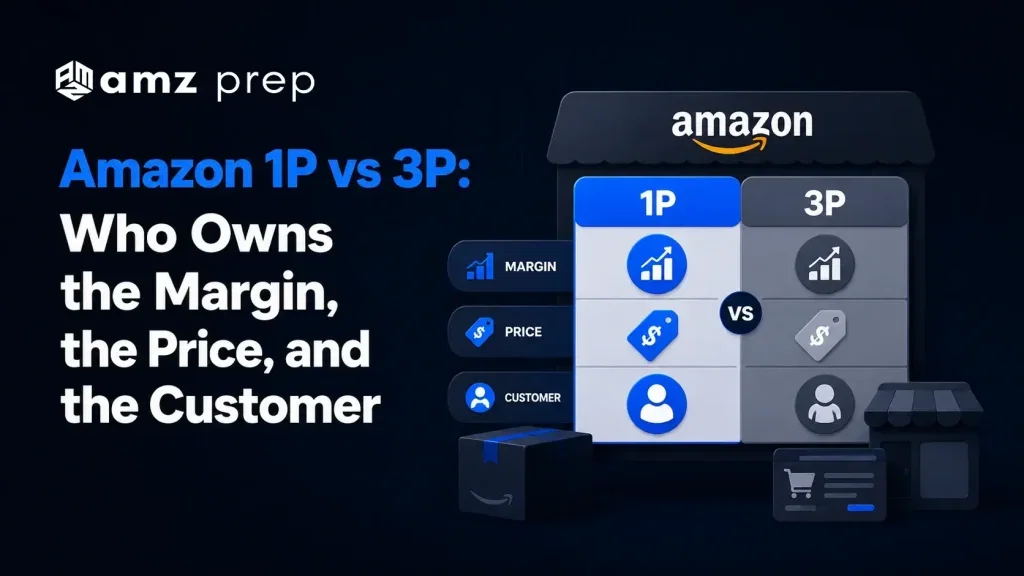
Amazon 1P vs 3P comes down to who owns the inventory after it leaves your dock. In 1P, you sell wholesale to Amazon and Amazon resells it. In 3P, you sell directly to consumers and Amazon takes a fee. 1P suits brands that want volume without operational load. 3P suits brands that want margin and control.
I work with brands weighing this selling model choice constantly. Most treat it as a paperwork decision. It is a channel decision, and it reshapes pricing, data, and operations together.
What Is the Difference Between Amazon 1P and 3P?
The two models create different relationships with the same company.
The 1P model explained
1P refers to a first-party relationship. Amazon purchases products from you in bulk and becomes the retailer. You act as a wholesale supplier. Amazon owns the inventory the moment it takes the title.
1P involves shipping against a purchase order. You have no say in retail price. Your listings carry the “Ships from and sold by Amazon” badge. Access to Vendor Central comes by invitation from Amazon only.
Amazon handles pricing, fulfillment, customer service, and returns. Amazon acts as the retailer of record.
The 3P model explained
3P involves selling directly to consumers on the Amazon marketplace. You stay the retailer of record. Amazon will charge a referral fee on each sale.
3P selling runs through Seller Central. You list products, set prices, and choose how orders ship. Amazon provides the audience, the payment rail, and optional fulfillment. Registration is open to nearly every Amazon seller.
The 1p vs 3p meaning question usually gets a dictionary answer. The useful version is an ownership question. In a 1P relationship, Amazon owns the price, the stock, and the customer. In a 3P relationship, you own all three.
Amazon 1P vs 3P at a Glance
| Factor | Amazon 1P | Amazon 3P |
|---|---|---|
| Who owns inventory after handoff | Amazon | You |
| Who sets retail price | Amazon | You |
| Who owns the customer | Amazon | You |
| Portal | Amazon Vendor Central | Amazon Seller Central |
| Listing control | Limited, edits take weeks | Full, edits go live fast |
| Revenue type | Wholesale | Retail, less Amazon fees |
| Main cost drivers | Co-op, chargebacks, shortages | Referral, FBA, storage, ads |
| Payment terms | Net 30 to Net 90 | Roughly every 14 days |
| Fulfillment options | Amazon only | Fulfillment by Amazon, FBM, or SFP |
| Data access | Aggregated, limited granularity | Order-level, near real time |
| Entry | Invitation only | Open Seller Central account |
That table settles 1p or 3p for most smaller brands. For larger ones, the cost structure decides it.
How Has the Amazon 1P and 3P Sales Split Changed?
The Amazon 3p vs 1p sales split has moved in one direction for a decade.
First-party sales declined in 2025, finishing at $255B against $260B the prior year. Third-party marketplace sales grew 15% over the same period. Third-party volume now sits near 69% of total marketplace GMV.
Our team tracks the full dataset on the Amazon marketplace seller statistics page.
Direction matters more than the exact number. Amazon earns better margin collecting fees than carrying stock. That economics shapes how it treats 1P vendor accounts.
The same pattern shows up across 1p ecommerce more broadly. Walmart, Target, and other retail marketplaces are shifting inventory risk to sellers and keeping the fee income. 1p vs 3p ecommerce is now a platform-wide question, not an Amazon-only one.
Where Each Selling Model Costs You Money
Both models look profitable in a spreadsheet. The costs that surprise brands appear in month three.
1P cost structure
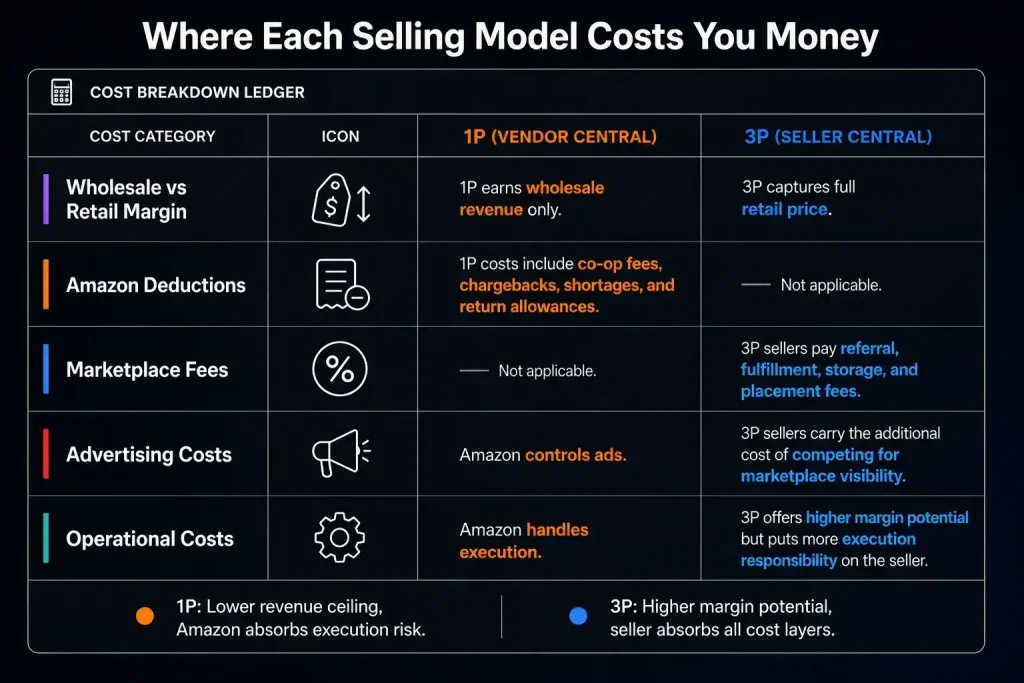
Wholesale pricing sets your ceiling. Everything below it is a deduction.
- Co-op and marketing allowances, usually a fixed percentage of shipped cost
- Chargebacks for routing errors, label failures, ASN mismatches, and late deliveries
- Shortage claims where Amazon reports receiving less than you shipped
- Damage and returns allowances written into the vendor agreement
- CRaP delisting risk when Amazon cannot make margin at your current cost
Chargebacks are the line item brands underestimate most. They are operations failures billed back as finance items. Clean inbound execution is the only reliable defense.
3P cost structure
Retail pricing sets a higher ceiling. The deductions look different.
- Referral fees on every sale, by category
- Fulfillment fees by size tier and weight when you use FBA
- Storage fees, with peak rates well above standard
- Inbound placement fees when shipments go to one destination
- Advertising spend, closer to mandatory than optional in competitive categories
What this does to profit margins
Published comparisons quote fixed percentages. I would treat those carefully. Real profit margins depend on category, unit economics, ad efficiency, and inbound discipline.
The reliable statement is this. Gross margin per unit is usually higher under 3P selling, because you capture retail price instead of wholesale. Net margin is less certain, because you carry ad spend and operating cost.
Brands that move to 3P without changing operations see margin improve on paper and stay flat in the bank. The gain lives in execution.
What Changes Operationally When You Switch
Most brands price this at zero. It is not zero.
Inbound routing and purchase order compliance
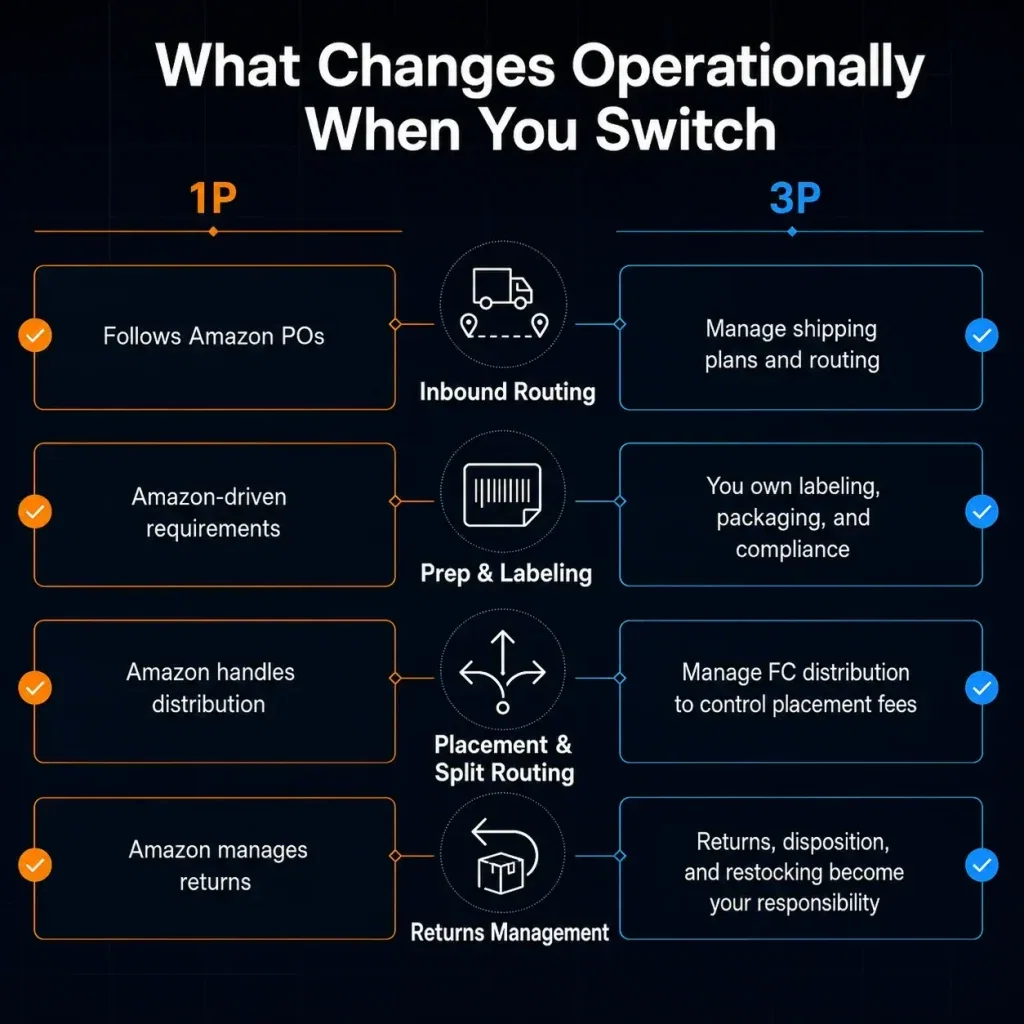
Under 1P with Amazon, routing is dictated. You ship against a PO inside a fixed delivery window. Miss it and you take a chargeback.
Under 3P, you own routing. You build shipping plans, split cartons, and manage freight. Our operations team handles Vendor Central purchase order routing for brands running both models. The capability gap shows up fast.
Prep and labeling requirements
1P prep follows the vendor manual. 3P prep follows FBA requirements. They overlap without matching.
Case labeling, carton content information, and polybag rules all shift. A brand that switches models with the same prep SOP will fail inbound checks quickly.
Placement fees and split routing
Placement fees apply when a 3P seller sends inbound stock to a single Amazon location. Splitting across multiple destinations reduces or removes the charge.
Brands arriving from 1P have never built that capability. They shipped wherever the PO said. Our network was built with five-way split routing on FBA inbound to close that gap.
Returns and reverse logistics
In 1P, returns become Amazon’s problem after title transfers. In 3P, they stay yours.
You need a return address, a disposition rule, and a restock-or-liquidate decision. Brands that skip this find out during the first post-holiday return wave.
Good logistics design is what separates a clean switch from a costly one.
Can You Run 1P and 3P Together?
Hybrid is more common than most comparisons suggest. It is also harder to run well.
The logic works at ASIN level, not brand level. A workable split usually looks like this.
- 1P for high-volume, low-complexity ASINs, where Amazon buying power moves real units and margin compression is tolerable
- 3P for launches, premium SKUs, and bundles, where you need pricing control and fast listing changes
- 3P for seasonal and meltable items, where Amazon’s retail team rarely buys deep
Two conditions make hybrid work. First, minimum advertised price discipline, because Amazon’s 1P pricing can undercut your own listing on a sibling ASIN. Second, one inventory pool. Separate 1P and 3P stock strands units in the wrong bucket every quarter.
Several of our brands run both flows from a single facility. One pool, two outbound paths, one forecast. That structure holds up across peaks.
How to Choose Between Amazon 1P or 3P
Five questions settle Amazon 1p or 3p for most brands.
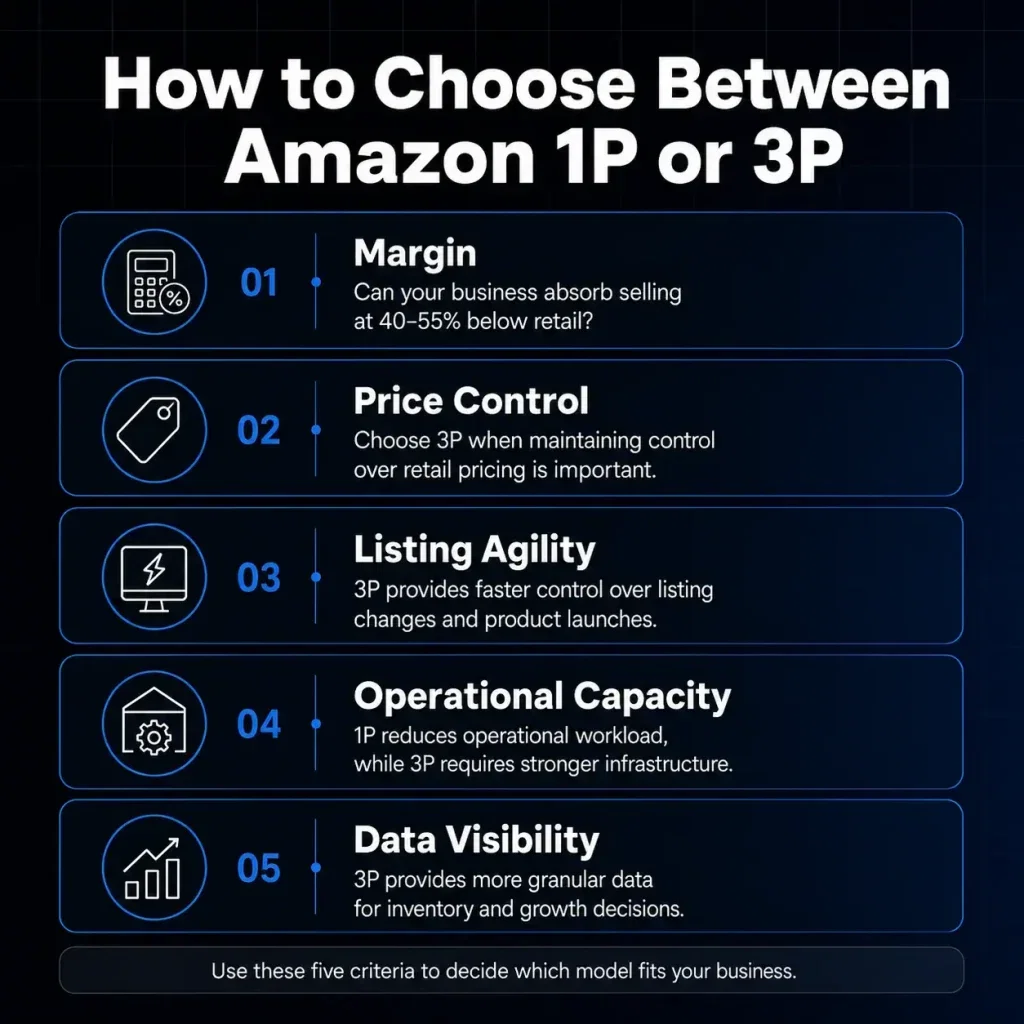
1. Can you absorb 40% to 55% off retail as your selling price?
If yes, 1P is viable. If your unit economics needs retail capture, lean on 3P.
2. Do you need price control?
If MAP protection or consistency across retail partners matters, lean on 3P.
3. How fast do listing changes need to go live?
Frequent launches and listing optimization work point to 3P. Vendor Central edits move slowly.
4. Do you have operations capacity, in-house or through a partner?
3P transfers real work to you. Without that capacity, 1P buys time.
5. How much does order-level data matter?
3P gives you granular data and better selling tools and sales reports. If your growth plan runs on that data, the answer is already set.
Three or more answers pointing to 3P makes the call clear. Split answers point to hybrid.
What 1P and 3P Sellers Get Wrong About Data
1P and 3P sellers face different visibility problems.
1P sellers see aggregated performance without knowing who bought. Vendor analytics show demand, not customers. Building a retention program on that data is difficult.
3P sellers on Amazon get order-level detail. The challenge is connection. Advertising sits in one system, inventory in another, fulfillment in a third. Brands that optimize across all three win. Brands that read each in isolation make slower decisions.
Either way, the fix is the same. Pull the data into one view before you build strategy on it.
Conclusion: Build Readiness Before You Need It
The Amazon 1p and 3p split is not stable, and Amazon has made its preference clear. Brands still holding a vendor relationship should treat 3P readiness as a project with a date, not a backup plan.
Readiness is operational, not administrative. It means routing capability, prep compliance, split shipments, and a returns process that works before the first return arrives. Brands that build those things first switch cleanly. Brands that build them afterward spend a quarter recovering.
Start by costing your inbound. Model both paths against your real freight, prep, and placement exposure. Once those numbers sit side by side, the 1p vs 3p question tends to answer itself.
AMZ Prep supports both models across 50+ fulfillment centers in six countries. If you want the inbound math for your SKUs, our team can build it.
Frequently Asked Questions
What is 1P?
1P means first-party selling. You sell inventory wholesale to a retailer such as Amazon. The retailer takes ownership, sets the price, and sells to the end customer under its own name.
What is Amazon 3P?
Amazon 3P means third-party selling. You list and sell products on Amazon’s marketplace directly to shoppers. You keep ownership of inventory and pay Amazon a referral fee per sale.
What does 1P mean?
1P is shorthand for first-party. The platform buys your goods and resells them. Your revenue comes from wholesale purchase orders rather than individual consumer orders.
What is 1P and 3P?
1P and 3P describe two selling relationships on Amazon. In 1P, Amazon buys and resells your product. In 3P, you sell to shoppers and Amazon collects a fee.
How do you become an Amazon 1P seller?
Amazon 1P access is invitation only. Amazon approaches brands with strong marketplace performance or category value. You accept the offer, agree terms, then register through Vendor Central.
How do you become an Amazon 3P seller?
Registration is open. Create a Seller Central account, verify business and tax details, enroll in Brand Registry if you hold a trademark, then list products and pick a fulfillment method.
Should a brand sell on Amazon 1P or 3P?
It depends on margin tolerance and operations capacity. Brands needing price control, listing speed, and order-level data choose 3P. Brands wanting volume without operational load choose 1P.
What data challenges do 1P and 3P sellers face?
1P sellers get aggregated reporting and little buyer visibility. 3P sellers get order-level data but must connect advertising, inventory, and fulfillment systems themselves to make it useful.

Arishekar N is a Vice President (VP) of Marketing at AMZ Prep, specializing in ecommerce fulfillment and Amazon logistics strategies with a proven track record of driving growth for e-commerce businesses. He is a strategic leader with extensive expertise in marketing, e-commerce operations, SEO & advertising, and branding.
Stay updated on his latest insights by following him

















Comments