
It’s two months before Black Friday or Prime Day, your busiest sales season of the year. You’ve just closed a big international order to stock up before the rush.

Everything’s going great until your overseas buyer asks, “Will this be shipped FCA or DAP?”
Suddenly, you’re wondering: What’s the difference? Which one costs more? Who handles customs? Who’s responsible if something goes wrong?
Incoterms 2020 are still the standard for international shipping through 2025, so knowing which terms to use is important. Picking the right ones can help you cut your shipping costs by 15-20% and help you avoid delays when things get busy during the peak holiday season.
What is Incoterms 2020 in 2025
FCA and DAP are part of Incoterms 2020, the international trade rules set by the International Chamber of Commerce (ICC). These are still the official standards through 2025, even though people are talking about future updates.
These rules guide billions of dollars worth of global trade every year. They spell out who’s responsible for what, who pays for what, and when risk shifts from seller to buyer.
What is FCA (Free Carrier) Incoterms?
FCA (Free Carrier), is one of the most often used terms in shipping. In FCA, the seller is responsible for delivering goods to a carrier or another buyer at a mutually agreed destination. These terms are established by the International Chamber of Commerce (ICC) as part of the Incoterms for short.
The key here is flexibility of location. FCA delivery meaning, the delivery can happen at many places:
- At the seller’s facility (factory, warehouse, etc.)
- At a freight forwarder’s warehouse
- At a port or airport
- At any other mutually agreed-upon location
Note: Once the goods are handed over to the buyer’s carrier, the risk transfers from seller to buyer. Unlike Free On Board (FOB) terms that are limited to sea transport, FCA is suitable for any mode of transport.
Under Incoterms 2020, FCA now includes enhanced provisions for electronic Bills of Lading (eBL), making it particularly suitable for modern eCommerce operations. For sellers using digital freight platforms, FCA allows the buyer’s carrier to issue an on-board bill of lading directly to the seller crucial for letters of credit and payment security in online transactions.
Seller Responsibilities in FCA Logistics
When shipping under FCA freight terms, sellers must handle several key responsibilities:
- The products must be properly packaged for export.
- If delivery is at the seller’s facility, the seller has to pay for loading the goods onto the buyer’s collecting vehicle.
- The seller must have licenses and complete all the export customs formalities.
- If the handover location isn’t at the seller’s premises, the seller must arrange and pay for transportation to the other location.
- Evidence must be given by the seller once the goods are delivered.
Once these responsibilities are fulfilled, the seller’s responsibility ends. This is why FCA destination terms are popular among sellers who want to limit their liability in the shipping process.
Buyer Responsibilities in FCA Logistics Terms
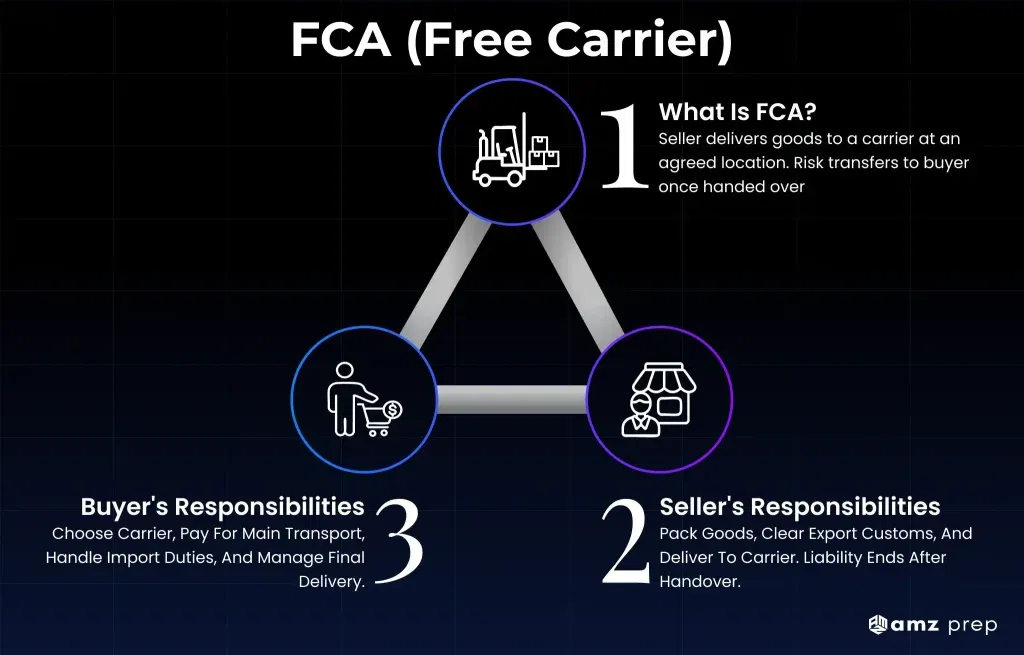
Buyers and sellers need to understand their obligations clearly. Buyers take on huge responsibilities under FCA shipping terms. The buyer gets to choose the freight forwarder or carrier and make a shipping contract. All main transportation costs and insurance are the buyer’s responsibility. The buyer is responsible for all import formalities, including paying duties, taxes, and customs clearance fees.
AMZ Prep has launched a US reciprocal fees calculator which gives you the real-time data to know about the tariffs. The buyer pays for unloading at the destination port or terminal. Transportation from the arrival port to the final destination is the buyer’s responsibility.
What is DAP (Delivered at Place) Incoterms?
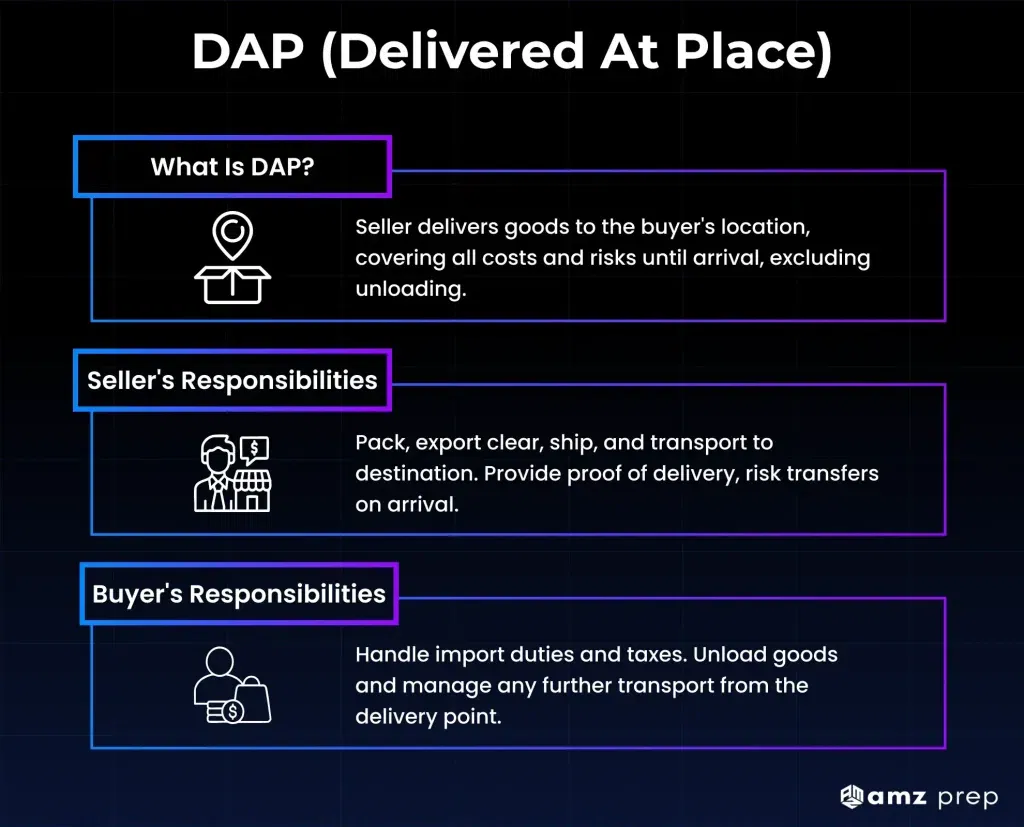
Under DAP terms, the seller delivers goods when they are placed at the buyer’s disposal, unloaded, at a destination.
What makes DAP vs FCA so different? With DAP, the seller bears almost all transportation risks and costs until the goods reach the specified destination point. The cost and risk remain the seller’s responsibility through, export clearance, unloading at destination port, transport to the agreed location.
Only after the goods are loaded at origin and delivered to the agreed destination does the risk transfer to the buyer once the goods arrive at the designated location. This makes DAP a very buyer-friendly option.
So, if you’re confused about DAP with DDP, here’s a brief definition of DDP.
Under DDP (Delivered Duty Paid) terms, the seller handles both export and import customs clearance and pays all import duties/taxes. It’s even more convenient for the buyer but comes with higher risk and cost for the seller.
Responsibilities of the Seller Under DAP Logistics
When you ship under DAP terms, the seller handles most of the work. Sellers handle work like packaging and labeling, loading the goods at their facility, and transporting it to the port or airport where it needs to be headed.
The seller also manages export documents and fees, books the international shipping, and covers those costs. On top of that, they need to provide proof that the delivery was made.
Responsibilities of the Buyer Under DAP Shipping Terms
Under DAP terms, buyers don’t have much to worry about:
- They handle import customs, duties, and taxes when the goods arrive.
- Even though the seller gets everything to the final location, unloading the goods is usually on the buyer.
- If the delivery location isn’t where the goods ultimately need to go, the buyer arranges that last part of delivery.
Insurance Considerations for DAP Incoterms
Carriers typically don’t cover much if something goes wrong, so if you’re selling under DAP terms, you should seriously think about cargo insurance. Since you’re responsible for the shipment until it’s delivered, most people get coverage for about 110% of the goods’ value to protect themselves from any problems.
FCA vs DAP: Key Differences in Incoterms
For eCommerce sellers deciding between FCA vs DAP shipping terms, understanding these key differences is essential for making the right choice for your business needs.
| Metrics | FCA (Free Carrier) | DAP (Delivered at Place) |
|---|---|---|
| Risk Transfer Point | When goods are delivered to the carrier | When goods arrive at the named destination |
| Seller Pays For | Export packing, loading at seller’s facility, export clearance, transport to handover point | Export packing, loading, export clearance, main carriage, delivery to destination |
| Buyer Pays For | Main carriage, insurance, import duties, unloading, final delivery | Import duties, taxes, customs clearance, unloading |
| Export Clearance | Seller’s responsibility | Seller’s responsibility |
| Import Clearance | Buyer’s responsibility | Buyer’s responsibility |
| Transport Arrangement | Buyer arranges main carriage | Seller arranges entire transport to destination |
| Insurance Typically Arranged By | Buyer | Seller |
| Best For | B2B sales, experienced importers | B2C sales, convenience-focused customers |
| Seller’s Risk Level | Lower | Higher |
| Pricing Impact | Lower base product prices | Higher all-inclusive prices |
| Insurance Responsibility | Buyer (optional but recommended) | Seller (highly recommended at 110% coverage) |
| Digital Documentation | Supports eBL and digital platforms | Supports all digital documentation |
FCA vs DAP for eCommerce Businesses
While managing an eCommerce business and fulfillment, you must know when to choose FCA and when to choose DAP. Let’s find out!
When to choose FCA Shipping
FCA shipping terms work particularly well in the below given eCommerce scenarios. For Experienced International Sellers, choose FCA:
- When selling to business buyers with established importing processes
- When working with buyers who prefer to use their own freight forwarders
- When selling to markets where you lack knowledge of local transportation
- When you want predictable, limited shipping responsibilities
- When you want to use digital freight platforms that offer real-time tracking and automated documentation.
- When shipping through established trade lanes where eBL (electronic Bills of Lading) are accepted.
Coming to the cost considerations, you must choose FCA when offering competitive pricing. There will be some chances where buyers can secure better international shipping rates. If you want to avoid building complex shipping costs, you can choose FCA. Also, if you’re selling high-volumes and lower margin products.
You can also choose FCA, if you’re testing new international markets, selling to countries with complex import processes, and to avoid custom delays.
Note: For many eCommerce businesses selling B2B, FCA seller’s facility terms offer the perfect balance of service and limited liability.
When to choose DAP Shipping
Choose DAP, if you’re focused more on selling to customers (B2C). It is always best to choose DAP if buyers lack experience on importing. Offering landed cost pricing is advantageous in choosing DAP and you can sell to markets where you have strong logistics partnerships.
Choose DAP if you’re looking to expand into new markets, building a reputation for hassle-free international shipping and when you have established logistics networks in destination countries. DAP is particularly useful for sea freight shipments where you want to maintain control over the logistics process.
Note: Many successful eCommerce businesses use DAP for B2C transactions and FCA for B2B relationships.
FCA and DAP Shipping for Amazon FBA and Shopify Sellers
Selling through Amazon FBA or your own Shopify store? Here’s how FCA and DAP impact your fulfillment strategy.
For Amazon FBA Sellers
FCA (Free Carrier) is a solid choice when you’re sending inventory to Amazon warehouses because it gives you more control over your supply chain. Your job ends once the carrier picks up your goods, which works great if you already know your way around customs.
You’ll usually save 15-20% on shipping costs versus options where the seller handles delivery all the way through. If you’re a high-volume Amazon seller moving 5 or more containers each month, that could mean $5,000 to $15,000 savings every year.
FCA also lets you work with freight forwarders who know how to navigate Amazon’s delivery appointment system (CARP), which helps you avoid those 3-7 day rescheduling errors.
Most Amazon sellers who’ve been at it a while use FCA for domestic shipments but flip to DAP when they’re shipping to Amazon warehouses in other countries for the first time. This type of hybrid approach will help you cut your costs while making it easier for you to deal with new markets where customs requirements might be unfamiliar.
For Shopify Sellers (Direct-to-Consumer)
DAP (Delivered at Place) makes international shipping easier for your Shopify customers. Your shipping partner handles the whole process like moving the goods, clearing customs, and getting everything delivered to your customer’s doorstep. No surprise fees when the package shows up.
Customers like seeing the full price upfront, duties and taxes included, which helps boost your international conversion rates. DAP usually runs 10-15% higher than FCA, but the smoother experience tends to bring customers back and cuts down on abandoned carts.
A lot of Shopify sellers use DAP for customer orders but switch to FCA when they’re restocking their own warehouses. It’s a good middle ground option when you want to keep deliveries simple for shoppers while keeping your inventory costs in check.
If your Shopify business is growing, it’s worth connecting with fulfillment partners in the countries where you sell the most. You’ll cut down on shipping times and costs while still giving customers that convenient DAP experience.
You can also partner with an experienced fulfillment company like AMZ Prep. They handle both FCA and DAP shipments on international routes. Whether you’re shipping from your manufacturer to one of our fulfillment centers (FCA), or delivering orders straight to your customers’ doorsteps worldwide (DAP), AMZ Prep got you covered.
FCA vs DAP for Amazon Sellers in the US
The U.S. offers a mix of coastal and inland fulfillment hubs. FCA is common in port-heavy states, while DAP suits sellers far from ports or using 3PLs.
| FCA | |
|---|---|
| State / City | Why FCA Works for eCommerce in US |
| California (Los Angeles, Long Beach) | Major FBA prep hubs; eCommerce brands arrange freight from ports for cost control. |
| New Jersey / New York (Newark) | Access to Northeast FBA and 3PL facilities; preferred by seasoned Amazon/Etsy sellers. |
| Georgia (Savannah) | Low port congestion; eCommerce sellers import in bulk and manage downstream distribution. |
| Illinois (Chicago) | Central access to Midwest fulfilment networks via rail/truck; FCA offers cost-efficient routing. |
| Texas (Houston) | Used by high-volume eCommerce sellers importing from Latin America or Asia; port pickup is common. |
| DAP | |
|---|---|
| State / City | Why DAP Works for eCommerce in US |
| Ohio (Columbus) | Large Amazon and Walmart fulfillment network; sellers prefer door delivery to 3PLs. |
| Tennessee (Nashville, Memphis) | Inland eCommerce hubs; DAP removes freight and customs complexity. |
| Texas (Dallas, San Antonio) | Home to many Amazon 3PLs; small sellers opt for full delivery. |
| Colorado (Denver) | No nearby port; online brands avoid managing inland freight. |
| Arizona (Phoenix) | DAP helps brands importing from LA port directly to fulfilment centres. |
FCA vs DAP for Amazon Sellers in Canada
For cross-border routes like shipping from the USA to Canada, FCA makes sense if you’re close to major ports and want to cut costs down. DAP will be the smartest choice for sellers who run small businesses or those in remote areas who’d rather have someone else handle the delivery details
| FCA | |
|---|---|
| Province / City | Why FCA Works for eCommerce in Canada |
| British Columbia (Vancouver) | Amazon sellers importing from Asia manage pickup at port for lower landed cost. |
| Ontario (Toronto, Mississauga) | Large FBA/3PL concentration; FCA used by brands managing customs clearance. |
| Quebec (Montreal) | EU shipments are often routed here; experienced eCommerce importers arrange local collections. |
| Alberta (Calgary) | Large-volume sellers manage rail/truck pickup from port to inland warehouse. |
| DAP | |
|---|---|
| Province / City | Why DAP Works for eCommerce in Canada |
| Manitoba (Winnipeg) | DAP simplifies import and last-mile to fulfilment centres for small brands. |
| Nova Scotia (Halifax) | Smaller eCommerce operations rely on full delivery for ease. |
| Saskatchewan (Regina) | Remote brands prefer seller-managed logistics. |
| Ontario (Ottawa, Windsor) | DAP preferred by sellers using regional 3PLs with limited freight expertise. |
FCA vs DAP for Amazon Sellers in the UK
UK sellers tend to use FCA when they’re near ports or have easy access to freight forwarders. DAP is the go-to for smaller brands or sellers who aren’t located in major logistics hubs.
| FCA | |
|---|---|
| Region / City | Why FCA Works for eCommerce in UK |
| Felixstowe / Southampton | FBA and large retailers collect goods from ports for cost efficiency. |
| London (Heathrow) | Airfreight preferred for fast-turnover eCommerce goods; importers collect via forwarders. |
| Birmingham | FCA preferred for Amazon/Etsy sellers managing logistics from Midlands hubs. |
| Liverpool / Manchester | Sellers with 3PLs in North England use FCA for direct port coordination. |
| Glasgow / Grangemouth | Scottish brands with EU imports handle inland delivery themselves. |
| DAP | |
|---|---|
| Region / City | Why DAP Works for eCommerce in UK |
| Leeds / Sheffield | Regional sellers prefer door delivery to reduce logistics overhead. |
| Bristol / Cardiff | Smaller brands favour DAP to avoid port handling complexity. |
| Belfast (Northern Ireland) | DAP avoids post-Brexit clearance issues for sellers importing from the EU. |
| Oxford / Cambridge | University-town eCommerce brands focus on product, not shipping. |
| Devon / Cornwall | Remote areas where DAP simplifies supply chains for niche brands. |
2025 Shipping Trends That Impact FCA and DAP Choices
Digital Documentation
More shipping companies and freight forwarders are using electronic Bills of Lading and smart contracts now, which makes FCA easier to manage if you’re comfortable with technology. Going digital cuts processing time by a day or two and reduces mistakes.
Environmental Rules
With stricter environmental regulations rolling out especially in the EU and California your choice of Incoterm affects how you report your carbon footprint. DAP gives sellers more say in picking routes and carriers, so you can potentially lower emissions by choosing greener shipping options.
AI Freight Tools
Today’s digital freight forwarders use AI to find better routes and handle customs paperwork automatically. These tools pair well with FCA since buyers get more control over which carriers they use and how goods get routed.
Supply Chain Stability
After all the pandemic-related disruptions, managing risk has become just as important as managing costs. A lot of online businesses aren’t just chasing the cheapest option anymore. DAP gives you more predictability, while FCA lets you switch between carriers and routes quickly when problems pop up.
Common Mistakes When Using FCA or DAP
1. Misunderstanding the Transfer of Risk
One of the biggest mistakes sellers and buyers make is missing the exact moment when responsibility changes hands.
With FCA, risk shifts as soon as the seller hands the goods over to the buyer’s carrier at the agreed spot. With DAP, risk doesn’t transfer until the products show up at the buyer’s location, ready to be unloaded.
If something gets damaged or lost after that handoff point, whoever’s responsible at that stage pays for it. If you miss this detail, and you could end up in disputes or stuck with bills you weren’t expecting.
2. Not Specifying Delivery Locations Clearly
Incoterms like FCA and DAP require a precise location to be named. For FCA, it could be a warehouse, terminal, or carrier depot. For DAP, it must be the exact place of delivery (e.g., “DAP – 123 Main St, Atlanta, GA”).
If the location is not clearly mentioned, logistics teams and carriers will find difficulty to deliver the products to the wrong place or charge extra for redelivery.
3. Failing to Consider Customs and Duty Handling
Many people don’t realize how FCA and DAP split customs responsibilities. Under FCA, the seller handles export customs while the buyer takes care of import clearance and duties. With DAP, the seller delivers the goods to the destination, but the buyer is still responsible for clearing customs and paying import fees.
When buyers aren’t ready to deal with customs, shipments can get stuck or even returned. Sellers using DAP sometimes think they’ve handled everything when really, they haven’t.
4. Ignoring Digital Documentation Options
A lot of sellers are still using paper documents when they could go digital. With FCA shipments, not using electronic Bills of Lading can slow down payments and customs clearance. By 2025, most modern freight forwarders will offer eBL as the norm, cutting document processing time from 5-7 days down to 1-2 days.
Conclusion
Choosing between FCA and DAP shipping terms isn’t just a paperwork decision, it affects your costs, how customers experience your service, and how complicated your operations get.
The smartest move for your eCommerce business might be using both, depending on the situation. Use FCA for wholesale orders, B2B deals, and buyers who know how to deal with international shipping. Use DAP for retail customers, when you’re entering new markets, or when you want to offer premium service.
No matter which terms you go with, clear communication, solid documentation, and really understanding what you’re responsible for will save you from expensive mistakes and shipping challenges.
Frequently Asked Questions
Who pays for freight in FCA terms?
In FCA freight terms, the buyer pays for the main freight charges. The seller only pays for transportation to the named handover location if it’s not at the seller’s facility.
Who handles customs clearance under DAP terms?
Under DAP vs FCA Incoterms, the division of customs responsibilities is similar. The seller handles export clearance in both cases. The buyer always handles import clearance, including paying duties and taxes.
Can FCA terms be used for domestic shipments?
While FCA delivery meaning was designed for international trade, many businesses adapt it for domestic shipments. It works well when transferring shipping responsibility to the buyer at a specific handover point.
Which is better for new eCommerce sellers: FCA or DAP?u003cbru003e
If you’re new to eCommerce, FCA terms usually offer an easier way to start shipping internationally since your liability is limited. Once you’ve got some experience and want to step up your service, you can consider switching to DAP in certain markets.
Can I switch between FCA and DAP for different customers?u003cbru003e
Yes, definitely! Most of the successful eCommerce businesses use FCA and DAP strategically depending on the customer type, market, or what they’re selling. Just make sure your documentation and pricing match up with whichever terms you’re using for each order.

Blair Forrest is the Founder of AMZ Prep, one of North America’s fastest-growing third-party logistics and fulfillment networks, built entirely without outside capital since 2016. Under his leadership, AMZ Prep has scaled to 50+ fulfillment centers across 6 countries, processing over 10 million plus units monthly and powering $2 billion+ in annual GMV for more than 5,000 brands worldwide including 437, Silverts, Saltyface, Unilever, Duracell, and JBL. A recognized authority in eCommerce logistics, Amazon FBA strategy, and supply chain optimization, Blair has helped thousands of sellers and brands master their fulfillment operations from first shipment to enterprise scale. He regularly consults on FBA prep, multi-channel fulfillment, last mile delivery, international expansion, and cost reduction strategies that save brands 20–40% compared to traditional 3PL providers. Blair’s insights on Amazon logistics, 3PL operations, and eCommerce growth are widely cited across the industry. Through AMZ Prep’s content, guides, and resources, he continues to share battle-tested strategies drawn from managing one of the largest independently owned fulfillment networks in North America.
















AMZ Prep explains international shipping rules in a way that’s easy to understand, even for beginners.
The comparison chart between FCA and DAP is a quick reference I’ll keep using.
AMZ Prep’s guide makes it easy to decide which Incoterm works best for your business. Very practical tips!
Knowing when to use FCA vs DAP has helped me avoid extra import fees and delays.
This guide clarified responsibilities, costs, and risk under both FCA and DAP. Highly recommended!
Learning the difference between FCA and DAP terms has made planning international shipments much simpler.
The step-by-step examples of shipping under each term are invaluable. I feel more confident planning shipments now.
AMZ Prep’s insights into Incoterms simplify a topic that usually feels complicated.
The explanation of responsibilities under FCA and DAP really helped me understand shipping costs better.
AMZ Prep’s breakdown of FCA vs DAP Incoterms is clear and very easy to follow.