Crowdfunding has become a powerful tool for sellers, product creators, and entrepreneurs seeking to launch, validate, and scale their products.

It allows creators to raise small amounts of money from a large number of people, typically via online platforms, while simultaneously testing market demand, building an audience, and generating pre-orders.
Choosing the right crowdfunding platform can determine not only the success of your campaign but also the funding received, audience engagement, and long-term business growth.
Kickstarter and Indiegogo are two of the most popular crowdfunding platforms, each offering unique advantages, funding models, and audience reach. Kickstarter operates primarily on an all-or-nothing funding model, attracting a large and creative backer community.
Indiegogo, in contrast, provides flexible funding options and the InDemand feature, allowing ongoing sales after the main campaign ends. Both platforms give sellers professional campaign tools, analytics, and marketing integrations to optimize visibility and engagement.
For sellers, crowdfunding is not just about raising capital. It is a way to:
- Validate demand: Confirm whether customers are genuinely interested in your product. Validate your business idea before proceeding with mass production.
- Build an audience: Create a community of early adopters and advocates who can help spread the word.
- Collect feedback: Learn directly from backers to refine your product before full-scale launch.
- Generate pre-orders: Fund production, logistics, and scaling costs through early sales.
Selecting the wrong platform can lead to wasted resources, higher fees, poor visibility, and even lost credibility.
Factors such as platform rules, fees, audience demographics, funding models, and post-campaign support should all be considered to ensure your campaign aligns with your goals.
Understanding these differences between Indiegogo vs Kickstarter is the first step toward launching a successful crowdfunding campaign.
What is Indiegogo vs Kickstarter?
Kickstarter crowdfunding platform overview:
Kickstarter is one of the oldest and most well-known crowdfunding platforms (since 2009), focused primarily on creative projects, games, design, art, tech gadgets, etc. It uses an all-or-nothing funding model: if the funding goal isn’t met, no money changes hands. Backers only pay if the goal is reached.
Indiegogo (founded in 2008) offers more variety: flexible funding (you keep what you raise even if you don’t meet the goal), fixed funding (similar to Kickstarter), and post-campaign sales via its InDemand feature, which allows continuing sales after the main campaign ends.
Why these platforms are important for launching and validating your product
- You can test market demand before mass production.
- Pre-orders raise funds upfront, reducing financial risk.
- Visibility to a global or broad community of backers who are likely early adopters.
- Feedback loop: input from backers can improve your product.
- Marketing: campaigns generate buzz, media coverage, and social shares.
Choosing the right platform is critical. Kickstarter-type websites can differ in terms of audience, trust, and funding flexibility.
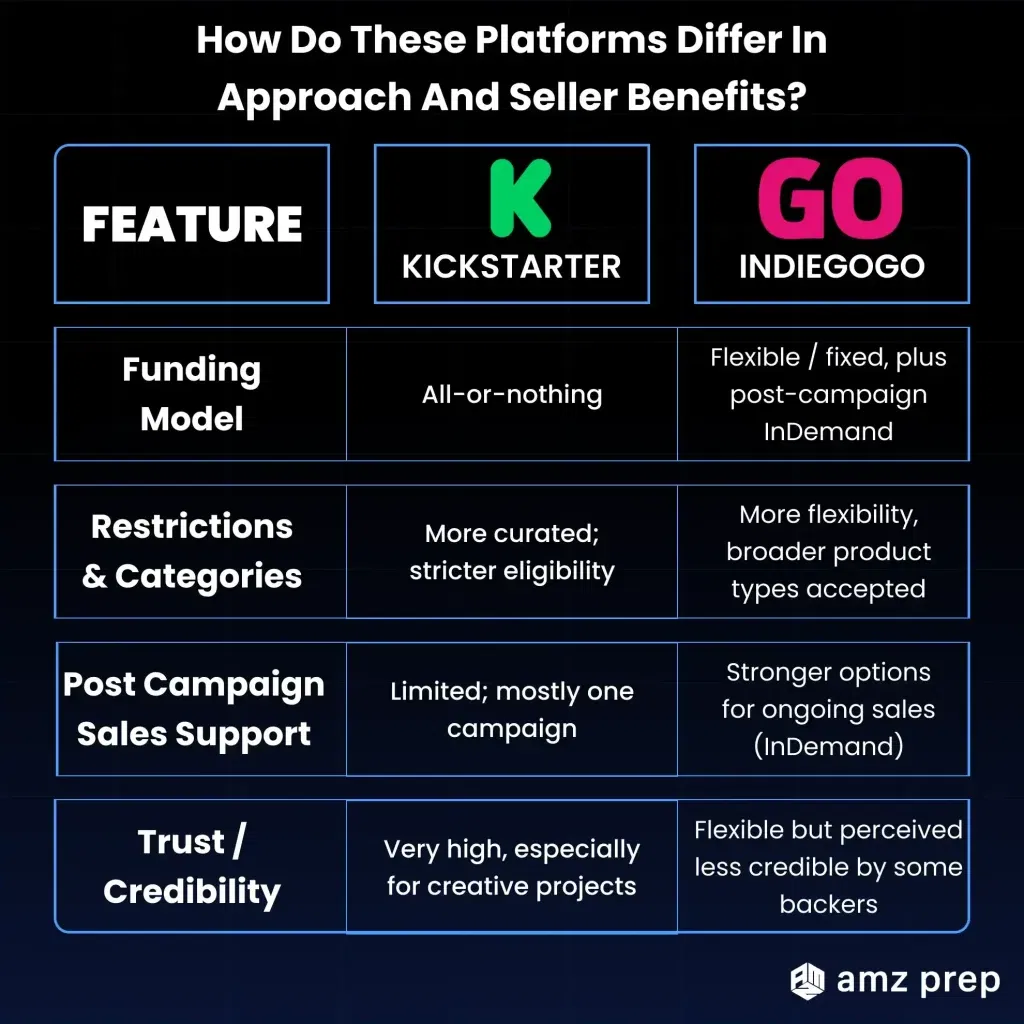
How do these platforms differ in approach and seller benefits?
As a seller, choosing the right crowdfunding platform is essential for a successful product launch. Kickstarter offers credibility and a large creative community through its all-or-nothing model, while Indiegogo provides flexibility and ongoing sales opportunities with features like InDemand. Understanding these differences helps you select the platform that aligns with your product, audience, and long-term business goals.
Some of the main differences are:
What’s at Stake if You Choose the Wrong Platform
As a seller, selecting the wrong crowdfunding platform can have significant consequences that affect both the immediate success of your campaign and your long-term business growth.
Funding Outcomes
The platform you choose directly impacts how much money you actually raise. Kickstarter’s all-or-nothing model may result in zero funding if you fail to meet your goal, whereas Indiegogo’s flexible funding allows you to keep partial funds. Selecting the wrong model for your product or audience can leave you underfunded and unable to execute your project.
Audience Reach
Each platform attracts a different type of backer. Kickstarter’s community is highly engaged in creative projects, games, and polished tech products, while Indiegogo tends to draw early adopters interested in tech gadgets and lifestyle innovations. Launching on a platform that does not align with your product category may limit your backer pool and reduce campaign visibility.
Costs and Fees
Platform choice influences the total costs you incur. Both platforms charge a 5% fee plus payment processing fees, but differences in funding models, promotional tools, and fulfillment options can affect your net revenue. Poor planning for international shipping or choosing a platform with limited fulfillment support can erode your margins.
Brand Building and Long-Term Value
Crowdfunding is not just about raising money; it is a chance to build your brand and foster loyal customers. Launching on a platform that does not support post-campaign engagement or ongoing sales can limit your ability to retain backers and grow your business beyond the initial launch.
Campaign Risk and Backer Perception
Choosing a platform that does not suit your product or strategy increases the likelihood of campaign failure or underperformance. Falling short of your goal on Kickstarter can lead to disappointment among backers and potential reputational damage, while launching on a platform with less trust can reduce backer confidence even if you meet your funding goal.
Selecting the right platform is therefore critical. It determines not only your funding success but also how effectively you reach your audience, control costs, and establish a foundation for long-term growth.
By aligning your product, funding strategy, and target audience with the strengths of either Kickstarter or Indiegogo, you reduce risk and maximize the potential impact of your campaign.
What Does Kickstarter Mean for You as a Seller?
How it works – The project-based campaigns with “all-or-nothing” funding
On Kickstarter, you define a funding goal and campaign duration. If in the end your campaign does not reach its goal, no backer is charged, and you receive no funds. This model tends to increase urgency (backers feel their pledge matters to reach the target) and reduces risk for backers.
Kickstarter has certain rules: you need to have a working prototype (depending on product category), follow product eligibility policies (no weapons, etc.), and the platform reviews projects before launch.
Why sellers choose Kickstarter – credibility, visibility, and community
Some of the reasons sellers prefer Kickstarter:
- Credibility: Because of the all-or-nothing model, backers often trust that if the goal is met, the campaign is serious.
- Visibility: A large, active community of backers who regularly browse for creative, artsy, design-forward, or gaming projects.
- Organic discovery: Projects that are tagged well, that get selected for “Projects We Love,” etc., can get featured.
The brand reputation tends to lend legitimacy, especially for first campaigns.
Common industries – tech gadgets, board games, creative products
Kickstarter has a strong track record in categories like:
- Tabletop games/board games
- Product design
- Publishing, comics, creative arts
- Hardware & gadgets (when the project is well-prepared)
These are areas where storytelling, visuals, and creative appeal matter, and backers are looking for novel, often quirky, creative products.
What Does Indiegogo Mean for You as a Seller?
Indiegogo is one of the most popular Kickstarter alternatives, especially for product sellers who want more flexibility and global reach.
Unlike Kickstarter, which is heavily curated and focuses on creative projects, Indiegogo positions itself as a platform for innovators, makers, designers, and entrepreneurs who want to test new ideas and continue selling beyond the initial launch.
Here’s what Indiegogo really means for you:
How it works – flexible vs fixed funding models
Indiegogo gives you choices in how you raise money, which can be a big advantage depending on your risk tolerance.
- Fixed funding works just like Kickstarter’s all-or-nothing model. You set a goal (say, $50,000), and if you don’t reach it, you don’t keep any of the funds. This is great if you need a minimum amount of capital to actually make the product viable, since it protects both you and the backers.
- Flexible funding allows you to keep whatever amount you raise, even if you don’t reach your full goal. For example, if you set a $50,000 goal but only raise $25,000, you still get the money, minus fees. This is useful if you can still deliver a scaled-down version of your project or use the funds to continue development.
- InDemand is Indiegogo’s signature feature that many sellers love. After your main campaign ends, you can switch into InDemand and continue collecting pre-orders. Think of it as turning your campaign page into an e-commerce storefront, where momentum doesn’t stop just because the campaign timer runs out. This is especially powerful if you want to transition smoothly into long-term sales channels like Shopify or Amazon.
Why sellers choose Indiegogo: flexibility, global reach, “InDemand” option
There are several reasons sellers pick Indiegogo over Kickstarter, especially if they value freedom and reach.
Global reach: Indiegogo is available in more countries than Kickstarter, which means if you’re outside Kickstarter’s eligible markets, you can still launch your product on Indiegogo. It also attracts more international backers who are used to shopping on the platform.
Flexibility reduces risk: If you’re not confident about hitting your funding target, flexible funding means you don’t walk away empty-handed. This safety net is attractive for first-time creators or those testing new concepts.
Post-campaign selling power: With InDemand, your campaign doesn’t end abruptly. Many successful sellers keep raising tens of thousands of dollars after their main campaign by continuing pre-orders. It turns your crowdfunding into a sales funnel.
Broader eligibility: Kickstarter has strict rules about what products are allowed and often requires a working prototype. Indiegogo is more open to concept-stage ideas and a wider range of categories, which makes it accessible to sellers who aren’t fully production-ready yet.
Common industries: hardware, design innovations, lifestyle products
Indiegogo has carved out a reputation as the go-to place for certain industries, especially those with an innovative or tech-driven angle.
Hardware/consumer electronics
Many gadget makers launch on Indiegogo, especially if they’re still in the prototype stage. From drones to smart home devices, Indiegogo backers are used to seeing cutting-edge hardware.
Design and lifestyle products
Innovative furniture, wearables, travel gear, and eco-friendly homeware often perform well on Indiegogo. The platform’s audience is open to new, practical products that improve daily life.
Tech gadgets and innovations
Indiegogo is strong with early adopters. If you have a futuristic gadget or a breakthrough idea, you’ll find an audience that’s eager to take risks for first access.
Ongoing sales of products
Because of InDemand, Indiegogo is also favored by sellers who want their crowdfunding page to evolve into a longer-term sales channel. Many creators use their campaign page as a bridge to full e-commerce stores later.
Seller’s Guideline: Choosing Between Indiegogo vs Kickstarter
When you’re preparing to launch a product, choosing the right crowdfunding platform is one of the most important decisions you’ll make.
Both Indiegogo vs Kickstarter give you access to backers and funding, but the way they work, the audiences they attract, and the tools they offer can lead to very different outcomes for you as a seller. Below is a clear guideline to help you choose with confidence.
Kickstarter
1. Creative focus
Kickstarter has always been a stronghold for creative projects. If you’re launching a tabletop game, design object, art product, or publishing idea, this platform gives you access to an audience that values originality and wants to feel part of something imaginative.
2. All-or-nothing funding
The platform works on a strict all-or-nothing model. That means if you don’t hit your funding target, you don’t receive any money. It might feel risky, but it saves you from being stuck with partial funds that aren’t enough to deliver.
3. Financial safety net
While tough, this system protects you from underfunding. It ensures that if you move forward, you’ll actually have the resources to bring your product to life without cutting corners.
4. Large and loyal backer base
Kickstarter has over 21 million registered backers, with a strong concentration in North America and Europe. These supporters aren’t just casual shoppers; they’re people who actively look for innovative ideas to fund.
5. High trust factor
Because of Kickstarter’s stricter rules and curation, backers have more confidence in the campaigns they support. This helps you as a seller since credibility can make or break your fundraising.
6. Higher success rate
Kickstarter campaigns have a success rate of around 40%, which is much higher than most crowdfunding platforms. Sellers who prepare well and align with the platform’s strengths have a solid chance of reaching their goals.
7. Backer engagement through storytelling
The Kickstarter community thrives on stories. Backers want to feel like they’re part of your journey, so campaigns that explain the “why” behind the project often resonate more than those just showing off the product.
8. Credibility boost for your brand
Being funded on Kickstarter carries weight. A successful campaign here signals to future customers, retailers, and investors that your product has been validated by a demanding community.
9. Strict eligibility rules
Kickstarter doesn’t accept all product types. Categories like supplements, adult content, or services are excluded. While this can be restrictive, it’s part of what keeps the platform trustworthy.
10. No post-campaign tools
Once your campaign ends, Kickstarter doesn’t offer ways to keep selling. If you want to continue, you’ll need to set up your own e-commerce store or move to another platform.
Indiegogo
1. Tech and innovation-friendly
Indiegogo has built a reputation as the go-to platform for gadgets, hardware, and lifestyle products. If your product involves new technology or unique problem-solving, you’ll find an audience here that loves being first to try it.
2. Flexible funding model
Unlike Kickstarter, Indiegogo gives you options. You can choose fixed funding (similar to all-or-nothing) or flexible funding, which allows you to keep whatever amount you raise.
3. Keeping partial funds
With the flexible model, you don’t need to worry about falling just short of your goal. For example, if you set a $50,000 target and raise $45,000, you can still access the funds and attempt delivery. This is appealing if you’re confident you can adjust your plans.
4. Wider international reach
Indiegogo attracts a more global audience, with strong traction in Asia and emerging markets. This can be a big advantage if you’re targeting international customers rather than just North American or European ones.
5. Audience of early adopters
Backers on Indiegogo are less about creative storytelling and more about innovation. They behave more like early shoppers, excited to test new gadgets and lifestyle products before anyone else.
6. InDemand feature
One of Indiegogo’s strongest advantages is InDemand. This feature lets you keep selling even after your campaign ends, creating a smooth transition from crowdfunding into ongoing e-commerce.
7. Fewer restrictions
Indiegogo is more flexible when it comes to product categories and eligibility. This makes it easier to get approved and launch quickly, which can be a relief for sellers who don’t fit into Kickstarter’s stricter framework.
8. Lower average success rate
Indiegogo campaigns typically have a success rate of 18–30%. This is lower than Kickstarter’s, largely because of its openness to a broader range of projects, some of which don’t perform as well.
9. Potential trust issues
Because Indiegogo is more lenient, some campaigns fail to deliver, and this has created a perception among certain backers that it’s less reliable than Kickstarter. As a seller, you’ll need to work harder to build trust through transparency and communication.
10.Partnerships for growth
Indiegogo offers unique partnerships that help sellers scale. For example, collaborations with Arrow Electronics support hardware creators, while integrations with Facebook ads and fulfillment partners can ease marketing and logistics.
Kickstarter vs Indiegogo – The Seller’s Lens
Here’s a deeper comparison to help you see which platform might be more suitable from a seller’s perspective.
Platform Reach and Audience
- Kickstarter has a large backer community: over 23 million total backers, highly active repeat backer numbers (~34.7%), and large monthly traffic (~27.3 million visits).
- Indiegogo has a somewhat smaller but global reach: estimates vary, with monthly visits ~2.6 million for active visits in one report.
- Kickstarter tends to have stronger organic discovery and higher repeat backer engagement. Indiegogo’s backers sometimes behave more like early adopter shoppers.
- Geographically, both have global reach, but Kickstarter has stricter eligibility for who can create campaigns. Indiegogo tends to accept creators from more countries.
Funding Models: Risk vs Flexibility
| Scenario | Kickstarter | Indiegogo |
|---|---|---|
| All-or-nothing vs flexible funding | Kickstarter is all-or-nothing only. If the funding goal is not met, you get nothing. This reduces risk for backers and tends to drive urgency. | Offers both flexible (keep what you raise) and fixed funding. Also allows ongoing sales via InDemand. More flexibility. |
| What if you set a high goal (say US$50,000)? | Must reach the full goal to get anything. If you miss, you walk away with zero and still have spent on preparing the campaign (video, marketing, etc.) | With flexible funding, you might raise $30,000, keep it, to maybe build part of the product, or validate demand. But you still pay fees on what was raised, and need to deliver rewards. |
Example: $50,000 goal
Let’s say you want to raise $50,000 to build your tech gadget.
- Kickstarter: You set $50,000 goal, 30 days. If you get only $40,000 by the end, your campaign fails; you get nothing. So your risk: you lose all the effort and choose the minimum goal, which is realistic.
- Indiegogo: If you choose fixed funding, similar to Kickstarter, you either get to $50,000 or nothing.
If you choose flexible funding, you might keep $40,000. That allows you to start partial production, but you may have to scale back features, etc. Also, you’ll need to account for fees and shipping costs even on a partial scope.
Fees and Costs That Impact Your Bottom Line
Both Kickstarter and Indiegogo charge platform fees and payment processing fees, plus there are hidden costs.
| Type of Fee / Cost | Kickstarter | Indiegogo |
|---|---|---|
| Platform fee | ~5% of funds raised (only if successful) | Also ~5% for commercial projects; sometimes waived for charitable causes |
| Payment processing/transaction fees | About 3-5% plus a small fixed amount per transaction (varies country to country) | Similar (≈3-5%), plus sometimes wire transfer fees if moving funds internationally. |
| Hidden costs | Marketing & advertising; video production; prototype costs; shipping & fulfillment (especially international); taxes; refunds; delays. | Same + sometimes costs for continuing InDemand; holding funds; possible higher per order shipping; exchange rate losses if non-US bank transfers. |
Example: Raising $100,000
- Platform fee: 5% → $5,000
- Payment processing (say 3.5%) → $3,500
- Marketing/video, etc., might run another 10-20% of the goal, depending on how polished you go.
- Shipping & fulfillment could eat up a big chunk, especially if you offer global rewards.
Thus, your net might be quite a bit less than the gross. Choosing a platform with good tools and clear shipping/fulfillment support helps protect margins.
Seller Tools and Post-Campaign Support
Kickstarter has more limited tools for ongoing sales. Once the campaign ends, there isn’t really a built-in “storefront” option. Some creators use “Late Pledges” or links to their own shops. Tools for analytics, pledge management, and updates are there, but more basic.
Indiegogo offers InDemand, which allows you to continue to accept orders after the campaign finishes. This helps smooth the post-campaign dip and allows you to keep momentum. It also lets you gradually scale, fulfill in batches, etc.
Marketing integrations, dashboards: both platforms provide some analytics. Indiegogo might be more flexible in allowing email capture, downloading leads, etc. Pre-launch tools differ.
Credibility and Trust Factors
Kickstarter’s reputation is strong: backers often perceive it as more curated, higher quality, and more creative projects. The all-or-nothing model adds to trust (backers know their money only exchanges hands if the project promises are more likely to be fulfilled).
Indiegogo’s flexibility is great, but it does sometimes lead to “half-finished or high-risk” projects. Some backers are more cautious.
Campaign success rates (below) also feed into trust.
Pros and Cons for Sellers
| Platform | Pros | Cons |
|---|---|---|
| Kickstarter | Strong trust & brand; higher success rates; large built-in community; better organic discovery; good if you can reach the goal. | All-or-nothing means high risk if goal is ambitious; stricter eligibility rules; less built-in support for ongoing sales; limited categories in some places; less flexibility on funding types. |
| Indiegogo | Flexible funding; InDemand for ongoing/pre-orders; broader eligibility; more flexibility in project types; useful if you can’t reach full goal quickly. | Lower full success rate; less backer trust in some cases; may require more external marketing; possible higher costs or logistical complexity; sometimes less organic traffic. |
Pre-Launch Marketing Support – Which Platform Helps You Build Buzz?
- Pre-launch pages / “coming soon” landing pages: both platforms have some tools, but India/other markets may have different access.
- Email capture: Indiegogo tends to allow direct lead/email collection more flexibly. Kickstarter’s preview mode has limitations.
- Ad integration (Facebook, Instagram): You’ll likely need to depend on external marketing regardless, but running ad campaigns that send traffic to a good landing page ahead of the campaign helps both. Which platform integrates better depends on your ad funnel; Indiegogo sometimes is perceived to be more flexible in tracking & linking; Kickstarter perhaps more constrained, but higher trust can mean lower spending on converting that traffic.
International Shipping & Fulfillment Challenges
- Shipping to many countries, customs, VAT/GST, returns: big issues. If you promise free global shipping, that margin can kill you.
- Kickstarter fulfillment partners may exist, but the platform doesn’t have native global shipping calculators in many cases; you must build your own shipping & fulfillment plan.
- Indiegogo has tools or suggestions, shipping calculators, and more global partner networks in some cases, but still, the seller must plan carefully. Exchange rates, bank transfer fees, customs, etc.
Backer Psychology: How Buyers Think on Each Platform
- On Kickstarter, backers often see themselves as patrons of creativity. They expect quality storytelling, good visuals, a clear roadmap, and prototypes. They like risk, but want it to be credible.
- On Indiegogo, many backers behave more like early shoppers: looking for deals, early access, and new gadgets. They may be more forgiving of rougher prototypes or less polished, depending on the category. But they also may have a lower tolerance for delays or ambiguous promises. Messaging matters: you need to adapt your reward structure, storytelling, risk disclosure, etc.
Algorithm & Discovery: How Campaigns Get Found
Indiegogo has its own spotlighting mechanisms, newsletter features, marketing placements (paid picks, etc.), and InDemand helps extend discovery post-campaign. But because traffic is lower overall (in many markets), external marketing tends to play a larger role.Here’s a side-by-side from a seller’s perspective.
Product Category Sweet Spots
| Category | Better fit: Kickstarter | Better fit: Indiegogo |
|---|---|---|
| Tabletop / Board games | Strong on Kickstarter | Some successes on Indiegogo, but Kickstarter has a stronger audience here |
| Tech & Electronics (gadgets, wearables) | If a well-prepared prototype, strong visuals | Indiegogo often sees earlier-stage hardware, concept stage |
| Design / Aesthetics / Home decor | Kickstarter tends to reward strong design storytelling | Indiegogo is possible, but with more competition, less polish is expected |
| Publishing / Comics / Art | Kickstarter is strong here | Possible, but perhaps less visibility/success rate |
| Lifestyle / Fashion / Accessories | Mixed; often, Indiegogo might have more flexible options and less strict prototype requirements |
Kickstarter has editorial curation (“Projects We Love”), category editors, featured spots, newsletter inclusion, etc. Good campaigns that meet certain quality criteria can get boosts.
Long-Term Customer Retention Value
- Kickstarter helps in building brand credibility. If you deliver well, backers become loyal customers and spread word-of-mouth. But after the campaign, unless you have infrastructure (own e-commerce store, mailing list, etc.), retention may drop off.
- Indiegogo’s InDemand helps you get post-campaign orders, giving you a smoother path into running ongoing sales. You can bridge into your own store, Amazon, etc. If you plan on making crowdfunding part of a long-term business funnel (not just one project), Indiegogo may offer more flexibility.
Legal & Policy Restrictions That Affect Sellers
- Kickstarter has stricter product eligibility: no weapons, no adult content in certain forms, no illegal activities, etc. Also, stricter rules around crowdfunding exist in certain countries.
- Indiegogo is somewhat looser in what it accepts (though still with rules), but looser doesn’t mean “anything goes”—you still need to comply with shipping laws, taxes, customs, and refund policies. Also, backer trust can suffer if your campaign is perceived as risky or vague.
Platform Ecosystem Partnerships
- Kickstarter often collaborates with creative grants, publishers, creative media outlets, etc. Getting featured in press, design blogs, etc, often helps.
- Indiegogo has been building tools for hardware and design; they have partnerships for fulfillment, global shipping, ad placements, etc. Their InDemand program is a key partnership for post-campaign.
- Both platforms benefit from other services: prototype manufacturers, fulfillment agencies, marketing/PR, and influencer networks.
How to Choose the Right Platform – Decision Framework
Here’s a suggested decision framework to help you pick:
Define your product type
- Is it creative, design, art, or game? Or is it hardware / early prototype / lifestyle / fashion?
- If your product is highly visual, design-led, creative/artistic, Kickstarter might be a better match. If it’s early hardware / innovation / concept / you need flexible funding, Indiegogo might be more forgiving.
Decide your funding tolerance
- Can you afford to walk away with zero if the goal isn’t reached?
- If not, perhaps choose Indiegogo’s flexible model. If yes, and you can plan to hit your goal (marketing, audience pre-built, etc.), Kickstarter’s higher trust might yield better results.
Evaluate audience location
- Where are your likely backers? US/Europe? Asia? Are you targeting “design lovers”, gamers, or tech early adopters?
- Also, check whether your country allows you to launch on Kickstarter vs Indiegogo. Eligibility differs. Use that in deciding.
Consider long-term goals
- Is this a single product launch? Or do you want to build a brand that keeps selling?
- Do you want to transition into an ongoing storefront, or even an ecommerce platform (Shopify, etc.)? If yes, consider how post-campaign options (like InDemand) help.
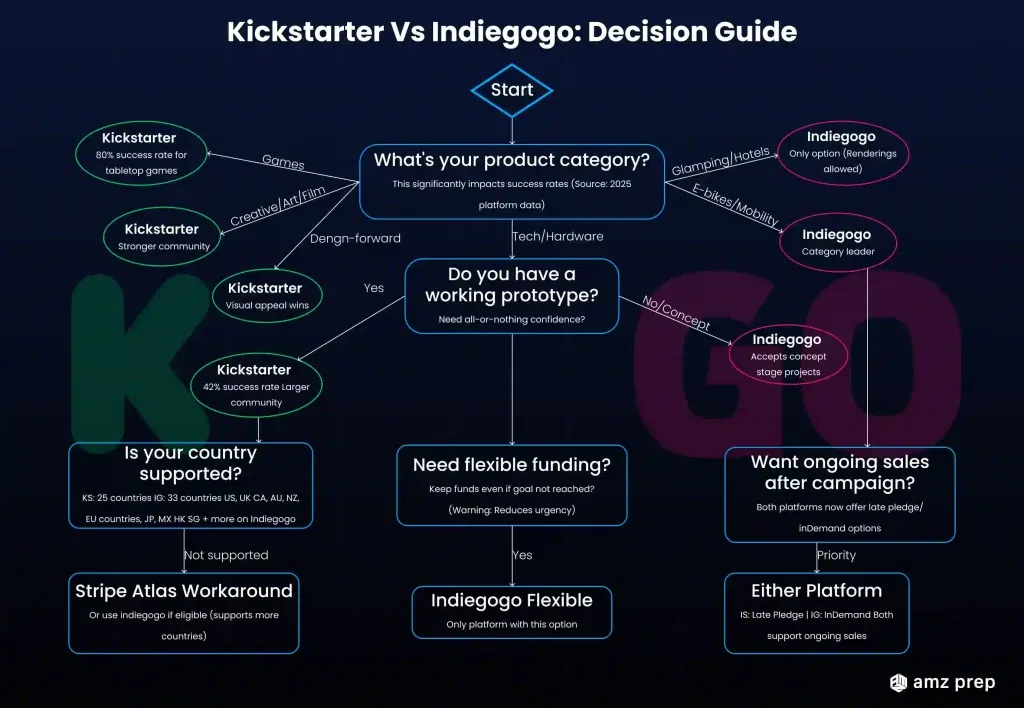
Flowchart (simplified)
Choosing between Kickstarter vs Indiegogo can feel overwhelming, but when you break it down step by step, the decision becomes clearer. As a seller, your product type, funding tolerance, audience location, and long-term business goals all point toward the platform that fits you best. The flowchart below simplifies this process, helping you see at a glance which crowdfunding path makes the most sense for your campaign.
Pro Tips to Maximize Your Crowdfunding Success
Even the best platform won’t help if your execution is weak. Here are pro tips:
Craft a compelling narrative and video
Backers want story, vision, clarity. Show the problem, the solution, and why you are the one to build it. Video quality matters, budget well for it.
Build your audience before launch
Use email lists, social media, and pre-launch landing pages. Sometimes, 30-50% of campaign funding comes from people you already know or have warmed up.
Offer rewards/perks thoughtfully
Early bird discounts, tiered pricing, clear shipping info, and Add-ons. Structure them to encourage higher pledges.
Transparency on risks & development timeline
Be honest about prototype level, manufacturing, and shipping. Backers appreciate realistic expectations. If delays happen, communicate.
Plan fulfillment & shipping costs carefully
Global shipping, customs, import duties, and packaging can blow up costs. Use correct estimates in your budgeting.
Use platform tools well
On Indiegogo, leverage InDemand, pre-launch tools, and email capture. On Kickstarter, use categories, tags, apply for featured spots, and ensure your campaign is well-edited and meets quality expectations.
Marketing & PR
Get press, bloggers, influencers onboard. Use social media, paid ads if budget allows. Even the best platform often gives only partial discovery; most traffic must be driven externally.
Update & engage backers
Regular updates, respond to questions, and involve them. Happy backers can become ambassadors.
Alternatives to Kickstarter Competitors
| Platform | Key Differences |
|---|---|
| Patreon | More for subscription / ongoing creative support rather than product pre-orders. Good for creators producing content regularly. |
| BackerKit / Backer-helper services | Not exactly a full campaign platform, more after-campaign or add-ons/pledge management. |
| CrowdSupply | Especially useful for hardware or open-source hardware projects; strong engineering/maker community. |
| RocketHub, Crowdfunder, GoFundMe | Tend to be more donation or charitable, or flexible in terms, less polished for product/sell pre-orders; sometimes less visibility for physical product launches. |
| Gamefound | Strong in board games/tabletop, rising prominence; sometimes operates in tandem with Indiegogo for gaming campaigns. (Also check local platforms in your country). |
| Equity Crowdfunding Sites (e.g., Wefunder, SeedInvest) | If you want to raise capital in exchange for equity rather than reward-based pre-orders. Different regulatory regime. |
If Kickstarter or Indiegogo doesn’t fit your needs, whether it’s due to eligibility limits, high fees, product restrictions, or audience mismatch, you still have plenty of options.
There are several crowdfunding platforms similar to Kickstarter, often called “Kickstarter type websites,” that serve as strong alternatives.
These Kickstarter competitors can give you the flexibility, reach, or niche focus you need to successfully launch your product
These Kickstarter competitors / Kickstarter alternatives may be more appropriate in certain niches, especially if your country disallows Kickstarter or your product falls outside Kickstarter’s eligibility.
2026 Crowdfunding Trends
To help you make an informed choice, here are some trends in 2026 in the world of crowdfunding of Kickstarter and Indiegogo.
Kickstarter:
- 42% success rate, highest among crowdfunding platforms
- Launched a built-in Pledge Manager so creators no longer need expensive third-party tools
- Tabletop games, design, wearables, and travel products perform best here
- Backers are design-lovers willing to spend more for quality
- Organic discovery is fading, so you must build an audience before launch
Indiegogo:
- Biggest news: Acquired by Gamefound in July 2025
- Dropped its flexible funding and now runs all-or-nothing like Kickstarter
Added AI campaign tools and better analytics dashboards - Best for tech gadgets, hardware, home automation, and e-bikes
- InDemand feature lets you keep selling after your campaign ends
Conclusion
If you are a seller weighing Kickstarter vs Indiegogo, the decision comes down to credibility versus flexibility. Kickstarter is the stronger choice if you want higher success rates, stronger trust, and media visibility, provided you have a polished prototype, strong visuals, and confidence in hitting your goal.
Indiegogo works better if you prefer flexible funding, ongoing sales through InDemand, and more forgiving eligibility, especially for hardware and lifestyle products. Align your choice with your business model, audience, and risk tolerance. Plan conservatively, account for shipping and delays, build your audience early, and use platform tools to strengthen your campaign.
FAQ
Which crowdfunding site actually gives sellers a higher chance of success?
Kickstarter’s campaigns succeed more often because the platform pushes credibility and attracts backers who trust its all-or-nothing system. Indiegogo’s numbers are lower, but if you’re testing demand or want to keep partial funding, it can still be the smarter pick. The real question is whether you’d rather risk raising nothing at all (Kickstarter) or risk being underfunded but obligated to deliver (Indiegogo).
Do I really need a prototype before launching?
On Kickstarter, yes, without a working prototype and strong visuals, you’ll almost certainly get rejected. Indiegogo lets you launch earlier, which sounds easier, but backers still expect proof. Even on Indiegogo, showing at least a functional sample dramatically improves conversion.
What happens to the money if I don’t hit my goal?
Kickstarter is all-or-nothing, if you fail to reach your goal, you walk away with zero. Indiegogo gives you options: fixed funding (like Kickstarter) or flexible funding, where you keep whatever you raise. Sellers should be careful with flexible funding, though. Keeping $20,000 on a $50,000 goal sounds good until you realize you still have to fulfill rewards with less money than you need.
How much will these platforms actually cost me?
Both take 5% of funds raised, plus roughly 3–5% in payment fees. What most sellers underestimate are the hidden costs of ads, influencer marketing, PR pushes, prototypes, and especially shipping. International orders can eat your profit if you don’t plan, no matter which platform you use.
Which types of products are better suited for each platform?
Kickstarter thrives on polished creative projects: tabletop games, books, films, and design pieces. Indiegogo shines with hardware and gadgets, especially for early adopters who don’t mind waiting. If your product is playful and creative, Kickstarter fits. If it’s innovative and tech-driven, Indiegogo’s audience will get it.
Can I launch outside the US?
Kickstarter only allows creators in specific countries, so if you don’t qualify, Indiegogo is usually the fallback. Some sellers set up business entities in eligible countries to access Kickstarter, but that adds legal and tax complexity. Indiegogo is generally more open and easier for international sellers.
Which platform is safer for a first-time seller?
If you want to play it safe and test demand, Indiegogo gives you breathing room. If you want to build credibility and get press coverage, Kickstarter is still the gold standard. A first-timer with a finished prototype should aim for Kickstarter, while someone earlier in development may find Indiegogo more forgiving.
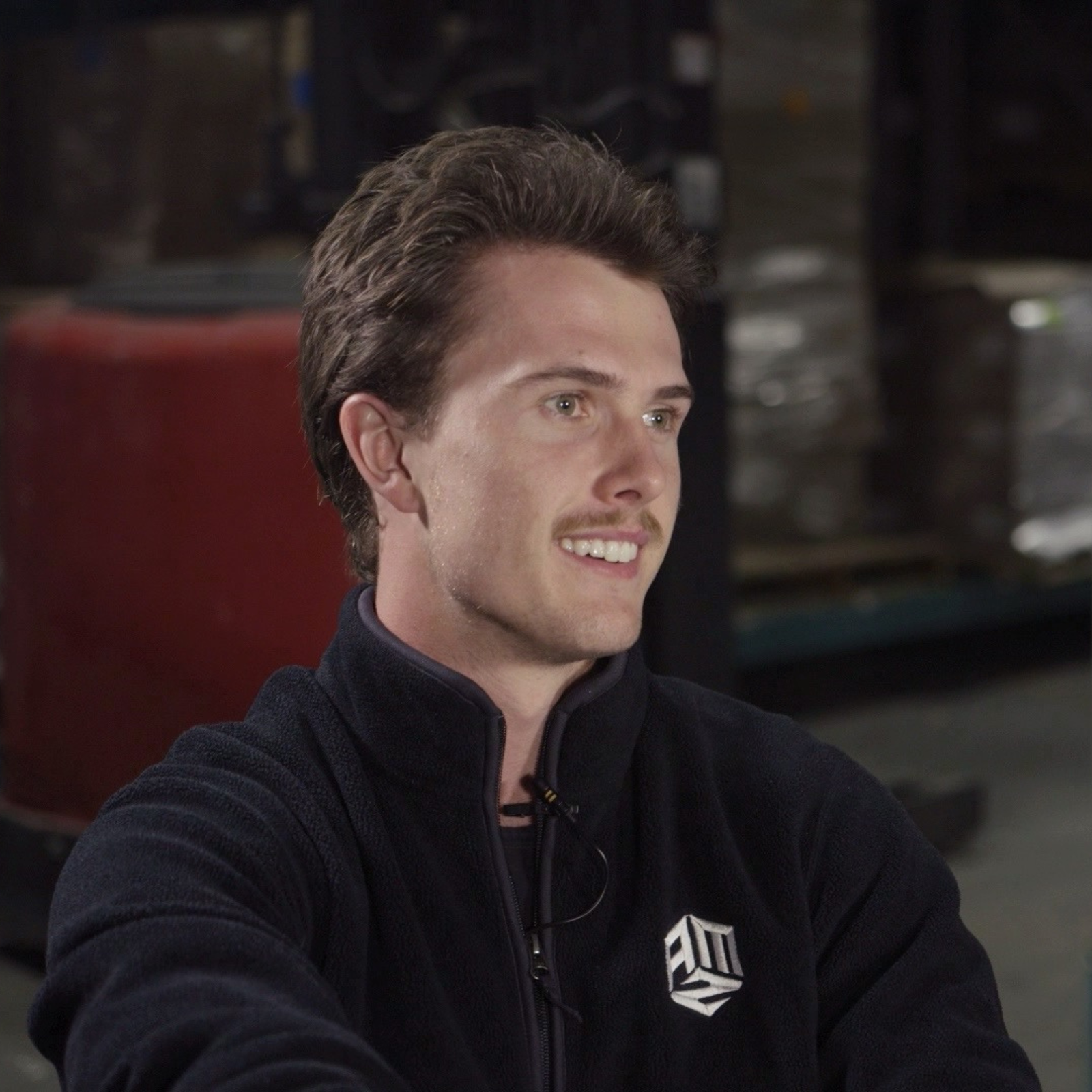
Blair Forrest is the Founder of AMZ Prep, one of North America’s fastest-growing third-party logistics and fulfillment networks, built entirely without outside capital since 2016. Under his leadership, AMZ Prep has scaled to 50+ fulfillment centers across 6 countries, processing over 10 million plus units monthly and powering $2 billion+ in annual GMV for more than 5,000 brands worldwide including 437, Silverts, Saltyface, Unilever, Duracell, and JBL. A recognized authority in eCommerce logistics, Amazon FBA strategy, and supply chain optimization, Blair has helped thousands of sellers and brands master their fulfillment operations from first shipment to enterprise scale. He regularly consults on FBA prep, multi-channel fulfillment, last mile delivery, international expansion, and cost reduction strategies that save brands 20–40% compared to traditional 3PL providers. Blair’s insights on Amazon logistics, 3PL operations, and eCommerce growth are widely cited across the industry. Through AMZ Prep’s content, guides, and resources, he continues to share battle-tested strategies drawn from managing one of the largest independently owned fulfillment networks in North America.














Very useful for choosing which crowdfunding route fits my new gadget.
Great side-by-side breakdown of the two platforms.
Love how you highlight the “all-or-nothing” vs flexible funding models.
The section about long-term brand building post-campaign resonated with me and made me rethink our strategy of treating crowdfunding as just one-off funding.
Excellent resource the decision framework at the end helps clarify whether our product fits Kickstarter’s creative-focus or Indiegogo’s tech innovation mindset.
The audience differentiation between Kickstarter and Indiegogo is eye-opening.
Good call on stressing prototype readiness before going for Kickstarter.
Short, actionable and full of insight for first-time crowdfunders.
I hadn’t realised how much backer trust differs between the two platforms until reading this. This will change how I plan my next launch.
Thanks for including the post-campaign sales capability of Indiegogo via InDemand.