
March began with Amazon expanding it’s ever evolving AI deeper into its ecosystem, and reshaping the economics around promotions, fulfillment, and platform access. For sellers, 3PLs, operators, and service providers, this is not just a list of product announcements.
What stands out to me is that March 2026 was not one isolated month of updates. It was a coordinated shift across policy, ad economics, logistics, seller cash flow, and customer-facing AI. That matters because Amazon rarely changes one part of the machine without affecting the rest. A policy update in Seller Central can change warehouse workflows. A fee adjustment in promotions can change margin strategy. A payout timing change can affect inventory planning. A consumer-facing AI rollout can shift traffic patterns, ad performance, and conversion behavior.
If you sell on Amazon, support Amazon sellers, manage operations, or build software around the marketplace, this is the kind of month you study carefully. And if you are reading this to understand what is actually important, I would focus on three themes:
First, Amazon is raising the operational standard for sellers.
Second, Amazon is taking promotional participation and automation bit more seriously than usual, I could say more controlled, but it’s more expensive really.
Third, As expected Amazon is betting on AI but for retail, healthcare, advertising, and cloud infrastructure. AI for Amazon is not tomorrow, it basically today it is becoming as integral as the Buy NOW button.
Below, I break down the biggest March 2026 updates, what changed, why it matters, and what it means in practical terms.
March 2026 Amazon Updates at a Glance
| Category | Update | Date | Why It Matters |
|---|---|---|---|
| Seller Policy | End of FBA commingling | March 31, 2026 | Changes labeling, eligibility, and inbound prep workflows |
| Seller Policy | Seller payout delay (DD+7) | March 12, 2026 | Impacts cash flow and working capital planning |
| Promotions | Prime Day 2026 fee structure | March 24, 2026 | Raises the cost of deal participation |
| Promotions | Prime Day moves to June | March 2026 | Changes seasonal planning and demand timing |
| Compliance | SDWA deadline | April 3, 2026 | Forces certification and compliance readiness for relevant ASINs |
| AI / Platform | BSA and Agent Policy update | March 4, 2026 | Expands oversight of automated tools and AI systems |
| Ads | Prompts reaches general availability | March 25, 2026 | Signals deeper AI-assisted shopping and ad discovery |
| Health | Health AI rollout | March 10–11, 2026 | Expands Amazon’s consumer health footprint |
| AWS | VPC Encryption Controls becomes paid | March 1, 2026 | Adds cost and governance considerations for cloud users |
| Business | Major partnerships and acquisitions | Throughout March | Reinforces Amazon’s long-term AI, logistics, and robotics strategy |
The end of FBA commingling is one of the most consequential seller-side changes in March 2026, and I do not say that lightly. On the surface, it sounds technical. In practice, it changes how sellers think about labeling, inventory ownership, and inbound accuracy.
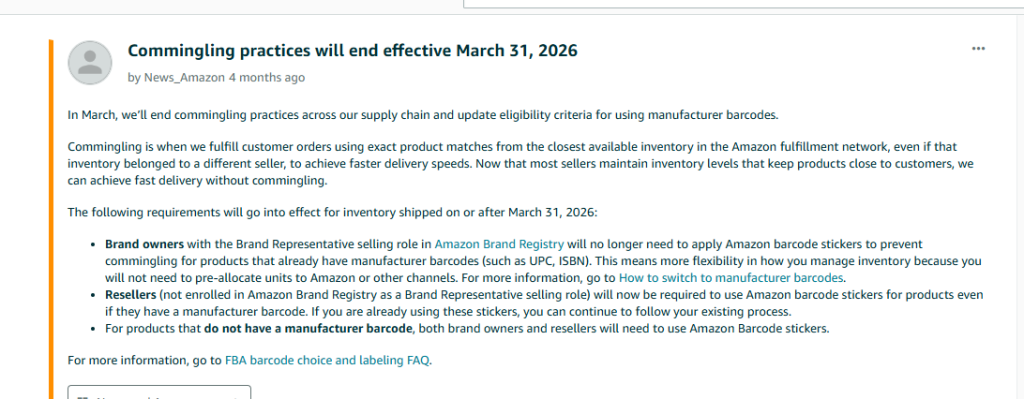
For years, commingling allowed Amazon to fulfill orders from matching inventory across the network, even when the units came from different sellers. That was efficient for speed, but it also created complexity around accountability, seller control, and product traceability. Ending commingling means Amazon is drawing a firmer line around which inventory belongs to whom and how it must be identified.
Sellers shifting into FBM or hybrid fulfillment should understand the role of Amazon approved carriers for Seller Fulfilled Prime, because using unsupported carriers can directly impact tracking performance and Prime eligibility.
Sellers should review Amazon FBA barcode requirements to ensure inventory meets updated inbound labeling standards following the end of commingling.
What changed
Brand owners in Brand Registry with the Brand Representative role no longer need to apply Amazon barcode stickers for products that already have manufacturer barcodes such as UPC or ISBN. That is a meaningful simplification for brand owners, especially those with strong catalog control and consistent packaging.
However, Resellers are in a different position. If a reseller is not enrolled in Brand Registry, they would need to use Amazon barcode labeling, including FNSKU labels, even when a manufacturer barcode exists. That means a more money spent on Prep and higher prices for customers. So if the price is same for a reseller and the Brand. Well the writing is on the wall.
Why it matters operationally
For sellers, this is not just a labeling story. It affects the entire fulfillment chain.
A few things become more important immediately:
- Inbound prep accuracy becomes more valuable.
- Warehouse SOPs need to distinguish brand-owner inventory from reseller inventory.
- Mislabeling risk goes up if teams are still operating under older assumptions.
- Reimbursements, receiving, and exception handling become more sensitive to label compliance.
The issue is simple: unlabeled or improperly labeled inventory arriving after the cutoff can be rejected or treated as defective. That creates a friction, and friction is expensive when it happens at scale.
What I read into this is Amazon’s preference for clearer ownership, cleaner data, and less ambiguity in fulfillment. The company does not want operational edge cases slowing down the network. Sellers who can document, label, and trace inventory cleanly will adapt faster. Sellers who relied on looser processes will feel the change immediately.
What sellers should do now
If I were advising an operator or brand on this change, I would focus on three immediate actions: review labeling standards by account type, audit inbound prep SOPs, and verify that 3PL partners understand the difference between Brand Registry permissions and reseller labeling requirements.
Compliance is becoming less of a checklist and more of a survival strategy, especially as Amazon FBA ASIN restrictions continue to tighten around meltable and regulated categories.
Seller Payout Delay: Cash Flow Just Became Part of the Strategy
The seller payout update introduced on March 12, 2026, may not sound dramatic at first glance, but it affects something every seller feels instantly: cash flow.
Amazon shifted FBA payouts to seven days after delivery, moving away from the prior post-shipment model. That means money now arrives later in the lifecycle of an order. That cash-flow pressure didn’t resolve in April it compounded. Our Amazon April updates breakdown covers how the fee surcharge that followed made the timing gap even harder to absorb for inventory-heavy sellers. For some brands, this is a manageable accounting shift. For others, especially sellers with rapid inventory turnover or tight replenishment cycles, it creates real pressure.
Why this matters
Cash flow is not a back-office detail. It determines how quickly you can reorder inventory, how much ad spend you can sustain, and how much working capital you need to keep the business running. When Amazon delays funds until after delivery, the lag between sale and usable cash expands.
That has several consequences:
| Area | Before DD+7 | After DD+7 |
|---|---|---|
| Cash availability | Faster release after shipment | Slower release after delivery |
| Inventory planning | Easier to recycle capital | More pressure on reserves |
| Ad spend | Easier to scale aggressively | Needs tighter budgeting |
| Peak season risk | Lower payout lag | Greater liquidity strain |
| Growth planning | Simpler reinvestment cycle | More disciplined forecasting |
The real operational impact
This policy matters most for sellers who depend on the timing of Amazon deposits to fund the next purchase order. It also matters for those selling lower-margin goods, where every day of delay compounds the working capital problem.
If your business runs on thin buffer inventory, it is time to rethink of your replenishment model. more conservative forecasts, closer tracking of payout timing, and a stronger focus on unit economics are needed now.
Reviewing the updated Amazon seller payment schedule is essential for forecasting inventory purchasing cycles under the DD+7 model.
My take
I see this as Amazon making the seller ecosystem behave more like a mature financial system and less like a fast-moving cash loop. The platform still gives sellers scale, but it expects them to carry more of the operational burden. That is the tradeoff.
If you support sellers, this is a conversation worth having proactively. Many founders will feel the payout delay as a mystery at first. It is much easier to manage when it is modeled into the business from the start.
Prime Day 2026 Fee Changes Reshape Deal Economics
March 24 brought one of the most watched changes of the month: the Prime Day 2026 submission window opened with a new fee structure for Lightning Deals, Best Deals, and Prime Exclusive Discounts.
This matters because Prime Day is one of the most important revenue events in the Amazon calendar. When Amazon changes how deal participation is priced, it changes how sellers think about margin, participation, and event ROI.
Sellers planning event participation should review Amazon Prime Day participation guidelines to understand eligibility and pricing expectations.
What changed
The headline shift is the move from free submissions to a “Fixed + Variable” fee model. Amazon also introduced an early bird incentive for submissions by April 30, with a $50 waiver on the U.S. fixed fee.
On top of that, pricing thresholds became more rigid. Deals must be at least 5% lower than the lowest price offered in the trailing 30 days. That reduces the room for artificial pricing games before a deal.
Why this matters for sellers
This change hits sellers in two ways.
First, it raises the cost of participation. Even strong sellers will now need to calculate whether Prime Day visibility is worth the fee structure.
Second, it narrows the room for price manipulation before events. The old playbook of temporarily increasing prices before discounting becomes far less effective when Amazon compares against the trailing 30-day floor.
Strategic implications
For performance marketers and marketplace operators, this is a signal that Amazon wants deal participation to reflect real promotional value, not merely tactical gaming.
That means sellers need to do more than ask, “Should I run a deal?” They need to ask:
- Will the incremental traffic convert?
- Does my margin support the fee and discount?
- Is this product already strong enough organically?
- Am I using the deal to drive rank, liquidation, seasonal volume, or new customer acquisition?
Prime Day 2026 planning considerations
| Question | What to evaluate |
|---|---|
| Margin | Can the business absorb discounting plus fees? |
| Inventory | Is stock deep enough to support event demand? |
| Price history | Is the trailing 30-day floor favorable? |
| Ranking goals | Is this a traffic play or a profit play? |
| Brand goals | Is the event meant to build awareness or clear inventory? |
My take
The fee change pushes Amazon promotions closer to a professional media-buy mindset. The sellers who win will be the ones who think in terms of contribution margin, rank impact, and basket economics rather than just “getting into Prime Day.”
Prime Day Moving to June Changes the Calendar for Everyone
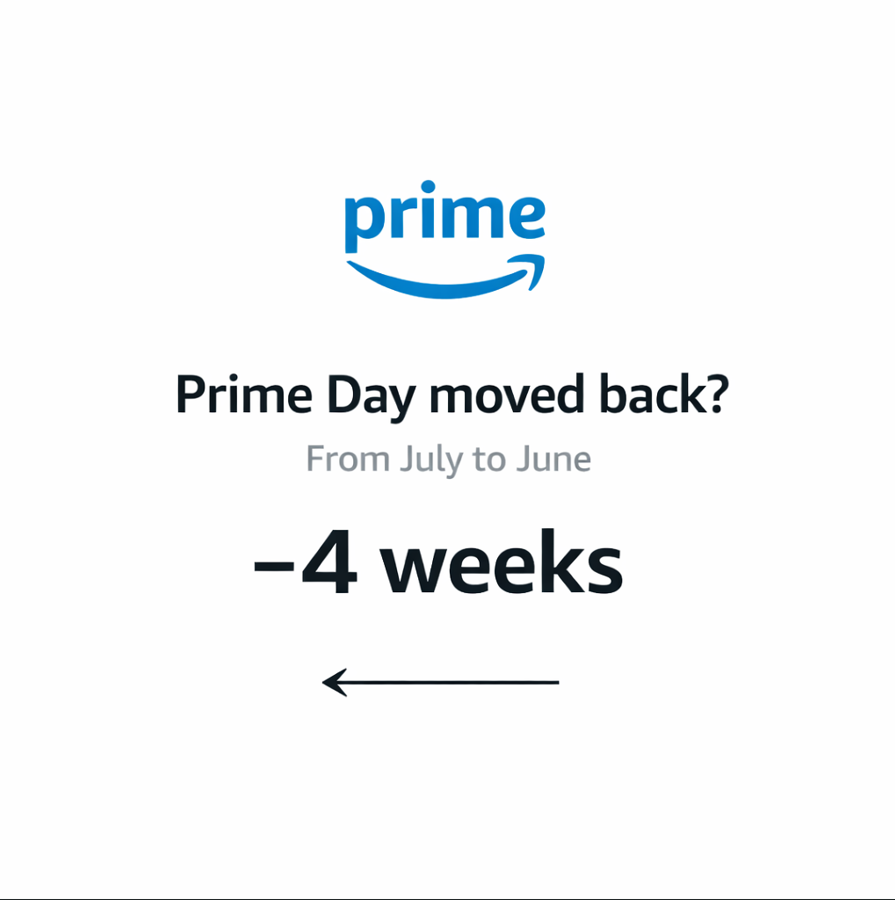
Amazon’s reported move of Prime Day from July to June is more than a marketing shuffle. It changes when demand happens, how brands prepare inventory, and how competitors respond.
A June Prime Day creates a different commercial rhythm. It pulls demand forward, changes the midpoint of the summer selling cycle, and potentially captures back-to-school and early seasonal spend before consumers disappear into vacation mode.
Why this matters
For sellers, calendar timing is never neutral. It affects procurement, warehouse planning, ad pacing, and launch windows.
A June event means:
- Inventory must be positioned earlier.
- PPC budgets need to be front-loaded.
- Launch schedules may need to be advanced.
- Seasonal assortments may need to hit the market sooner.
Industry-level effect
Competitors like Walmart and Target are not passive observers here. A shifted Prime Day changes how retail calendars align across the industry. It can trigger earlier competitive promotions and tighter pricing pressure in June.
My view
I see this as Amazon trying to own more of the summer consumer cycle before other retailers shape the narrative. That is classic Amazon behavior: use scale, timing, and logistics to define the market on its own terms.
For sellers, the takeaway is simple. Do not wait for the calendar to tell you what to do. Build your own event map around June, not just July.
Amazon’s New BSA and Agent Policy Bring AI Governance Into the Seller Stack
The March 4 update to Amazon’s Business Solutions Agreement and Agent Policy is one of the most important platform governance changes of the month.
This is where Amazon starts formally defining how automated systems and AI agents can interact with its services. That matters because sellers increasingly rely on software for repricing, inventory management, ad optimization, customer service, and reimbursement workflows.
Why this update matters
Amazon is making a distinction between ordinary software use and automated systems that act on behalf of users. That distinction matters in the age of AI agents. If a tool is not just reading data but acting programmatically in seller workflows, Amazon wants that relationship governed more tightly.
What this means for operators
Tools used for pricing, restocking, PPC management, and any FBA reimbursement automation tool that interacts with Seller Central or ad APIs may need to comply with the Agent Policy. In practical terms, this is a governance and risk issue.
Organizations should review:
- Which tools interact with Amazon programmatically
- Which tools are making decisions versus merely reporting data
- Whether internal automation scripts need compliance review
- Whether vendors have updated their terms and agent disclosures
Broader implication
I do not think this is just an Amazon policy update. I think it is part of a larger shift in how platforms manage AI access. Amazon is not rejecting automation. It is formalizing it, labeling it, and putting it inside a framework the company can control.
That should matter to anyone building or buying software in the Amazon ecosystem.
Amazon Health AI Shows Where the Platform Is Heading Next

The rollout of Health AI in March 2026 is another sign that Amazon is widening the definition of what its platform can do.
Health AI expanded from a more limited audience to broader availability, offering personalized guidance based on user health history and connecting more tightly with Amazon’s healthcare-related services.
Why it matters even for non-health sellers
At first glance, this may feel disconnected from e-commerce. It is not. Amazon’s move into healthcare is relevant because it shows how the company uses AI as a customer retention layer.
A customer who uses Amazon for shopping, health guidance, pharmacy, and device interactions is a customer inside a much wider ecosystem. That creates more touchpoints, more data, and more platform dependence.
Strategic reading
Amazon is building a lifestyle operating system, not just a marketplace. Health AI is part of that long game. The more useful Amazon becomes in daily life, the harder it is to leave the platform.
For sellers, that means competition is not just about product ranking anymore. It is about competing inside a platform that is increasingly shaping the whole customer journey.
AWS Updates Signal the Future of Amazon’s Infrastructure Play
March also brought several AWS changes that are worth paying attention to, even if your business lives primarily in retail.
VPC Encryption Controls moving from free preview to paid status is a good example. On its own, it is an AWS pricing change. In context, it reflects Amazon’s ongoing move toward more controlled, enterprise-grade governance features across its cloud stack.
With rising freight costs and tighter compliance windows, ignoring freight insurance is one of the fastest ways to turn a small shipping mistake into a major financial loss.
Why sellers should care about AWS news
A lot of sellers ignore AWS because they assume it only matters to developers. That is a mistake. AWS is one of Amazon’s strategic engines. When AWS pushes new governance, AI, and platform features, it influences the tools and services that retailers later depend on.
The bigger pattern
Across AWS in March, I see four themes:
- More agentic AI support
- More managed governance
- More workflow automation
- More monetization of advanced features
That is the same pattern we see in retail. Amazon is turning complexity into a paid, managed layer.
Amazon Ads Are Becoming More AI-Native
Amazon’s AI-related ad changes are just as important as its retail policy updates. The move of Prompts into general availability shows how Amazon is folding contextual AI deeper into the ad experience.
Prompts rely on first-party signals to surface more relevant information at key moments. For advertisers, that is a meaningful shift because it changes the shape of shopper intent.
Why this matters
In practical terms, ads are moving closer to shopping assistance. That means targeting, creative, and conversion are becoming more interconnected.
The old model was simple: keyword, impression, click, sale. The new model is more layered. AI systems now influence discovery, relevance, and the path to purchase in ways that are less linear and more contextual.
Implications for sellers
Sellers should expect:
- More competition for high-intent placements
- More dependence on clean catalog data
- Greater importance of detail page quality
- More pressure to align ad spend with actual conversion behavior
My view
This is not just an ad product upgrade. It is Amazon teaching the marketplace how to sell inside an AI-mediated shopping flow.
Consumer Features Like Alexa+ Matter More Than They Seem
Alexa+ launching new actions, including food ordering through Grubhub and Uber Eats, may look like a consumer convenience update. But it is also another sign that Amazon wants to own task execution, not just product discovery.
That is a serious distinction.
A shopping assistant is useful. A task-completing assistant is more powerful.
Why this matters
The more Alexa+ can do on behalf of a customer, the more Amazon can collapse the gap between intent and action. That increases the value of Amazon’s ecosystem and makes the company less dependent on traditional search behavior alone.
For sellers, that means the platform may increasingly reward brands and products that fit naturally into direct decision flows, recurring needs, and assistant-led shopping.
Business, Robotics, and Logistics Moves Point to Long-Term Scale
March 2026 also featured major business and infrastructure moves, including acquisitions, partnerships, and warehouse investment.
From a strategist’s perspective, these are not side stories. They are clues.
Amazon’s investment in robotics fulfillment, satellite connectivity, and AI partnerships shows that the company is still building for scale in the physical and digital layers of commerce at the same time.
As fulfillment complexity increases, more brands are turning to white glove delivery for oversized and high-value shipments where setup, placement, and damage prevention matter as much as speed.
Why this matters to operators
Every investment in robotics, fulfillment, satellite, or AI eventually affects service levels, shipping speed, warehouse design, and customer expectations.
That means sellers and 3PLs need to think several quarters ahead, not just react to the latest policy post.
Compliance Is Becoming a Competitive Advantage
The Safe Drinking Water Act deadline is a good reminder that compliance is no longer a background task. It is a competitive filter.
When Amazon sets a hard compliance deadline for categories like faucets, valves, pumps, pipes, and barrier materials, sellers either meet the standard or lose access to the market.
What makes this important
Compliance work often looks slow and administrative, but it has direct revenue consequences. Sellers who organize testing, certification, and documentation early preserve listing continuity. Sellers who wait often face interruptions, rejection, or remediation costs.
Operational takeaway
For regulated categories, compliance should be treated as a revenue protection function, not just a legal requirement.
The Biggest Strategic Takeaways From March 2026
If I had to boil the entire month down to a few strategic lessons, this is how I would frame it.
| Theme | What Amazon is doing | What it means for sellers |
|---|---|---|
| Control | Tightening policy and labeling rules | Less tolerance for sloppy operations |
| Monetization | Introducing or expanding fees | More cost discipline required |
| Automation | Formalizing AI and agent access | Software governance becomes essential |
| Speed | Shifting calendars and payout timing | Cash flow and logistics planning matter more |
| Ecosystem expansion | Moving into health, retail tasks, and devices | Amazon becomes harder to treat as a single channel |
The biggest story in March 2026 is not any single announcement. It is the direction of the platform itself.
Amazon is becoming more structured, more AI-driven, more regulated, and more operationally demanding. Sellers who understand that early will make better decisions. Sellers who do not will keep treating Amazon like it is still operating on older assumptions.
That is a costly mistake.
For brands expanding internationally, understanding how to ship supplements to Canada is critical because regulatory paperwork and ingredient approvals can delay launches if overlooked.
This is what sellers need to Hear
If I were speaking directly to brands, resellers, aggregators, and operators, here is the advice I would give.
Get your labeling and inbound workflows right immediately.
Model your cash flow as if payouts will always arrive later than expected.
Treat Prime Day as a margin decision, not just a visibility event.
Audit every automation tool that touches Amazon data or workflows.
Make compliance part of your operating rhythm, not an emergency response.
Those are not dramatic recommendations. They are practical ones. And in a month like March 2026, practical wins.
Final Thoughts
The marketplace is becoming more disciplined. The promotion layer is becoming more expensive. Automation is becoming more governed. And AI is becoming more visible across nearly every surface Amazon controls.
For sellers, that means success will depend less on hustle and more on system-level thinking. Data is the key to wins, disciplined margins, compliant inventory, and flexible cash flow. That is the new baseline. No escaping that but hustling.
And for anyone watching Amazon as an industry signal, March 2026 is a reminder of something I think the market keeps relearning: Amazon does not usually move in small, isolated ways. It moves in layers. The people who understand the layers early are the ones who stay ahead of the curve.
FAQ
What is the most important Amazon update in March 2026?
For sellers, the most important updates are the end of FBA commingling, the seller payout delay, and the Prime Day fee structure change. Those three affect operations, cash flow, and promotions directly.
Does the commingling change affect every seller the same way?
No. Brand owners in Brand Registry with the right role are treated differently from resellers. That is why account type and labeling status matter so much.
Why does the payout delay matter so much?
Because it changes when cash becomes usable. Even if sales are strong, delayed access to revenue can create inventory and advertising pressure.
Should sellers still participate in Prime Day?
Yes, but the decision should be more analytical. The new fee structure means every deal should be evaluated on margin, volume, and strategic value.
Is Amazon becoming more AI-driven overall?
Absolutely. March 2026 shows that AI is no longer a side project for Amazon. It is becoming part of shopping, advertising, healthcare, and cloud operations.

Arishekar N is a Vice President (VP) of Marketing at AMZ Prep, specializing in ecommerce fulfillment and Amazon logistics strategies with a proven track record of driving growth for e-commerce businesses. He is a strategic leader with extensive expertise in marketing, e-commerce operations, SEO & advertising, and branding.
Stay updated on his latest insights by following him

















Comments