You’re moving thousands of frozen orders every month. Your product works. Your customers are coming back. But somewhere between the growth you’ve built and the operation running behind it, something feels off.
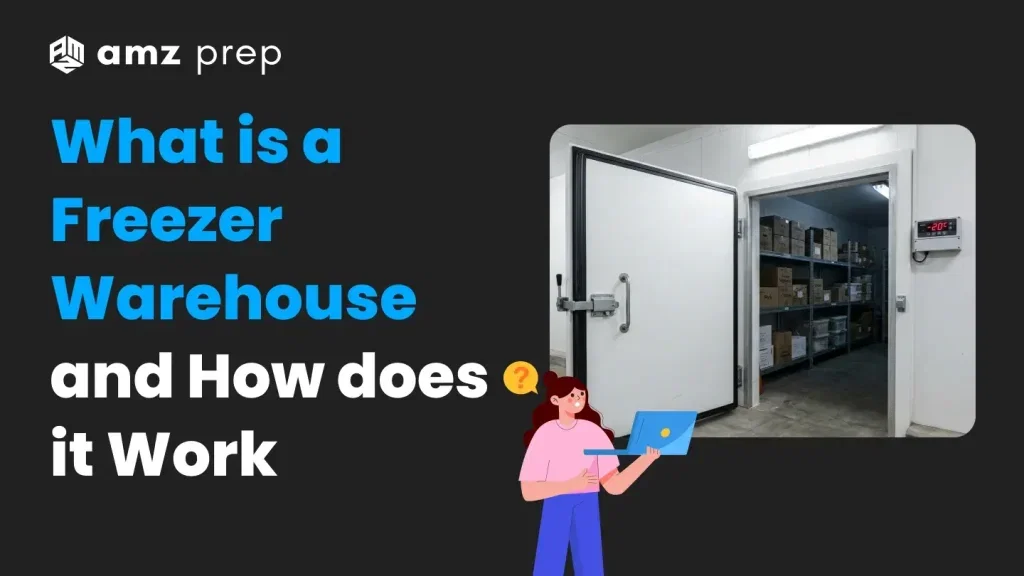
Maybe your freezer warehouse partner goes quiet when you ask for temperature logs. Maybe you’re seeing recurring chargebacks from customers receiving partially thawed products.
Maybe storage costs keep climbing and you can’t pinpoint exactly why.
The common thread in almost every one of these situations is the same: a freezer warehouse setup that was never built to handle the volume you’re running today.
This isn’t a beginner’s guide to what a freezer warehouse is. You already know, you’re using one.
This is a guide to using one well, spotting the ones that will quietly cost you, and making sure your freezer warehouse is actually built for where your business is going.
How to know if your freezer warehouse is actually doing its job
Here’s the definition that matters in practice. A freezer warehouse is a purpose-built, sub-zero storage facility that maintains products at or below 0°F (-18°C) continuously, and at your volume, it’s the single operational environment responsible for protecting the quality, compliance, and commercial value of every frozen unit in your inventory.
That distinction is important. A freezer warehouse that averages 0°F but swings between -5°F and 10°F throughout the day isn’t doing its job.
A freezer warehouse that loses power for four hours without automatic backup isn’t doing its job. A facility that stores product correctly but handles it carelessly at the dock, letting pallets sit in ambient heat during loading, isn’t doing its job either.
The standard isn’t just “frozen.” It’s consistently frozen, compliantly handled, and fully traceable from receiving to dispatch. If your current freezer warehouse doesn’t meet all three, you’re absorbing losses you may not even be seeing yet.
Freezer warehouse vs. Cold storage: Why the difference matters for your operation
These two terms get used interchangeably all the time. They’re not the same, and mixing them up when evaluating providers will cost you.
Cold storage is the broad category, referring to any temperature-controlled storage environment, from fresh produce kept at 38°F to pharmaceutical products held at -80°C.
A freezer warehouse is the sub-zero segment of that category.
Specifically designed, specifically built, and specifically operated for products that need to stay frozen.
What this means practically: a facility that calls itself a cold storage provider may have a refrigerated zone and a small freezer room bolted on. That’s very different from a purpose-built freezer warehouse where sub-zero operations are the entire business.
At 5,000 frozen orders a month, that difference shows up in temperature consistency, dock protocols, compliance certifications, and ultimately in your product quality and your customer reviews.
When you’re evaluating options, ask directly: is frozen storage your primary operation, or part of a broader ambient and refrigerated offering?
The answer tells you a lot about how seriously they treat it.
And once you know where a provider actually stands on that question, it becomes a lot easier to figure out which of the following situations you’re in.
Why your freezer warehouse setup may not be working
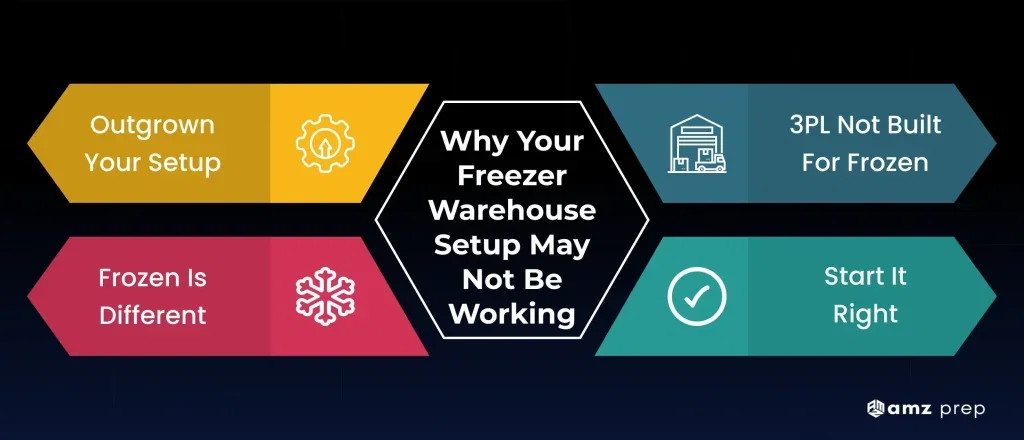
Sellers at your volume don’t land on a guide like this out of idle curiosity. You’re here because something in your current freezer warehouse arrangement is creating friction. Let’s name the situations directly.
Outgrown your setup
It made sense early on, a rented freezer unit, a local cold storage arrangement, maybe your own walk-in.
Now you’re processing 150 or more frozen orders every single day. Manual inventory management is burning your team’s time. Storage fills up before the month ends. You know the setup needs to change.
You just haven’t pulled the trigger.
3PL not built for frozen
Your 3PL offered freezer warehousing as a side service, not a core one. This is one of the most common issues at your volume. A lot of general 3PLs have a cold room.
They’ll take your frozen inventory. But when capacity gets tight during peak season or a competitor client has more volume, your product gets deprioritized. Temperature logs are inconsistent. FIFO rotation becomes an afterthought.
When you push for answers, you get reassurances instead of data.
Frozen is different
You expanded into frozen from ambient and underestimated the gap. Frozen fulfillment isn’t ambient with a lower temperature dial.
It’s a fundamentally different operational environment with different packaging requirements, different carrier relationships, different compliance frameworks, and a much narrower margin for error.
Sellers who discover this mid-scale usually discover it the hard way.
Start it right
You’re launching frozen for the first time and want to get it right from day one.
Building your freezer warehouse foundation properly from the start costs far less than patching it together at volume and trying to fix it later.
Whichever situation you’re in, what you store and how your product category behaves under frozen conditions changes what you actually need from a provider.
What you’re storing in a freezer warehouse and what that demands
Your product category drives everything about what a competent freezer warehouse needs to do for you. This is not one-size-fits-all.
Frozen meals and DTC food brands
Your customers ordered a premium product. They expect it to arrive exactly as your marketing promised.
That means temperature consistency during storage, proper FIFO rotation to prevent expiration issues, and outbound packaging engineered for last-mile frozen delivery. At your volume, a freezer warehouse managing expiration dates in a spreadsheet is a liability.
You need a WMS tracking lot numbers, production dates, and rotation automatically.
Meat and seafood
The least forgiving frozen category. HACCP certification, USDA approval, and FDA registration are non-negotiable baseline requirements for any freezer warehouse handling these products.
Temperature requirements are also stricter, as premium seafood often needs storage at -40°F or below. A freezer warehouse running at standard -18°C and claiming to handle high-grade seafood long-term is underselling the risk.
Get temperature capability confirmed in writing.
Dairy and ice cream
More sensitive than most sellers expect. Even brief temperature variance during freezer warehouse storage causes ice crystal formation that changes texture, and customers notice, photograph, and review it.
If you’re shipping premium dairy at scale, your freezer warehouse’s temperature consistency is a direct driver of your product ratings.
Pharmaceutical and biotech products
The compliance bar here is categorically higher. You need GDP (Good Distribution Practice) compliance, documented chain-of-custody, and in many cases ultra-low temperature capability down to -80°C.
A freezer warehouse built for food products but lacking pharmaceutical compliance protocols isn’t suitable for this category, regardless of how good the cold infrastructure looks.
Knowing what your product demands is one side of the equation. The other side is understanding where most sellers go wrong once they’re operating at scale.
Amazon sellers storing meltable inventory can use this playbook to plan their fulfillment and sales strategy across the restricted period. Button: Download the Meltable Season Playbook
Common freezer warehouse mistakes sellers make at scale
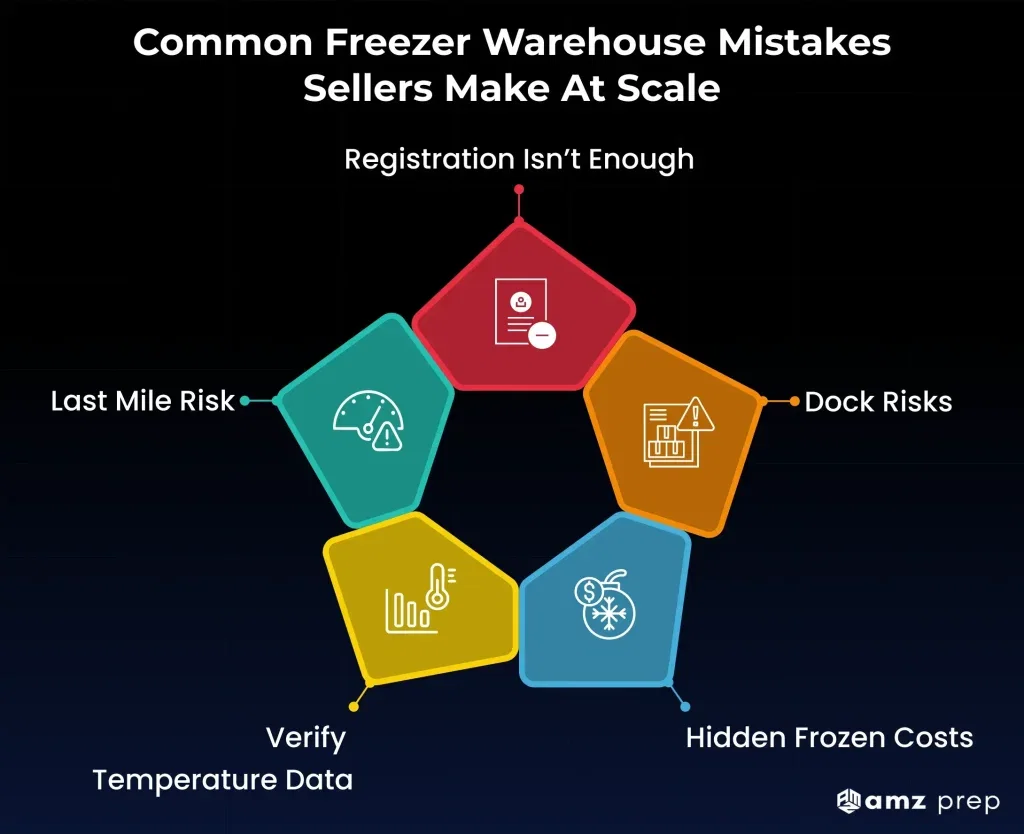
Most costly errors in frozen fulfillment aren’t dramatic failures. They’re slow leaks, things that quietly drain margin and damage customer relationships long before they show up as visible problems.
Registration isn’t enough
Assuming “FDA registered” means “fully compliant.” FDA registration is a starting point, not a quality certification. A freezer warehouse can be registered and still run inconsistent temperature logs, poor dock management, and sloppy FIFO rotation.
Registration tells you the facility is on the FDA’s radar. It doesn’t tell you how well they operate day to day.
Dock risks
Focusing on the storage environment and ignoring the dock. The cold chain breaks at the dock far more often than inside the freezer warehouse itself. Looking inside an eCommerce fulfillment center shows why receiving, staging, loading, and inventory movement all matter to maintaining the cold chain.
Product sitting on a loading dock in summer heat for twenty minutes, a staging area without temperature control, a door left open too long during receiving.
These are where quality failures actually happen. Most sellers never ask about dock protocols. Ask.
Hidden frozen costs
Not modeling your full frozen fulfillment cost before pricing your product. Freezer warehouse storage fees are higher than ambient because of continuous energy costs.
But the surrounding costs catch sellers off guard: insulated liners, dry ice or gel packs, cold-rated corrugated, and temperature-controlled carrier premiums all add up per order.
If you didn’t build every layer into your margins before launch, you’re already losing money you hadn’t planned to lose.
Verify temperature data
Taking your freezer warehouse partner’s temperature claims at face value. Every facility will tell you they maintain consistent sub-zero temperatures.
The ones who can prove it hand you 12 months of temperature logs without hesitation. The ones who can’t will tell you the data is available but hard to access right now. That friction is your answer.
Last mile risk
Protecting the freezer warehouse and ignoring the last-mile delivery.
You can have the most compliant freezer warehouse in the country, but if your carrier isn’t set up for temperature-controlled delivery and your packaging isn’t engineered for your specific transit times and seasonal temperature ranges, your customer still gets a compromised product.
The cold chain is only as strong as its weakest link, and for most ecommerce sellers, that link is the final mile.
If you’re not sure whether your current setup is already making some of these mistakes, the next section will help you find out.
How to audit your current freezer warehouse setup
Not sure if your current freezer warehouse is actually performing at the level your business needs? Run through this honestly.
Temperature documentation
Can you pull a temperature report covering the last 30 days for your freezer warehouse storage area right now, without requesting it from your 3PL and waiting?
If the answer is no, your visibility into the most critical variable in your frozen operation is essentially zero.
Deviation records
Ask your partner directly: how many temperature deviation events occurred in your freezer warehouse storage zone over the last six months, and what was the documented response to each one?
A facility that’s genuinely on top of this has clean records.
One that isn’t will struggle to answer clearly.
FIFO compliance
Pull a sample of recent outbound shipments and check the production or best-by dates on what shipped. Is the oldest stock moving first?
If a newer product is going out while older inventory sits in your freezer warehouse, your rotation management is broken, and so is your expiration risk management.
Dock protocol
Ask your freezer warehouse partner to walk you through exactly what happens from the moment a carrier docks for outbound pickup to the moment the last pallet is loaded. How long is the product outside a frozen environment?
Is there a temperature-controlled staging area? What happens when a carrier is delayed? The specificity of the answer tells you a lot.
Backup power
When was the last time the backup generator was tested under full load? What’s the documented response time from power failure to backup activation?
Any freezer warehouse handling your product that can’t answer this question immediately is running infrastructure risk that ultimately sits on your inventory.
Certification currency
When were HACCP, SQF, or other applicable certifications last audited and renewed?
Certifications that haven’t been renewed in several years are worth raising directly with your current or prospective partner.
If your current setup is showing cracks under that audit, the red flags below will help you recognize the same patterns when you’re evaluating someone new.
How much does freezer warehouse fulfillment cost?
Frozen fulfillment costs more than ambient. That’s just the reality. But the sellers who get burned aren’t usually surprised by the base cost of freezer warehouse storage. They’re surprised by what they didn’t account for upfront.
Pallet storage fees in a freezer warehouse run two to three times higher than ambient because of continuous energy costs. That’s expected.
What catches sellers off guard is the surrounding costs. Insulated packaging adds $2 to $8 per order depending on liner type and transit window. Dry ice or gel pack replenishment is an ongoing consumable.
Temperature-controlled carrier premiums stack on top of standard shipping rates. Blast freezing fees apply if your supply chain involves fresh-to-frozen production.
Run the full math per frozen order before you make any decisions. Sellers who model the complete cost structure make better decisions about pricing, partners, and growth plans.
Sellers who look at freezer warehouse storage fees in isolation end up with invoice surprises they could have avoided.
The cost of getting it wrong is the other side of the equation. A temperature breach compromising a pallet of premium seafood, a compliance gap triggering a recall, a wave of negative reviews from customers receiving thawed orders.
Those costs compound quickly and are very hard to recover from at scale.
Once you have a clear picture of what frozen fulfillment actually costs, you’re in a much better position to evaluate whether the partner in front of you is genuinely built to deliver it.
Choosing the right freezer warehouse partner
You’re not looking for a facility with cold walls and a dock door. You’re looking for an operational partner who is as serious about the quality and compliance of your product as you are.
They answer your questions with data, not reassurances. Temperature logs, deviation records, and audit histories are handed over without being chased. Certifications are current and certificates are produced on request.
Their WMS gives you real-time inventory visibility you can access yourself. Dock protocols are documented and followed consistently. Backup power has been load-tested recently and they can tell you exactly when.
Their capacity model is honest about peak limitations rather than overpromising flexibility they don’t have.
And most importantly, frozen fulfillment is their core competency, not a side service. When something goes wrong, because something always eventually goes wrong in logistics, there’s a protocol.
They call you before you call them. They isolate the issue, document it, and tell you exactly what it means for your product and your next steps.
That’s what your operation deserves from a freezer warehouse partner. Anything less is a risk your business shouldn’t carry.
Final Thoughts
Your freezer warehouse is not just a line item in your logistics budget. It is the part of your operation that either holds everything together or slowly pulls it apart. Temperature logs that don’t exist, dock protocols nobody actually follows, certifications that lapsed two years ago. None of that is a minor administrative gap. At the volume you’re running, those are real hits to your product quality, your reputation, and your margins.
Go back through everything covered in this guide before you sign your next contract. Push for documentation, not promises. Push for data, not reassurances.
A freezer warehouse partner who knows what they’re doing will not flinch when you ask hard questions. That reaction alone is worth paying attention to.
FAQs
1. Can a freezer warehouse handle ecommerce fulfillment, or is it just storage?
It depends on the provider, but most modern freezer warehouses do a lot more than just hold your pallets. Many of them will pick, pack, and ship your orders straight to your customers. Before you sign anything, confirm they can connect with whatever platform you’re selling on, whether that’s Shopify, Amazon, or somewhere else.
2. How much will freezer warehouse storage cost you?
More than you’d pay for regular warehousing, that’s for sure. Frozen storage typically runs $25 to $60+ per pallet each month, and that’s before you factor in receiving fees, pick and pack, and shipping. Ask for a line-by-line breakdown of every fee before you commit. Monthly invoices from 3PLs can get messy fast if you’re not paying attention upfront.
3. Do you need to meet a minimum volume to get started?
Usually, yes. A lot of providers won’t take you on unless you can commit to a certain number of pallets or monthly orders. If your business is still growing, be upfront about your current numbers and ask whether they have flexible pricing options. Some will work with you, others won’t, and it’s better to know that before you waste time going back and forth.
4. What temperature will your products actually be stored at?
Most freezer warehouses run at or below 0°F (-18°C). If your product has tighter requirements than that, say you’re dealing with certain pharmaceuticals or specialty foods, make sure you get the exact temperature range confirmed and written into your contract. A verbal assurance isn’t worth much if something goes wrong.
5. How do you ship your products without breaking the cold chain?
You’ll need refrigerated freight. If your shipment shows up outside the facility’s accepted temperature range, they have every right to turn it away. Talk to your freight carrier and your 3PL before your first inbound shipment so everyone is on the same page about requirements, transit times, and handoff procedures.
6. What certifications should you be looking for?
For food products, SQF or HACCP certification should be non-negotiable. If you’re in pharma, check that the facility is FDA registered. These aren’t just badges on a website. They mean the facility has gone through independent audits and has real food safety protocols in place, which matters if something ever goes sideways with your product.
7. What happens to your inventory during a power outage?
Any facility worth working with should have backup generators and redundant cooling that kicks in without any manual intervention. Ask them directly how long their backup systems can sustain frozen temperatures and what their protocol is if cooling fails for an extended period. Also find out if their insurance actually covers product loss in that scenario, and get it documented.
8. Can you store both frozen and non-frozen products under one roof?
Yes, if the facility has separate temperature zones set up for it. A lot of 3PLs now run ambient, refrigerated, and frozen storage in the same building. If you carry a mix of frozen and shelf-stable products, finding a provider that handles both saves you from splitting your inventory between two different warehouses and dealing with two sets of fees and contacts.
9. How do you make sure your products arrive at your customer’s door still frozen?
This comes down to packaging and transit time planning. Ask your provider exactly what they use, gel packs, dry ice, insulated liners, and whether their packaging holds up for ground shipments going across multiple states. Summer months are where this gets tricky, so make sure they have a clear protocol for warm weather and not just a generic answer.
10. How do you get a quote?
Pull together your numbers before you reach out: monthly order volume, how many SKUs you carry, average pallet count, required temperature range, and any extras like kitting or custom labeling. The more specific you are, the faster you’ll get a real quote back. Vague inquiries usually get vague answers, and you want to be able to compare providers properly.

Arishekar N is a Vice President (VP) of Marketing at AMZ Prep, specializing in ecommerce fulfillment and Amazon logistics strategies with a proven track record of driving growth for e-commerce businesses. He is a strategic leader with extensive expertise in marketing, e-commerce operations, SEO & advertising, and branding.
Stay updated on his latest insights by following him
















Comments