
Your apparel shipment just got rejected by Amazon’s FBA prep center. The reason? Improper poly bagging.
Three weeks of planning. Thousands spent on inventory. And now you’re stuck to fix it before going out of stock.
If you sell apparel on Amazon, you’ve probably faced similar issues – a supplier missed their deadline, quality issues, customs held up your peak-season shipment. The same prep discipline applies if you’re expanding to other platforms for example, a Shein fulfillment service has its own packaging and inbound standards you’ll need to plan around.
These problems usually aren’t about bad luck, they’re signs of a weak or misunderstood supply chain.
Most sellers focus on products and pricing. But they skip over the operations, logistics, and prep work that actually determine whether their business runs smoothly or loses revenue.
This blog will break it all down. From sourcing to fulfillment, this blog will walk you through each stage of the apparel industry supply chain. Let’s go behind the scenes!
Understanding the Apparel Industry Supply Chain
The apparel supply chain involves suppliers, manufacturers, shippers, and fulfillment centers all working together. There are six main stages:
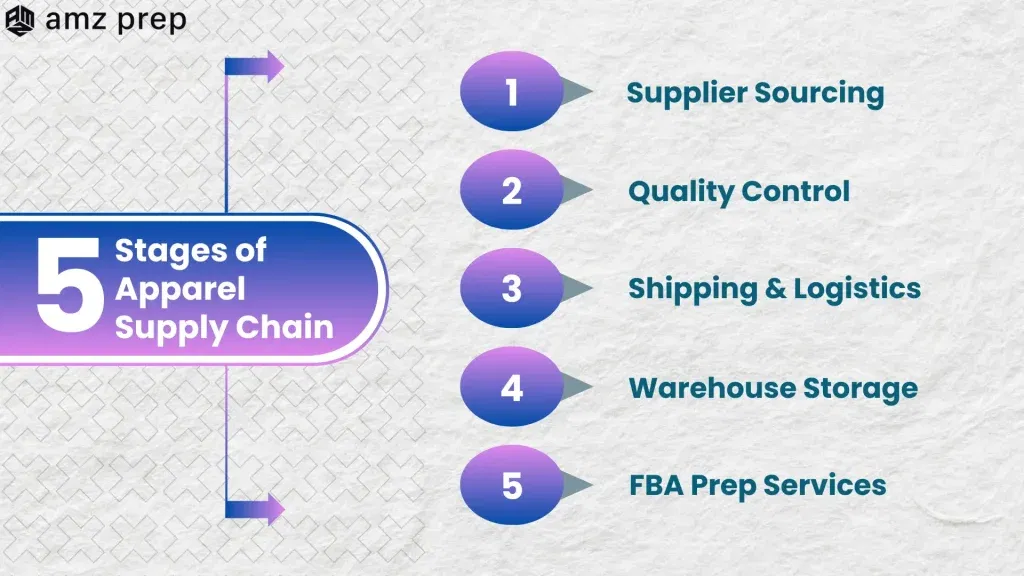
Stage 1: Supplier Sourcing – Finding and vetting manufacturing partners
Stage 2: Manufacturing – Converting designs into finished products
Stage 3: Quality Control – Ensuring product standards and specifications
Stage 4: Shipping & Logistics – International transportation and customs
Stage 5: Warehousing – Storage and inventory management
Stage 6: Fulfillment – Order processing and customer delivery
Let’s look into each stage in detail:
Stage 1: Supplier Sourcing
Supplier sourcing is the foundation of your apparel business. The suppliers you choose will determine your product quality, costs, lead times, and ability to scale. As a retailer, your success depends on finding reliable manufacturing partners who can bring your vision to life.
Finding the Right Suppliers
Not all suppliers are created equal. Different manufacturers specialize in different product categories, quality levels, and order volumes. Your choice of supplier will impact everything from product quality to delivery timelines.
Domestic vs. International Suppliers
Domestic suppliers offer faster communication, shorter lead times, and easier quality control, but typically come with higher costs. International suppliers, particularly in Asia, offer competitive pricing and large production capacity but require more complex logistics and longer lead times. For certain industries, like electronics or apparel that rely on wiring components, working with the best wire harness manufacturers in China can provide both cost efficiency and dependable production capacity.
Production Capacity Assessment
Understand your supplier’s current capacity and growth potential. Suppliers operating at 90%+ capacity can’t handle rush orders or accommodate your business growth. Look for partners with room to scale alongside your business.
Building Supplier Relationships
Strong supplier relationships are the backbone of successful apparel businesses. These partnerships go beyond transactional exchanges to create mutual value and reliability.
Supplier Diversification Strategy
Never rely on a single supplier for critical products. Develop relationships with 2-3 suppliers for your core items, even if it means slightly higher unit costs. When one supplier faces capacity constraints, quality issues, or unexpected problems, you have alternatives ready.
Long-term Partnership Approach
Treat suppliers as partners, not just vendors. Suppliers who see you as a long-term partner are more likely to prioritize your orders, offer better pricing, and accommodate special requests. This might include sharing forecasts, providing advance notice of seasonal needs, or offering design feedback.
Managing Supplier Lead Times and Seasonal Demands
Apparel is inherently seasonal, which creates unique challenges for supplier management and inventory planning.
Seasonal Planning
Start planning your seasonal collections 4-6 months in advance. Spring/summer collections need to be ordered by fall, while fall/winter items should be ordered by early spring. This requires forecasting demand well before you have current season sales data.
Supplier Capacity Management
Understand your suppliers’ busy seasons and plan accordingly. Most apparel manufacturers experience peak demand before major selling seasons. Book capacity early and be prepared to pay premium rates for rush orders.
Sample Development Timeline: Factor in sample development time when planning your sourcing timeline. Custom products require multiple sample rounds, which can add 2-4 weeks to your overall timeline. Standard products with minor modifications still need samples for approval.
Stage 2: Quality Control
Quality control goes beyond just manufacturing – it affects every part of your business. Quality problems directly hurt customer loyalty, increase returns, and damage your brand.
Implementing Multi-stage Quality Control
Effective quality control takes place at various stages along your supply chain, not simply at the end.
Look at your materials as soon as they get to the factory. Finding problems early saves you a lot of time and money because they’re much easier to fix right away.
Watch out for these common problems:
- Colors that look different than what you wanted
- Tears, holes, or other damage in the fabric
- Materials that aren’t what you actually ordered
Final quality control before products leave the manufacturer. This is your last chance to find out for any issues before products reach customers or your fulfillment center.
When products arrive at your fulfillment center or third-party logistics facility, do perform quality checks. This detects shipping damage and ensures that products satisfy your criteria after they leave the manufacturing facility.
Common Quality Issues in Apparel
Knowing what usually goes wrong helps you prevent problems and catch them faster.
- Wrong sizing is the top reason customers return clothes.
- Color matching problems occur when different material lots don’t match or when dyeing processes aren’t controlled properly. Set up color standards using systems like Pantone and ask for sample approvals for each batch of dyed fabric.
- Bad stitching, weak seams, or wrong assembly methods cause products to fall apart and upset customers.
- Fabric flaws, print quality issues, or incorrect materials affect product appearance and performance. Incoming material inspection catches most of these problems before they reach customers.
Stage 3: International Shipping & Logistics
International shipping and logistics connect your manufacturing and fulfillment processes. This stage comprises complex laws, time considerations, and cost management, all of which have a direct impact on the preparation of inventory and profit.
Understanding International Shipping Options
Different shipping methods offer trade-offs between cost, speed, and reliability. Picking the right option greatly affects your inventory planning, cash flow, and keeping customers happy.
| Mode | Typical Transit Time | Best For |
|---|---|---|
| Sea Freight | 14–21 days (Asia to US) + customs/inland time | Seasonal inventory, large/bulk shipments, when timing is flexible |
| Air Freight | 3–7 days (Asia to US) | Urgent orders, high-value products, avoiding stockouts |
| Express Services | 2–5 days (global) | Samples, small urgent orders, time-sensitive deliveries |
| Rail/Truck | Varies by origin (faster from Mexico/Canada) | Cross-border shipments from Canada/Mexico, balancing cost and speed |
Suggested Read: A Practical Guide to CUSMA, HTS Codes, and Preferential Duty
Customs and Compliance Management
When shipping to other countries, you must follow customs rules. These rules change based on how long shipping takes, what it costs, and whether you’re following the law.
Getting Your Product Coded and Paying Fees
Clothes have special codes called HTS codes that decide how much tax you pay. Getting the right code matters because it affects your final costs and how fast customs lets your products through. Talk to customs people or shipping companies who know about clothing codes.
Papers You Need
When shipping to other countries, you need several papers: bills that show what you’re selling, lists of what’s in each box, shipping documents, and sometimes papers that prove where your products were made. If your papers are wrong or missing, customs will hold up your shipment. This can add weeks to your delivery time.
Special Programs
There are programs like C-TPAT that can make customs faster, but you have to do extra work to follow their rules and make your supply chain more secure.
Handling Shipping Problems and Delays
Shipping to other countries has many risks that can mess up your inventory plans and disappoint customers.
Customs Hold-Ups
Customs might inspect your products, your papers might have problems, or rules might change. All of these can delay your shipments without warning. Working with good customs agents and keeping your paperwork perfect helps, but problems can still happen.
Suggested Read: The Complete Guide to Shipping from China to the UK
Stage 4: Warehouse Storage and Keeping Track of Your Products
Good storage and knowing what you have in stock is the key to getting clothes to customers successfully. If you mess this up, everything else gets harder and costs more money.
How to Store Different Types of Clothes
Different clothes need to be stored in different ways. Your warehouse company should know this stuff without you having to teach them.
Hanging Storage: Dresses, suits, coats, and clothes that wrinkle easily should be hung up to stay in good shape. This costs more than flat storage, but prevents damage and returns from wrinkled items.
Flat Storage: Basic t-shirts, jeans, and casual clothes can be stored flat in boxes or on shelves. This is cheaper but requires proper folding and organization to prevent damaging of the product.
Climate Control: Natural fabrics like cotton and wool get damaged in extreme heat, cold, humidity, or dryness. Synthetic materials handle changes better but can still be ruined in severe conditions.
Switching Seasonal Items: Your warehouse should know how to handle winter and summer clothes without messing up your regular business. This means safe storage for off-season items and easy ways to bring seasonal products back when you need them.
Inventory Tracking and Management Systems
Apparel inventory management is more complex than single-SKU products because of size and color variations. Your 3PL team needs to handle this complexity accurately.
SKU Management: Each size and color combination is a separate SKU in most systems. Your 3PL should understand how to set up and maintain these SKU structures correctly.
Cycle Counting: Regular inventory counts are essential for accuracy. The best 3PLs do ongoing cycle counts rather than waiting for full physical inventories that disrupt operations.
Low Stock Alerts: Automated alerts when inventory drops below specified levels help prevent stockouts. These need to account for lead times and seasonal patterns.
Managing Seasonal Inventory Fluctuations
Apparel brands face extreme seasonal variations that challenge most 3PL operations. Your provider needs systems and flexibility to handle these changes. Your 3PL should help you plan storage needs for peak seasons and have solutions for handling temporary capacity increases.
Older inventory should be rotated out first to prevent quality issues. This requires proper dating and tracking systems. Your 3PL should have processes for identifying and managing slow-moving inventory, including options for liquidation or donation.
Stage 5: FBA Prep Services
Amazon’s FBA prep requirements are specific, constantly changing, and strictly enforced. The right 3PL partner makes this complex process smooth and reliable.
Understanding Amazon’s Apparel Prep Requirements
Amazon’s requirements for apparel prep are detailed. Small mistakes can result in your entire shipment being rejected or subjected to expensive fees.
Poly Bagging Requirements: Most soft goods need poly bagging for protection during storage and shipping. The bags must be transparent, properly sized, and include suffocation warnings. Different product types have different bagging requirements.
Labeling Requirements: FNSKU labels must be placed correctly on each item. For apparel, this usually means on the manufacturer’s main label or care tag. The placement needs to be consistent and clearly visible.
Size and Packaging Standards: Items must meet Amazon’s size and weight requirements. Oversized items incur additional fees, and improperly packaged items may be rejected.
Special Requirements: Certain apparel items have additional requirements. Shoes need specific prep, intimate apparel has special handling requirements, and some materials are restricted. For custom apparel designs, check Amazon Merch on Demand guidelines to align with FBA prep.
Suggested Read: The Ultimate Guide to Amazon FBA Prep and Packaging Requirements
Quality Control and Inspection Services
Quality control during the prep process prevents problems and customer complaints. The best 3PLs inspect items as they prep them, catching issues before they reach customers.
When Items Arrive: Check your products as soon as they get to the warehouse. This helps catch damage from shipping, problems from the factory, and other issues early.
Double-Checking During Prep: Look at your items again while workers are getting them ready for shipment. Make sure they put them in bags the right way, stick on labels where they belong, and pack everything properly.
Final Look Before Sending Out: Take one more look at everything before it goes to Amazon. Check that all items follow Amazon’s rules and meet what they expect.
What to Do with Damaged Products: Your warehouse needs a clear plan for handling products that are broken or not right. They should:
- Keep the bad items away from the good ones
- Write down exactly what’s wrong with each item
- Either throw them out or send them back to where they came from
Keeping Prep Costs Low While Doing Good Work
Getting products ready for Amazon can cost a lot, especially for clothes which have tricky requirements. Understanding these costs and making the process better saves money without making quality worse.
Most warehouses give you better prices when you do more items at once. Doing prep work in batches can make each item cost less. Simple things like basic t-shirts cost less to prep than complicated items like coats or shoes. Think about these differences when picking products and setting prices.
Warehouses get really busy during peak times (October through December for most clothes). Planning early makes sure you can get your work done and get better prices. Prep mistakes that make Amazon reject your products or make customers complain cost a lot of money. Paying for good prep services usually saves you money over time.
Order Fulfillment: FBM and Direct-to-Consumer Operations
While FBA handles many orders, most apparel sellers also need direct fulfillment capabilities for their own websites, other marketplaces, or special programs. Your 3PL’s fulfillment capabilities directly impact customer satisfaction and your brand reputation.
Pick, Pack, and Ship Operations
Apparel fulfillment requires accuracy and attention to detail. Understanding what happens inside fulfillment operations can help brands identify where picking errors, incorrect sizes, and color mismatches occur. Sending the wrong size or color creates immediate customer service issues and potential returns.
The best 3PLs achieve 99%+ accuracy rates through systematic picking processes, barcode scanning, and quality checks. For apparel, this means getting the right item, size, and color every time.
Your packaging reflects your brand. Work with your 3PL to develop packaging standards that protect products while creating a positive unboxing experience.
Most customers expect fast shipping. Your 3PL should offer same-day or next-day processing for orders received by cutoff times. Some apparel items need special handling – delicate fabrics, expensive items, or products with special packaging requirements.
Check common mistakes in picking, packing, inventory management, and shipping can lead to delays, higher costs, and customer dissatisfaction. Watch the video below to learn about five common apparel fulfillment mistakes and how to fix them.
Multi-Channel Fulfillment
Most apparel sellers use multiple sales channels, and your 3PL should handle this complexity seamlessly. Your 3PL should integrate with Amazon, Shopify, eBay, and other platforms you use, automatically receiving and processing orders from each channel.
Some 3PLs can allocate inventory between channels, ensuring you don’t oversell on any platform. Different platforms have different packaging and shipping requirements. Your 3PL should handle these variations automatically.
Shipping Options and Carrier Management
Shipping costs and speed directly impact customer satisfaction and your profitability. Your 3PL’s carrier connections and shipping expertise can provide significant advantages.
Service Options: Your 3PL should offer multiple shipping speeds and services to match customer expectations and your budget.
Zone Skipping: Some 3PLs offer zone skipping services that reduce shipping costs for distant destinations by consolidating shipments.
International Shipping: If you sell internationally, your 3PL should handle customs documentation, international carrier relationships, and help you with marketplace expansion.
Conclusion
As your apparel business grows, consider working with experienced 3PL apparel fulfillment providers who understand the unique challenges of the fashion industry. The right partnership allows you to focus on product development, marketing, and customer relationships while ensuring your fulfillment operations run smoothly and efficiently.
Your fulfillment operations are more than just a way to get products to customers – they’re a competitive advantage when managed well and a liability when ignored. Invest the time to understand your options and build the right partnerships, and your business will be stronger for the effort.
Frequently Asked Questions
How do I know if my apparel business is ready for a 3PL partnership?
You’re ready when managing fulfillment operations takes significant time away from growing your business, when you’re struggling with FBA prep requirements, or when you need to scale beyond what you can handle in-house. Most sellers benefit from 3PL services once they’re consistently moving 500+ units per month.
How long does it take to integrate with a new 3PL provider?
Plan for 4-6 weeks for a typical integration including system setup, process documentation, staff training, and testing. Complex integrations or custom requirements can take longer. Start the process well before you need the services active.
Should I use one 3PL for everything or different providers for different services?
Most apparel sellers benefit from using one primary 3PL for core services (storage, FBA prep, fulfillment) to simplify operations and communication. You might use specialist providers for unique services like returns processing or international fulfillment.
How do I handle returns and exchanges with a 3PL?
Choose a 3PL with strong returns processing capabilities including inspection, restocking, and customer communication. Establish clear criteria for what can be restocked, how defective items are handled, and how quickly returns are processed.
Can a 3PL help with international expansion?
Many 3PLs offer international services including customs documentation, duty calculation, and local fulfillment partnerships. This can be easier than managing international logistics yourself, especially for complex apparel products.

Arishekar N is a Vice President (VP) of Marketing at AMZ Prep, specializing in ecommerce fulfillment and Amazon logistics strategies with a proven track record of driving growth for e-commerce businesses. He is a strategic leader with extensive expertise in marketing, e-commerce operations, SEO & advertising, and branding.
Stay updated on his latest insights by following him
















This piece gives a strong foundation for apparel brands to audit their supply chain stage by stage. Very actionable.
The emphasis on prep work and operational readiness before scaling is spot-on. This guide helped me rethink our supplier vetting process.
Really helpful to see the focus on manufacturing and lead-times.
Love how you break it down into discrete stages — makes the chain easier to understand.
Useful reminder that warehousing and inventory management are more than just storage.
The section on shipping & logistics resonates with my recent experience.
Nice job pointing out that poor quality control often causes inventory bottlenecks.
Fantastic article — the part about how a weak supply chain causes more cost than bad luck really hit home.
Clear and concise good guide for apparel sellers stepping up operations.
Great overview of the six stages from sourcing to fulfillment.