
Shipping from China to the UK remains a cornerstone of British commerce, with billions of pounds worth of goods traversing global supply chains annually.
Whether you’re a small enterprise sourcing products, an e-commerce retailer building inventory, or an established importer expanding your operations, mastering the intricacies of China-UK shipping has never been more vital for brand success.
The post-Brexit landscape of 2025 presents both challenges and opportunities for UK importers.
New customs procedures, evolving duty structures, and enhanced regulatory requirements have fundamentally transformed how brands approach international freight shipping from China to the UK.
Understanding these changes isn’t merely about compliance, it’s about maintaining competitive advantage in an increasingly complex marketplace.
The Strategic Importance of China-UK Shipping
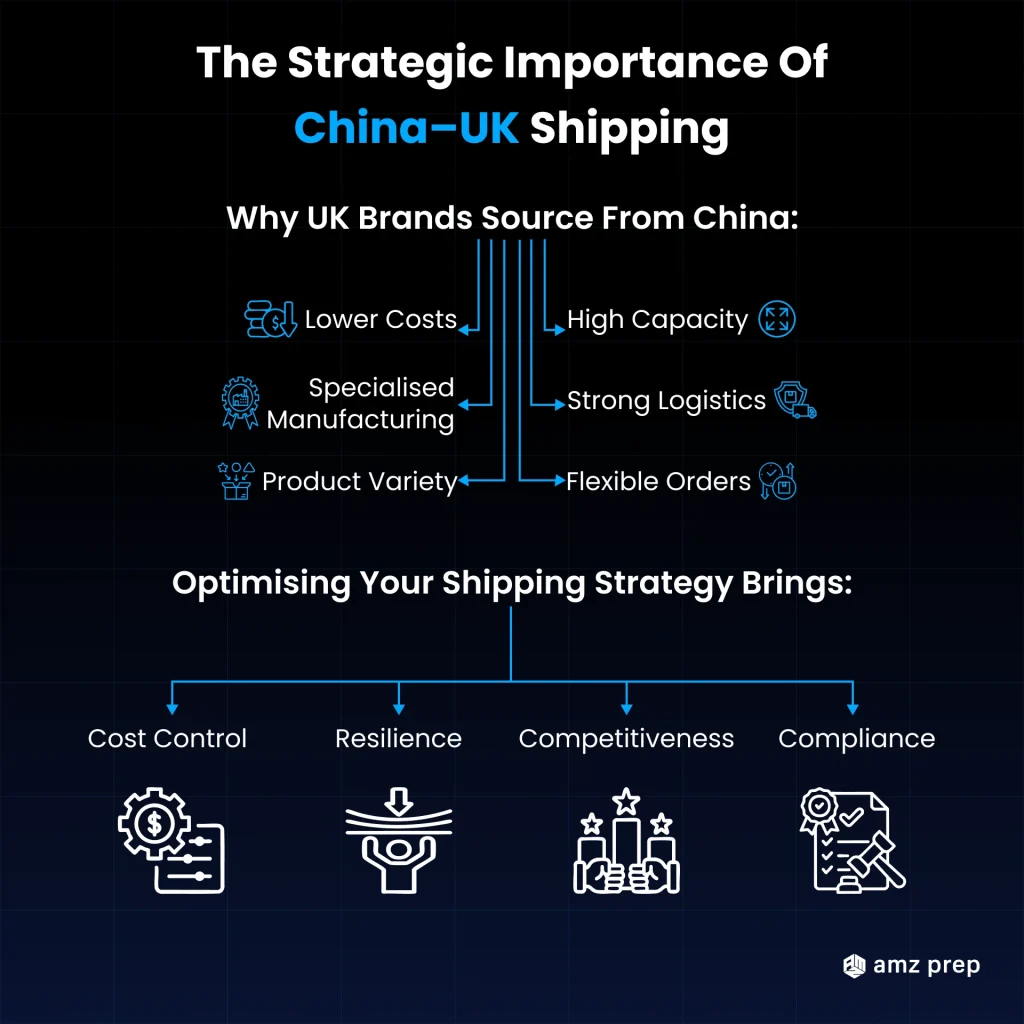
Shipping from China to the UK is not just a transactional process, it is a cornerstone of modern brand strategy for companies looking to remain competitive in an increasingly globalized market. China continues to serve as a critical sourcing hub for UK brands due to a combination of manufacturing capacity, cost advantages, and logistics sophistication.
Competitive Manufacturing Costs
One of the primary reasons UK brands turn to China is the significant cost advantage offered by Chinese manufacturers.
- Lower Production Costs: Chinese factories benefit from economies of scale, lower labor costs, and efficient production methods, which help brands preserve profit margins. For example, a product that costs £20 to manufacture in the UK may cost only £8–£10 in China. This margin difference can be decisive for small brands and e-commerce retailers competing on price.
- Access to Specialized Manufacturing: Beyond cost, Chinese suppliers can offer advanced manufacturing capabilities for electronics, textiles, machinery, and consumer goods. This level of specialization is often unavailable locally or comes at a much higher cost.
- Bulk Discounts and Flexible Order Sizes: Many Chinese manufacturers offer tiered pricing for larger orders and can accommodate flexible production runs, which allows UK importers to manage inventory and cash flow efficiently.
High Production Capacity
China’s massive industrial base enables UK brands to source virtually any type of product in large quantities.
- Scalability: Whether a company needs a few hundred units for a test run or tens of thousands for mass distribution, Chinese factories have the capacity to deliver.
- Speed to Market: High-volume production capabilities reduce lead times for new products, helping brands respond to market trends more quickly than relying on domestic production alone.
- Product Diversity: From electronics and clothing to furniture and industrial equipment, the breadth of available products allows UK importers to consolidate suppliers and reduce logistical complexity.
Advanced Logistics Infrastructure
China has developed a sophisticated logistics ecosystem that supports efficient global shipping.
- Modern Ports and Transport Networks: Major ports like Shanghai, Shenzhen, and Ningbo are equipped to handle large container volumes and provide seamless connections to major international shipping lanes.
- Integrated Freight Services: Many manufacturers offer “door-to-port” or “door-to-door” shipping options, streamlining the process for UK importers and reducing administrative overhead.
- Technology-Driven Supply Chains: Chinese logistics providers increasingly use digital tracking, AI-based inventory management, and predictive analytics, giving UK brands real-time visibility and better control over shipments.
Benefits of Optimising Your China-UK Shipping Strategy
Leveraging the advantages of China-UK trade requires more than simply placing orders, it demands a strategic approach to shipping. By optimising logistics, brands can achieve multiple competitive advantages:
- Control Costs
- Shipping is a major component of landed costs, often representing 15–25% of the total expense.
- Choosing the right shipping method, sea freight shipping for large shipments or LCL (Less than Container Load) for smaller consignments, can significantly reduce expenses.
- Planning for seasonal fluctuations in rates and fuel surcharges can protect profit margins.
- Shipping is a major component of landed costs, often representing 15–25% of the total expense.
- Build Supply Chain Resilience
- Relying on multiple shipping routes and carriers ensures operational flexibility.
- In the event of delays, congestion at ports, or geopolitical disruptions, alternative routes can prevent costly stockouts.
- Maintaining relationships with several logistics partners reduces dependency on a single provider and mitigates risk.
- Relying on multiple shipping routes and carriers ensures operational flexibility.
- Ensure Regulatory Compliance
- Post-Brexit trade regulations require careful navigation of customs procedures, duties, VAT, and documentation.
- Partnering with experienced freight forwarders or customs brokers can prevent fines, delays, or rejected shipments.
- Staying informed about changing trade agreements, tariffs, and import restrictions ensures smoother operations.
- Post-Brexit trade regulations require careful navigation of customs procedures, duties, VAT, and documentation.
- Stay Competitive in the Market
- Efficient logistics enable faster delivery times, improving customer satisfaction.
- Lower shipping and operational costs allow brands to offer better pricing or reinvest savings into marketing, product development, or service enhancements.
- A reliable, optimised supply chain can provide a significant advantage over competitors who struggle with delays, high costs, or regulatory hurdles.
- Efficient logistics enable faster delivery times, improving customer satisfaction.
Navigating the 2025 Shipping Environment
Shipping dynamics in 2025 are shaped by evolving tariffs, transit times, and regulatory requirements. UK importers must stay informed to protect margins, maintain supply chain resilience, and secure a competitive edge.
| Market Factor | Current Status | Impact on Importers |
|---|---|---|
| Container Rates | £1,800–£3,200 per 40ft | Moderate rate environment |
| Schedule Reliability | 65–75% on-time performance | Plan for delays |
| Port Congestion | Manageable at UK ports | Minimal impact currently |
| Fuel Surcharges | 12–18% of base rates | Built into most quotes |
| Brexit Implementation | Fully operational | Compliance costs stabilised |
Key Insights for Effective Shipping
This guide provides practical insights for brands of all sizes, covering every key aspect of shipping from China to the UK:
- Shipping Methods and Cost Structures: Understand container, LCL, and freight options.
- Current Container Rates and LCL Options: Plan for costs with updated market data.
- Brexit Compliance and Duty Calculations: Navigate post-Brexit regulatory requirements.
- Time-Saving and Cost Optimisation Strategies: Maximise efficiency without sacrificing compliance.
- E-Commerce and Traditional Importer Guidance: Tailored advice for different brand models.
Whether you’re calculating the cost of a 40ft container or considering LCL shipments for smaller consignments, this guide equips you to make informed decisions and optimise your China-UK supply chain.
Average Shipping Time from China to the UK
Understanding realistic transit times is crucial for inventory planning and customer expectations. The average shipping time from China to the UK varies significantly based on your chosen method, but current market conditions add layers of complexity that can substantially impact delivery schedules.
Shipping Transit Times by Method
When planning your imports, you need a clear understanding of how long each shipping method takes. Knowing these timelines helps you set accurate expectations and manage your supply chain effectively.
| Shipping Method | Standard Transit | With Processing | Total Time | Reliability |
|---|---|---|---|---|
| Express Courier | 3-5 days | 4-7 days | 5-8 days | 95%+ |
| Air Freight | 5-8 days | 7-12 days | 10-15 days | 85-90% |
| Sea Freight | 25-35 days | 30-45 days | 35-50 days | 70-75% |
| Rail Freight | 18-22 days | 20-28 days | 25-32 days | 80-85% |
Detailed Method Analysis
Express Courier Services
Express shipping delivers within 3-5 days door-to-door, making it ideal for urgent shipments, samples, or high-value, low-weight items. Major carriers, including DHL, FedEx, and UPS, maintain excellent reliability to the UK, though costs reflect the premium service level.
Air Freight Operations
Air freight typically requires 5-8 days for airport-to-airport transport, plus additional time for ground handling and customs clearance. Total door-to-door service averages 10-15 days, offering a balanced solution between speed and cost for medium-weight shipments.
Sea Freight Services
Ocean freight remains the most economical option for substantial shipments, with port-to-port transit times of 25-35 days. When including inland transport, customs clearance, and final delivery, total transit extends to 35-50 days depending on the final UK destination.
Rail Freight Alternative
The China-Europe rail network offers an emerging alternative with 18-22 day transit times. Though more expensive than sea freight, rail provides faster delivery than ocean transport whilst remaining more economical than air freight.
Factors Influencing Transit Times
Seasonal Variations
- Chinese New Year (January-February): Production shutdowns extend delays by 2-4 weeks
- Peak Season (September-November): Increased demand may add 5-10 days to standard times
- Christmas Period: UK port congestion can cause additional delays
Port and Processing Delays – Step-by-Step Actions
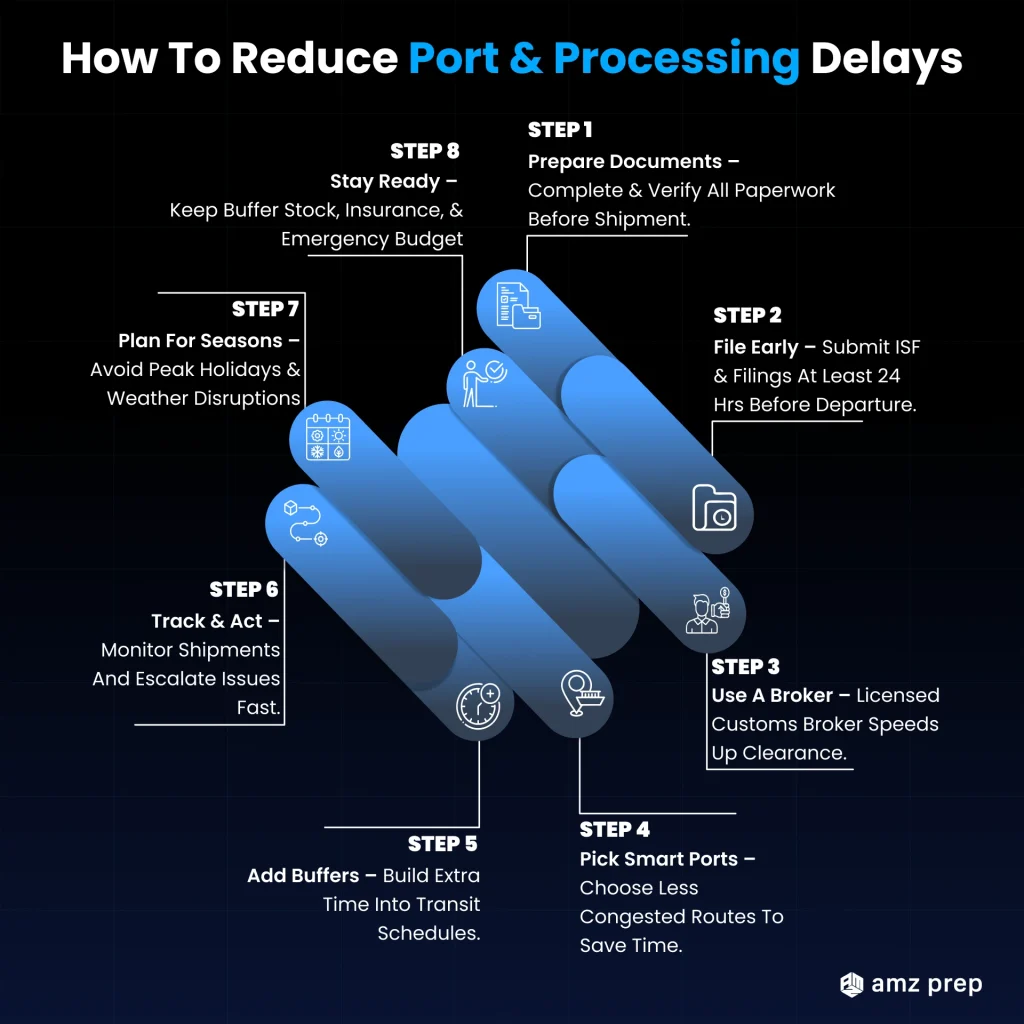
Step 1: Prepare complete documentation before shipment
You should compile and verify the commercial invoice, packing list, certificate of origin, and any product-specific certificates; missing or incorrect papers are the #1 cause of multi-day holds.
Step 2: File ISF and other pre-arrival filings early
You must submit ISF and required advance data at least 24 hours before vessel departure; pre-filing reduces the chance of automatic holds and steep penalties.
Step 3: Engage a licensed customs broker
Retain a broker to review entries, correct errors quickly, and represent you during examinations. This shortens inspections and prevents documentation delays.
Step 4: Choose ports and routes strategically
Select less congested ports when possible and work with your forwarder to route shipments that minimize terminal wait times and inland transit; alternate ports often save days.
Step 5: Build conservative schedule buffers
Add at least 50% to quoted transit times during peak season or known disruption windows so you don’t hit stockouts when containers are delayed.
Step 6: Monitor shipments in real time and escalate immediately
Track milestones, confirm arrival notices, and contact your forwarder or broker at the first sign of a hold so issues are resolved before demurrage accrues.
Step 7: Plan for weather and seasonal events
Identify seasonal risks (typhoon season, Chinese New Year) and shift production or sailings earlier to avoid the 1–7 day weather or holiday impacts on timelines.
Step 8: Maintain contingency resources
Allocate a small express budget, keep buffer inventory, and carry adequate cargo insurance so you can respond quickly to inspections, congestion, or documentation failures.
Planning Recommendations
When planning your shipments, you should evaluate timelines, costs, and potential risks in advance. A proactive approach helps you avoid delays and maintain supply chain efficiency.
A. Conservative Timeline Planning
Plan with a conservative shipping timeline, accounting for potential delays beyond the quoted estimates. This approach allows you to maintain sufficient inventory, avoid costly disruptions, and uphold customer satisfaction.
- Express shipping: Add a 2-3 day buffer
- Air freight: Add 5-7 days buffer
- Sea freight: Add 10-15 days buffer
- Rail freight: Add 7-10 days buffer
B. Inventory Management Integration
Streamline your supply chain by integrating shipping data directly with your inventory management system. This ensures you maintain real-time visibility, prevent stockouts, and plan replenishments more accurately.
- Setting reorder triggers based on maximum transit times
- Maintaining safety stock equivalent to average transit time plus buffer
- Using multiple shipping methods for different product categories
Shipping Methods from China to the UK
Selecting the optimal shipping method requires careful analysis of cost, speed, reliability, and service requirements. Each method serves specific brand scenarios and offers distinct advantages for different types of shipments.
Express Courier Services: Premium Speed and Reliability
Express services provide the fastest shipping from China to the UK, delivering within 3-8 days with exceptional reliability and comprehensive tracking capabilities.
- Product samples and prototypes requiring urgent delivery
- Emergency inventory replenishment to prevent stockouts
- High-value, low-weight items where speed justifies premium costs
- Time-critical product launches or seasonal merchandise
- Express Service Comparison
When using an express service, you benefit from rapid, dependable delivery with full tracking, ensuring your high-value or time-sensitive shipments arrive on schedule. Selecting the appropriate carrier allows you to manage costs effectively, reduce delays, and maintain control over urgent consignments.
| Carrier | Transit Time | Rate Range | Tracking | Insurance |
|---|---|---|---|---|
| DHL Express | 3-4 days | £12-18/kg | Excellent | Included up to £15/kg |
| FedEx International Priority | 3-5 days | £10-16/kg | Excellent | Included up to £12/kg |
| UPS Worldwide Express | 4-6 days | £9-15/kg | Very Good | Included up to £10/kg |
| TNT Express | 4-5 days | £11-17/kg | Very Good | Included up to £12/kg |
- Express Shipping Optimisation Strategies
To optimise your express shipping, ensure your packaging minimises dimensional weight and complies with carrier requirements, reducing unnecessary cost. Additionally, establish accounts with preferred couriers to access volume discounts and enhanced service reliability.
- Account Setup: Brand accounts receive 20-35% discounts versus casual rates
- Dimensional Weight Management: Optimise packaging to minimise chargeable weight
- Service Selection: Choose an appropriate service level based on urgency requirements
- Documentation Excellence: Ensure perfect paperwork to avoid delays
Air Freight: Balanced Speed and Cost
When you choose air freight, you gain a reliable solution that delivers your goods quickly without the premium cost of express shipping. This method is ideal for medium-sized shipments where timing matters, allowing you to maintain inventory flow and meet customer demand efficiently.
Step 1: Understand When to Use Air Freight
Air freight is ideal for shipments that need faster delivery than sea freight but don’t justify the higher cost of express courier services. It offers a balance between speed and cost, suitable for both regular and bulk shipments.
Step 2: Recognize the Advantages
Air freight provides predictable transit times, typically 10–15 days door-to-door. It offers superior tracking and visibility compared to ocean transport, is less affected by weather delays, and consolidation options can significantly reduce costs.
Step 3: Know the Cost Ranges
Rates vary depending on shipment size. Small urgent shipments are charged at a higher rate per kilogram, while larger bulk shipments benefit from lower rates per kilogram. Minimum charges apply based on the weight of the shipment.
Step 4: Choose the Right Service Option
You can select from several service types: direct flights for the fastest delivery, consolidation services to share aircraft space and save costs, deferred services with flexible timing and lower rates, or express air for premium guaranteed delivery.
Step 5: Plan Strategically
Match your shipment size and urgency with the appropriate service type. Consolidate shipments where possible to maximize efficiency, and always consider tracking, reliability, and delivery deadlines when planning your air freight.
Sea Freight: Maximum Economy for Volume
Sea freight delivers the most economical shipping rates for substantial consignments, making it the preferred choice for regular imports and bulk shipments despite longer transit times.
Full Container Load (FCL) Services shipping provides dedicated container space with the best per-unit costs for large shipments and maximum control over cargo handling.
- 20ft Container Shipping Cost from China to the UK
Shipping a 20ft container from China to the UK allows you to move large volumes efficiently, helping you optimize costs and streamline your supply chain. By understanding current freight rates, surcharges, and transit times, you can plan shipments strategically and avoid unexpected delays or extra charges.
| Port Pair | Low Season | High Season | Average |
|---|---|---|---|
| Shanghai – Felixstowe | £1,200-1,800 | £1,600-2,200 | £1,500-2,000 |
| Shenzhen – Southampton | £1,100-1,600 | £1,500-2,100 | £1,300-1,850 |
| Ningbo – Liverpool | £1,150-1,700 | £1,550-2,150 | £1,350-1,925 |
| Qingdao – London Gateway | £1,250-1,850 | £1,650-2,250 | £1,450-2,050 |
2. Cost of Shipping a 40ft Container from China to the UK
Shipping a 40ft container from China to the UK can vary significantly depending on the port, season, and current market rates. You should plan for costs ranging from $3,000 to $5,500, including potential surcharges and fees, to ensure accurate budgeting and smooth import operations.
| Container Type | Low Season Range | High Season Range | Annual Average |
|---|---|---|---|
| 40ft Standard | £2,000-3,000 | £2,800-4,000 | £2,400-3,500 |
| 40ft High Cube | £2,200-3,200 | £3,000-4,200 | £2,600-3,700 |
| 40ft Refrigerated | £4,500-6,500 | £6,000-8,500 | £5,250-7,500 |
Less than Container Load (LCL) Services shipping from China to UK provide economical solutions for smaller shipments by sharing container space with other importers.
LCL Shipping Cost Structure
When using LCL shipping, you pay only for the space your cargo occupies, making it a cost-effective solution for smaller shipments. Be sure to account for consolidation, handling, and documentation fees to understand your total landed cost.
| Cubic Metres | Rate per CBM | Minimum Charge | Transit Time |
|---|---|---|---|
| 1-5 CBM | £80-120 | £200 | 35-45 days |
| 5-10 CBM | £70-110 | £350 | 32-42 days |
| 10-15 CBM | £60-100 | £500 | 30-40 days |
| 15+ CBM | £50-90 | £750 | 28-38 days |
LCL Service Considerations
- Longer transit times due to consolidation and deconsolidation
- Less control over handling and timing
- Potential for cross-contamination with other shippers’ goods
- Documentation complexity with multiple shippers per container
Rail Freight: The Emerging Alternative
Rail freight via the China-Europe railway network offers a middle ground between air and sea freight, providing faster delivery than ocean transport whilst maintaining reasonable costs.
Rail Freight Characteristics
- Transit time: 18-28 days, depending on route and destination
- Cost: Typically 2-3 times sea freight, 50-70% less than air freight
- Reliability: Generally good with less weather dependency
- Capacity: Growing but still limited compared to sea freight
Rail Route Options
When shipping from China to the U.S., consider rail routes as a reliable and cost-effective alternative for medium-to-large shipments. You can benefit from faster transit than ocean freight while maintaining lower costs than air freight, all with predictable schedules and reduced handling risks.
| Route | Transit Time | Frequency | UK Connection |
|---|---|---|---|
| Yiwu – London | 18-20 days | Weekly | Direct rail terminal |
| Chengdu – Duisburg | 16-18 days | 3x weekly | Road/rail to the UK |
| Xi’an – Hamburg | 17-19 days | 2x weekly | Road/rail to the UK |
| Chongqing – Duisburg | 16-18 days | Weekly | Road/rail to the UK |
Shipping Costs from China to the UK
Shipping costs from China to the US comprise multiple components that extend beyond the freight rate.
Understanding the breakdown of base rates, surcharges, and additional fees is essential for accurate budgeting and avoiding unexpected expenses.
Costs fluctuate depending on shipment size, method, and seasonal factors, so having a clear overview helps you plan efficiently and optimize your logistics strategy.
Key Points
- Base Freight Costs (40–50% of total)
- Express courier: £9–18/kg, no minimum, premium service.
- Air freight: £3–12/kg, 45 kg minimum, standard service.
- FCL sea freight: £1,500 – £4,000 per container, offering an economy service for large shipments.
- LCL sea freight: £50–120 per CBM, 1 CBM minimum, shared service.
- Surcharges and Additional Fees (25–35% of total)
- Fuel adjustment: 12–18% of base rate, applied monthly.
- Peak season surcharge: £200–800 per container (Sep–Nov).
- Security surcharge: £25–75 per shipment.
- Documentation fee: £50–150 per shipment.
- Terminal handling charges: £150–400 per container for sea freight.
- Planning Considerations
- Seasonal fluctuations can affect capacity and pricing.
- Extra fees can significantly impact total landed costs.
- Careful planning and early bookings help optimize expenses.
UK Customs and Duty Structure
Since Brexit, customs procedures have become a crucial factor in calculating the total landed cost of imports from China. Knowing the rules ensures you can accurately estimate costs and stay fully compliant, avoiding surprises at the border.
- Customs Duty Rates: Duty rates depend on the product classification under the UK Global Tariff schedule and generally range from 0% to 12%.
- VAT Application: After applying the customs duty, VAT at 20% must be added. VAT is calculated on the total value of the goods, including shipping costs and any customs duties.
Example of Duty Calculation:
- Product value: £10,000
- Shipping cost: £1,500
- Subtotal before duty: £11,500
- Customs duty (6%): £690
- Duty-inclusive base: £12,190
- VAT (20%): £2,438
- Total landed cost: £14,628
By factoring in both customs duty and VAT, you can plan pricing, inventory, and cash flow accurately. Proper understanding of these costs helps importers avoid fines, delays, and other compliance issues while ensuring their shipments reach the UK smoothly.
Shipping Costs from China to the UK
Many UK brands source products through Alibaba, where understanding shipping cost implications helps evaluate total purchase costs effectively.
Alibaba Shipping Cost Factors
- Most Alibaba suppliers quote EXW (Ex Works) terms, placing shipping responsibility on buyers
- Freight costs can equal 15-30% of product value for small orders
- Consolidation services through freight forwarders can reduce per-unit costs
- Payment terms affect cash flow and the total cost of ownership
Shipping costs from China to the UK Alibaba
| Order Value | Recommended Method | Shipping % of Value | Total Cost Impact |
|---|---|---|---|
| £500-2,000 | Express courier | 25-40% | High impact |
| £2,000-8,000 | Air freight | 15-25% | Moderate impact |
| £8,000-20,000 | LCL sea freight | 8-15% | Lower impact |
| £20,000+ | FCL sea freight | 5-10% | Minimal impact |
Hidden Costs and Additional Charges
When shipping from China, you must account for hidden costs and additional charges that can significantly increase your total spend. These include surcharges, customs fees, documentation costs, and unexpected port or inspection expenses, all of which require careful planning to avoid surprises.
Step 1 — Port & handling charges
- Request and document demurrage rates (e.g., £50–150/day) from your carrier or forwarder.
- Confirm port storage fees (£25–75/day) and set calendar alerts for pickup deadlines.
- Budget for possible examination fees (£200–600) and plan alternate pickup/transport if selected.
- Avoid out-of-hours delivery premiums (£100–300) by confirming delivery windows in advance.
- Add a contingency line in your landed-cost model for at least 5–10 days of potential port-related charges.
Step 2 — Documentation & compliance costs
- Engage a customs agent and get written fee estimates (£125–350 per entry).
- Ensure EORI registration is completed and linked to your importer profile.
- Verify commodity classification (HS code) accuracy; budget £150–500 for complex rulings.
- Order certificates of origin when required (£50–150) and keep proof of issuance.
- Implement a pre-shipment compliance checklist and retain all documents for audits.
Step 3 — Currency & financial considerations
- Monitor exchange rates and model a 2–8% FX sensitivity in your cost forecasts.
- Compare payment methods (LC vs T/T) and include bank fees in your cash-flow plan.
- Purchase insurance (0.1–0.5% of cargo value) and obtain quotes to lock premiums early.
- Factor in interest or financing costs for extended payment terms into the unit landed cost.
- Set hedging or payment timing policies to limit currency and payment-term exposure.
Cost Optimisation Strategies
Optimize your shipping costs by carefully choosing between air, sea, and express options based on your shipment size, urgency, and budget. By consolidating orders, negotiating with carriers, and planning for peak seasons, you reduce unnecessary expenses while ensuring smoother supply chain operations.
A. Volume Consolidation Benefits
- Combine multiple suppliers into single shipments
- Use freight forwarder consolidation services
- Plan orders to achieve FCL container quantities
- Negotiate annual volume agreements for better rates
B. Supplier Negotiation Approaches
- Request CIF quotes to compare total delivered costs
- Negotiate shared shipping responsibilities
- Explore supplier financing options
- Consider long-term partnerships for volume discounts
C. Service Selection Optimisation
- Match shipping method to urgency requirements
- Use slower services during non-critical periods
- Balance cost against inventory carrying costs
- Consider rail freight for medium-urgency shipments
UK Compliance and Regulatory Requirements
Post-Brexit import regulations have created a comprehensive framework for goods entering the UK from China. Understanding these requirements prevents costly delays, penalties and ensures smooth customs clearance for all shipments. Essential Registration and Documentation Requirements are:
- Economic Operator Registration and Identification (EORI) Number
Brands are required to obtain an Economic Operator Registration and Identification (EORI) number to import goods into the UK. All UK importers must obtain an EORI number before importing goods. EORI Registration Process is:
- Application through HMRC online services
- Required for all brands importing goods into the UK
- Free registration with immediate online approval for most applicants
- Must be renewed if brand details change significantly
- Mandatory Import Documentation
When importing goods, you must ensure all mandatory documentation is accurate and complete, as errors can cause costly delays at customs. You are required to provide invoices, packing lists, and certificates in line with UK compliance standards.
| Document Type | When Required | Who Provides | Validity Period |
|---|---|---|---|
| Commercial Invoice | All shipments | Supplier | Per shipment |
| Packing List | All shipments | Supplier | Per shipment |
| Bill of Lading/AWB | All shipments | Carrier | Per shipment |
| Certificate of Origin | Duty relief claims | Supplier/Chamber | 12 months |
| Import Licence | Restricted goods | Government agency | Varies |
Customs Declaration Procedures
Entry Summary Declarations (ENS)
On 31 January 2025, the UK introduced entry summary declarations for EU imports. Entry Summary Declarations are required for security purposes before goods arrive in the UK. Full Customs Declaration Process is:
- Required for all commercial imports from China
- Must be submitted before goods are released
- Includes detailed product descriptions and values
- Requires accurate commodity code classification
Customs Declaration Submission Options
You must ensure your customs declaration is submitted accurately, either through a licensed customs broker or by using government-approved digital systems. By choosing the right option, you can avoid costly delays and penalties, and ensure your goods move smoothly across UK borders.
| Submission Method | Processing Time | Cost | Best For |
|---|---|---|---|
| Direct CHIEF System | Same day | £0 | Large importers |
| Customs Agent | 1-2 days | £125-350 | Small/medium importers |
| Freight Forwarder | 1-3 days | £100-300 | Regular shippers |
Product-Specific Regulatory Requirements
Ensuring that products meet category-specific regulatory requirements is essential to avoid customs issues, penalties, or shipment delays. Certifications such as FDA, FCC, or CPSC must be secured in advance to demonstrate full compliance with legal obligations.
CE / UKCA Marking – Step by step
- Identify the product’s category and the applicable directives or regulations (eg, Low Voltage, EMC, Radio Equipment).
- Determine the appropriate conformity assessment route (self-assessment or third-party conformity assessment).
- Commission required tests (safety, EMC, radio, etc.) from an accredited laboratory.
- Perform a technical risk assessment and document design, materials, and safety measures.
- Compile the technical file: test reports, design drawings, risk assessment, user instructions, and declarations.
- Prepare and sign the Declaration of Conformity (CE or UKCA as applicable).
- Affix the correct conformity mark and ensure all labelling and packaging meet regulatory requirements.
- Retain the technical file and evidence of conformity for the legally required period and make it available to market surveillance authorities.
Electronics & Electrical Goods – Step by step
- Classify the equipment (electrical, electronic, wireless) and list specific standards that apply.
- Arrange EMC testing, low-voltage safety testing, and radio testing for wireless products.
- Verify supplier quality and ensure components carry relevant approvals or test evidence.
- Produce clear safety and installation instructions and include essential warnings in the user manual.
- Ensure product markings include model, serial number, safety symbols, and the appropriate conformity mark.
- Confirm packaging, transport, and battery handling meet transport and waste-disposal rules.
- Maintain traceability records linking each product batch to test reports and supplier documentation.
Consumer Product Safety – Step by Step
- Determine precise product classification (toy, textile, cosmetic, food, etc.) and the relevant UK regulations.
- Carry out a product safety risk assessment covering foreseeable use and misuse.
- Commission category-specific tests (eg, EN71 for toys, fibre content tests for textiles, chemical analyses for cosmetics).
- Prepare correct labelling: age warnings, fibre content, care instructions, and required safety markings.
- Compile chemical safety data sheets and ensure REACH obligations and restricted substance checks are completed.
- Document supply-chain evidence and keep audit trails for forced-labour and provenance checks where relevant.
- Implement ongoing monitoring: periodic testing, supplier audits, and retention of records for inspections.
Food and Agricultural Products
When shipping food and agricultural products, you must ensure full compliance with UK safety, labelling, and traceability regulations to avoid costly delays. You are also responsible for securing the correct certifications and inspections to guarantee product quality and legal entry into the market.
| Product Category | Key Requirements | Processing Time | Additional Costs |
|---|---|---|---|
| Processed Foods | Health certificates | 5-10 days | £200-500 |
| Fresh Produce | Phytosanitary certificates | 7-14 days | £300-800 |
| Organic Products | Organic certification | 14-28 days | £500-1,500 |
| Novel Foods | Pre-market authorisation | 3-18 months | £2,000-15,000 |
Duty and Tax Calculation Framework
UK Global Tariff Structure The UK Global Tariff replaced EU tariffs post-Brexit, generally offering more competitive rates for many product categories. Common Duty Rates by Product Category are:
| Product Category | Typical Duty Rate | VAT Rate | Total Tax Burden |
|---|---|---|---|
| Electronics | 0-14% | 20% | 20-34.8% |
| Textiles | 8-12% | 20% | 29.6-34.4% |
| Footwear | 8-17% | 20% | 29.6-40.4% |
| Furniture | 0-10% | 20% | 20-32% |
| Industrial Machinery | 0-8% | 20% | 20-29.6% |
Duty Relief and Suspension Schemes
- Temporary admission for processing or exhibition
- Inward Processing Relief for goods to be re-exported
- Duty suspensions for specific industrial inputs
- Preferential rates under trade agreements
A Roadmap to Regulatory Readiness
Following a structured compliance checklist ensures you consistently meet UK import regulations, reducing the risk of delays, penalties, or rejected shipments. By systematically verifying documentation, licences, and internal processes, you can maintain control and safeguard your supply chain.
Confirm import restrictions
- Identify whether goods fall into restricted categories (weapons & ammunition, controlled drugs/precursors, endangered-species items, dual-use goods).
- Obtain the appropriate licence or permit from the relevant UK authority (for example, a Home Office licence for weapons or a CITES permit for protected species).
- Record licence numbers and expiry dates in the supplier file.
Screen for prohibited items
- Run product lists against IP takedown, safety, and sanctions watchlists to block counterfeit, unsafe, or sanctioned goods.
- Remove any SKU failing safety or authenticity checks and notify procurement to halt shipment.
- Maintain an updated prohibited-items register and circulate it to suppliers and logistics partners.
Achieve documentation excellence
- Maintain complete commercial invoices, packing lists, and certificates for a minimum of six years.
- Ensure invoices include accurate HS codes, full product descriptions, unit value, and country of origin.
- Obtain required certificates from qualified suppliers (e.g., FCC, FDA, CPSC) and store them in a document management system with version control.
Establish robust customs agent relationships.
- Select agents with proven UK customs experience and professional indemnity insurance.
- Agree on written SLAs covering ISF/entry filing times, communication cadence, error handling, and penalty responsibility.
- Conduct quarterly performance reviews and require evidence of continuous regulatory training.
Build internal compliance systems (prioritise and implement)
- Stage 1: Pilot a commodity-classification database: budget £2,000–8,000, expected annual savings £5,000–15,000, typical ROI 6–18 months.
- Stage 2: Deploy automated documentation: budget £5,000–20,000, expected annual savings £10,000–40,000, typical ROI 6–12 months.
- Stage 3: Launch a customs training programme: budget £1,000–5,000, expected annual savings £3,000–12,000, typical ROI 6–18 months.
- Stage 4: Implement a compliance audit system: budget £3,000–12,000, expected annual savings £8,000–25,000, typical ROI 6–15 months.
- For each stage: run a small proof-of-concept, integrate with inventory/accounting systems, train staff, measure error and cost reduction, then scale.
Monitor, review, and improve
- Schedule regular audits of documents, licences, and ISF/entry accuracy.
- Update the prohibited-items register, supplier checklists, and SLAs whenever regulation or guidance changes.
- Log incidents and near-misses, derive corrective actions, and feed improvements back into training and systems.
E-commerce and Marketplace Shipping Strategies
E-commerce brands face unique challenges when shipping from China to the UK, requiring specialised approaches to inventory management, customer expectations, and platform compliance requirements that differ significantly from traditional B2B importing.
Amazon FBA Shipping from China to the UK
Amazon FBA remains the dominant fulfilment method for e-commerce sellers, requiring adherence to specific requirements and optimised logistics strategies.
FBA Preparation Requirements
- Products must carry Amazon FNSKU barcodes rather than manufacturer codes
- Packaging must comply with Amazon’s prep requirements
- Dangerous goods classification is required for applicable products
- Maximum unit weight restrictions vary by product category
FBA Shipping Method Selection Matrix
You should carefully evaluate your FBA shipping options based on shipment size, urgency, and cost to ensure efficiency. Selecting the most suitable method helps maintain stock levels, reduce fees, and optimise your supply chain performance.
| Inventory Level | Recommended Method | Lead Time | Cost per Unit | Best Timing |
|---|---|---|---|---|
| Emergency Restock | Express courier | 5-8 days | £2-8/unit | Stock-out risk |
| Regular Restock | Air freight | 12-18 days | £0.80-3.50/unit | Planned replenishment |
| Bulk Inventory | Sea freight | 35-50 days | £0.30-1.20/unit | Seasonal preparation |
| New Product Launch | Air freight express | 7-12 days | £1.50-5.00/unit | Market entry |
FBA Prep Services in China
Using Chinese prep services can significantly reduce costs and improve efficiency: Prep Service Cost Comparison.
| Service Type | China Cost | UK Cost | Savings | Quality Considerations |
|---|---|---|---|---|
| FNSKU Labelling | £0.15-0.25/unit | £0.40-0.80/unit | 60-70% | Requires quality control |
| Poly Bagging | £0.08-0.15/unit | £0.25-0.50/unit | 65-75% | Material quality varies |
| Bundling/Sets | £0.50-1.50/set | £2.00-5.00/set | 70-80% | Assembly accuracy crucial |
| Quality Inspection | £0.20-0.40/unit | £1.00-2.50/unit | 75-85% | Expertise requirements |
Multi-Channel E-commerce Strategy
Adopting a multi-channel e-commerce strategy enables control over inventory allocation across marketplaces, third-party fulfilment centres, and direct sales channels. This approach enhances customer reach while mitigating the risks of stockouts and supply chain disruptions.
- Inventory Allocation Framework
Successful e-commerce brands diversify across multiple channels to reduce platform dependency and maximise reach.
| Platform | Inventory Allocation | Fulfilment Method | Shipping Strategy |
|---|---|---|---|
| Amazon UK | 40-50% | FBA | Sea freight bulk + air top-ups |
| eBay UK | 15-25% | 3PL/Self | LCL + air freight |
| Own Website | 20-30% | 3PL/Self | Mixed methods |
| Other Marketplaces | 10-15% | Various | Flexible approach |
2. Cross-Platform Inventory Management
- Centralised inventory tracking across all channels
- Automated reorder triggers based on velocity
- Buffer stock for demand spikes and seasonality
- Coordinated shipping schedules to optimise costs
Direct-to-Consumer (Dropshipping) Considerations
Ensure robust supplier reliability and product quality to maintain brand reputation and customer trust in a direct-to-consumer dropshipping model.
Dropshipping Logistics Challenges
- Individual package shipping from China carries premium rates
- Customer expectations for fast delivery conflict with economic shipping costs
- Returns processing complexity increases costs
- Quality control difficulties with distributed inventory
Dropshipping Cost Structure
| Order Value | Shipping Method | Cost Range | Delivery Time | Customer Satisfaction |
|---|---|---|---|---|
| £10-50 | ePacket/China Post | £2-8 | 15-25 days | Low |
| £50-150 | Express economy | £8-20 | 8-15 days | Moderate |
| £150+ | Express premium | £15-35 | 5-10 days | High |
Seasonal Planning and Inventory Management
Effective seasonal planning and inventory management ensure optimal stock levels are maintained, reducing excess holding costs while meeting fluctuating customer demand with precision.
E-commerce Seasonal Calendar
| Period | Key Events | Shipping Strategy | Lead Time |
|---|---|---|---|
| January-March | Post-holiday restocking | Sea freight bulk orders | 8-12 weeks |
| April-June | Spring/summer preparation | Mixed air/sea | 6-10 weeks |
| July-August | Q4 preparation begins | Sea freight priority | 10-14 weeks |
| September-November | Peak season | Air freight only | 2-4 weeks |
| December | Emergency only | Express courier | 1 week |
Inventory Planning Best Practices
- Maintain 90-120 days of inventory during Q4 preparation
- Use air freight for fast-moving items during peak season
- Plan new product launches for Q1-Q2 to allow sea freight
- Build safety stock based on the longest lead time scenarios
Returns and Customer Service Logistics
Efficient management of returns and customer service logistics ensures a seamless experience, fostering trust and satisfaction while minimising operational disruptions.
Returns Processing Strategy
- Establish UK-based returns handling to reduce customer friction
- Implement quality inspection procedures for returned items
- Negotiate return shipping agreements with carriers
- Consider write-off thresholds for low-value returns
Customer Communication Framework
- Proactive shipping updates and tracking information
- Clear delivery timeframes based on shipping method
- Seasonal delay notifications during peak periods
- Alternative shipping options for urgent customer needs
Platform-Specific Requirements
Ensure adherence to platform-specific requirements to maintain seamless functionality and compatibility across diverse systems, thereby enhancing user experience and operational efficiency. Careful consideration of these standards will safeguard against technical issues and align your deliverables with industry best practices.
Amazon UK Specific Considerations
- Hazmat classification requirements for batteries and chemicals
- Restricted products list compliance
- Product authenticity verification
- Brand registry and intellectual property protection
eBay UK Requirements
- Global Shipping Programme participation options
- Managed delivery service integration
- Return policy compliance
- Distance selling regulations adherence
Marketplaces Integration Strategy
| Platform | Integration Priority | Technical Requirements | Shipping Considerations |
|---|---|---|---|
| Amazon | High | API integration | FBA compliance |
| eBay | Medium | Standard integration | Flexible shipping |
| Etsy | Medium | Basic integration | Artisan focus |
| Own Site | High | Full integration | Complete control |
Money-Saving Tips and Optimisation Strategies
Optimizing shipping costs from China to the UK requires strategic thinking across packaging, consolidation, timing, and supplier relationships. The most successful importers treat logistics as a competitive advantage rather than merely an operational expense.
Packaging and Dimensional Optimisation
Understanding Dimensional Weight Pricing Carriers charge based on either actual weight or dimensional weight, whichever is greater. This makes packaging optimisation crucial for cost control.
Dimensional Weight Calculations
- Air freight: Length × Width × Height (cm) ÷ 6,000 = chargeable kg
- Express: Length × Width × Height (cm) ÷ 5,000 = chargeable kg
- Sea freight: Generally charged by cubic metre or container
Packaging Optimisation Strategies
| Optimisation Method | Potential Savings | Investment Required | Payback Period |
|---|---|---|---|
| Custom box design | 20-35% | £1,000-5,000 | 2-6 months |
| Product orientation changes | 15-25% | £500-2,000 | 1-3 months |
| Vacuum packaging | 30-50% for soft goods | £2,000-8,000 | 3-8 months |
| Component assembly optimisation | 25-40% | £3,000-15,000 | 6-18 months |
Practical Packaging Guidelines
- Eliminate unnecessary packaging layers and void fill
- Design products with shipping efficiency in mind
- Use packaging materials that protect with minimal weight
- Coordinate with suppliers on packaging standards
- Test different orientations and configurations
Consolidation and Volume Strategies
Observing consolidation patterns alongside trading volume offers critical insights into potential market shifts, allowing informed assessment of price stability and breakout likelihood. Careful analysis of volume spikes during these phases can reveal underlying momentum, guiding strategic decision-making with greater precision.
- LCL Consolidation Benefits
LCL shipping from China to the UK becomes more economical when consolidating multiple suppliers or orders into single shipments. Check our Freight Forwarding Guide for consolidation strategies.
Consolidation Service Options
| Service Type | Cost Savings | Control Level | Complexity |
|---|---|---|---|
| Freight forwarder consolidation | 20-40% | Medium | Low |
| Self-managed consolidation | 30-50% | High | High |
| Supplier consolidation | 15-30% | Medium | Medium |
| Buy-and-hold services | 25-45% | Low | Low |
Consolidation Strategy Framework
- Map all suppliers by geographic region
- Identify common shipping schedules and requirements
- Calculate break-even points for different consolidation levels
- Build relationships with consolidation service providers
- Implement inventory management for longer lead times
Timing and Seasonal Optimisation
- Understand seasonal rate patterns to strategically plan shipments and reduce costs.
- Ship bulk inventory during low-rate periods, particularly between January and March, to take advantage of cost savings.
- Use rate forecasting tools to time large shipments effectively and avoid peak-season surcharges.
- Build inventory buffers to ensure continuity during high-demand periods.
- Coordinate with suppliers to align production schedules with favourable shipping periods.
- Implement flexible shipping windows for non-urgent items to capitalise on lower rates.
Supplier Relationship Optimisation
- Understand and negotiate shipping terms to reduce overall costs and maintain operational control.
- Consider different shipping terms:
- EXW (Ex Works): Supplier delivers at factory gate; buyer covers all shipping costs, high risk, maximum cost control.
- FOB (Free on Board): Supplier handles export clearance; buyer manages international shipping, medium risk.
- CIF (Cost, Insurance, Freight): Supplier provides full delivery with insurance; buyer handles import clearance, medium cost, and low risk.
- DDP (Delivered Duty Paid): Supplier handles complete door-to-door delivery; buyer only pays, very low risk.
- Assess suppliers based on:
- Geographic location relative to major ports.
- Volume discounts and pricing flexibility.
- Expertise in export documentation and compliance.
- Packaging capabilities and willingness to optimise shipments.
- Quality control systems to reduce returns and defects.
Technology and Process Optimisation
- Implement shipping management technology to automate processes and improve decision-making.
- Invest in solutions according to brand needs:
- Rate comparison platforms for regular shippers to save on costs.
- Inventory management systems to support growing brands with larger stock volumes.
- Customs management software for complex imports to ensure compliance and efficiency.
- Freight audit services for high-volume shippers to recover overcharges.
- Leverage process automation for:
- Automated rate shopping across multiple carriers.
- Exception-based tracking and management of shipments.
- Compliance checking and automatic documentation generation.
- Performance analytics to optimise shipping strategies.
- Integration with accounting and inventory systems for streamlined operations.
Financial Optimisation Strategies
You should implement tailored financial optimisation strategies to maximise your returns while minimising risk, ensuring every decision aligns with your long-term objectives and regulatory compliance.
1. Manage Currency Risk
Exchange rate fluctuations can significantly affect your shipping costs when paying in foreign currencies. You can mitigate this risk by using forward contracts for predictable volumes, currency options for more flexible shipments, or natural hedging to balance exposures. For small, irregular shipments, the spot market may suffice, though it offers no risk protection.
2. Optimize Payment Terms
Improve your cash flow and reduce financial pressure by negotiating extended payment terms with suppliers, utilizing letters of credit for large shipments, exploring trade financing solutions, or leveraging supplier financing programs.
3. Negotiate Volume Discounts
Maximize savings by leveraging your shipping volumes. Establish annual contracts with your carriers to secure predictable rates and priority service during peak periods. Higher commitment levels and larger volumes can unlock deeper discounts and access to dedicated support or custom solutions.
4. Bundle Multi-Services
Reduce overall costs and enhance operational efficiency by combining sea, air, and express services. Include additional services such as insurance, customs clearance, and warehousing. Explore cross-trade opportunities and participate in loyalty programs with preferred carriers to gain further benefits.
By systematically applying these strategies, you can optimize both your financial exposure and shipping operations, creating a more efficient, cost-effective, and resilient supply chain.
Conclusion
Successfully shipping from China to the UK in 2025 requires you to plan strategically, ensure regulatory compliance, and optimise operations. Treat shipping as a core capability, balancing cost, speed, and reliability while understanding the total landed cost. Post-Brexit procedures mean accurate documentation, and working with qualified customs agents is essential. Audit costs, review paperwork, and assess suppliers immediately. Negotiate contracts, adopt technology, and build supplier relationships in the medium term. Long-term, integrate your supply chain, manage risks, and continuously improve. Embrace sustainability and digital tools to gain a competitive edge and grow your brand successfully.
FAQs
What is the average shipping time from China to the UK for different methods?
Transit times depend on the shipping method and current conditions. Express courier services usually deliver within 3–7 days door-to-door with high reliability. Air freight typically takes 10–15 days, including customs clearance, while rail freight via the China-Europe network averages 25–32 days. Sea freight takes the longest at 35–50 days, including clearance, and currently operates at around 70–75% schedule reliability, so it’s wise to include buffer time when planning.
How do seasonal factors affect shipping times from China?
Seasonal events can significantly delay shipments. The Chinese New Year in January–February may add 2–4 weeks, peak season from September to November can add 5–10 days, and Golden Week in October may cause a 1–2 weeks’ delay. Additionally, UK port congestion during the Christmas period can add 3–7 days to transit times.
Which UK ports receive shipments from China?
Major UK ports for China imports include Felixstowe, which handles around 40% of UK containers; Southampton, offering excellent inland connections; Liverpool, with growing direct China services; London Gateway, the newest automated port; and Thames, which handles smaller volumes but is closer to London markets.
How much does it cost to ship a container from China to the UK?
Container shipping costs vary by size and season. A 20ft container ranges between £1,200–2,200, while a 40ft container costs £2,000–8,500 depending on type, season, and surcharges, which can add 25–35% to the base. LCL shipping depends on volume, season, port pairs, and service level, with well-utilised containers reducing costs per cubic metre.
What documents are required for importing from China to the UK?
Essential documents include a commercial invoice, packing list, bill of lading or air waybill, and an EORI number. Additional requirements may include an Entry Summary Declaration (ENS), certificate of origin, product-specific certificates like CE marking, and import licences for restricted goods. Accurate documentation ensures smooth customs clearance and regulatory compliance.
How does Brexit affect importing from China to the UK?
Brexit introduced a new UK Global Tariff replacing EU rates, enhanced border controls, and mandatory UK EORI numbers. UKCA marking is required for regulated products, and documentation requirements have become more comprehensive. Brands must adjust their processes to comply with these changes to avoid delays or penalties.
When should I choose air freight versus sea freight from China to the UK?
Air freight is ideal for high-value shipments, urgent deliveries, or when inventory carrying costs are high. Sea freight is better for bulk shipments, heavy cargo, and when cost minimisation is more important than speed. Your choice should consider shipment size, value, urgency, and predictable demand.
How can I reduce my shipping costs from China to the UK?
Cost reduction strategies include optimising packaging to reduce dimensional weight, consolidating multiple orders into single shipments, negotiating annual contracts, and using LCL for medium-sized shipments. Building supplier relationships, planning inventory to avoid rush shipments, and leveraging seasonal shipping patterns can also significantly reduce expenses.
What are the risks of shipping from China to the UK, and how can I mitigate them?
Common risks include delays, damage, loss, currency fluctuations, rate increases, hidden costs, documentation errors, and product compliance issues. Mitigation strategies include building buffer time into schedules, using appropriate packaging and insurance, working with reputable freight forwarders, verifying product standards, and employing professional customs clearance services.
Should I use a freight forwarder or handle shipping directly?
Freight forwarders are recommended if you have smaller shipments, limited logistics expertise, multiple suppliers, or complex regulatory needs, as they handle customs, insurance, and documentation. Direct shipping is better for high-volume operations with dedicated logistics teams, predictable shipping patterns, and strong supplier relationships.
What shipping management technology should I consider?
Small brands can use rate comparison tools to save costs, medium-sized brands benefit from integrated logistics platforms for automation, and large enterprises often require ERP integration for full control over their shipping operations. Investing in technology improves visibility, efficiency, and overall supply chain management.

Blair Forrest is the Founder of AMZ Prep, one of North America’s fastest-growing third-party logistics and fulfillment networks, built entirely without outside capital since 2016. Under his leadership, AMZ Prep has scaled to 50+ fulfillment centers across 6 countries, processing over 10 million plus units monthly and powering $2 billion+ in annual GMV for more than 5,000 brands worldwide including 437, Silverts, Saltyface, Unilever, Duracell, and JBL. A recognized authority in eCommerce logistics, Amazon FBA strategy, and supply chain optimization, Blair has helped thousands of sellers and brands master their fulfillment operations from first shipment to enterprise scale. He regularly consults on FBA prep, multi-channel fulfillment, last mile delivery, international expansion, and cost reduction strategies that save brands 20–40% compared to traditional 3PL providers. Blair’s insights on Amazon logistics, 3PL operations, and eCommerce growth are widely cited across the industry. Through AMZ Prep’s content, guides, and resources, he continues to share battle-tested strategies drawn from managing one of the largest independently owned fulfillment networks in North America.

















Love how the article covers seasonal effects on shipping times. Planning my inventory just got easier.
Thanks for sharing detailed cost structures for different shipment sizes. Makes budgeting much smoother.
This guide is packed with valuable insights for anyone importing from China to the UK. Very helpful!
The e-commerce focused sections were spot on, especially for Amazon FBA sellers like me.
The tips on optimizing packaging to save on dimensional weight costs are a game changer.
Very thorough explanation of duty and VAT calculations. This article really simplifies complex topics.
Clear and concise shipping time tables exactly what I was looking for!
Excellent details on customs compliance post-Brexit. Saved me from a costly delay last month.
Great breakdown of shipping methods and costs. Helped me decide between air freight and sea freight.
Helpful advice on choosing ports strategically to avoid congestion. Practical and actionable!