
To sell on Temu, register at Temu Seller Center, choose your country and account type, and verify your business, ID and bank details. Temu says applications are normally reviewed within one business day. Local sellers then list products and ship orders from stock in their own country.
That last part is the catch. Temu’s Local Seller Program is built for businesses that hold inventory and fulfill orders locally. This guide covers sign-up, documents, costs and fulfillment for US, UK and Canadian sellers.
I work with ecommerce brands on channel strategy, and Temu comes up far more often than it did a year ago. Most of those brands already run Amazon and DTC, and want to know if Temu fits.
Quick Answers
Can you sell on Temu?
Yes. Businesses in the US, UK, Canada and many other markets can sell through Temu’s Local Seller Program. You’ll need business and tax details, a representative’s ID and a local bank account. Temu normally reviews applications within one business day.
How much does it cost to sell on Temu?
Temu doesn’t publish a public fee schedule. Rates vary by country, category and seller type, and you see yours in the Seller Center during onboarding. Budget for commission, shipping, returns and any advertising you choose to run.
How long does Temu seller approval take?
Temu says applications are normally reviewed within one business day. The application itself takes about ten minutes. Names, addresses and tax numbers must match your official documents exactly, or verification stalls.
Temu Seller Center Login & Portals
Most people searching “Temu Seller Center” want the right login page. Temu runs separate portals by region, so sign in where your business is registered.
| Where your business is registered | Seller Center portal |
|---|---|
| United States | seller.temu.com (choose United States) |
| Canada | ca.seller.temu.com |
| United Kingdom and EU | seller-eu.temu.com |
| Mainland China or Hong Kong | Separate registration path, linked from seller.temu.com |
Before you log in for the first time, have these ready:
- Your legal business name and registered address, exactly as on official records
- Your tax ID: an EIN in the US, a business number in Canada, or Companies House or UTR details in the UK
- Government ID for the business representative
- A bank account in the business’s name, in your country
Temu’s free Seller Academy, linked from Seller Center, walks through registration, listings, orders, logistics and ads.
Can You Sell on Temu? Who Can Sell + Documents Needed
Yes, if your business can hold stock and ship orders in a market Temu supports. Temu is a marketplace owned by PDD Holdings. Its Local Seller Program opened in the US in March 2024. By mid-2025, Temu said sellers in more than 20 countries had joined, including the US, Canada and the UK.
Requirements differ by country:
| United States | United Kingdom | Canada | |
|---|---|---|---|
| Who can apply | Individuals, sole proprietors, partnerships, corporations | Individuals and businesses | Businesses registered in Canada |
| Tax ID | EIN for business accounts | Companies House number or UTR | Canadian business registration |
| ID | Representative’s government ID | Photo ID and proof of address | Representative’s government ID |
| Bank | US account in the business name | UK account in the same name | Canadian account |
| Stock | Local US inventory | Local UK inventory | Local inventory and fulfillment in Canada |
The most common hold-up is a mismatch: the name, address or tax number on your application doesn’t match your official documents or bank account. Fix that before applying.
Sellers already on Amazon can compare the two in our guide to selling on Amazon UK before committing.
Temu’s Two Seller Models: Fully Managed vs Local Seller
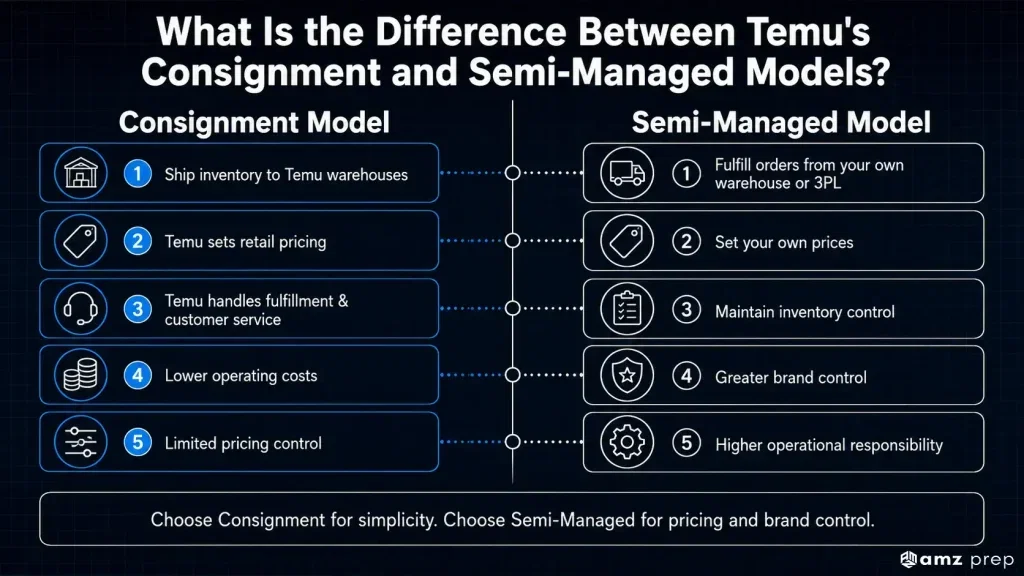
Temu runs two broad models. Which ones you’re offered depends on your country and category, and Seller Center shows the options during sign-up. The choice decides who controls your price and who ships your orders.
The Fully Managed Model
In the fully managed model, you supply inventory and quote a supply price. Temu handles the storefront price, delivery to the customer and customer service. You don’t control the retail price shown to shoppers, and it can sit below what you charge elsewhere.
The Local Seller Model
In the local seller model, you set your own prices and hold your own stock. You ship orders from your warehouse or from a fulfillment partner in your country. This is the model the Local Seller Program is built on. It gives you pricing control, and with it full responsibility for delivery speed and returns.
The Pricing Control Difference Most Sellers Miss
In the fully managed model, your product can appear on Temu at a lower price than on your Amazon listing or your own store. That creates channel conflict and erodes your pricing everywhere else.
That matters more than the commission rate. If protecting price across channels is a priority, start with the local seller model.
How to Create a Temu Seller Account (Step-by-Step)
Registration is free and open in Temu’s local seller markets. No invitation code is needed, and the referral code field is optional.
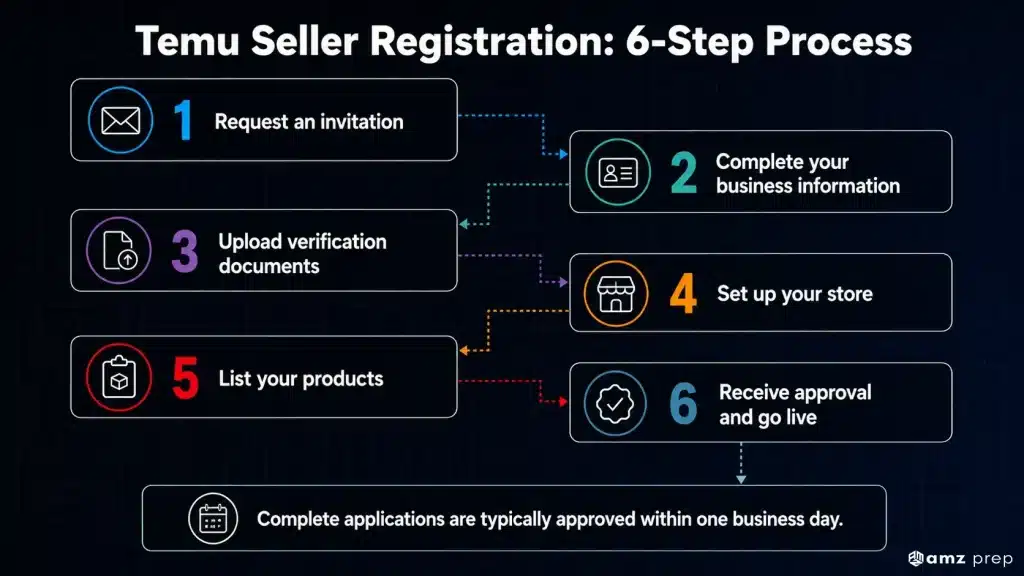
- Choose your portal and country. Go to the Seller Center for your region (see the table above). Select the country where your business is registered, then click Sign up.
- Create your login. Enter an email or phone number and a password. Temu says this takes about a minute.
- Choose your account type. Pick individual, sole proprietorship, partnership or corporation, depending on what your country offers.
- Enter business and tax details. Use your exact legal name, registered address and tax ID as they appear on official records. Temu verifies them against those records.
- Verify the representative and bank. Upload the representative’s government ID and link a bank account in the same name. Temu says the whole application takes about ten minutes.
- Wait for review, then set up your shop. Temu normally reviews applications within one business day. Once approved, set up your shipping templates and returns options, then add your first products. If you’re deciding where to hold stock, see where Temu’s warehouses are located.
Is there a Temu seller registration fee? No. Temu doesn’t charge to register.
Temu Local Seller Program 2026 (Countries + Fulfillment)
The Local Seller Program is how most Western brands sell on Temu. You list products, hold stock in your country and ship orders locally. Shoppers get faster delivery than on cross-border orders, and Temu’s search favors that speed.
Where it runs:
- United States: launched March 2024.
- Canada: opened to Canadian-registered businesses in February 2025. US sellers have been able to sell into Canada since December 2025.
- United Kingdom and EU: UK and EU sellers register through the EU Seller Center. EU sellers can sell across EU markets from one account.
- Elsewhere: Temu has also opened the program in markets including Japan, South Korea and Australia.
The model has two hard requirements: local stock and a local returns address. Temu doesn’t run logistics for local sellers directly. It offers integrated shipping options, but the warehouse, picking, packing and returns are yours to arrange.
That’s where most brands get stuck. A brand fulfilling Amazon, Shopify and Temu from separate stock pools runs out in one channel while sitting on extra stock in another.
What It Costs to Sell on Temu
Temu doesn’t publish a public fee schedule. Rates vary by country, category and seller model, and you see your own in the Seller Center during onboarding. Treat any single figure you read online with caution, because published estimates conflict widely.
What to budget for:
- Commission on each sale, set by category
- Outbound shipping, which local sellers pay
- Returns, including return shipping and unsellable units
- Advertising, optional but common for new listings
- Fulfillment costs, in-house or with a 3PL
Registration and listing are free.
Selling on Temu from the UK
UK sellers register through the EU Seller Center and need a UK bank account in the same name as their ID or business. Temu reports UK sellers’ income to HMRC under the digital platform reporting rules. VAT registration applies once taxable turnover passes £90,000 in a rolling 12 months.
For product safety, CE and UKCA marks are both accepted in Great Britain for most product types. Our full UK seller guide covers HMRC, VAT, product marking and UK requirements in detail.
Fulfillment Requirements for Temu Local Sellers
Local sellers ship their own orders. Temu sets handling and delivery time standards in Seller Center, and late or missed shipments hurt your visibility. Temu offers integrated shipping options, but it doesn’t run the warehouse.
This is the operational requirement I see brands underestimate most when they first consider adding Temu. If your current setup fulfills from a single location, or manages warehouse operations in-house, a volume spike on Temu will stress those standards fast.
Sellers running Temu alongside Amazon FBA or a DTC store need a fulfillment partner that can pick, pack and dispatch across all channels from one inventory pool. That gives you the coverage without adding warehouse headcount or splitting stock across locations.
AMZ Prep’s omnichannel fulfillment supports exactly this setup. It handles multiple sales channels through one warehouse network, with the carrier access and dispatch speed the local seller model requires. Brands selling across several marketplaces should also see how ecommerce order fulfillment handles returns across channels.
What Sells on Temu?
Category selection matters more than listing volume. One well-researched product in a low-competition niche consistently outperforms 50 generic products uploaded at volume.
Open Temu as a customer. Search your target category and sort by Best Sellers and Top Rated. Products with 5,000 or more reviews are proven sellers. Read the 2- and 3-star reviews on your target product, because common complaints become a product brief:
- “Runs small” across 40 reviews means fix your size guide.
- “Took 3 weeks to arrive” across 60 reviews means promise fast local dispatch, then meet it.
Categories to Approach with Compliance Preparation
Some categories need paperwork before you list. Cosmetics, children’s toys and electronics carry safety, labeling and conformity rules in every market Temu serves. Temu may ask for conformity documentation for these categories. Source only from suppliers who can provide it.
Beauty sellers should review our cosmetics and beauty fulfillment requirements before sourcing. Electronics sellers can review electronics 3PL fulfillment for storage and compliance-handling requirements.
How to Optimize Your Temu Listings
Title Formula
Temu titles can run up to 200 characters, but the first few words matter most. Lead with the product type, then the key attribute, then the material or feature, then the use case or audience.
- Strong: “Oversized Fleece Hoodie Women’s Sherpa Lined Warm Winter Pullover”
- Weak: “Super Soft Premium Quality Ladies Hoodie Amazing Value”
The first targets search queries buyers actually type. The second wastes space on adjectives with no search volume.
Images
Lead with a clean product shot on a plain white background. Temu’s listing tools accept up to 24 images, with the longest side at least 500 pixels. Follow with:
- a lifestyle shot
- detail close-ups
- a size guide for apparel in cm and inches
- a what’s-in-the-box layout
Size-related complaints are the most common driver of returns in fashion. A clear size guide in your secondary images directly reduces return rate and protects your seller rating.
Descriptions
Open with the problem the product solves, not a feature list. Follow with dimensions, materials, compatibility, care instructions and what’s included. Mobile buyers scan, so short paragraphs and clear structure outperform dense copy every time.
Pricing
Temu buyers expect low prices. Calculate landed cost before setting a price:
- supplier cost
- inbound freight
- import duty and taxes
- packaging and labels
- outbound shipping to the customer
Underestimating landed cost is the most common reason new sellers run negative margins.
Selling on Temu vs Amazon
From a channel strategy standpoint, the two platforms serve different roles. Temu is a volume and cash flow channel; Amazon is a brand and retention channel. Sellers who do well on Temu treat it as an addition to their channel mix, not a replacement.
| Factor | Temu (local seller) | Amazon |
|---|---|---|
| Commission | Category-based, not publicly published | Category-based referral fees, published |
| Monthly fee | None to register | Professional plan fee (£25/month ex VAT in the UK) |
| Fulfillment | Seller ships or uses a 3PL | FBA or FBM |
| Pricing control | Full (local seller model) | Full |
| Brand building | Limited | Brand Registry tools |
| Buyer intent | Heavily price-led | Broad, including premium |
For a deeper breakdown of how to start on Amazon alongside Temu, our guide on how to sell on Amazon covers FBA setup, listing requirements and fee structures.
Suggested read: Amazon Haul vs. Temu: Low-Cost Showdown
Conclusion
Brands adding Temu almost always hit the same ceiling at the same time: fulfillment. The local seller model rewards fast, reliable local delivery, and that’s hard to run from a separate stock pool. Set up shared inventory and returns before you scale listings.
Frequently Asked Questions
How do beginners start selling on Temu?
Sign up at the Temu Seller Center for your country, choose an account type, and enter your business, tax, ID and bank details. Temu normally reviews applications within one business day. Then set up shipping and list products.
Is it legal to resell Temu products?
Generally yes, if the products meet local safety and labeling rules and aren’t counterfeit. Branded goods need the brand owner’s authorization. Each marketplace you resell on also has its own rules about sourcing.
Is selling on Temu worth it in 2026?
It can be for brands with competitive landed costs and local fulfillment in place. Buyer intent on Temu is heavily price-led, so premium brands often fit less well. Test a few SKUs before committing inventory.
Can I sell on Temu and Amazon at the same time?
Yes, and many brands run both. Keep prices consistent across channels to avoid conflict, and fulfill both from one inventory pool so neither channel runs out first.
Which Temu seller model should I choose?
Choose the local seller model if you want pricing control and already ship orders locally. The fully managed model hands pricing and delivery to Temu, which can undercut your prices on other channels. Seller Center shows which models your country offers.
What happens if I miss Temu’s fulfillment standards?
Temu sets handling and delivery standards in Seller Center, and repeatedly shipping late hurts your store’s visibility in search. A fulfillment partner with local stock helps you meet those standards without adding warehouse staff.
What changed for Temu sellers in 2026?
US sellers can now sell into Canada, which opened in December 2025. US duty-free de minimis entry remains suspended, pushing more sellers toward local stock. EU sellers must follow Temu’s Product Safety and Compliance Policy and Seller EU Services Agreement.
What are Temu’s product title rules?
Temu’s listing tools allow titles up to 200 characters. Lead with the product type and key attribute, avoid promotional adjectives, and check your category’s rules in Seller Center before publishing.
What are Temu’s product image requirements?
Use a clean main image on a plain white background. Temu’s listing tools accept up to 24 images per product, each at least 500 pixels on the longest side. Category rules can add more.
Where do I find Temu’s seller terms and conditions?
Temu publishes its seller agreements and policies in Seller Center, including the Seller Privacy Policy. EU and UK sellers sign the Seller EU Services Agreement. Read the version for your country before you list.
Can I sell on Temu from Canada?
Yes. Temu opened its Local Seller Program to Canadian businesses in February 2025. Your business must be registered in Canada, with local inventory and fulfillment. Apply at ca.seller.temu.com.

Arishekar N is a Vice President (VP) of Marketing at AMZ Prep, specializing in ecommerce fulfillment and Amazon logistics strategies with a proven track record of driving growth for e-commerce businesses. He is a strategic leader with extensive expertise in marketing, e-commerce operations, SEO & advertising, and branding.
Stay updated on his latest insights by following him







Question: is Temu still requiring China-based shipping for new sellers, or have they opened up US-fulfilled options for the semi-managed model? The info online keeps contradicting itself.
The platform comparison table is genuinely useful. Most people lump Temu in with Shein but the seller economics are very different.
Solid breakdown. One thing worth adding: their returns process is almost entirely buyer-favored, which destroys your unit economics on anything over $30 retail.
Wish I’d seen this guide before I tried selling there. Lost about $4K on inventory I couldn’t move at the prices Temu set.
As a beginner, this answered the question I was most afraid to ask, yes, Temu does control your pricing in the fully-managed model. Glad I read this before signing up.
Curious if you’ve seen any sellers successfully cross-list between Temu and Amazon without cannibalizing themselves. That’s the puzzle I’m trying to solve right now.
Anyone here actually scaled past $50K/month on Temu and kept margin above 20%? Genuinely curious because everyone I know got squeezed within 6 months.
Tried Temu for 4 months selling kitchen accessories and pulled out. Platform reach is real but the margin compression is brutal, your section on pricing pressure nailed it.
The semi-managed vs fully-managed breakdown is the part most YouTubers gloss over. Fully-managed basically makes you a wholesaler, not a brand.
I’d push back gently on the “huge audience” framing, yes, traffic is high, but the buyer intent is heavily price-led. Not a great fit for premium or niche brands.
Good to know about the low competition on Temu. Makes me feel confident to start.
Great breakdown on 3PL options. Definitely makes fulfillment less stressful.
I didn’t realize Temu had local warehouses in Europe. Super helpful info!
This guide made selling on Temu so much clearer. Excited to start!
The product photography and description advice is spot on. Too many sellers ignore this and wonder why sales don’t come in.
This feels like a full roadmap, not just an intro. Bookmarking this for when I set up my account!
Love how this guide balances opportunity with challenges—like the intense price competition. Feels realistic, not just hype.
Great call on 3PL. Handling fulfillment myself was always the scariest part, but outsourcing sounds way smarter.
Thanks for pointing out the hidden costs—shipping and payment fees can eat into profits if you’re not careful.
I didn’t realize Temu had local warehouses in Germany, France, and Spain. That makes logistics so much easier.
The quick success tips are gold. Especially the reminder to manage reviews early on.
I like how you included the compliance side (CE, VAT, EPR). Most guides skip that part, but it’s crucial.
The comparison to Amazon really clicked—Temu feels less crowded right now, which is a huge opportunity.
The step-by-step breakdown is super clear. Didn’t know registration was still invite-only in Europe—good to know before jumping in.
I was overwhelmed by selling online, but this guide simplifies everything.
Step-by-step guide is perfect for beginners like me.
Love how you explained the VAT and compliance requirements. Very clear.
Fast shipping and 3PL tips are gold. This saves me so much time!
Really useful for UK and EU sellers. Appreciate the detailed walkthrough!
Helpful tips on pricing strategy. Can’t wait to optimize my listings.