
Selling frozen food in 2026 is exciting, especially with the rise in demand for frozen products. From gourmet ice cream to ready-to-eat meals, frozen foods are becoming eCommerce bestsellers, driven by convenience, variety, and longer shelf life.

But getting these products to customers in perfect condition? That’s the real challenge. Whether you’re shipping premium meats, vegan meals, or chocolate-covered treats, keeping everything frozen and fresh is key to happy customers.
Shipping frozen goods can feel like science, logistics, and magic all rolled into one chilly package. But don’t worry we’ve come up with simple steps anyone can follow.
In this blog, you’ll learn the best way to ship frozen food, how dry ice works, common challenges, carrier options, pro tips, and how to send frozen food internationally. Let’s dive in!
How to Ship Frozen Items: Step-by-Step
In 2026, frozen food is no longer just for grocery aisles, it’s becoming an important category. Shoppers are filling their carts with everything from artisanal ice cream to heat-and-eat dinners, and they expect it to arrive perfectly frozen.
Learning how to send frozen food isn’t just about pasting a ‘Keep Frozen’ sticker on a box. You need to prep your items carefully and follow certain steps and guidelines.
Here’s a step-by-step guide:
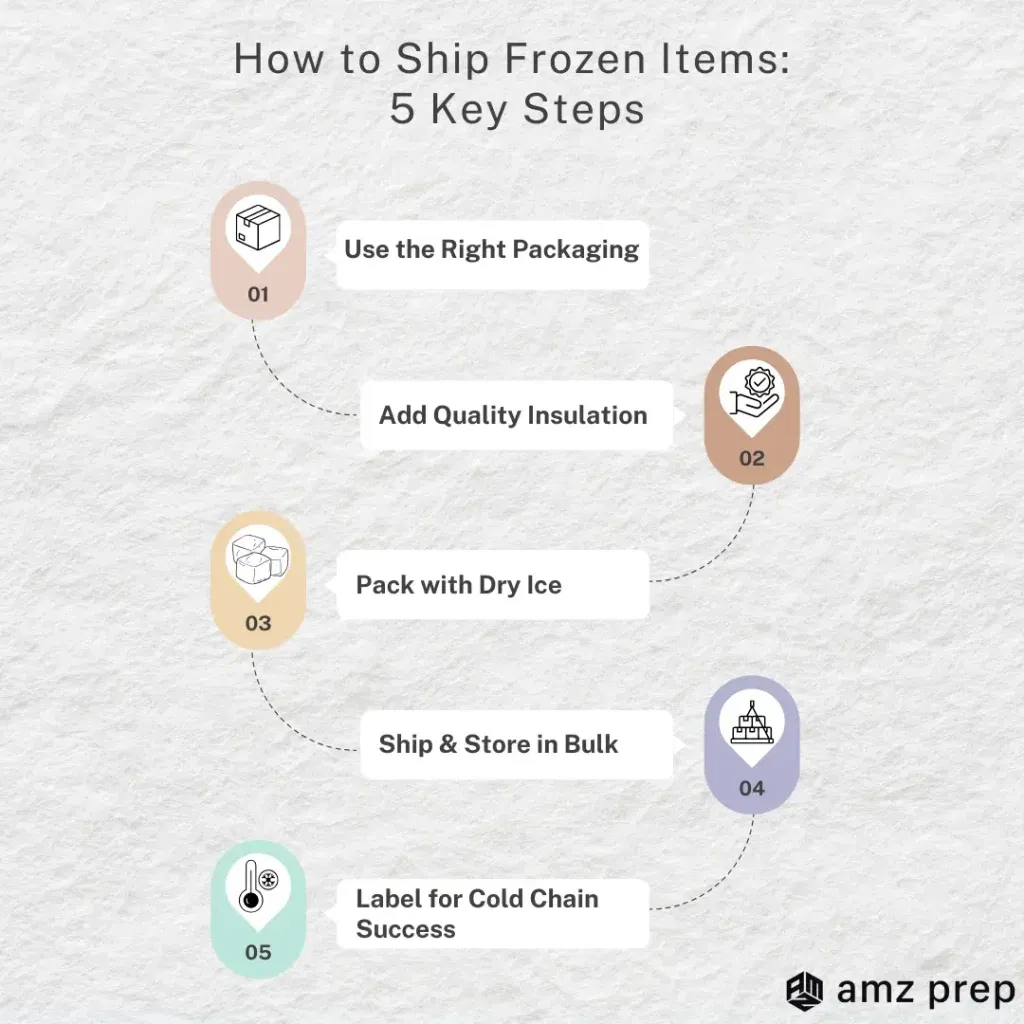
Step 1: Improve Your Packaging Strategy
One of the most important parts of shipping frozen goods is getting the packaging right. Even if you’re using refrigerated trucks, poor packaging can lead to spoilage or damaged goods.
At the beginning, handling packaging in-house might feel simple and cost-effective. But as your business grows, packaging inefficiencies quickly drive up costs. To avoid this, focus on using lightweight, insulated materials such as styrofoam that maintain cold temperatures without adding much weight.
Also, avoid placing small items in large boxes. Oversized packaging leads to higher shipping costs and wasted space in your delivery vehicles. If you must use a larger box, add bubble wrap or packing peanuts to prevent product movement and protect frozen items during transit.
Step 2: Use High-Quality Insulated Foam Containers
You can use insulated containers to keep products frozen, if you feel refrigerated trucks are not a cost effective option.
Thick foam containers help trap cold air and reduce temperature fluctuations. When you choose high-quality insulation, your frozen items stay colder for longer. Many businesses make the mistake of using oversized containers with excess gel packs, which wastes space and refrigerant.
Instead,
- Use smaller, tight-fitting containers to reduce air space.
- Add insulation materials such as:
- Foam padding
- Aluminum liners
- Plastic wraps
- Air cushions
- Tighter packaging improves temperature retention.
Step 3: Pack with Dry Ice for Maximum Cold
When it comes to keeping things frozen, dry ice is one of the most effective options. It’s the solid form of carbon dioxide and doesn’t melt as it sublimates (turns into gas) at -109.2°F.
Because of its extremely low temperature, dry ice quickly lowers the temperature inside your package and keeps it cold for extended periods. Always use protective gloves when handling dry ice to avoid frostbite, and never seal it in an airtight container (gas buildup can be dangerous).
Step 4: Order and Ship in Bulk
Ordering your materials in bulk isn’t just smart, it’s efficient. With the frozen food market growing steadily, insulated packaging supplies are in high demand, and bulk purchases can help you save significantly.
Bulk buying also improves warehouse operations. Here’s how:
- Your team can prep and pack more items faster.
- Ready-to-go packaging improves order turnaround times.
- Fewer reorders mean fewer delays and better planning.
Keep a dedicated cold storage area where frozen products are staged just before shipment. This reduces temperature fluctuations during handling. Test and optimize this workflow before scaling it up.
Step 5: Label Everything Clearly and Strategically
Labeling may seem like a small detail, but it plays a big role in cold chain logistics. Clear, accurate labeling helps you:
- Track packages throughout the shipping process.
- Share manufacturing and expiration dates with customers.
- Prioritize shipments based on perishability.
Use color-coded or custom labels to mark high-priority shipments. When delivery teams know which boxes to unload first, highly perishable items reach customers faster, extending their shelf life and improving satisfaction.
Will Dry Ice Keep Things Cold or Frozen During Shipping?
Yes, dry ice will keep things cold or even frozen during shipping. Since it is often seen as the gold standard, is it always the best choice?
Dry ice is solid carbon dioxide that maintains a temperature of -109°F (-78.5°C) that is significantly colder than your typical freezer. Instead of melting into a liquid, dry ice undergoes sublimation, transforming directly from a solid to a gas.
This process has several advantages like you need not deal with the mess of liquids. Even in extremely cold temperatures you can keep the products completely frozen. It creates a CO2 environment that can help preserve some food items
Like the coin having two sides, it has its own challenges. It requires special handling (gloves are necessary to prevent ‘dry ice burns’). The packages need ventilation that allows CO2 gas to escape. It sublimates at a rate of 5-10 pounds per 24 hours, depending on insulation quality.
So, now you may have a question about how long the dry ice will keep the food frozen. The sublimation rate of dry ice depends on various factors including insulation quality, outside temperature, and package size. As a general guideline:
- 5 pounds of dry ice will typically last 24-36 hours in a standard styrofoam cooler
- 10 pounds may last 48-60 hours under ideal conditions
- Adding additional insulation layers can extend these timeframes significantly
For shipments requiring longer transit times, you’ll need to calculate carefully and possibly increase both the amount of dry ice and the insulation quality.
Alternative Cooling Solutions
While dry ice is powerful, it’s not always practical. From safety concerns to shipping restrictions, it’s not a one-size-fits-all fix. That’s where alternative cooling solutions come in — offering flexibility, safety, and efficiency for different shipping needs.
Below are some of the cooling options that are effective and yield you better results.
Gel packs – These reusable gel packs typically freeze around 32°F (0°C) but some specialty versions can reach lower temperatures.
They’re safer to handle than dry ice and don’t have shipping restrictions, making them suitable for shorter transit times (under 24 hours) and products that don’t need to be kept rock-solid frozen.
Traditional Ice Packs – Less expensive than gel packs but also less effective. These can work for very short transits or as secondary cooling support.
Block Ice – In some situations, frozen blocks of water in sturdy containers can provide effective cooling, especially for items that don’t need to remain completely frozen.
Common Challenges Of Shipping Frozen Items
Even with careful planning, shipping frozen food presents unique challenges. Being aware of these potential pitfalls helps you develop strategies to overcome them.
Temperature Fluctuations
One big challenge of frozen food shipping is temperature inconsistency. Your package might experience multiple climate zones, sitting on hot tarmacs or in unrefrigerated delivery vehicles.
These fluctuations can occur even with premium shipping services. To avoid this:
- Use temperature indicator strips inside packages to track if temperatures exceeded safe thresholds
- Consider phase-change materials that absorb and release energy at specific temperatures
- Create redundant cooling systems using multiple types of cooling materials
- Package items in the center of your container, surrounded by cooling materials on all sides
Extended Transit Times
Some delays may happen due to weather events, mechanical issues, or human error that can extend your carefully planned shipping timeline.
In order to avoid delays, ensure the package is planned for 24 – 48 hours longer than expected transit time.
You must consider weather delays in your planning, especially during storm seasons, and always have a clear communication with your customers about expected delivery times.
Seasonal Considerations
Shipping frozen food in May presents very different challenges than shipping in January. Seasonal adaptations are something crucial that you should consider.
If you’re shipping frozen food in the summer,
- Increase cooling materials by 25-50%
- Use expedited shipping services exclusively
- Ship early in the week to avoid weekend delays
- Consider night delivery options when temperatures are lower
If, in case, you’re shipping the products in winter:
- Monitor for extreme cold that could affect other aspects of your shipment
- Watch for storm systems that might delay delivery
- Take advantage of naturally colder conditions to reduce cooling material needs
- Still ensure adequate insulation, as packages may encounter heated environments during transit
Note: Regional considerations matter too, as shipping to Alabama in summer requires different preparations than sending to Maine in the same season.
Amazon sellers shipping meltable products can use this playbook to plan their fulfillment strategy across the full restricted season. Download the Meltable Season Playbook!
Choosing a Carrier to Ship Your Perishables
When shipping frozen foods, selecting the right carrier is critical to making sure your products arrive in perfect condition. Let’s look into the features:
| Feature | USPS | UPS | FedEx |
|---|---|---|---|
| Refrigeration Services | No specific refrigeration services | No dedicated refrigeration, but reliable cold chain handling | Offers FedEx Temp-Assure specialized solutions |
| Recommended Service | Priority Mail Express | UPS Next Day Air® | FedEx Express with Temp-Assure |
| Dry Ice Policy | Acceptable for domestic shipments only | Acceptable with 5.5-pound limit for air shipments | Acceptable with proper documentation |
| International Dry Ice | Not permitted | Permitted with IATA regulations | Permitted with IATA regulations |
| Container Requirements | Leakproof but not air-tight; thick polystyrene box recommended | Thin plastic liner inside with thick insulated foam container | Minimum 1-1/2″ (4-cm)-thick insulated foam walls |
| Documentation | Class 9 DOT hazard label; shipper’s declaration in triplicate; food name and dry ice weight marked | Hazard labels and declaration for dry ice | Proper identification, classification, markings, and labeling required |
| Cooling Methods | Dry ice (domestic only) | Dry ice and gel packs (frozen water not recommended) | Dry ice with proper labeling |
| Best For | Economical domestic shipments of lighter items | Reliable tracking and delivery speed | High-value frozen products requiring temperature control |
| Cost Efficiency | Most economical for smaller packages | Mid-range pricing with good value for medium shipments | Premium pricing with specialized services |
Suggested Read: Cold Storage Fulfillment Guide: Choosing the Right 3PL Partner for Perishable Products
How to Send Frozen Food Internationally?
Shipping frozen food internationally is more complex than domestic delivery. It involves strict customs rules, longer transit times, and additional packaging considerations.
Here’s a breakdown of how to do it right
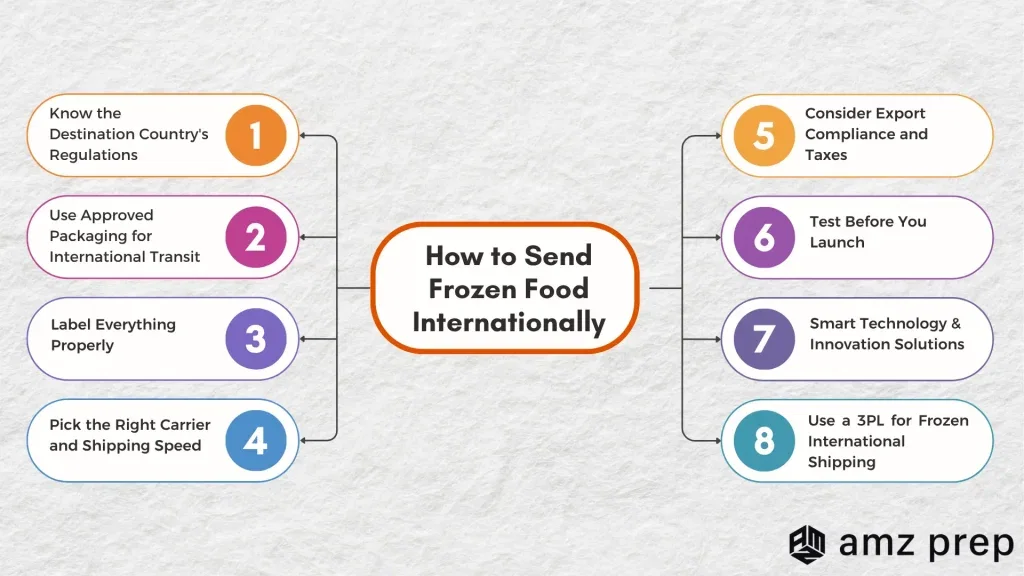
1. Know the Destination Country’s Regulations
Every country has its own rules about importing perishable items. Some may completely restrict certain foods, while others allow frozen goods with proper documentation.
In North America, the US requires USDA/FDA permits and Prior Notice filing, while Canada’s CFIA demands import permits 15 days in advance. The EU operates through the TRACES system for streamlined documentation, though the UK now requires separate health certificates post-Brexit.
It is advisable to check import laws for meat, dairy, seafood, and other perishables. Be aware of any FDA, USDA, or international customs paperwork required. Some countries may require health certificates or lab tests for food safety.
2. Use Approved Packaging for International Transit
When sending frozen goods abroad, the packaging must endure longer transit times and more handling. Here’s how to pack them:
- Use insulated containers made of styrofoam, thick plastic, or thermal liners.
- Add plenty of dry ice or gel packs. Dry ice works better for longer hauls, but it’s regulated.
- Choose a leak-proof, food-grade inner layer to prevent spills.
- Outer packaging should be sturdy cardboard with ventilation holes (especially when using dry ice).
3. Label Everything Properly
International frozen food shipments must have proper labels. For example; ‘Perishable’ or ‘Keep Frozen’ must be visible. Dry ice packages must be marked with ‘UN 1845’ (the hazardous material code).
Ensure to include origin and destination addresses, contents, and weight. If the labeling is correct, then it passes the custom clearance and avoids misrouting or spoilage.
4. Pick the Right Carrier and Shipping Speed
International shipping can take days or even a week. As speed is critical, choose carriers that offer overnight shipping or 2-day international delivery. FedEx, UPS, and DHL all have temperature-controlled or perishable shipping options.
For North American routes, FedEx International Priority and UPS Worldwide Express Plus offer excellent temperature control and customs clearance capabilities. In Europe, DHL Express has the best track record for customs clearance, while DPD Cold specializes in frozen food networks within the EU.
Avoid postal services or economy shippers for frozen food as they’re too slow and inconsistent. Make sure to verify transit time, temperature maintenance capabilities, and customs handling expertise.
5. Consider Export Compliance and Taxes
Shipping frozen food internationally may come with extra costs:
- Import duties or VAT (value-added tax)
- Customs brokerage fees
- Export documentation costs
- Clarify with your customer who is responsible for these costs. Use Incoterms (like DDP – Delivered Duty Paid) to avoid confusion.
6. Test Before You Launch
Before offering international shipping broadly, test your packaging and carrier. Run trial shipments to ensure the product stays frozen. Also, check for delays, temperature issues, or damaged goods.
Use temperature sensors or indicators inside the package to monitor cold chain integrity. This helps avoid customer complaints and spoilage losses.
7. Smart Technology & Innovation Solutions
Modern frozen food shipping is powered by more than dry ice. Tech makes cold chains smarter, faster, and more reliable.
The frozen food shipping industry is growing with advanced smart tech to boost performance and reduce waste. IoT temperature monitoring devices offer real-time tracking, alerts, and compliance documentation.
Advanced packaging using phase change materials (PCMs) provides more stable and eco-friendly cooling than traditional ice packs. Smart packaging adds features like RFID, QR codes, and biodegradable insulation.
AI and predictive analytics now optimize delivery routes, forecast demand, and personalize shipping strategies based on customer behavior and weather conditions.
8. Use a 3PL for Frozen International Shipping
If you’re scaling and want to simplify operations, consider using a third-party logistics (3PL) partner with cold chain expertise.
A good 3PL like AMZ Prep can manage international documentation, provide certified insulated packaging, and coordinate cold storage trucking services for temperature-controlled transportation across North America, while storing frozen goods in compliant, monitored facilities. This frees you up to focus on product development and customer service.
Food Safety Certifications & Compliance
If you’re shipping frozen food, you can’t ignore food safety certifications. Whether you’re selling B2B or DTC, buyers expect proof that your cold chain is safe.
Maintaining food safety certifications is essential for frozen food shipping. Certifications like HACCP, ISO 22000, FSSC 22000, BRCGS, and SQF ensure regulatory compliance, build consumer trust, and minimize liability risks. while clearly defining who is responsible for conducting a hazard assessment within the organization.
HACCP, in particular, focuses on identifying and controlling hazards by requiring documented temperature monitoring, critical control point checks, corrective actions, and process validation.
Compliance also demands temperature logging, traceability, supplier verification, audits, and staff training. The benefits? Lower risks, better market access, stronger customer confidence, and simplified business operations.
Conclusion
Shipping frozen goods isn’t just about keeping things cold, it’s about managing risk, ensuring compliance, and delivering customer satisfaction. From smart packaging and refrigerants to express delivery and customer communication, every step matters.
Remember that shipping frozen goods requires attention to detail. Each step plays a vital role in successful outcomes. As orders grow, managing every shipment on your own can feel overwhelming. That’s where working with a trusted fulfillment partner pays off. They handle the cold-chain chaos so you can scale with confidence.
Frequently Asked Questions
Can frozen food be sent through the mail?
Yes, you can ship frozen food through the mail using insulated packaging and refrigerants like dry ice or gel packs. Just ensure you follow your carrier’s guidelines and choose express or overnight shipping to reduce transit time.
Is shipping frozen goods with dry ice effective?
Yes, dry ice is highly effective for shipping frozen goods. It sublimates at -109.3°F, keeping items frozen throughout transit. Just follow carrier safety guidelines when using it in your shipments.
What is the best carrier to ship frozen food?
FedEx, UPS, and USPS all allow frozen food shipping, but FedEx and UPS offer more specialized services for perishables. Choose a carrier based on speed, temperature control, and service area. Overnight or 2-day shipping is ideal.
How to keep food frozen when shipping?
Use a combination of insulated containers, dry ice or gel packs, and tight packaging. Limit air space inside the box, seal everything properly, and minimize handling time before drop-off.
How long will meat stay frozen in a cooler with ice?
With adequate insulation and dry ice, meat can stay frozen for 24 to 48 hours in a cooler. The more dry ice and insulation you use, the longer the meat stays frozen. Gel packs can help extend the chill if dry ice isn’t an option.
What’s the best way to ship frozen food for eCommerce?
The best way to ship frozen food is with a combination of dry ice, insulated packaging, and express delivery. This helps maintain the right temperature and ensures the product arrives in perfect condition.
How to ship cold food products safely?
Use temperature-controlled packaging, such as styrofoam coolers or thermal bubble wrap, and refrigerants like gel packs or dry ice. Ship cold food products early in the week to avoid weekend delays.

Daniel Rozario is the Lead Content Specialist at AMZ Prep, collaborating with the marketing team to produce blogs and articles on e-commerce fulfillment and logistics. He specializes in creating resources that help brands navigate inventory management, operational efficiency, and fulfillment strategy.
















Great tips on keeping frozen products safe and intact during shipping
The guide made complex shipping requirements much easier to understand.
Practical ideas that any food seller can apply right away
Very helpful breakdown of packaging options for temperature‑sensitive items.
Useful suggestions for insulating packages and maintaining product quality.
I liked the focus on minimizing thawing and spoilage risks.
Clear advice on choosing the right cold chain carriers.
Great overview of best practices for shipping perishable food.
Helpful reminder to plan for transit times and temperature control.
Easy‑to‑follow tips for packaging frozen goods efficiently.