Quick Answer: The seven largest rail freight companies in the USA are;
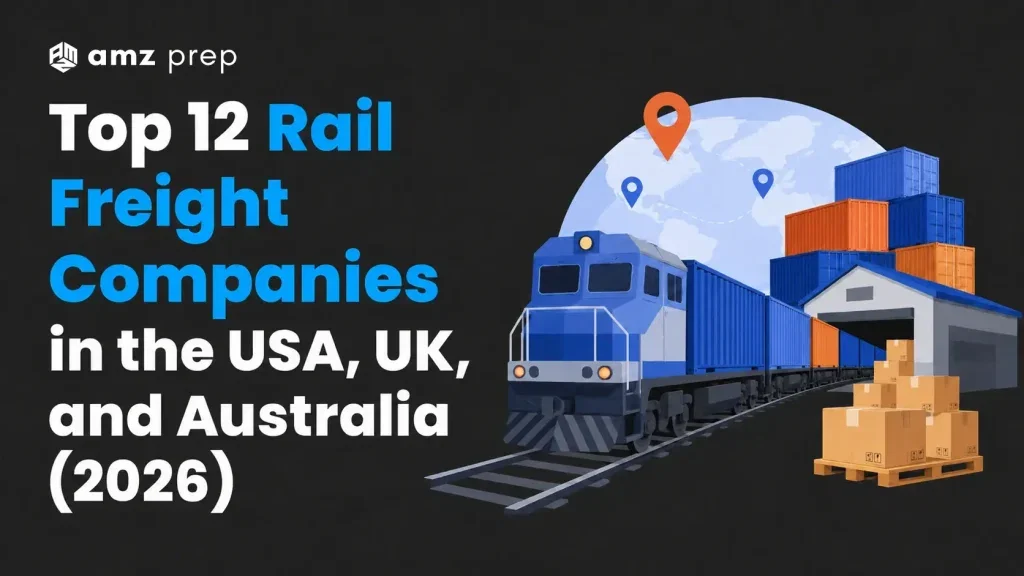
- Union Pacific Railroad,
- BNSF Railway,
- CSX Transportation,
- Norfolk Southern Railway,
- Canadian Pacific Kansas City (CPKC),
- Canadian National Railway (CN), and
- Amtrak (passenger only).
For Amazon FBA shipping, the top five freight railroads are Union Pacific, BNSF, CSX, Norfolk Southern, and CPKC.
Rail freight companies reduce shipping costs by 20-30% compared to trucking for bulk inventory shipments over 500 miles. These are Class I railroads companies that own the tracks, terminals, and equipment that physically move freight by train.
This article covers the largest Class I railroads in the USA, UK, and Australia, explains when rail freight makes sense over trucking, and matches each railroad to the right Amazon FBA shipping routes.
What Are Rail Freight Companies and How Do They Work?
What is a rail freight company?
A rail freight company transports goods by train using containers or specialized railcars across long distances. In the USA, seven Class I railroads own and operate 140,000+ miles of track connecting ports, warehouses, and distribution centers.
Class I railroads own the rail network like tracks, terminals, and equipment. Sellers book the rail leg directly with the carrier. The railroad moves the freight from origin terminal to destination terminal. Drayage (truck pickup and delivery at each end) is arranged separately.
This is different from freight forwarders, who coordinate the full truck-plus-rail-plus-truck process but don’t own any rail assets. If you need end-to-end intermodal coordination for Amazon FBA, a freight forwarder or 3PL handles that. This article covers the railroads themselves.
When to Use Rail Freight Companies
When should you use rail freight instead of trucking?
Use rail freight when:
- Distance exceeds 500 miles (cost advantage grows with distance)
- Shipment volume is 500+ cubic feet (rail pricing based on container capacity)
- Transit time is flexible (rail takes 7-10 days coast-to-coast vs. 3-5 days for FTL trucking)
- Destination is near a rail terminal (within 50-100 miles for drayage)
Don’t use rail freight when:
- Distance is under 500 miles (trucking is faster and cheaper)
- Volume is low (LTL trucking beats LCL rail for partial loads)
- Speed is critical (urgent replenishment needs air freight or expedited FTL)
Rail vs. Trucking Cost Comparison
| Route | Distance | FTL Trucking | Rail (Intermodal) | Savings | Transit Time Difference |
|---|---|---|---|---|---|
| LA to Chicago | 2,000 miles | $3,500-$4,500 | $2,500-$3,200 | 20-30% | Rail +2-4 days slower |
| LA to Dallas | 1,500 miles | $3,000-$4,000 | $2,200-$2,800 | 25-30% | Rail +2-3 days slower |
| Savannah to Ohio | 800 miles | $2,200-$2,800 | $1,800-$2,400 | 18-25% | Rail +1-2 days slower |
Top Rail Freight Companies in the USA
What are the largest rail freight companies in the USA?
The seven largest rail freight companies in the USA are:
- Union Pacific Railroad (32,100 route miles, Western/Central USA)
- BNSF Railway (32,500 route miles, Western USA)
- CSX Transportation (20,000 route miles, Eastern USA)
- Norfolk Southern Railway (19,300 route miles, Eastern/Midwest USA)
- Canadian Pacific Kansas City (CPKC) (20,000 route miles, Canada/USA/Mexico)
- Canadian National Railway (CN) (19,500 route miles, Canada/USA)
- Amtrak (passenger rail only, not freight)
Best rail freight companies for Amazon FBA shipping
| Railroad | Coverage | Best For | Transit Time | Cost (LA-Chicago) | Key Advantage |
|---|---|---|---|---|---|
| Union Pacific | Western/Central USA (23 states) | West Coast ports to inland FCs | 7-10 days | $2,500-$3,200 | Largest network, most terminals |
| BNSF | Western USA (28 states) | Fastest West-to-Midwest transit | 7-8 days | $2,500-$3,200 | Fastest transit times |
| CSX | Eastern USA (23 states) | East Coast ports to Southeast FCs | 4-7 days | $1,800-$2,400 | Regional speed |
| Norfolk Southern | Eastern/Midwest USA (22 states) | East Coast to Midwest FCs | 4-7 days | $1,800-$2,400 | Trucking partnerships |
| CPKC | Canada/USA/Mexico | Cross-border shipping | 7-10 days | $2,200-$2,800 | Single-line cross-border |
Union Pacific Railroad
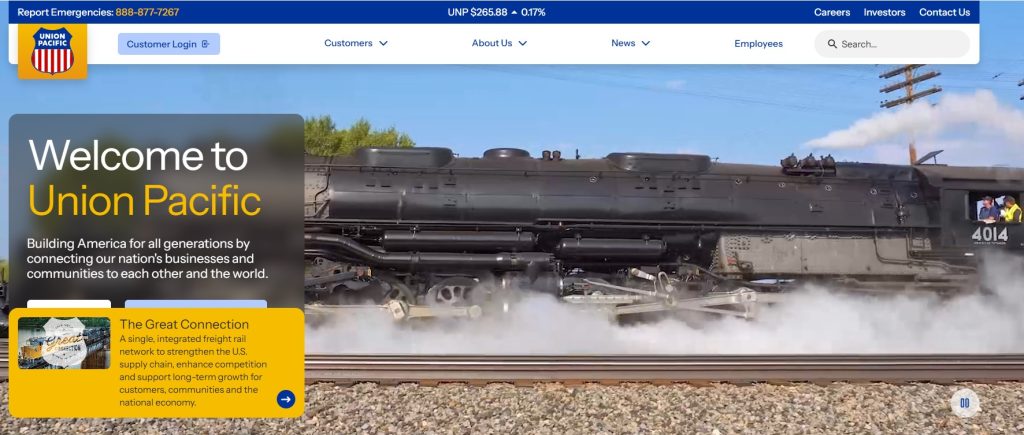
Union Pacific Railroad is the largest freight rail network in North America, operating 32,100 route miles across 23 Western and Central US states. Union Pacific specializes in intermodal freight (containers), bulk commodities, and automotive transport.
Union Pacific coverage area:
- Western USA: California, Oregon, Washington, Nevada, Arizona
- Central USA: Texas, Oklahoma, Kansas, Nebraska, Iowa, Missouri
Why Amazon FBA sellers use Union Pacific
Union Pacific connects West Coast ports (Los Angeles, Long Beach, Seattle) directly to inland Amazon FCs in Texas, Ohio, and the East Coast through dedicated intermodal terminals. Their LA terminal sits 30 miles from Inland Empire FC clusters. The Chicago terminal connects to 15+ Midwest FCs within 100 miles.
Union Pacific shipping costs:
- LA to Chicago (2,000 miles): $2,500-$3,200 per 53-ft container
- LA to Texas (1,400 miles): $2,200-$2,800 per 53-ft container
- Transit time: 7-10 days coast-to-coast
Union Pacific merger status
Union Pacific and Norfolk Southern filed a merger application in 2024 to create America’s first transcontinental railroad. If approved by the Surface Transportation Board (STB), the combined network would span 50,000+ route miles connecting West Coast to East Coast on a single railroad.
BNSF Railway
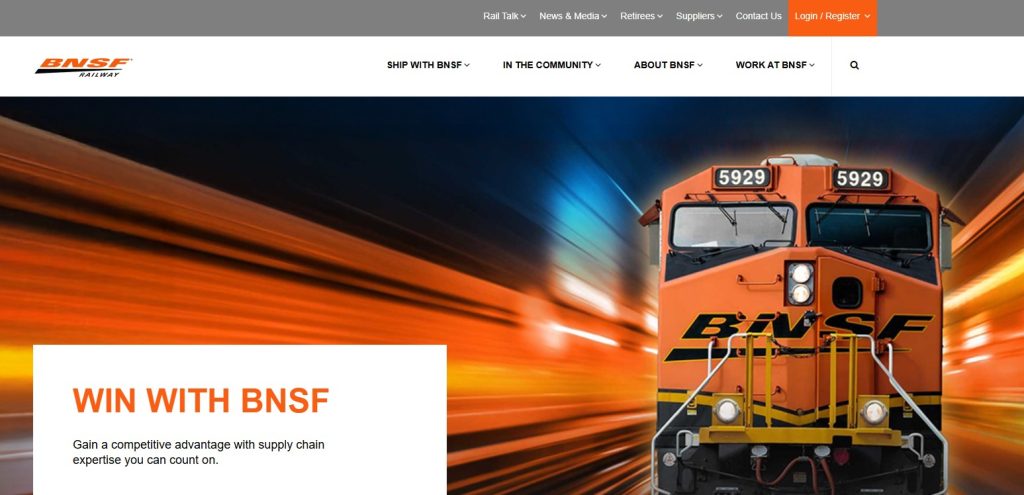
BNSF Railway operates the largest intermodal network in North America, spanning 32,500 route miles across 28 Western US states. BNSF is owned by Berkshire Hathaway and specializes in container shipping, coal transport, and agricultural products.
BNSF coverage area:
- Western USA: California, Oregon, Washington, Montana, Wyoming, Colorado
- Midwest USA: Illinois, Missouri, Kansas, Oklahoma, Texas
- 28 states total
Why Amazon FBA sellers use BNSF:
BNSF offers the fastest rail transit times among Class I railroads. LA to Chicago averages 7-8 days via BNSF intermodal (vs. 8-10 days on competitors). BNSF maintains strong partnerships with LA/Long Beach port authorities, reducing container dwell time at terminals by 24-48 hours compared to other carriers.
BNSF Railway cost:
- LA to Chicago (2,000 miles): $2,500-$3,200 per 53-ft container
- LA to Dallas (1,500 miles): $2,200-$2,800 per 53-ft container
- Transit time: 7-8 days coast-to-coast (fastest among Class I railroads)
BNSF key strength: Speed. If you’re managing time-sensitive bulk shipments from West Coast ports to Midwest Amazon FCs, BNSF offers the best speed-to-cost ratio among train shipping companies.
CSX Transportation
CSX Transportation operates 20,000 route miles across 23 Eastern US states. CSX specializes in intermodal freight, coal transport, and agricultural products. Strong presence in Florida, Georgia, and the Carolinas.
CSX coverage area:
- Eastern USA: Florida, Georgia, South Carolina, North Carolina, Virginia
- Mid-Atlantic: Maryland, Delaware, Pennsylvania, New Jersey, New York
- 23 states east of the Mississippi River
Why Amazon FBA sellers use CSX:
CSX owns the Eastern USA rail network. If you’re importing through East Coast ports (Savannah, Charleston, Norfolk, Baltimore), CSX connects directly to Amazon FC clusters in Florida, Georgia, the Carolinas, and the Mid-Atlantic region. Savannah is one of the fastest-growing ports in the USA. CSX handles significant container volume from there.
CSX Transportation cost:
- Savannah to Ohio (800 miles): $1,800-$2,400 per 53-ft container
- Charleston to Southeast FCs (400-600 miles): $1,500-$2,000 per 53-ft container
- Transit time: 4-7 days (regional routes)
CSX key strength: Regional speed. For routes under 1,500 miles, CSX beats trucking by 18-25% on cost while adding only 1-2 days to transit time.
Norfolk Southern Railway
Norfolk Southern Railway operates 19,300 route miles across 22 Eastern and Midwest US states. Norfolk Southern specializes in intermodal freight, automotive transport, and coal.
Norfolk Southern coverage area:
- Eastern USA: Virginia, North Carolina, South Carolina, Georgia, Florida
- Midwest USA: Ohio, Pennsylvania, Indiana, Illinois, Michigan
- 22 states total
Why Amazon FBA sellers use Norfolk Southern:
Norfolk Southern connects East Coast ports to Midwest Amazon FCs. If you’re moving freight from Norfolk, Baltimore, or Charleston to FCs in Ohio, Pennsylvania, or Indiana, Norfolk Southern offers competitive pricing and transit times.
Norfolk Southern has strategic partnerships with trucking carriers that handle last-mile delivery from rail terminals to Amazon FCs. This reduces drayage coordination complexity for FBA sellers.
Norfolk Southern Railway cost:
- East Coast to Midwest (800-1,200 miles): $1,800-$2,400 per 53-ft container
- Transit time: 4-7 days (regional routes)
Merger status: The pending Union Pacific and Norfolk Southern merger (awaiting STB approval) would create a coast-to-coast rail network, improving routing options for transcontinental shipping.
Canadian Pacific Kansas City (CPKC)
Canadian Pacific Kansas City (CPKC) operates 20,000 route miles connecting Canada, the USA, and Mexico. CPKC is the only single-line railway connecting all three North American countries. Formed in 2023 through the merger of Canadian Pacific and Kansas City Southern.
CPKC coverage area:
- Canada: British Columbia, Alberta, Saskatchewan, Manitoba, Ontario, Quebec
- USA: Midwest (Illinois, Missouri, Kansas, Oklahoma, Texas), Gulf Coast (Louisiana)
- Mexico: All major Mexican markets
Why Amazon FBA sellers use CPKC:
No interchange handoffs. CPKC is the only railroad offering single-line service across all three North American countries. If you’re managing Canada-to-US FBA shipments or US-to-Canada fulfillment, CPKC eliminates the border handoff that slows down transit when using two separate railroads.
CPKC handles customs clearance as part of their cross-border service. One railroad, one invoice, simplified documentation.
CPKC cost:
- Toronto to Chicago (550 miles): $2,200-$2,800 per 53-ft container (includes customs)
- Vancouver to US Midwest (1,800 miles): $2,500-$3,200 per 53-ft container
- Transit time: 7-10 days (cross-border routes)
CPKC key strength: Single-line cross-border. No railroad switching at the border. No duplicate customs paperwork.
Canadian National Railway (CN)
Canadian National Railway (CN) operates 19,500 route miles spanning coast-to-coast Canada with connections into the USA. CN is the only North American railroad reaching three coasts: Atlantic, Pacific, Gulf of Mexico.
CN coverage area:
- Canada: Coast-to-coast (British Columbia to Nova Scotia)
- USA connections: Detroit, Chicago, New Orleans, Memphis
Why Amazon FBA sellers use CN:
CN provides routing flexibility for Canadian ecommerce brands shipping to US Amazon FCs. Multiple border crossing options (Detroit, Chicago, New Orleans) allow sellers to optimize routes based on destination FC location.
CN’s intermodal terminals in Vancouver, Toronto, Montreal, and Chicago sit close to major Amazon FC clusters, minimizing drayage costs.
CN cost:
- Vancouver to Chicago (2,100 miles): $2,500-$3,200 per 53-ft container
- Toronto to US Midwest (500-800 miles): $2,200-$2,800 per 53-ft container
- Transit time: 7-10 days (cross-border routes)
CN key strength: Three-coast reach. Only railroad connecting Pacific, Atlantic, and Gulf coasts.
Rail Freight Companies in the UK
What are the largest rail freight companies in the UK?
The three largest rail freight companies in the UK are:
- Freightliner (largest, ports to inland terminals)
- GB Railfreight (second-largest, bulk goods and containers)
- DB Cargo UK (UK subsidiary of Deutsche Bahn, cross-border UK-Europe)
Freightliner
Freightliner is the largest rail freight operator in the UK, moving containers between ports (Felixstowe, Southampton, London Gateway) and inland terminals across England, Scotland, Wales.
Freightliner coverage: All major UK ports and distribution hubs
Best for: eCommerce brands managing cross-border inventory between UK and Europe
Key routes: Felixstowe to Midlands, Southampton to Birmingham/Manchester
GB Railfreight
GB Railfreight is the second-largest UK rail freight company, specializing in bulk goods, containers, and automotive transport.
GB Railfreight coverage: UK-wide network
Best for: High-volume bulk shipments and containerized freight
Key routes: Port of London to Midlands, cross-country routes
DB Cargo UK
DB Cargo UK is the UK subsidiary of Deutsche Bahn (Germany’s national railway). Operates freight services across the UK and Europe. Strong cross-border rail shipping between the UK and Europe.
DB Cargo UK coverage: UK domestic + cross-border UK-Europe
Best for: Cross-border rail between UK and European markets
Key advantage: Rail shipping between UK and Europe provides cost-efficient alternatives to road transport for eCommerce brands managing cross-border inventory
Rail Freight Companies in Australia
What are the largest rail freight companies in Australia?
The three largest rail freight companies in Australia are:
- Aurizon (largest, 2,670 km network in Queensland/NSW)
- Pacific National (all states, intermodal specialist)
- SCT Logistics (containerized freight, interstate routes)
Aurizon
Aurizon is Australia’s largest rail freight company, operating 2,670 kilometers across Queensland and New South Wales. Specializes in bulk commodities (coal, minerals, agricultural products) and general freight.
Aurizon coverage: Queensland, New South Wales
Best for: Bulk goods across long distances in Australia’s vast geography
Pacific National
Pacific National operates rail freight services across all Australian states. Strong intermodal network connecting major ports (Sydney, Melbourne, Brisbane, Perth) to inland distribution centers.
Pacific National coverage: All Australian states
Best for: Containerized freight and intermodal shipping across Australia
SCT Logistics
SCT Logistics specializes in containerized rail freight across Australia. Dedicated interstate routes between Melbourne, Perth, Brisbane, Adelaide.
SCT Logistics coverage: Interstate routes across Australia
Best for: Interstate containerized shipments
Key advantage: Rail is critical for moving bulk goods across long distances in Australia’s vast geography
How to Choose the Right Rail Freight Company for Your Business
How do you choose a rail freight company?
Choose a rail freight company based on:
- Shipping lanes (match routes to railroad coverage)
- Volume (high volume justifies direct Class I booking)
- Internal logistics capacity (direct booking requires your team to manage drayage and compliance)
- Pricing (compare rail vs. truck vs. air on your specific lanes)
Match Your Routes to Railroad Coverage
- Shipping West Coast to Midwest: Union Pacific or BNSF
- Shipping East Coast to Southeast: CSX
- Shipping East Coast to Midwest: Norfolk Southern
- Shipping cross-border Canada to USA: CPKC or CN
Know What You Are Responsible For
Booking directly with a Class I railroad means your team manages drayage at both ends, Amazon FC appointment scheduling, labeling compliance, and pallet configuration.
Sellers without internal logistics teams typically work with a freight forwarder or 3PL that handles this coordination. That is a separate category from the railroads covered in this article.
Compare Pricing and Transit Times
Get quotes for:
- Rail-only service (you coordinate drayage)
- FTL trucking (for cost comparison on your specific lanes)
Rail saves 20-30% vs. FTL trucking but adds 2-4 days to transit time on most routes.
Conclusion
Rail freight companies reduce bulk inventory costs by 20-30% for Amazon FBA sellers shipping 500+ cubic feet over 500 miles. The six Class I freight railroads like Union Pacific, BNSF, CSX, Norfolk Southern, CPKC, and CN own the tracks, terminals, and equipment that make this possible.
- Union Pacific and BNSF: West Coast to Midwest routes
- CSX and Norfolk Southern: East Coast to Southeast and Midwest routes
- CPKC and CN: Cross-border Canada-US shipping
Direct booking with Class I railroads works best for sellers with internal logistics teams who can manage drayage and FC compliance independently.
Frequently Asked Questions
What are the 7 Class I railroads in the USA?
The seven Class I railroads are Union Pacific, BNSF Railway, CSX Transportation, Norfolk Southern Railway, Canadian Pacific Kansas City (CPKC), Canadian National Railway (CN), and Amtrak (passenger only).
Which railroad is best for Amazon FBA shipping?
Union Pacific and BNSF are best for West Coast to Midwest routes. CSX and Norfolk Southern are best for East Coast to Southeast routes. CPKC is best for cross-border Canada-US shipping.
How much does rail freight cost compared to trucking?
Rail freight costs 20-30% less than FTL trucking for shipments over 500 miles. Example: LA to Chicago costs $2,500-$3,200 via rail vs. $3,500-$4,500 via FTL trucking.
How long does rail freight take?
Coast-to-coast rail freight takes 7-10 days. Regional routes take 4-7 days. Add 1-2 days for drayage at each end.
What is the difference between Class I railroads and freight forwarders?
Class I railroads own the tracks and handle rail transport only. Freight forwarders coordinate the entire process (truck pickup, rail transport, delivery) but don’t own rail assets.
What are the largest rail freight companies in the UK?
The three largest rail freight companies in the UK are Freightliner, GB Railfreight, and DB Cargo UK.
What are the largest rail freight companies in Australia?
The three largest rail freight companies in Australia are Aurizon, Pacific National, and SCT Logistics.
Why is rail freight cheaper than trucking?
Rail freight is cheaper because trains move 1 ton of freight 500+ miles on 1 gallon of fuel, while trucks move 1 ton only 100-150 miles per gallon. Rail also carries higher volume per trip (one train = 280+ trucks).

Chadwick Collins is an Enterprise Fulfillment Consultant at AMZ Prep, where he partners with high growth ecommerce brands to design and scale Amazon first logistics strategies. He brings extensive experience in freight, supporting brands across domestic and cross border transportation, routing optimization, and cost control.
At AMZ Prep, Chadwick works closely with enterprise clients to improve inventory flow, reduce landed costs, and accelerate delivery performance across North America. His expertise spans FBA, DTC, and B2B fulfillment, with a strong focus on aligning freight strategy with overall supply chain efficiency. He helps brands navigate complex logistics challenges while turning operations into a competitive advantage.
















Comments