
A freight bill audit is the process of reviewing carrier invoices against original rate contracts to catch billing errors, duplicate charges, and hidden accessorial charges. It ensures shippers only pay for services actually received.
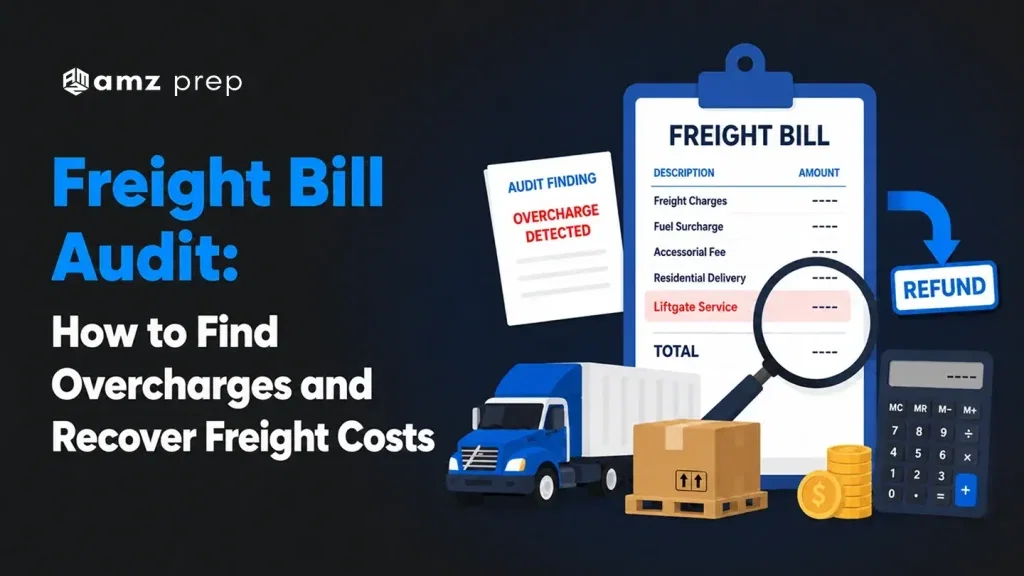
Done consistently, freight audits recover 3–7% of total freight spend for mid-market shippers.
On a $1M annual transportation spend, that is $30,000–$70,000 sitting in billing errors most operators never chase.
Freight invoice errors are not rare. Industry data puts the freight invoice error rate at 5–8% across most shipping programs. An audit is how you close that gap and restore supply chain visibility into what you are actually spending.
This guide covers what a freight audit and payment process looks like in practice, the error types worth targeting, and how to decide between in-house auditing and an outside freight audit provider.
What Is a Freight Bill Audit
A freight bill audit is the structured process of examining freight invoices against three sources of truth: your carrier contracts, your shipment records (BOL, POD, weight/dimension data), and your accessorial authorization logs.
The goal is to identify any charge that does not align with agreed terms and either short-pay before payment goes out or file a claim after the fact.
The freight audit and payment process covers all freight modes. That includes LTL, truckload, parcel, and intermodal. The complexity of freight billing increases with volume. A company running 50 shipments a month can audit manually. A company running 500 or more cannot do it accurately without automated systems.
What gets reviewed in a freight audit
| Line Item | What the Audit Checks |
|---|---|
| Base freight rate | Does the billed rate match the contracted lane rate and effective date? |
| Fuel surcharge | Is the FSC table correct for this carrier and this shipment date? |
| Accessorial charges | Were the services actually performed and pre-authorized? |
| Weight and dimensions | Do the billed figures match the BOL and shipper records? |
| Freight classification | Is the NMFC class on the invoice consistent with what was shipped? |
| Duplicate invoices | Has this invoice number or load already been paid? |
Why Freight Audits Matter
Three outcomes justify building a consistent freight audit process:
Cost recovery
With freight invoice error rates running between 5% and 8%, even a mid-size shipper overpays thousands of dollars monthly on charges that go uncontested. A comprehensive freight audit recovers those overcharges before they compound.
Contract compliance
Carriers do not always bill at negotiated rates. Systems get updated. Discount tiers expire. A freight audit confirms that every invoice reflects the exact terms agreed upon at contract signing, not the carrier’s published tariff.
Data-driven decisions
Cleansed freight data from a consistent audit process translates into actionable KPIs. Verified transportation costs by lane, carrier, and mode give procurement and logistics teams real numbers for budgeting, benchmarking, and future contract negotiations.
Pre-Audit vs Post-Audit
A pre-audit happens after an invoice arrives but before payment is released. It is the preferred method because it keeps capital in your account while disputes are resolved. Short-paying an invoice with a reason code (“Re-rated per Contract #1234”) is standard practice and gives you the negotiating position.
A post-audit is a retrospective review, typically covering freight bills paid over the previous 6–12 months. Post-audits recover money already paid out. For LTL and truckload, the standard statute of limitations for overcharge claims is 180 days from invoice payment. Missing that window forfeits the claim. Pre-auditing eliminates that risk entirely.
The Most Common Freight Invoice Errors
These five error types account for the majority of recoverable overcharges in most freight programs. Each one has a specific signature on an invoice and requires specific documentation to dispute.
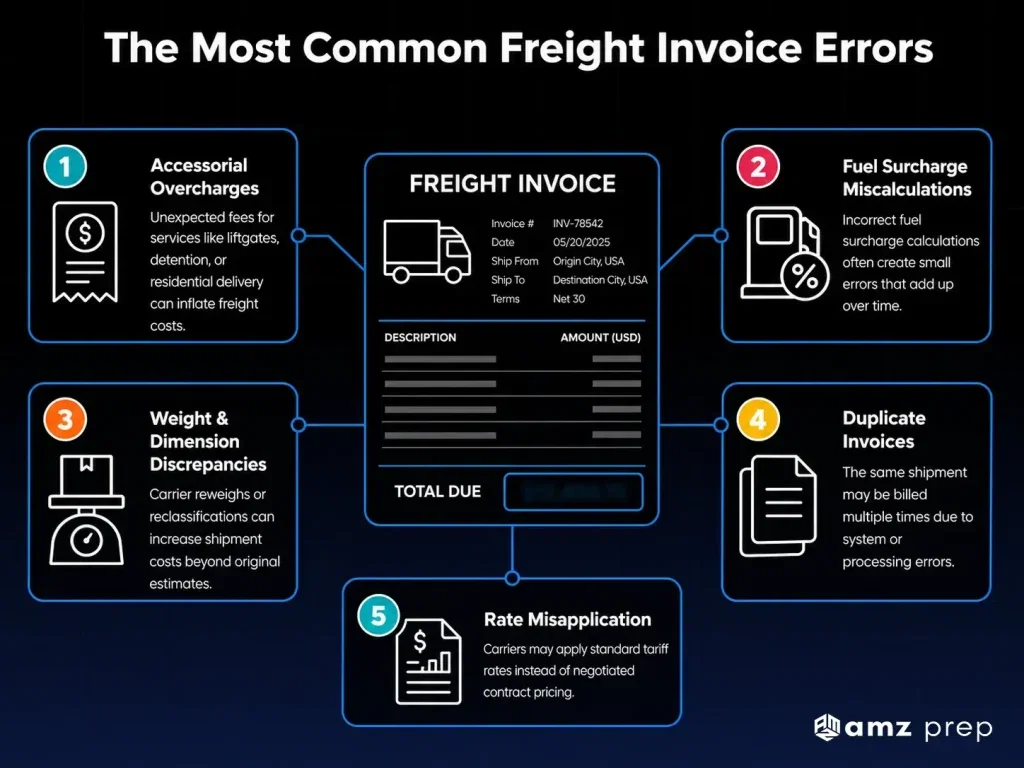
Accessorial Overcharges
Accessorial charges are the highest-error category in freight audit and payment. These are the add-on fees applied on top of base freight rates: liftgate service, detention, residential delivery surcharges, inside delivery, and TONU (Truck Ordered, Not Used).
Carriers often apply accessorial fees automatically through GPS geofencing or driver-entered data. A driver checks a liftgate box. The system applies the fee. By the time the freight invoice arrives 30 days later, no one can verify whether a liftgate was actually used.
Accessorial charges can add 8–20% to base transportation costs. That is the range across LTL shipments where accessorials are applied inconsistently and without documentation.
To dispute an accessorial charge, you need three things: the signed rate confirmation showing what was contracted, a driver-signed accessorial authorization log from the delivery, and the original BOL noting whether the service was requested. Without those three documents, the carrier’s invoice stands.
Prevention is simpler than recovery. Require a driver signature on an accessorial authorization form at every delivery. Log it at the dock level. That single step eliminates most disputed accessorial claims before they hit your accounts payable queue.
Fuel Surcharge Miscalculations
Fuel surcharge (FSC) tables change weekly. Each carrier uses its own calculation method, its own index baseline, and its own percentage tiers. A 0.5% FSC error sounds minor. Multiplied across 200 shipments per week over 52 weeks, it becomes a material line item.
Most shippers accept FSC charges without verification because the process of matching the right FSC table to the right carrier and the right shipment date requires data most AP teams do not have readily accessible. That is where errors accumulate quietly.
To audit FSC charges, you need the carrier’s FSC table for the specific week of each shipment, the index rate that applied on that date, and your contracted FSC cap or formula if one exists. If any of those three inputs differ from what was billed, the difference is recoverable.
Weight and Dimension Discrepancies
Carriers reweigh and reclassify LTL shipments at their terminals. Those adjusted figures often appear on the invoice unchallenged. If the BOL lists 800 lbs at Class 70 and the carrier bills 1,100 lbs at Class 92.5, you are looking at a meaningful rate increase on a single shipment. Across high-volume LTL freight programs, weight and classification disputes create invoice variances of 5–25% on individual bills.
The Bill of landing is the primary document for weight disputes. If your recorded weight at pack-out differs from the carrier’s reweigh, request the carrier’s scale certification and reweigh documentation. Many shipper-of-record contracts include reweigh dispute rights. Check your contract before assuming the carrier’s figure is final.
Common weight and dimension dispute scenarios
| Error Type | What Happens | How to Dispute |
|---|---|---|
| Reweigh overcharge | Carrier terminal reweighs above BOL weight | Request carrier scale certification and compare to pack-out records |
| Dimensional weight applied | DIM weight exceeds actual weight, DIM rate applied | Provide verified dimensions from your pack station |
| Freight reclassification | Carrier upgrades NMFC class at terminal | Reference the original commodity description and density calculation on BOL |
Duplicate Invoices
Duplicate billing occurs when the same shipment is invoiced more than once. This happens more often than most AP teams expect, especially in freight consolidation scenarios where both a carrier and a broker bill for the same load, or when a TMS system resubmits an invoice after a data error.
A duplicate invoice can be identical or slightly modified (different invoice number, same load and amount). Both pass through manual review in high-volume AP environments.
Prevention requires three controls: unique shipment identifiers cross-referenced in your TMS, automated deduplication logic flagging invoices with matching load numbers or amounts within a set time window, and a policy that no “corrected” invoice gets processed without confirmation that the original was voided.
Rate Misapplication
Rate misapplication is the error that passes most visual checks. The math on the invoice is correct. The starting rate is wrong. The carrier’s billing system applied its published tariff instead of your negotiated contract rate.
A discount tier expired in their system and was never updated. A lane-specific agreement did not carry over when rates were reuploaded.
AP clerks processing hundreds of invoices cannot memorize the contracted rates for 10-15 carriers across dozens of lanes. The error clears review and gets paid.
Catching rate misapplication requires contract-to-invoice matching at the line-item level, with the active contract version for the shipment date confirmed. Quarterly reconciliation, even a manual sample check of 20-30 invoices per carrier, surfaces this pattern quickly.
How to Run a Freight Bill Audit
This is the freight audit process used by AMZ Prep’s freight team for eCommerce brands running mixed LTL, FTL, and parcel programs. It does not require enterprise TMS software to execute, though automation accelerates every step.
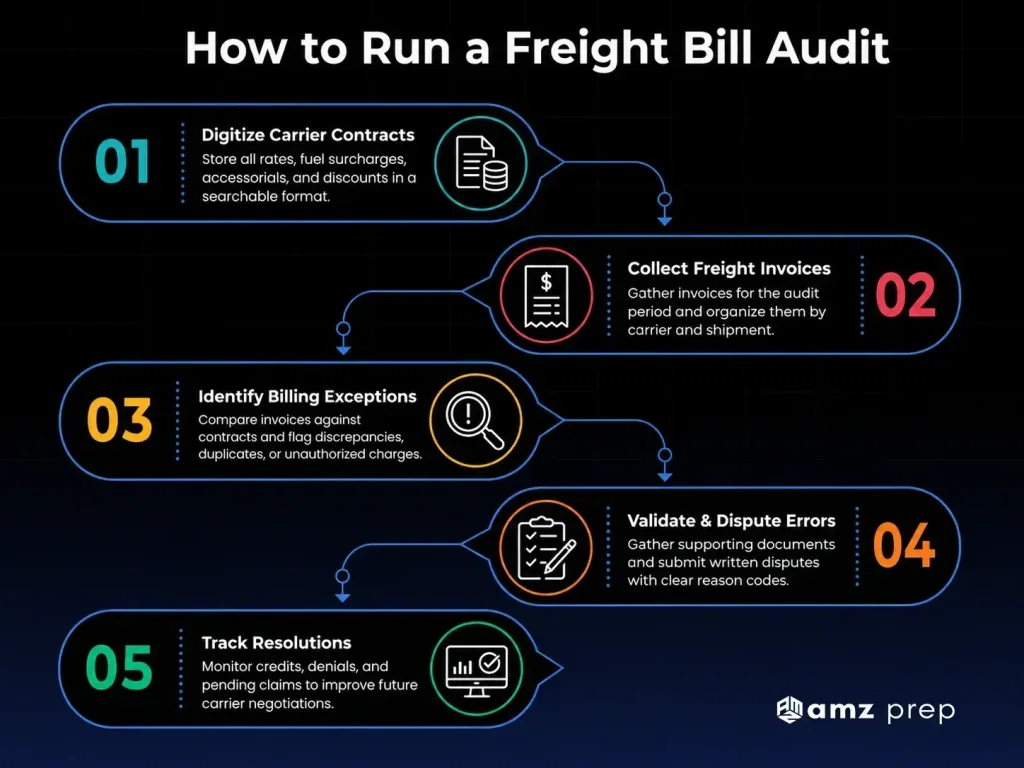
1. Invoice collection
Aggregate freight invoices across all shipping modes like parcel, LTL, truckload, ocean, and air from carrier portals, EDI feeds, or email systems. Every invoice needs to be in one place before the audit can begin. Fragmented collection is the most common reason errors slip through.
2. Pre-audit and verification
Compare each line item against your contracted rates, weight limits, and accessorial authorization records. This is where rate misapplication, fuel surcharge errors, and unauthorized accessorial fees get flagged. Automated freight audit software handles this comparison at scale. Manual review works at lower volumes.
3. Flag exceptions by category
Match each invoice against the contract master. Flag any line item where the billed amount differs from the contracted rate, where an accessorial appears without authorization, where weight or class differs from BOL records, or where a duplicate invoice number appears.
4. Gather dispute documentation
For each flagged item, pull the specific document that supports your dispute: signed rate confirmation, BOL, POD, accessorial authorization log, carrier FSC table, or scale certification. Each dispute needs the right document matched to it before submission.
5. Submit written disputes with reason codes
Send disputes to the carrier’s billing department in writing. Include the invoice number, the specific line item, the contracted rate or term that applies, the supporting document, and the dollar amount in dispute. Use a standard reason code format. Keep a dispute log with submission date and carrier response deadline.
6. Payment execution and data logging
Once disputed items are resolved and the corrected invoice is approved, process freight payment via your agreed method (ACH, wire, or check). Log every transaction, credit applied, and dispute outcome. This freight data becomes the input for contract renegotiation and carrier performance benchmarking.
In-House vs Outsourced Freight Auditing
The right model depends on invoice volume and internal team capacity.
| Factor | In-House Audit | Freight Audit Services Provider |
|---|---|---|
| Invoice volume | Under 500/month | 500+/month |
| Carrier count | 5 or fewer | 6 or more |
| Freight modes | Single mode | Multi-mode (LTL, FTL, parcel, intermodal) |
| Contract complexity | Standard tariff-based | Negotiated multi-tier, multi-lane |
| Team capacity | Dedicated logistics AP staff | Lean AP team, no freight specialization |
| Post-audit recovery | Limited (manual backlog review) | Systematic claim filing across full invoice history |
When In-House Auditing Works
Below 500 invoices per month, a disciplined internal process covering the five error types above captures most recoverable overcharges. The pre-audit workflow in the previous section is implementable with a spreadsheet and a well-organized contract file.
When to Use a Freight Audit Provider
Above 500 invoices per month, manual auditing becomes unsustainable. Volume outpaces the time available for line-item review. Error compound. The 180-day LTL claim window passes before anyone notices a pattern.
Companies above that threshold typically choose between deploying freight audit software internally or outsourcing to a freight audit and payment provider. Platforms like Cass Information Systems and Intelligent Audit manage the full cycle, from invoice aggregation to dispute filing to freight payment execution.
The ROI case is usually positive from the first month. Most providers charge a percentage of recovered overcharges, so the program costs nothing unless it produces results.
What to Look for in a Freight Audit Provider
| Capability | Why It Matters |
|---|---|
| Multi-mode coverage | Audits all freight modes you use, not just parcel or LTL |
| Actionable insights | Delivers freight data and benchmarks, not just a recovery report |
| Carrier relationships | Speeds up dispute resolution with established contacts |
| Contract compliance monitoring | Catches rate drift between renewal cycles |
| Transportation spend visibility | Breaks down costs by lane, carrier, and mode for strategic planning |
What to Do With Freight Audit Data
Most operators treat a freight audit as a one-time recovery exercise. The operators who compound the savings use audit data as a continuous input for freight management decisions.
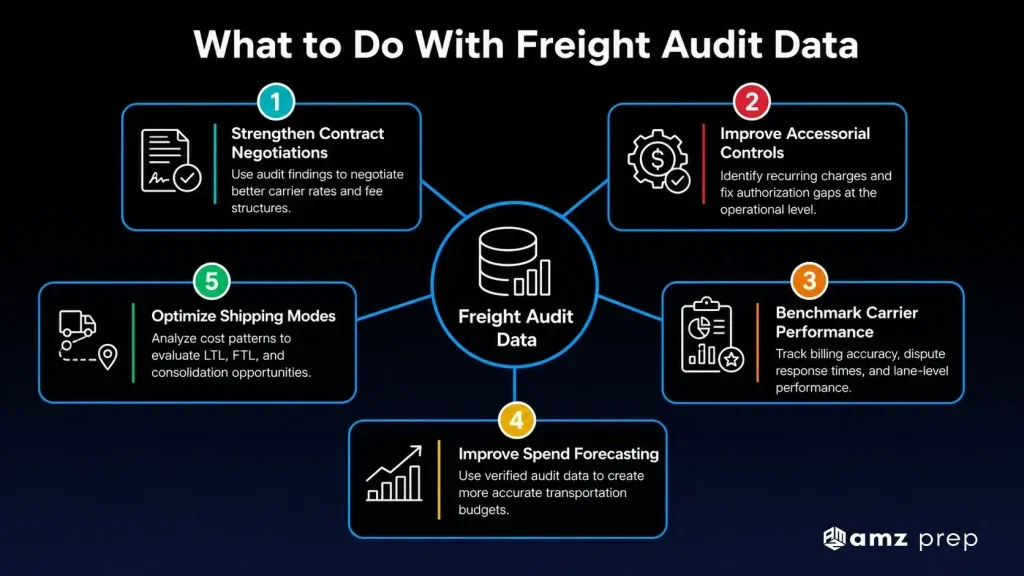
Contract renegotiation
Audit findings identify which carriers overbill most often and on which charge types. That data is used at renewal. If a carrier’s accessorial application rate is 3x higher than peers on comparable lanes, that conversation happens with documentation, not just a complaint.
Accessorial protocol improvement
If the same accessorial charges appear repeatedly across audits, the problem is not the carrier, it is the authorization process at the dock level. Audit data pinpoints where the process gap is and what specific change closes it.
Carrier performance benchmarking
Freight audit data, over time, becomes a scorecard. Which carriers apply fees accurately? Which lanes show consistent rate misapplication? Which carriers respond to disputes promptly and which drag past 60 days? That data informs routing decisions at the next bid cycle.
Transportation spend forecasting
Verified freight spend data, cleaned through the audit process, is materially more accurate for budgeting than raw invoice totals. Companies using freight audit results as the input for transportation costs forecasting see tighter variance between projected and actual spend.
Make data-driven decisions on modal shifts
If audit data shows LTL on a specific lane consistently generates reweigh disputes and accessorial overcharges, that is a signal to evaluate consolidation options or a truckload alternative. The decision is now supported by actual freight cost data, not estimates.
Conclusion
Working with a third-party freight provider that audits carrier invoices as part of standard operations is one way ecommerce brands reduce transportation spend without renegotiating contracts from scratch.
AMZ Prep’s freight team handles carrier compliance, rate verification, and freight management across domestic and cross-border lanes as part of the fulfillment relationship. For brands scaling freight volume, that removes the audit burden from internal teams while keeping overcharge recovery consistent.
Frequently Asked Questions
What is a freight bill audit?
A freight bill audit is the process of reviewing carrier invoices against contracted rates, shipment records, and accessorial authorizations to identify and recover billing errors. It covers all freight modes and charge types, from base rates to fuel surcharges.
How often should freight bills be audited?
Pre-auditing every invoice before payment is the standard best practice. For companies without the capacity for 100% coverage, auditing all invoices above $500 and all LTL shipments monthly captures the majority of error value.
What percentage of freight invoices contain errors?
Industry benchmarks from IOFM’s 2025 data put the freight invoice error rate at 22%. Most errors favor the carrier. In manual-review programs, 5–8% of total freight spend is recoverable through systematic auditing.
How long do I have to dispute a freight overcharge?
For LTL and truckload, the standard statute of limitations is 180 days from invoice payment. Missing that window forfeits the claim. Pre-auditing before payment eliminates the deadline risk entirely.
When should I use a freight audit company instead of auditing in-house?
At invoice volumes above 500 per month or when running more than five carriers across multiple modes, a freight audit company or freight audit services provider typically delivers better recovery rates and faster dispute resolution than internal teams can sustain.

Chadwick Collins is an Enterprise Fulfillment Consultant at AMZ Prep, where he partners with high growth ecommerce brands to design and scale Amazon first logistics strategies. He brings extensive experience in freight, supporting brands across domestic and cross border transportation, routing optimization, and cost control.
At AMZ Prep, Chadwick works closely with enterprise clients to improve inventory flow, reduce landed costs, and accelerate delivery performance across North America. His expertise spans FBA, DTC, and B2B fulfillment, with a strong focus on aligning freight strategy with overall supply chain efficiency. He helps brands navigate complex logistics challenges while turning operations into a competitive advantage.
























Comments