
Over 50% of customers have dealt with damaged deliveries caused by subpar packaging, turning potential repeat buyers into return cases and negative reviews.
Shipping fragile items requires special attention and expertise to avoid the risk of damage. Hence, Palletizing for fragile items is an unsaid skill you have to master if you sell fragile products.
To protect your bottom line, earn customer trust, and maintain a strong brand reputation, palletizing for fragile items should be a top priority.
This article walks you through ways you can palletize fragile items, fragile item packaging, pallet stability strategies, protective packaging materials, shipping fragile goods safely, cushioning for fragile items, load securing methods and much more.
Let’s begin.
What is Palletizing for Fragile Items?
Palletizing is simply stacking products on a pallet for efficient and convenient handling and transportation of goods.
What makes transporting fragile items different is the simple fact that they are fragile. They demand more care and expertise.
Amazon sees an average return rate of around 20% across all online purchases, with a significant portion attributed to products arriving damaged, defective, or broken.
Think about it this way, a pallet carrying 500 glass perfume bottles versus one carrying books will face different forces during forklift handling, acceleration, and braking. The same considerations apply when shipping bulk items, which may require additional support or packaging adjustments
Your objective would be to engineer a shipping process to reduce vibration, protect against compression, and maintain load integrity under dynamic pressure to safeguard your products from any harm.
Logistics Risks for Fragile Loads
While fulfilling fragile goods, risks are plenty. Each of them has to be countered with deliberate palletization techniques.
Vertical Compression: Forces from stacking in transit or storage can crush lower layers if load distribution is miscalculated.
Lateral Forces: Sudden stops, turns, or jolts create sideways pressure that can crack or destabilize fragile loads.
Shock Impact: Drops during loading, pallet jostling via forklift, or trailer bed bounce transfer energy directly to the cargo.
Vibration Fatigue: Continuous micro-movements during transit (especially LTL and intermodal shipping) can cause slow damage, chipping, label abrasion, or adhesive fatigue.
Why Palletizing for Fragile Items Is Not Like Any Other SKU Handling
Selling fragile items doesn’t follow the same protocols as selling regular goods. Here are some factors to consider.
The SKU Is Physically Non-Compatible With Stack Load Pressure
Encountering irregular sizing in fragile goods is more common than you would think. Why do you think that’s the case?
This is because fragile goods have structural limitations.
Imagine wrapping perfume bottles in foam cushions and stacking them vertically.
Even if they are sealed well and packed individually, they won’t be able to handle vertical compression.
This incompatibility with stack load pressure is why fragile items demand a completely different palletizing logic, from stacking configuration like block or column stacking to pallet layer padding, all to distribute weight without compromising the product’s physical integrity.
Wooden vs. Plastic Pallets for fragile loads
While many sellers default to wooden pallets out of habit, the growing use of plastic pallets in fragile load scenarios is based on real technical advantages.
Wooden pallets may most definitely be cost-effective and easy to acquire but they may not be the best choice for fragile goods.
Their uneven surface, protruding nails and rough surface can often cause damage or puncture shrink wraps or thin cartons carrying these fragile goods. For rigid products like books or phone cases, these may not be a major concern to take care of.
Moreover, wooden pallets absorb moisture, which can weaken the base of cartons and lead to mould. In industries like cosmetics or gourmet food, this increases the risk of contamination and product damage. Even when treated, wood lacks the hygienic reliability that fragile, high-value products demand.
For instance, a cosmetics brand shipping glass skincare bottles saw a 7% breakage rate directly linked to punctures and uneven pallet bases before switching away from wood.

Now, coming to Plastic pallets, that come with a smooth, non-porous surface, preventing abrasion and tearing, while their uniform base provides even load distribution which will reduce the risk of damage.
Plastic pallets don’t warp, host bacteria or absorb any moisture, making them perfect to use irrespective of any season or condition of the product.
This is exactly what your fragile products need. They are more expensive than wooden pallets but, this is the cost you pay to save yourself from paying the cost of any potential damage.
One 3PL using plastic pallets for ceramic exports reported a 60% reduction in breakage within two quarters, proving they’re more than a premium add-on.
Hence, choose the right pallet to best cater to your needs.

Check out our Pallet Shipping Cost Calculator
Pallet size and condition considerations
Most sellers default to a 40” x 48” GMA standard pallet. It fits most FBA requirements. But for fragile items, you need to pay closer attention to:
Deck Board Gaps: Avoid wide gaps. Fragile items in small cartons are more vulnerable to sagging or puncture from uneven support.
Four-Way Entry vs. Two-Way Entry: Four-way pallets are easier for forklifts to maneuver, minimizing aggressive lifts and drops less trauma during transfer points.
Material Type: Heat-treated wood is standard, but plastic pallets offer more consistent surface levels, reducing tilt risk for items like glass jars or vials stacked tightly.
Pallet size suggestions for various product categories
| Product Type | Recommended Pallet Size (L x W) | Why This Size? |
|---|---|---|
| Beverage packs | 48” x 40” (1219mm x 1016mm) | Optimized for uniform stacking of heavy items like soda/water; supports shrink-wrap |
| Cosmetic bundles | 40” x 40” (1016mm x 1016mm) | Compact size ideal for small but high-volume products, easily stretch-wrapped |
| Electronics (boxed) | 48” x 45” (1219mm x 1143mm) | Wider base accommodates larger boxed items with proper cushioning |
| Fragile items (glass, ceramics) | 42” x 42” (1067mm x 1067mm) | Square layout ensures center loading; reduces edge exposure during transit |
| Pharma/healthcare items | 48” x 40” (standard or Euro size) | Industry-standard; compatible with temperature-controlled shipping needs |
| Books/media | 48” x 36” (1219mm x 914mm) | Slightly narrower to maintain weight limits per pallet without compromising space |
| Clothing/textiles | 40” x 48” (1016mm x 1219mm) | Works well for stretch-wrapped soft packs or bagged inventory |
| Pet food/heavy dry goods | 48” x 48” (1219mm x 1219mm) | Extra width supports weight and stability; minimizes overhang for stacked bags |
What to consider while palletizing for fragile items
Here are some crucial factors to take into account while palletizing for fragile items.
Packaging Materials for Protection
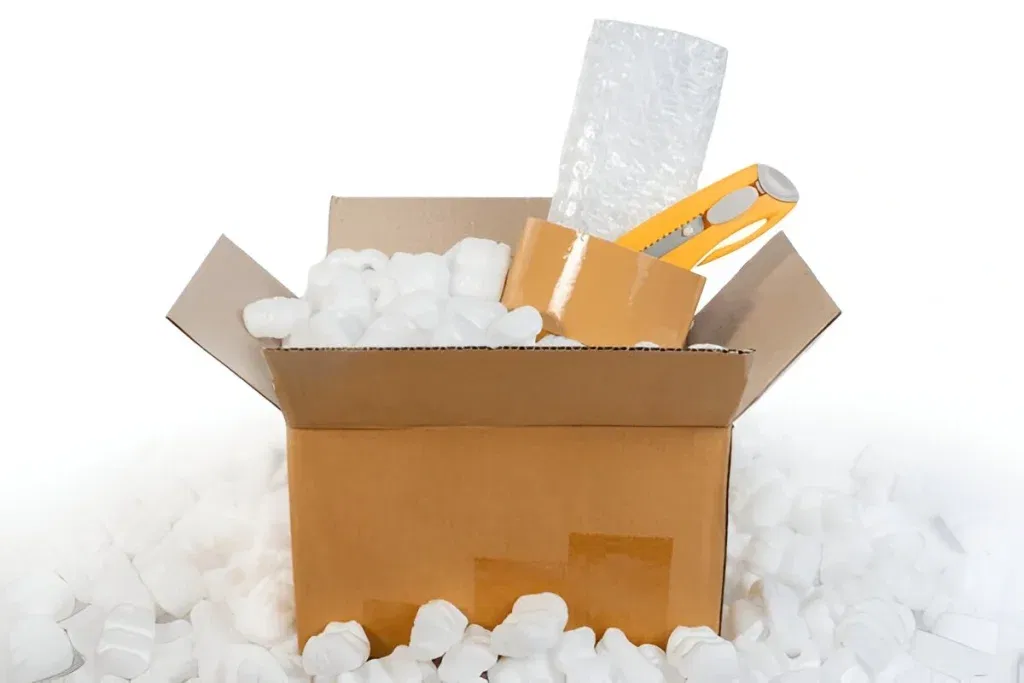
Protecting fragile items doesn’t stop at individually wrapping each item with bubble wrap alone. You have to ensure there is a cushioning layer between your product and the pallet’s surface.
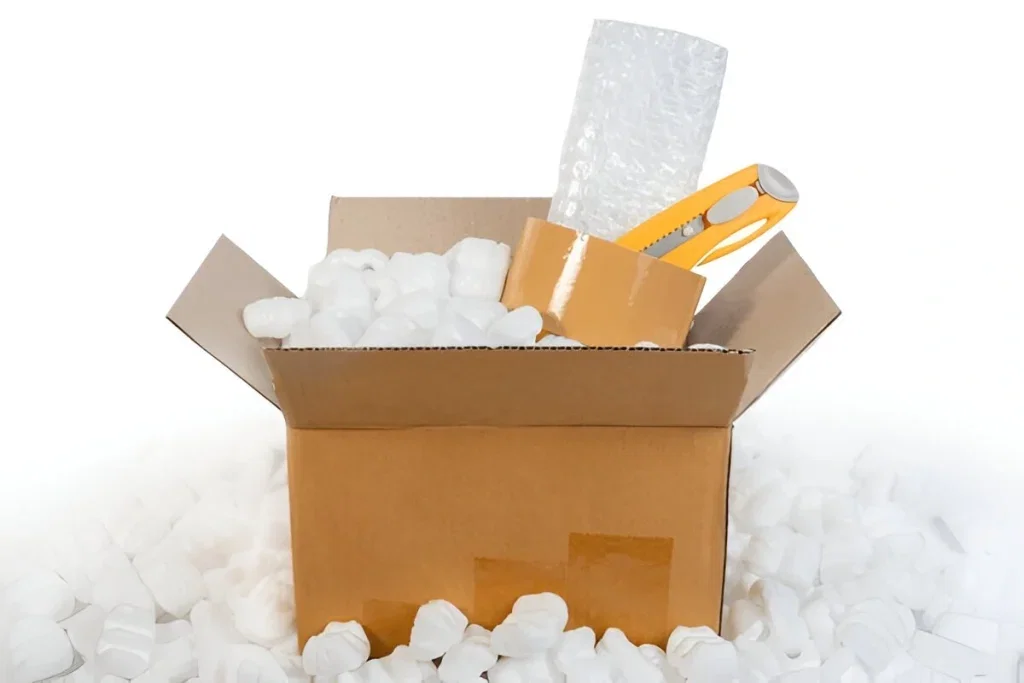
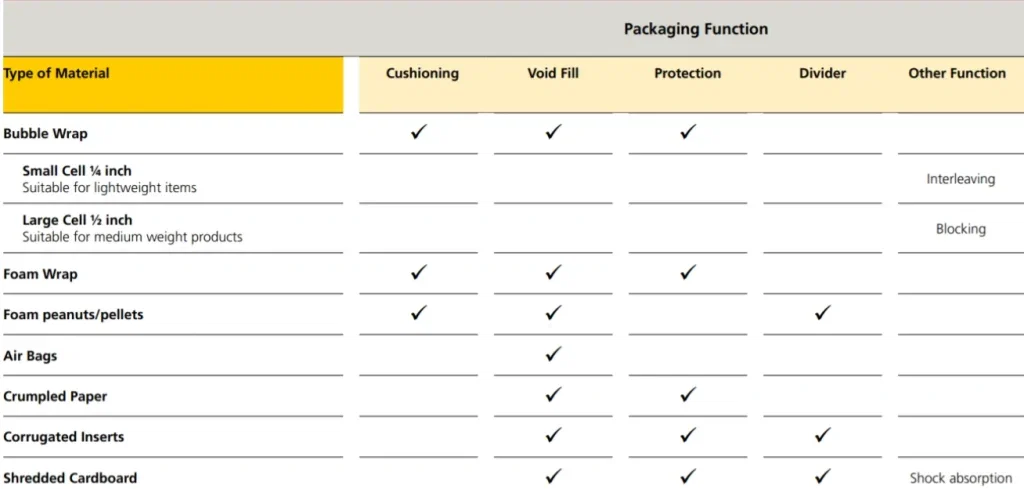
Foam inserts, Bubble film, packaging peanuts, corrugated dividers, honey comb paper that help in multiple layers of protection are non-negotiables.
Bubble wrap is lightweight and flexible, making it ideal for cushioning smaller individual units, while foam inserts offer precision-fit protection for fragile electronics and cosmetics.
Corrugated dividers, on the other hand, help create rigid compartments within boxes to prevent movement and collision during transit.
For void fill, air pillows, paper fill, packaging peanuts and foam-in-place are commonly used to restrict product shift inside larger cartons.
Secure them down with tape so they don’t move during transit and you’re good to go.
Additionally, sellers today are not only optimizing for damage reduction but also for environmental compliance and brand perception. Switching to sustainable cushioning has become a business strategy, especially for handmade, wellness, or artisan brands.
Materials like moulded pulp, recycled kraft paper, corrugated wrap, honeycomb paper or even biodegradable air pillows are gaining traction. They offer protection with a lower carbon footprint and are often compostable or recyclable, which most sellers aim to promote.

Securing the Load
You must have a clear understanding of how much load-bearing capacity your pallet has. Always ensure that the weight is evenly distributed and that there is enough cushioning between each item.
Need help figuring it out? Try our pallet calculator tool.
Weight distribution must be balanced, starting with the heaviest, most durable cartons at the bottom, and lighter, more delicate units on top. Avoid empty spaces to avoid movement and clashing of products against each other as well as overhanging where cartons are protruding out of the pallet which can cause clashing. Make use of edge protectors, shrink wrap, and sturdy straps to keep away from friction and ensure safe transit.
A popular question sellers debate upon when it comes to shipping is shrink wrap vs. stretch wrap for pallets.
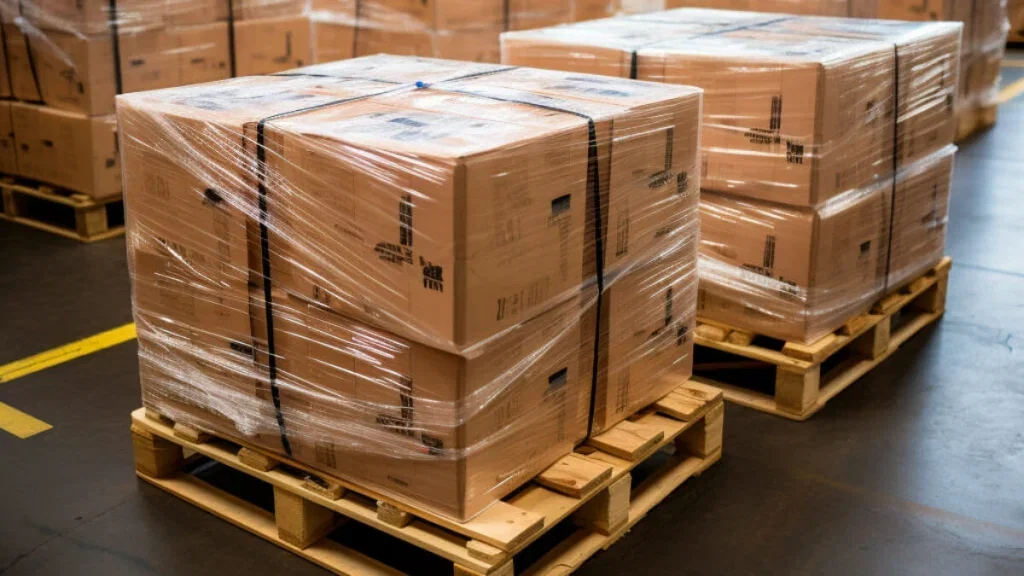
Stretch wrap is commonly used because of its flexibility and ability to tightly bind loads without heat. It also accommodates slight movements caused by road vibration and is typically used for floor loading.
Make use of Stretch wrap to wrap your entire cardboard cartons, pallets, so picking and packing can benefit from the concealed effect it offers. Here’s an image displaying stretch wrap.
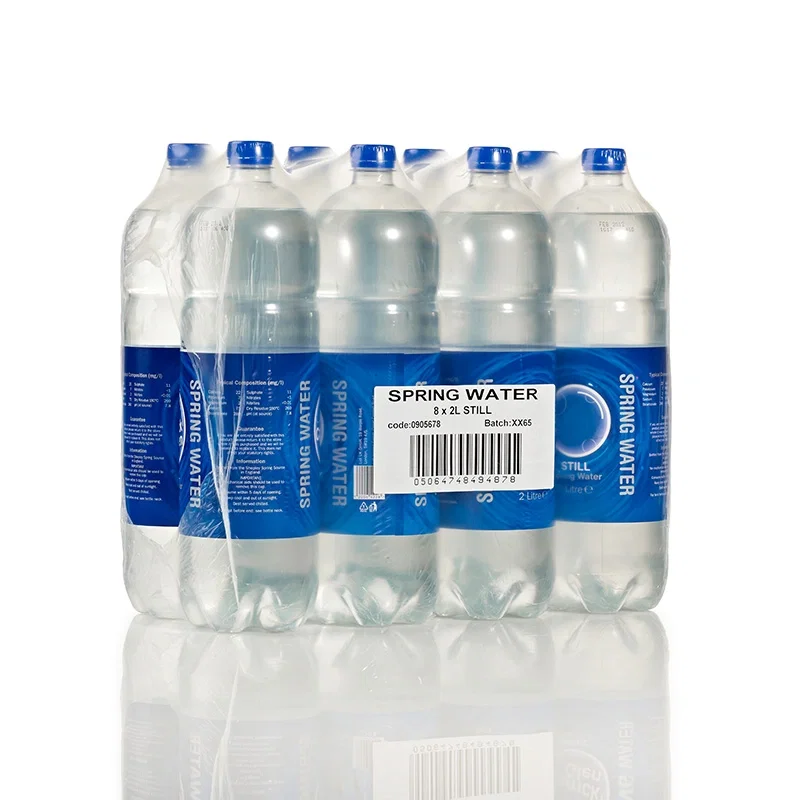
Shrink wrap, while offering a tighter fit, involves heat application, which is unsuitable for certain packaging films and sensitive products. This is best suitable when you pack bundles or combos that require multiple packs to stay together.
For example, you can shrink-wrap a dozen of soda cans, water bottles, shampoo bottle sets, etc. like shown in the image below.
Let’s look at a consolidated chart differentiating both Stretch wrap and Shrink wrap.
| Feature | Stretch Wrap | Shrink Wrap |
|---|---|---|
| Application Method | Applied cold by stretching around the product | Requires heat to shrink and tightly seal |
| Packaging Suitability | Great for pallets, cartons, and irregular shapes | Best for uniform, smaller bundles or multipacks |
| Protection Type | Offers load stability with flexibility | Offers a tamper-evident, sealed finish |
| Heat Sensitivity | Ideal for heat-sensitive goods | Not suitable for items sensitive to heat |
| Cost & Equipment | Lower cost; doesn’t require heat tools | Higher cost due to heat gun or shrink tunnel equipment |
| Visibility | Semi-conceals products, aiding in discreet transit | Highly transparent and form-fitting |
| Common Use Cases | Floor-loaded pallets, carton wrapping, bulk concealment | Combo packs, consumer multipacks (e.g., bottles, cans) |
| Recyclability | Widely recyclable (depending on material type) | Less commonly recycled due to multilayer composition |
Intra-pallet stabilization
Intra-pallet stabilization is often the overlooked layer of defence that sits between product-level packaging and external pallet wrapping.
Every unit should be immobilized within its packaging, so it doesn’t rattle or shift even if the pallet tilts.
This involves using precision-fit dividers, foam partitions, or corrugated trays that anchor each SKU in place, preventing lateral movement, frictional wear, or toppling during vibration and tilt. For irregular or fragile shapes, custom die-cut inserts or honeycomb grids can be used to nest items tightly while distributing weight evenly.
Remember, if units inside a single layer are shifting, even the best external strapping and wrapping won’t stop micro-movements that lead to cracks or dents. Stabilization from the inside out is what transforms a fragile pallet into a resilient shipping unit.
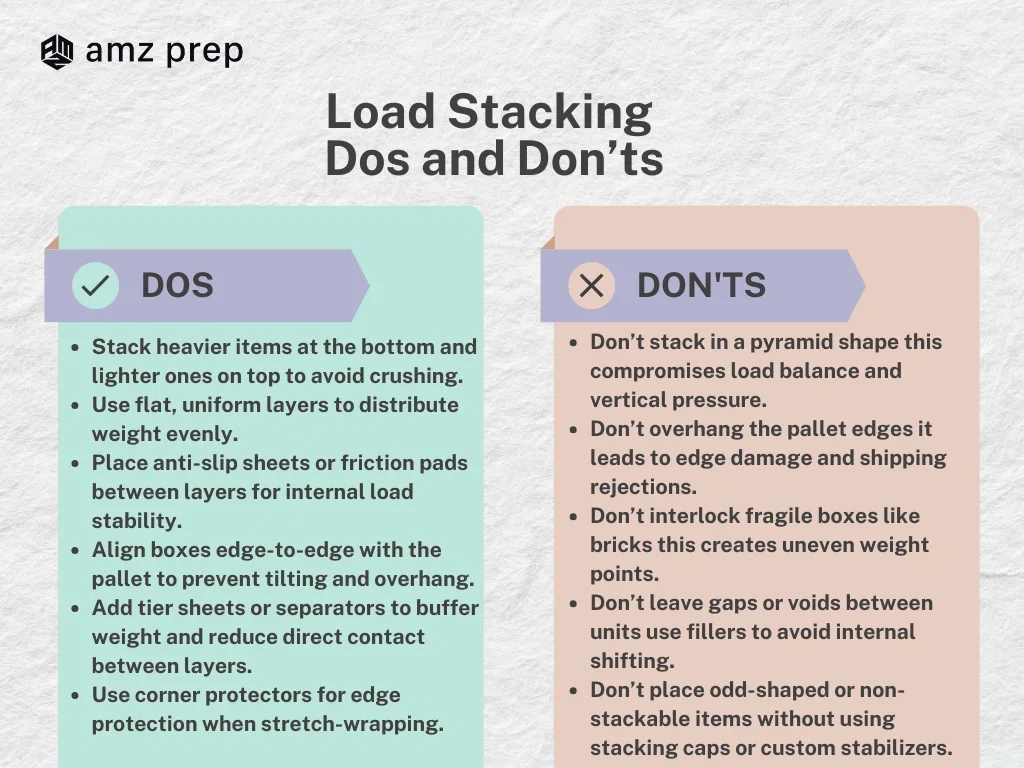
Load stacking dos and donts
Now, no matter how well you secure your final cartons or pallets itself, it may all go down the drain if you haven’t figured out a good pallet architecture. For fragile SKUs, layering and stacking fragile products directly influences it’s exposure to pressure, vibration, and corner crush during transit.
Slip sheets should be placed between layers, to help with maximum stability of boxes and reduce friction damage, while anti-slip mats prevent the load from shifting when a pallet is being forklifted or tilted during last-mile handling.
Damage sellers face when fragile goods are not palletised properly
Direct cost, compliance, and reputation is what is at stake when your products are not palletised the right way.
Crushed Inventory & Breakage
All the effort you have put into sourcing or manufacturing the product, listing the product on Amazon, running pricey PPC ads and finally making that sale, goes to waste in seconds when your product crumbles due to mismanaged pallets during shipment and transit.
Fragile items like glassware, ceramics, electronics, and liquid containers are sensitive to impact, pressure, and shifting.
For high-ticket fragile SKUs like $80 designer vases or $50 skincare kits, even a single damaged pallet can mean $5,000-$10,000 in write-offs.
Which is why, paying enough attention to safe securement of fragile goods is highly important.
High ACOS, Low ROAS
When a $60 skincare kit breaks in transit, you’re not just losing inventory but losing the ad spend that drove the sale. If you spent $15 in Amazon PPC to acquire that customer, and the order gets returned or refunded, that $15 becomes a complete loss.
Multiply that by 50 returned units, and you’ve burned $750 in ad spend without generating any real revenue. This spikes your ACOS (Advertising Cost of Sale) and pulls down your ROAS (Return on Ad Spend), making your entire campaign look inefficient, even if the ad targeting was perfect.
Return Rate Spike
It’s no news if a customer claims a return/replacement even for the slightest damage or a chipped edge in the product they’ve received.
You not only incur losses but also jeopardize your account health due to excessive returns.
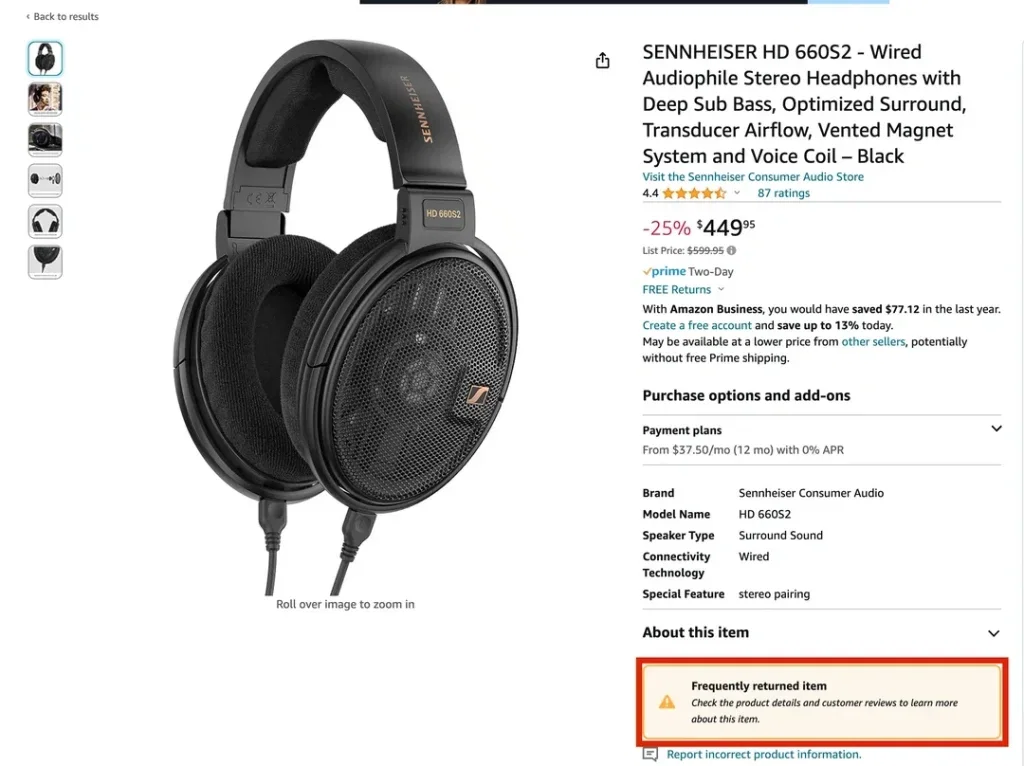
Amazon can flag your product listing with a high ODR (order defect rate) or “Frequently returned item” tag which can organically affect your market presence in the long run.
Additionally, damaged packaging even without product failure can reduce resale value by 20-30%, affecting bundled or seasonal kits when when they have absolutely no defect.
Carrier Rejection or Penalties
Poorly secured fragile pallets are most likely to be rejected at dock inspections for unsafe stacking or unstable wrapping.
Carriers don’t want to put other pallets at risk if your pallet isn’t secured correctly. Carriers would be answerable if any damage is caused to somebody else’s goods and they wouldn’t want to risk it.
Hence, if your fragile load shifts and damages someone else’s inventory on a shared truck, you may be liable via freight claim disputes.
Customer Lifetime Value Dips
Fragile-item customers tend to be gift buyers, high-AOV shoppers, or beauty/electronics repeat customers. When a customer receives a cracked candle jar or broken ceramic bowl, you lose more than a sale, you lose a potential repeat customer. Your Customer Lifetime Value (CLV) drops, and your retention marketing efforts become less efficient.
One damaged pallet can look like a few hundred dollars in product breakage…
But in reality, it could be thousands in lost ad efficiency, ranking drops, refund costs, and long-term customer trust.
Final Checklists: What Sellers Should Audit Before Shipping Fragile Pallets
Before a pallet of fragile goods leaves your warehouse or 3PL, you need to run through a technical checklist that goes beyond just shrink-wrapping and labelling. This audit ensures that every fragile shipment is compliant, stable, and ready to survive transit shocks, warehouse re-handling, and vertical pressure. Here’s what sellers should be verifying:
Pallet Load Configuration– Are boxes column-stacked instead of interlocked? Is there overhang or misalignment that could cause edge compression?
Void Fill & Cushioning– Ensure to check if the inner packs are using high-impact absorption materials like foam-in-place, molded pulp, or air cells to reduce vibration and breakage.
Corner & Edge Protection– Have you added corrugated edge guards or honeycomb boards to prevent shifting or crushing during forklift movement?
Stability Aids– Is the pallet shrink-wrapped with adequate tension? Are tier sheets or slip sheets used between layers for anti-slip support?
Labeling Compliance– Do all four sides have pallet labels like “Fragile,” “Do Not Stack,” or tilt-monitor stickers placed clearly and per carrier guidelines?
Pallet Type & Condition– Is the pallet structurally sound (no cracks or missing boards)? Is it heat-treated (HT) for international shipping?
Weight Distribution Check– Is the pallet evenly weighted with a low center of gravity to avoid tipping in transit?
Photo Documentation– Have you documented the final packed pallet with photos for claims protection?
Customs Considerations for International Shipping of Fragile Items
Shipping fragile items overseas calls for a lot of measures to be taken into consideration.
ISPM-15 Pallet Compliance
Many countries including EU, China, Australia require wooden pallets to be heat-treated and stamped. Non-compliance? Your shipment gets rejected or fumigated. Use ISPM-15-certified or plastic pallets for safe passage.
Accurate HS Code Classification
Fragile goods like glassware, electronics, or cosmetics may fall under tariff-sensitive categories. A mismatched HS code will lead to unwanted delays, fines, or reclassification. Always double-check with a customs broker.
Extra Documentation for Sensitive Items
High-value or potentially hazardous fragile goods like perfume, skincare, glass jars, may require:
- Material Safety Data Sheets (MSDS)
- Certificates of Origin
- Fragility declarations or waivers
Risk of Customs Repacking
Some customs authorities open and inspect packages, especially those marked “fragile.” This is mostly to take adequate measures for dealing with any illegal or punishable goods.
If not repacked correctly, it leads to breakage. Use internal bracing, tamper-proof seals, and packaging that can withstand repacking.
Labeling in Local Language
In order for the locals to understand the language, “Fragile” and “Handle with Care” labels should be included in both English and the destination country’s language. This step aids customs officers and reduce mishandling.
Insurance is a Must
Fragile goods are high-risk. Most carriers limit liability, so take third-party insurance for international routes.
Pro Tip: Work with a customs broker or experienced 3PL to handle fragile freight—they’ll navigate country-specific nuances and reduce the chance of damage or clearance delays.
Suggested Read: The Complete Guide to Shipping from China to the UK
How the right logistics provider can handle this best
With a network of over 50 warehouses globally, AMZ Prep is well-positioned to equip you with the most trusted and streamlined logistics solutions for your fragile goods.
It is obvious that, only a specialized 3PL provider has the expertise to handle the complexities of securely fulfilling your fragile goods.
Our process begins with taking SKU-specific handling protocols like the usage of the right packing materials, slip sheets, edge wraps, and corner guards to ensure zero shifting or collapse during transit.
Most importantly, AMZ Prep ensures that all this doesn’t eat into your margins. By balancing material usage, optimizing pallet height, and minimizing void fill waste, we help you ship in the most cost-effective manner possible.
If your business can’t afford palletization mistakes, AMZ Prep gets it right, every time.
Final Thoughts
There, we’ve come to the end of this article and I hope it covered all about palletizing for fragile items. You must now know that if you want a real-world stable supply chain, every layer from primary packaging to pallet base needs to be engineered specifically for fragility.
Taking extra special care while palletizing for fragile items should be a non-negotiable. It can save you from losing money as well as the trust of your customers, ensuring continued profitability.
Take assistance from a 3pl provider who will take care of these things on your behalf. Palletizing right is how you scale fragile SKUs with confidence, consistency, and control.
FAQ
1. Can I use standard stretch wrap for fragile loads?
Stretch wrap is suitable but may not be sufficient alone. For fragile loads, it should be combined with corner boards, anti-slip mats, and proper bracing. For temperature-sensitive or form-sensitive goods, shrink wrap or containment nets may offer more stability.
2. What happens if my fragile pallet gets rejected by a carrier or Amazon dock?
Improperly secured pallets risk carrier rejection, delayed inbound receiving, and inventory damage during transit. You may face additional handling fees, rework costs, or liability claims if the pallet causes damage to other goods in shared transport.
3. Are wooden or plastic pallets better for fragile items?
Plastic pallets offer better consistency, no moisture absorption, and smoother surfaces, reducing puncture risks. If treated and handled correctly, wooden pallets may provide more durability for heavier fragile loads.
4. What cushioning materials are most effective for fragile pallet loads?
It depends on the item:
Foam-in-place is best for high-precision, sensitive products.
Bubble wrap and air pillows work well for lightweight goods.
Corrugated inserts and molded pulp offer eco-friendly options without sacrificing protection.
5. Is there a difference in shipping rates for palletized fragile goods?
Yes. Shipping fragile pallets can be more expensive due to dimensional weight, custom packaging, and handling surcharges. However, proper palletization can lower return-related losses and freight damage claims, optimizing your overall shipping ROI.
6. How does improper palletization impact my ACOS or ROAS?
Every damaged item is a wasted ad dollar. High breakage leads to more returns, fewer conversions, and negative reviews, all of which drag down your Ad Spend Efficiency, inflate your ACOS, and reduce ROAS due to lost trust and wasted budget.
7. What are some common palletization mistakes for fragile goods?
Overhanging items that get crushed in transit.
Ignoring vertical compression limits.
Inadequate internal bracing or cushioning.
Using uneven or low-quality pallets that shift under pressure.
8. How can a 3PL like AMZ Prep improve palletization for fragile goods?
AMZ Prep offers SKU-specific handling, load stability optimization, and custom cushioning solutions tailored to fragile inventory. Unlike FBA’s standardized prep, they provide more control, reduced breakage, and smoother carrier compliance, all essential for fragile shipments.

Blair Forrest is the Founder of AMZ Prep, one of North America’s fastest-growing third-party logistics and fulfillment networks, built entirely without outside capital since 2016. Under his leadership, AMZ Prep has scaled to 50+ fulfillment centers across 6 countries, processing over 8 million units monthly and powering $2 billion+ in annual GMV for more than 5,000 brands worldwide including 437, Silverts, Saltyface, Unilever, Duracell, and JBL. A recognized authority in eCommerce logistics, Amazon FBA strategy, and supply chain optimization, Blair has helped thousands of sellers and brands master their fulfillment operations from first shipment to enterprise scale. He regularly consults on FBA prep, multi-channel fulfillment, last mile delivery, international expansion, and cost reduction strategies that save brands 20–40% compared to traditional 3PL providers. Blair’s insights on Amazon logistics, 3PL operations, and eCommerce growth are widely cited across the industry. Through AMZ Prep’s content, guides, and resources, he continues to share battle-tested strategies drawn from managing one of the largest independently owned fulfillment networks in North America.
















Excellent resource your section on customs considerations for fragile pallets overseas helps brands avoid unexpected issues at the border.
Understanding intra-pallet stabilization and void-fill really changed how I view shipment prep. This guide will save a lot in breakage costs.
Nice clarity on why plastic pallets often beat wood for fragile loads.
Short, actionable and full of logistics realism for delicate products.
The comparison of load types and the table of pallet sizes for fragile goods was especially useful.
Helpful checklist on load stacking dos and don’ts for fragile SKUs.
Loved how you explained how improper palletizing can erode ad ROI via returns.
The overview of cushioning materials (foam, honey-comb, etc.) is very practical.
The section on vibration fatigue during transit really opened my eyes.
Great breakdown of how fragile items need special palletizing strategy.