
Hey there, e-commerce sellers!!!
Ever found yourself staring at a mountain of products? As a seller, are you wondering how to get them safely to your customers without breaking the bank? Trust me, we’ve all been there! And will continue to be there. This is the case if you are just starting your e-commerce journey or looking to optimize your current shipping strategy; choosing the right ecommerce shipping box sizes can make or break your business (and your products!).
In this essential guide, we’ll unpack everything you need to know about e-commerce shipping boxes—from standard dimensions to custom solutions that’ll make your customers say “wow!” Plus, we’ll share some money-saving tips that’ll help your bottom line without compromising on protection.
Ready to become a shipping box pro? Let’s dive in!
Essential E-Commerce Box Sizes
They’re literally carrying your business’s reputation from warehouse to doorstep! Let’s break it down.
Understanding ECommerce Shipping Box Sizes
Let’s start with the basics.
What is a Ecommerce Shipping Box Sizes?
A shipping box is more than a cardboard container—it’s your product’s armor during shipping! It protects your items in transit. It also uses space and materials efficiently. Selecting the perfect box size is key for fulfillment success.Choosing the right box sizes is essential for all fulfillment strategies, including eBay dropshipping.Proper ecommerce shipping box size selection prevents plant damage during transit.
Why Ecommerce Box Size Matters?
Most e-commerce platforms prefer optimized delivery boxes. As shipments impact cost, efficiency, and customer satisfaction, optimizing ecommerce box sizes is in their best interest. Carriers calculate shipping costs based on both actual and dimensional weight, so use a dimensional weight calculator to determine which weight will apply to your shipment.
Why ECommerce Box Size Matters
Box sizes can also impact shipping costs, especially with changing regulations like Donald Trump’s new tariffs on imports from countries like Mexico, Canada, and China.
Cost Efficiency
Choosing the right box size helps reduce shipping costs by minimizing dimensional weight charges. Smaller, well-fitted boxes prevent excess fees from carriers.
Product Protection
Appropriately sized boxes secure products, reducing movement and preventing damage. This lowers return rates and improves customer satisfaction. Small boxes for shipping makes sense for small items.
Factors to Consider When Selecting Ecommerce Box Sizes
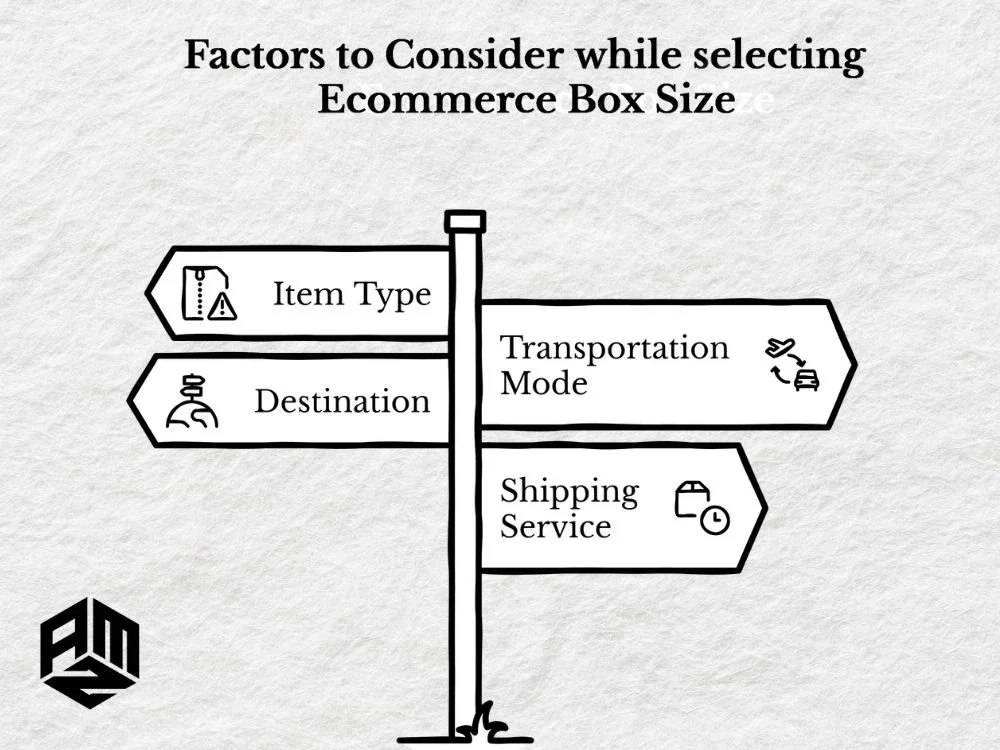
Type of Item
Fragile or high-value items may require sturdier, larger boxes with extra padding to ensure safe delivery.
Mode of Transportation
Shipping via air or ground comes with different size and weight restrictions, influencing box selection. Large shipping boxes make more sense during international shipping.
Shipping Destination
Domestic vs. international shipping policies vary, affecting permissible box dimensions and weight limits making ecommerce shipping solutions in Canada valuable for cross-border sellers.
Delivery Timeframe
Expedited shipping services may have specific size requirements to optimize logistics.
Environmental Considerations
Selecting the right box size reduces waste, minimizes carbon footprint, and supports sustainability goals. Custom Size cardboard boxes can often be manufactured with environmental consideration in mind.
Pros and Cons of Different Ecommerce Box Sizes from Ecommerce Seller POV
| Box Size | Pros | Cons |
|---|---|---|
| Large | Accommodates multiple items, reducing the number of shipments. | Difficult to handle and store; excess space can lead to product movement and damage. |
| Small | Provides better protection for individual items, reducing dimensional weight costs. | May require extra packaging materials, increasing overall costs. |
| Feature | Large Sellers (Variety & Deals) | Small Sellers (Niche & Repetition) |
|---|---|---|
| Strategy | Bundles, multiple SKUs, discount-driven sales. | Single/few SKUs, recurring purchases, steady demand. |
| Pros | Higher AOV, broad appeal, trend adaptability, fast turnover. | Simpler operations, loyal customers, predictable revenue, higher margins. |
| Cons | Higher costs (storage, shipping, marketing), complex inventory, lower margins. | Risky if demand drops, scaling is hard, niche competition, upfront marketing costs. |
| Examples | Amazon, Walmart (bundles, deals, wide selection). | Niche brands (artisan coffee, subscription boxes, premium phone cases). |
Standard Shipping Ecommerce Box Sizes for Online Retailers
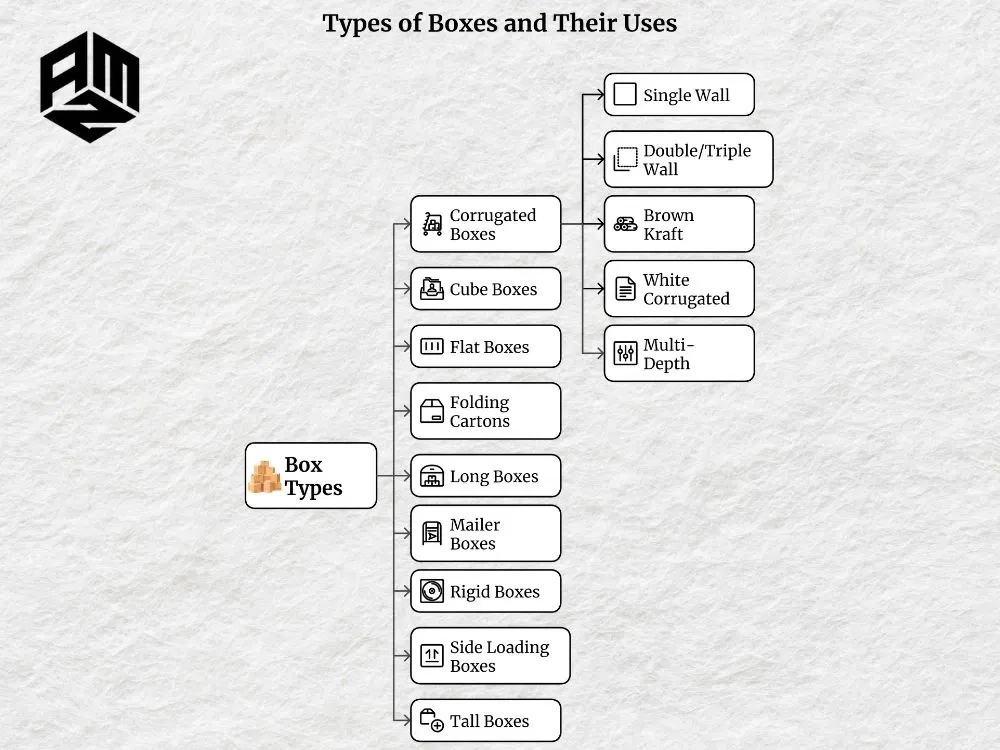
Various cardboard box options are available, including large cardboard sheets, standard box sizes, small mailing boxes, and custom size shipping boxes, to cater to different packaging needs.
Common Ecommerce Box Sizes and Uses
| Box Size (inches) | Max Weight | Best For |
|---|---|---|
| 4 x 4 x 4 | Up to 3 lbs | Small cubic, round, or odd-shaped items (mugs, small accessories) |
| 5 x 5 x 5 | Up to 5 lbs | Regular or odd-shaped items |
| 6 x 4 x 4 | Up to 4 lbs | Jewelry, cosmetics, small accessories |
| 8 x 6 x 4 | Up to 9 lbs | Books, electronics, picture frames, apparel |
| 10 x 8 x 6 | Varies | Larger books, shoes, small appliances |
| 12 x 6 x 6 | Up to 11 lbs | Long, narrow items |
| 12 x 9 x 6 | Varies | Clothing bundles, kitchenware, toys |
| 14 x 10 x 6 | Varies | Medium electronics, office supplies, large clothing items |
| 14 x 14 x 5 | Varies | Flatter items like books, framed pictures, shallow home decor |
| 14 x 14 x 14 | Varies | Small devices, bulkier merchandise |
| 15 x 15 x 6 | Varies | Clothing, small electronics, home goods |
| 16 x 12 x 8 | Varies | Large electronics, home decor, sports equipment |
| 18 x 14 x 8 | Varies | Large appliances, multiple clothing items, fragile products with padding |
| 20 x 15 x 15 | Varies | Bulkier items, bulk orders |
| 20 x 14 x 10 | Varies | Large electronics, multiple boxed items, oversized products |
| 22 x 18 x 12 | Varies | Bulky home goods, multiple product orders |
| 24 x 20 x 12 | Varies | Extra-large products, furniture parts, wholesale shipments |
| 36 x 6 x 6 | Varies | Long, narrow items like posters, umbrellas, rolled-up products |
| 40 x 12 x 12 | Varies | Large elongated items like golf clubs, long hardware tools |
Platform Specific (Amazon, Shopify, Walmart,eBay) Box Size requirements
| Platform | Standard Box Size | Oversized Box Size | Weight Restrictions | Key Considerations |
|---|---|---|---|---|
| Amazon FBA | Min: 6″ x 4″ x 1″ (15.2 cm x 10.0 cm x 2.5 cm) Max: 25″ on any side | Up to 2″ of additional packaging if item exceeds 25″ | Min: 0.15 kg Max: 23 kg (50 lbs) Over 15 kg requires “Heavy Package” label | Oversized boxes may incur extra fees or restrictions |
| Shopify | No specific recommendations | Choose the smallest box that fits snugly | No specific limits | Smaller boxes reduce costs and prevent damage |
| eBay | No specific recommendations | Choose the smallest box that fits snugly | No specific limits | Avoid excess space to prevent damage and save on costs |
| Walmart Marketplace | No specific recommendations | Must comply with Walmart’s strict packaging guidelines | No specific limits | Follow Walmart’s packaging guidelines to avoid issues |
As of January 2026, Amazon’s fee structure now includes price-based tiers. Box size affects both dimensional weight AND which fee tier applies (under $10, $10-$50, over $50), making precise sizing more important than ever for profitability.
Choosing the Right Ecommerce Box Size for Your Needs
Selecting the right ecommerce shipping box sizes is crucial. The shipping box size for ecommerce plays a significant role. By choosing the correct box size for ecommerce shipping, businesses can minimize the risk of damage.
Box Selection for Various Shipping Carriers
Using the correct ecommerce shipping box sizes can make all the difference in preventing damage and ensuring timely delivery. The shipping box size for ecommerce should be carefully selected to prevent movement and damage during transit. This applies to standard products as well as larger shipments, such as shipping Large items, which may require reinforced boxes or custom packaging solutions. A well-sized box size for ecommerce shipping can help businesses reduce costs and boost efficiency.
USPS Box Sizes
| Box Size (inches) | Best For |
|---|---|
| 15 x 15 | Medium-sized items |
| 16 x 16 | Slightly larger items |
| 12 x 4 | Long, narrow items |
| 15 x 12 | Larger, flatter items |
UPS Box Sizes & Flat Rate Shipping
| Category | Dimensions (inches) | Best For |
|---|---|---|
| Popular Sizes | ||
| 25 x 25 | Large, bulky items | |
| 11 x 11 | Medium-sized packages | |
| 24 x 4 | Long, slender items | |
| Flat Rate Extra Small | 4 x 4 x 4, 6 x 4 x 4, 8 x 6 x 2 | 1-100 cubic inches |
| Flat Rate Small | 6 x 6 x 6, 8 x 6 x 5, 12 x 9 x 2 | 101-250 cubic inches |
| Flat Rate Medium | 8 x 8 x 8, 12 x 9 x 6, 13 x 11 x 2 | 251-650 cubic inches |
| Flat Rate Large | 10 x 10 x 10, 12 x 12 x 7, 15 x 11 x 6 | 651-1,050 cubic inches |
| Flat Rate Extra Large | 12 x 12 x 12, 16 x 12 x 9, 18 x 12 x 6 | 1,051-1,728 cubic inches |
FedEx Box Sizes & Flat Rate Shipping
| Category | Dimensions (inches) | Best For |
|---|---|---|
| Popular Sizes | ||
| 14 x 14 | Medium-sized items | |
| 14 x 4 | Flat, wide items | |
| 8 x 8 x 8 | Smaller, cubic items | |
| Standard Small Box | 12.375 x 10.875 x 1.5 | Documents, jewelry |
| Standard Medium Box | 13.25 x 11.5 x 2.375 | Clothing, books, electronics |
| Standard Large Box | 17.25 x 11.5 x 12.375 | Shoes, kitchen appliances, toys |
| FedEx Envelope | 9.5 x 12.5 | Max volume 300 cubic inches |
| FedEx Pak | 10.25 x 12.75 | Max volume 650 cubic inches |
| FedEx Small Box | 10.875 x 1.5 x 12.375 | Max volume 420 cubic inches |
| FedEx Medium Box | 11.5 x 2.375 x 13.25 | Max volume 650 cubic inches |
| FedEx Large Box | 12.375 x 3 x 17.5 | Max volume 1,100 cubic inches |
| FedEx Extra Large Box | 11.875 x 10.75 x 11 | Max volume 2,200 cubic inches |
| FedEx Tube | 6 x 6 x 38 | Max volume 2,200 cubic inches |
Maximum Box Sizes for FedEx Shipping
| Shipping Method | Max Dimensions (inches) | Max Weight (lbs) |
|---|---|---|
| FedEx Express | 119 x 165 x 165 | 150 lbs |
| FedEx Ground & Home Delivery | 108 x 165 x 165 | 150 lbs |
Dimensional Weight (DIM Weight)
Carriers charge based on the greater value between actual weight and DIM weight:
DIM Factors by Carrier
- FedEx/UPS: 139 (domestic)
- USPS: 166
Example Calculation:
A 12″ × 10″ × 8″ box with an actual weight of 5 lbs has a DIM weight:
Since the dimensional weight (7 lbs) is greater than the actual weight (5 lbs), shipping would be charged based on the 7 lbs dimensional weight.
Note: Always check with your specific carrier for the most current DIM factors, as they may change periodically.
Shipping Box Costs & Logistics
Different e-commerce platforms may have different requirements for packaging. Check out the top e-commerce platforms for 2026
By choosing the right shipping box size for ecommerce, businesses can reduce waste and minimize their environmental footprint. The box size for ecommerce shipping should be carefully considered.
How Ecommerce Box Size Impacts Shipping Rates
As of 2026, carriers continue using dimensional weight pricing to calculate shipping costs. With Amazon’s new price-tier fee structure (effective Jan 15, 2026) and rising carrier rates, optimizing box size is critical for both FBA sellers and direct-to-consumer brands.
Dimensional Weight (DIM Weight)
Carriers charge based on the greater value between actual weight and DIM weight:
Oversized Packaging Costs
- Empty Space
- A 12″ x 12″ x 12″ box with a 7-lb product results in a 13-lb DIM weight, adding $5+ per package.
- Annual Impact
- $5 extra on 100 daily shipments = $127,500/year in added costs.
- Damage Risk
- Oversized boxes increase product movement, raising return rates.
3. Carrier-Specific Rules
- USPS
- Free Flat Rate boxes (e.g., Medium: 11.25″ x 8.75″ x 6″) bypass DIM weight but have size restrictions.
- FedEx/UPS
- Extra charges apply for packages over 1,728 cubic inches (1 cubic foot).
Maximum Sizes:
- FedEx: Length + girth ≤ 330″
UPS: Length + girth ≤ 165″
| Dimensions (inches) | DIM Weight | Billable Weight | Cost |
|---|---|---|---|
| 8 x 4 x 2 | 1 lb | 3 lbs (actual) | $12.35 |
| 12 x 10 x 8 | 7 lbs | 7 lbs (DIM) | $17.10 |
| 16 x 16 x 12 | 23 lbs | 23 lbs (DIM) | $39.23 |
Understanding the best box sizes for LTL freight shipping can optimize your fulfillment processes, ensuring cost-effective shipping.
Final Thoughts
Selecting the right ecommerce box size for shipping is a critical factor. This will be most evident in controlling costs, ensuring product safety, and customer satisfaction. Correct box sizes not only helps reduce shipping costs but also improve order processing time, which is critical for meeting customer expectations.
The ideal box minimizes dimensional weight pricing prevents damage during transit, and aligns with carrier-specific requirements to avoid unnecessary fees.
Choosing the Right ECommerce Box Sizes FAQ
What is the most cost-effective box size for e-commerce?
The most cost-effective shipping solutions prioritize space efficiency while maintaining carrier compatibility. Industry analysis indicates optimal sizing focuses on minimizing dimensional weight pricing, particularly crucial in today’s shipping environment.
Can I use any box for shipping, or does it have to be a specific type?
While regulations permit various shipping containers, carrier requirements necessitate specific structural standards. Corrugated boxes represent the industry standard, offering verified durability and compliance. Carrier-specific options, such as flat rate boxes from major services including USPS, FedEx, and UPS, present strategic advantages for certain shipping profiles.
What are the best packaging options for fragile items?
Professional shipping protocols for delicate items mandate comprehensive protection strategies. Double-walled corrugated boxes serve as the primary containment system, supplemented by strategic implementation of protective materials such as bubble wrap, foam inserts, or packing peanuts. Clear marking with fragile indicators ensures appropriate handling throughout the shipping network.
How do I determine the right size shipping box for my product?
The process requires systematic assessment beginning with precise product measurements across all dimensions. Industry standards recommend incorporating adequate padding space, typically 1-2 inches per side for fragile items. So sometimes extra large moving boxes may be necessary., Selection criteria should prioritize minimal viable e commerce box sizes while ensuring sufficient protection. Dimensional weight considerations remain crucial for cost management.
Are custom boxes worth the investment for small businesses?
Analysis indicates custom size boxes packaging presents strategic value under specific operational conditions. Primary advantages emerge through brand enhancement via customized presentation, precise sizing optimization for shipping efficiency, and cost benefits at scale for high-volume operations. However, smaller operations may find standard stock solutions more economically viable during initial growth phases.
Have shipping box requirements changed in 2026?
Core carrier requirements remain similar, but cost implications increased. Amazon’s January 2026 fee restructuring added price-based tiers, meaning box size now impacts both carrier DIM weight charges and Amazon fulfillment fees. Small optimizations now yield larger savings.

Arishekar N is a Vice President (VP) of Marketing at AMZ Prep, specializing in ecommerce fulfillment and Amazon logistics strategies with a proven track record of driving growth for e-commerce businesses. He is a strategic leader with extensive expertise in marketing, e-commerce operations, SEO & advertising, and branding.
Stay updated on his latest insights by following him

















Optimizing shipping box sizes is a real profit lever — thanks for laying out the rules clearly.
Great reminder that boxes are more than cardboard they really do carry the brand experience from warehouse to doorstep.
The standard size chart is super practical. I’ve bookmarked this for when I restock my packaging supplies.
The example with $127,500/year in wasted costs really hit me. Makes me rethink how I’ve been packing orders.
I like how you didn’t just give dimensions, but also matched them with best uses. Makes box selection way less confusing.
The section on carrier-specific box limits is gold — avoids surprise fees down the line.
Reducing empty space while protecting items — that balance is hard, and this guide nails it.
The DIM weight example changed how I’ll pack small electronics — eye-opening read
The tables on USPS, UPS, and FedEx sizes are so handy. I’m always Googling these when prepping shipments.
The carrier-specific breakdown is gold. I’ve been burned by FedEx DIM charges before, wish I had this earlier.
Seeing how oversized boxes inflate costs pushed me to revisit my current packaging strategy.
The DIM calculation example was perfect. I’ve never really understood how they measure that before.
This guide is a lifesaver! I always thought bigger boxes meant safer shipping, but now I see how much that’s been costing me in DIM fees.
Custom packaging may cost more upfront, but the branding + reduced waste make it worth it.
Love that you included environmental considerations. Sustainability is huge for my brand, and right-sizing boxes helps both the planet and my wallet.
Including environmental considerations is smart — packaging is now part of brand trust.
Great tip: standard box sizes + padding = less damage, fewer returns.
Thanks for linking box size choice to carrier rules and costs — makes decisions less arbitrary.
The table of standard box dimensions is going straight into my operations playbook.
Thanks for pointing out the difference between small sellers and large sellers. As a niche brand, I always struggled with finding the right balance.