
What’s the most boring task for you as a seller? Everyone has a different answer. Yet, most consider inventory management to be tedious. If that’s you, read on. There’s a simpler way to manage inventory. Imagine a system that tracks your stock automatically. It updates with every sale, new product, or move. Interested? Let’s compare it to traditional methods. You won’t need to count items manually. This system uses technology like POS systems and scanners. It’s like having a helper with real-time stock updates. Not using this system yet? Don’t worry.
This blog will explain everything you need to know. Let’s get started!
How Does a Perpetual Inventory System Work?
Here’s a step-by-step breakdown of a perpetual inventory system
Point-of-Sale System Updates Inventory Levels
Each time a sale is made, the point-of-sale (POS) system automatically adjusts the inventory levels.
Example
A customer purchases three units of a product. The POS system scans the barcodes, and the perpetual inventory system decreases the stock count by 3.
Cost of Goods Sold (COGS) Is Updated
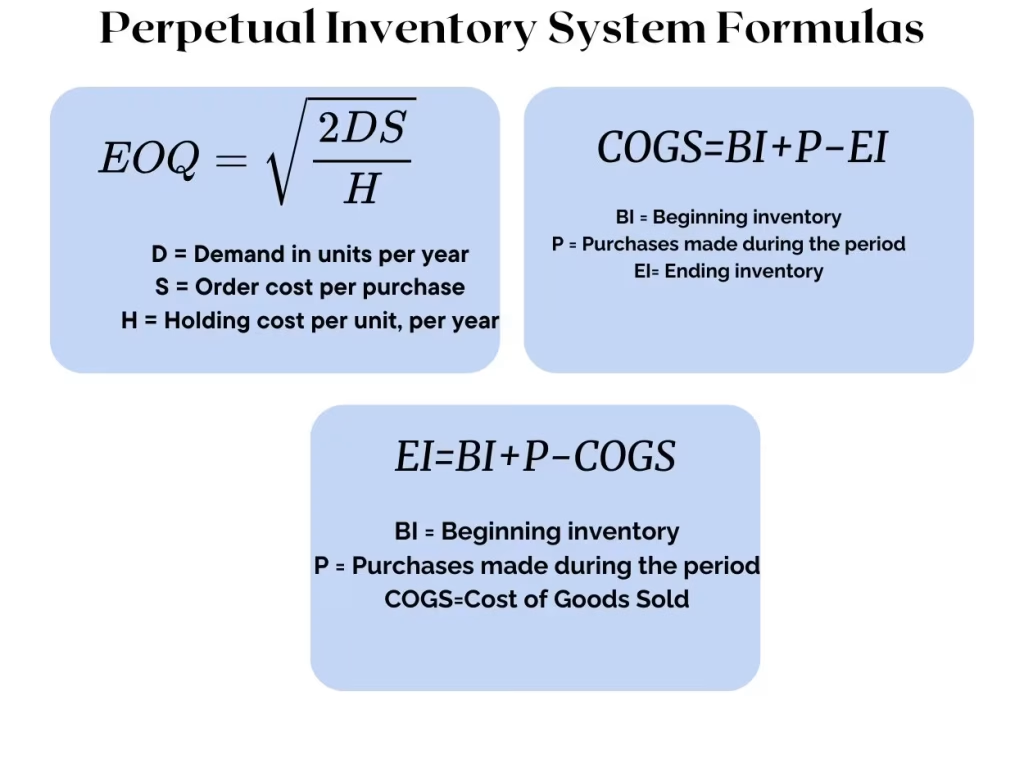
COGS is determined by adding the starting inventory to the cost of purchases and subtracting the ending inventory.
- Example
If the COGS per unit is $5 and a customer buys 3 units, the system automatically adds $15 to the company’s COGS.
Replenishment Levels Are Updated
Using historical sales data, the system dynamically adjusts reorder points. Optimize reorder points with predictive demand forecasts from our inventory forecasting calculator.
- Example
If a product’s sales increase, the system raises the reorder point to ensure enough stock is available for future sales.
Purchase Order Is Created
The system automatically generates a purchase order on reorder point and sends it to the supplier.
- Example
If a product’s stock level drops to 10 units (the reorder point), the system creates a purchase order for more and sends it to the supplier.
Purchased Goods Are Reconciled Upon Receipt
When new stock arrives, warehouse employees scan the goods into the system using tools like warehouse management software.
- Example
A shipment arrives, and employees scan the items. The system adds the new stock to the database, reflecting the updated inventory levels instantly.
If you’re keeping up with e-commerce trends, the rivalry between Amazon Haul and Temu is heating up. To understand which platform is pulling ahead in the competitive landscape, check out this in-depth comparison of Amazon Haul vs. Temu.
What is the Difference Between a Perpetual And Periodic Inventory System?
When it comes to managing inventory, businesses typically rely on two main systems: Perpetual inventory systems or Periodic inventory systems. Let’s dive into the key differences and when to use each.
Perpetual Inventory Systems
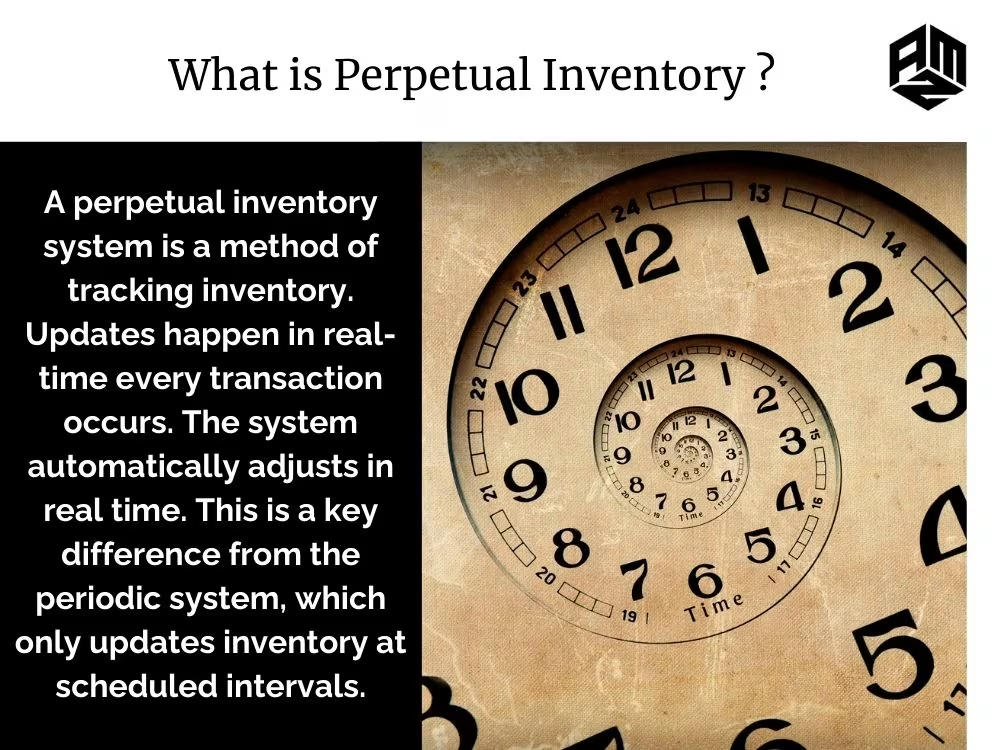
A perpetual inventory system continuously tracks inventory in real-time. Using tools like point-of-sale (POS) systems, barcode scanners, and software. These systems automatically update inventory levels whenever products are purchased, sold, or restocked.
Best for
- Companies with high sales volumes.
- Businesses with multiple locations or complex operations.
- Organizations need precise inventory control and quick updates.
Periodic Inventory Systems
In contrast, a periodic inventory system updates inventory records only at specific intervals, such as monthly or quarterly. This is typically done through manual physical inventory counts.
Best for
- Smaller businesses with low sales volumes.
- Companies that don’t require constant inventory updates.
- Organizations without the resources to implement a perpetual system.
Key Differences
| Feature | Perpetual Inventory System | Periodic Inventory System |
|---|---|---|
| Updating Records | Real-time after every transaction | Only at scheduled intervals |
| COGS Calculation | Constantly updated | Calculated after inventory counts |
| Error Tracking | Easy due to detailed records | Difficult due to aggregated data |
| Technology Dependency | Requires software and tools like POS | Minimal technology needed |
| Cycle Counting | Used to maintain baseline accuracy | Not applicable |
| Recording Purchases | Tracks purchases in raw materials/merchandise | Logs purchases in a separate account |
As technology advances, perpetual systems are becoming more accessible and affordable, making them a popular option among other types of inventory and accounting systems.
Staying updated on Amazon’s latest policies is essential for Amazon sellers looking for an wdge. One key development in November 2024 is Amazon’s stricter enforcement of its low inventory level limits.
This is where perpetual inventory systems become invaluable. By providing real-time insights into stock levels, these systems help sellers stay within Amazon’s inventory thresholds while ensuring products remain in stock to meet customer demand. Efficient inventory tracking not only avoids penalties but also optimizes storage fees and improves fulfillment performance.
To learn more about inventory management for navigating Amazon’s policies, check out our detailed guide on inventory management strategies.
Perpetual Inventory System Advantages And Disadvantages
Perpetual inventory systems are gaining popularity, mostly due the advancements in technology.
Advantages of Perpetual Inventory Systems
Real-Time Insights
- Track stock levels across multiple sales channels (e.g., Amazon, Shopify, physical stores) to avoid stockouts or overstocking.
- Reallocate inventory dynamically based on demand fluctuations for each channel. Example If demand for a product spikes on Amazon but lags on Shopify, shift stock allocation to prioritize Amazon
- Identify and address bottlenecks (e.g., delayed deliveries to FBA warehouses) to ensure timely replenishment and smooth fulfillment.
Detailed Inventory Records
- Tracks every transaction (purchases, sales, transfers, adjustments) with a comprehensive audit trail.
- Improves inventory control and simplifies error resolution and auditing processes.
Lower Inventory Costs
- Reduces the risk of overstocking and stockouts by optimizing inventory levels.
- Minimizes holding costs and losses from obsolescence or spoilage.
Software Integration
- Easily integrates with accounting, sales, and marketing systems for streamlined operations.
- Improves data consistency and supports better cross-department decision-making.
Accurate Demand Forecasting
- Using Historical data, e-commerce sellers clan inventory effectively for major events like Prime Day, Black Friday, summer sales, and seasonal promotions.
- Amazon sellers can anticipate demand spikes, stock up on high-performing products, and avoid overstocking or stockout critical for success when choosing between Seller Fulfilled Prime vs FBA.
Multi-Location Capability
- Centralizes inventory tracking across multiple locations, improving flexibilty and reducing stockouts.
- E- commerce Sellers can adjust stock levels based on demand in specific regions, ensuring high-demand areas are prioritized
- For example, during a summer sale, if demand for swimwear surges in coastal regions, a centralized system allows you to reallocate stock from less active inland warehouses.
Improved Accuracy and Efficiency
- Automation with barcode scanners and similar tools reduces human error.
- Speeds up inventory management tasks, saving time and labor.
Disadvantages of Perpetual Inventory Systems
Higher Setup Costs
- Requires investment in software, barcode scanners, and hardware, which can be expensive, especially for smaller businesses.
- Ongoing costs for maintenance, updates, and training may also add up.
Potential for Errors
- Vulnerable to issues like scanning mistakes or incorrect data entry.
- Regular cycle counts and reconciliations are necessary to maintain accuracy.
Loss of Items
- If items are lost or stolen without being recorded as sold, the system won’t detect these discrepancies until a physical count is conducted.
Theft and Damage
- Does not automatically account for inventory lost to theft or damage.
- Discrepancies caused by these factors only surface during periodic physical checks.
Understanding the right fulfillment strategy can make or break your business. Learn the ins and outs in this comprehensive Shopify fulfillment services guide.
Perpetual Inventory System Formulas
A perpetual inventory system is probably most suited for Amazon FBA. But for Amazon sellers struggling with inventory, dropshipping offers a low investment- no inventory alternative. Learn more in our guide on Amazon FBA vs. Dropshipping.
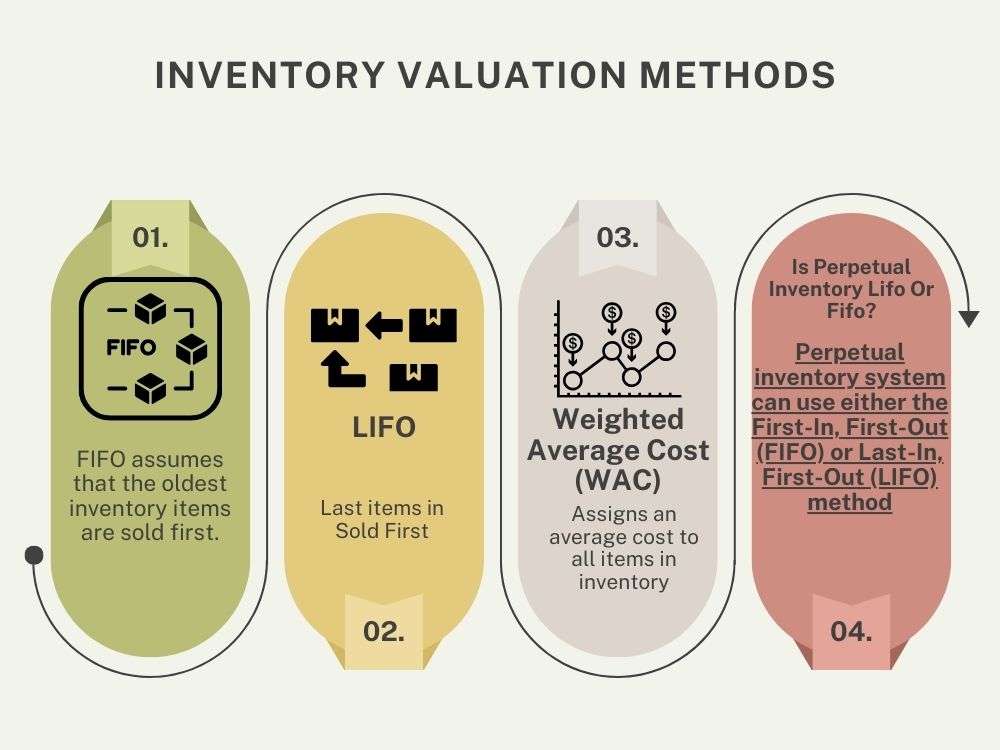
Inventory Valuation Methods in Perpetual Inventory Systems
Perpetual Inventory System Journal Entry
Here’s an example of a journal entry for a perpetual inventory system:
A company purchases 100 units of inventory at $20 each for a total of $2,000. This is an example of a perpetual inventory system in accounting.
How do I record in a perpetual inventory system?
Purchase of Inventory
Date: January 1
Journal Entry
| Account | Debit | Credit |
|---|---|---|
| Inventory | $2,000 | |
| Accounts Payable | $2,000 |
Explanation
When the purchase is made, the Inventory account is debited to reflect the increase in inventory on hand, and the Accounts Payable account is credited to recognize the liability.
Sale of Inventory
On January 5, the company sells 50 units of the purchased inventory for $40 each. The cost of goods sold (COGS) is recognized at the time of sale based on the perpetual inventory method.
Journal Entry Date January 5
| Account | Debit | Credit |
|---|---|---|
| Accounts Receivable | $2,000 | |
| Sales Revenue | $2,000 | |
| Cost of Goods Sold | $1,000 | |
| Inventory | $1,000 |
Explanation
- Accounts Receivable is debited to reflect the sales revenue to be received from the customer.
- Sales Revenue is credited to recognize the income generated from the sale.
- Cost of Goods Sold (COGS) is debited to reflect the expense incurred for the 50 units sold (50 units × $20 per unit).
- Inventory is credited to reduce the inventory balance by the cost of the sold goods (50 units × $20 per unit).
Efficient catalog management is critical for maintaining accurate product data and enhancing customer experience. Explore the top catalog management software to find tools that can optimize your e-commerce workflows.
Conclusion
A perpetual inventory system makes businesses more efficient and accurate. It offers real-time updates and detailed records. It also integrates well with other systems. This helps meet customer needs better. The initial cost is high, and there might be errors. However, the long-term benefits are worth it. These include lower costs, better forecasts, and easier management across locations. It’s crucial for all businesses. The right software and setup can greatly enhance inventory management and business performance.

Arishekar N is a Vice President (VP) of Marketing at AMZ Prep, specializing in ecommerce fulfillment and Amazon logistics strategies with a proven track record of driving growth for e-commerce businesses. He is a strategic leader with extensive expertise in marketing, e-commerce operations, SEO & advertising, and branding.
Stay updated on his latest insights by following him

















Comments