
First mile logistics is the movement of goods from a supplier or factory to the first warehouse that receives them. It is the first of three stages that move a product from the factory to the end customer. The middle mile moves freight in bulk between facilities, such as a prep center and an Amazon fulfillment center. The last mile is the final delivery of a single order to the buyer’s door.
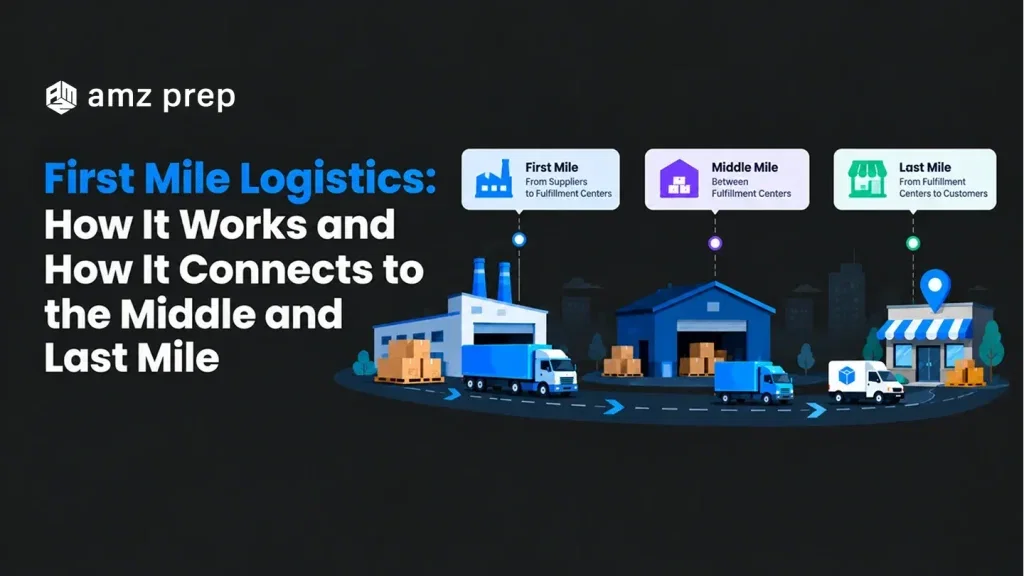
Each stage inherits what the stage before it produced. Clean carton data in the first mile speeds up receiving later. Good inventory position in the middle mile makes last mile delivery shorter and cheaper.
I work with brands on freight and routing every day. This guide covers how each stage works, who owns it by sales channel, and where planning improves the whole flow.
First Mile vs Middle Mile vs Last Mile: Comparison Table
The table below compares the three stages across the whole supply chain, from origin to doorstep.
| Factor | First mile | Middle mile | Last mile |
|---|---|---|---|
| Route | Supplier or factory to first warehouse | Warehouse to a distribution center, fulfillment center, or retailer DC | Fulfillment center to the end customer |
| What moves | Containers, pallets, master cartons | Full and partial truckloads, pallets | Single parcels |
| Typical transport | Ocean, air, port drayage, cross-border trucking | Truckload and LTL freight, dedicated lanes | Parcel carriers and local delivery vans |
| Who usually owns it | Brand and supplier, with a freight forwarder or the 3PL’s forwarding team | Brand or its 3PL | Amazon for FBA and 1P orders; the brand or 3PL for DTC, SFP, and B2B |
| Handoff to the next stage | Received, counted, labeled inventory | Inventory placed close to buyers, or checked in against a PO | A delivered order |
| Key metric | Supplier ship date and receiving accuracy | On-time to the quoted check-in date | Delivery time and customer experience |
Some teams call the middle mile the mid mile. Others call the last mile final mile delivery or the final leg. The meaning is the same.
What Is First Mile Logistics?
First mile logistics is the movement of goods from a supplier or factory to the first warehouse that receives them. For ecommerce brands, that warehouse is often a prep center or 3PL. The first mile covers pickup, export, international freight, customs clearance, and receiving. It sets the pace for every stage after it.
Most of the brands I work with source from overseas. For them, the first mile is a long-distance move with several handoffs before a single unit reaches a shelf.
First Mile Delivery Steps From Factory to Warehouse
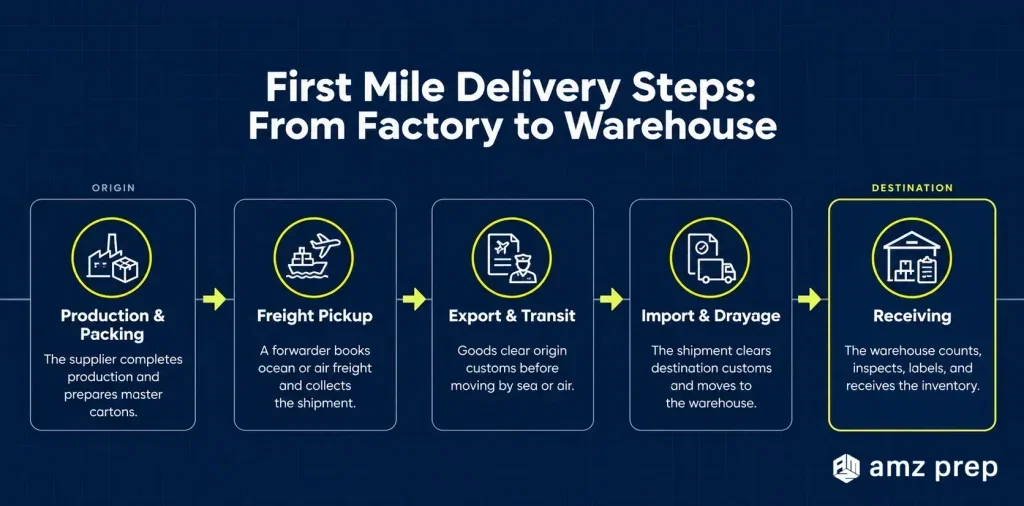
A typical first mile delivery for an imported product follows six steps.
- The supplier finishes production and packs master cartons.
- A freight forwarder books ocean or air space and picks up the goods.
- The goods clear export at origin and move to the port or airport.
- The shipment crosses the ocean or flies to the destination airport.
- The goods clear import customs, and a truck drays the container to a warehouse.
- The warehouse receives, counts, and inspects the cartons.
Ocean and air are the two main modes for imported ecommerce inventory, and the choice between them has the biggest effect on first mile cost and timeline. Ocean from China to a US West Coast warehouse typically runs 30 to 45 days door to door; air runs 5 to 10 days. The ocean costs less per unit. Air suits urgent restocks or high-value goods.
The forwarder also handles routing from the port to the warehouse door. When one team runs both international freight forwarding and receiving, carton data moves with the freight.
Cross-Border First Mile: Canada and the US
Not every first mile crosses an ocean. For brands based in Canada selling into US Amazon, or US brands opening Canada, the first mile is a truck crossing the border. The work is the same: commercial invoice, HTS classification, customs pre-clearance, then delivery to the receiving warehouse.
We run this lane in both directions, into FBA and into Amazon Vendor Central for 1P brands. Midday Squares ships temperature-controlled chocolate from Canada to the US this way, with pre-clearance and consolidation at our New Jersey hub before FBA delivery.
First Mile Freight Documents and Data
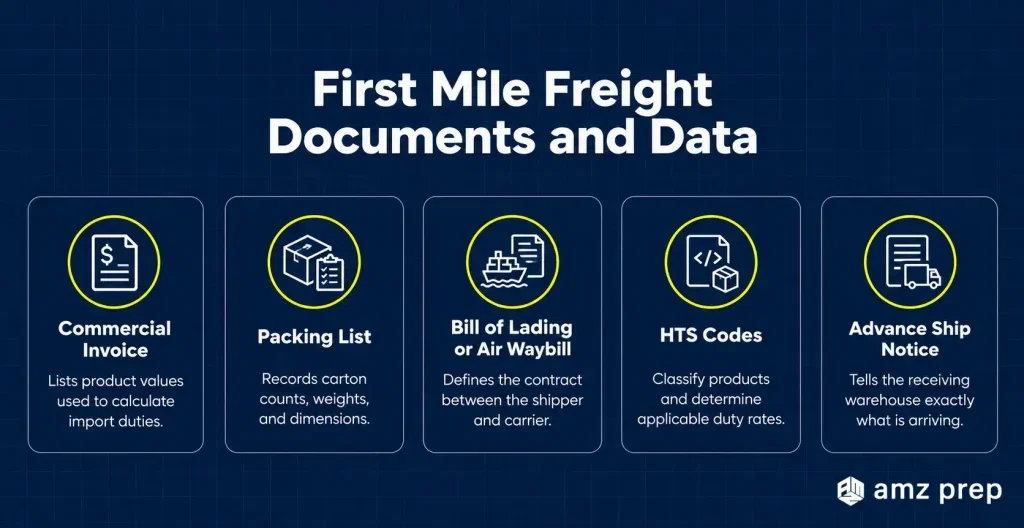
Clean paperwork keeps freight moving at every border. Documentation and tracking start in the first mile, and that data carries forward to every later stage.
The core documents are:
- Commercial invoice: product values, used to calculate duties.
- Packing list: carton counts, weights, and dimensions.
- Bill of lading or air waybill: the contract between the shipper and the carrier.
- HTS codes: the tariff classification for each product.
- Advance ship notice: tells the receiving warehouse what is arriving.
Accurate HTS codes set the duty rate. Under CUSMA, correct HTS classification helps confirm whether goods qualify for preferential duty. Duties then feed into landed cost, which our import duty calculator can estimate before goods ship.
First Mile Carton Labeling for Amazon FBA
The factory is the cheapest place to get labels right. A supplier can apply FNSKU labels and set case packs before goods ship.
This matters most for brands selling on Amazon. Amazon sets firm barcode label requirements for every unit, plus limits on carton size and weight.
Strong cartons and correct packing also prevent damage in transit. A carton that survives an ocean crossing intact arrives ready for its next move.
First Mile Receiving at a Prep Center Warehouse
The first mile ends when a warehouse receives the goods. At a prep center, receiving includes carton counts, quality checks, and label verification. Any remaining prep work happens here.
Inventory management also starts at this point. Every unit gets a location and a count in the warehouse system.
Woof, a pet brand we work with, ships stock from China to AMZ Prep before it moves on to Amazon. Receiving and FBA prep happen in one building. That keeps the flow into FBA steady without changing their DTC operations.
Key Takeaway: The first mile determines how efficiently everything that follows can move. Factory-applied labels, accurate ASNs, and correct HTS codes help warehouses receive inventory in hours instead of days and avoid relabeling before the middle mile.
Where Middle Mile Delivery Fits Between the First and Last Mile
Middle mile delivery is the freight leg between two business facilities. It starts where the first mile ends and finishes before the last mile begins. In ecommerce, the most common example is middle mile freight into Amazon FBA.
Pallets also move to retail distribution centers, to Amazon’s inbound docks against a Vendor Central purchase order, and to other warehouses. The middle mile is bulk transportation, on full or partial truckloads, to a few business docks.
Most middle mile delivery runs on scheduled dock appointments. Carriers, brokers, and 3PLs all plan around those windows. A missed appointment means the truck waits for the next slot, and the inventory inside it is not sellable until it checks in.
Middle Mile to Amazon FBA and Placement Fees
When a seller ships cartons to Amazon on their own, Amazon decides which fulfillment centers receive them and charges an inbound placement fee per unit for the privilege. The fee is often larger than the freight itself.
Our Middle Mile program consolidates inbound shipments across many sellers onto full truckloads headed to the same Amazon regions, on daily lanes with pre-booked appointments. That is what removes the per-seller placement fee entirely and gets inventory checked in within 2 to 4 days [Chad: confirm the one figure we publish; home page currently says 1 to 3], against a 7 to 10 day industry average.
Middle Mile Plus: Pallets and Temperature-Controlled Freight
Standard Middle Mile moves cartons. Middle Mile Plus moves freight that ships on pallets, not in boxes: oversized goods, full-pallet replenishment, and temperature-controlled products that need reefer transport from our cold storage to Amazon or a retailer DC.
This matters because a brand with pallet freight is sometimes told “we can’t do the middle mile.” We can. It is a different lane with different equipment, and the same appointment-booked delivery.
Middle Mile for Amazon 1P (Vendor Central) Purchase Orders
For brands selling to Amazon as a first-party vendor, the middle mile is delivery against a purchase order. Amazon issues the PO, the vendor or its 3PL preps cartons to Amazon’s routing guide, sends an advance ship notice, books the dock appointment, and delivers.
Late, short, or mislabeled deliveries draw chargebacks, so the middle mile here is measured on compliance as much as transit time. Our Vendor Central fulfillment team runs this flow for 1P brands.
The middle mile hands forward inventory position. Where stock sits when an order comes in decides how far the last mile travels. That is why this stage shapes customer satisfaction, even though shoppers never see it.
Who Handles Last Mile Delivery for Amazon, DTC, and B2B Orders
Last mile logistics is the final delivery of goods from a fulfillment center to the end customer. Who handles it depends on the sales channel. Amazon handles it for FBA and 1P orders. The brand or its 3PL handles it for DTC, Seller Fulfilled Prime, and most B2B orders.
The last mile is usually the most expensive stage per unit. Each parcel travels alone, to a different address, on its own route.
Last Mile Delivery for Amazon FBA, 1P, and MCF Orders
For FBA orders, Amazon picks, packs, and delivers. The same applies to Multi-Channel Fulfillment orders, which ship from Amazon’s network for other sales channels, and to 1P orders, where Amazon owns the inventory once it is received against the PO.
Here, the brand’s role in the last mile ends at inventory placement. A seller supports fast delivery by keeping stock in the right fulfillment centers; a vendor supports it by delivering POs complete and on time.
Last Mile Delivery for DTC, SFP, and B2B Orders
For DTC orders, the brand or its 3PL chooses the carrier, the service level, and the packaging. Last mile operations in this channel have the strongest impact on customer satisfaction.
The last mile delivery process runs in four steps. The warehouse picks and packs each order, then sorts it by carrier. Carriers load parcels at a local hub. Drivers then complete the drop at the door.
Carriers use route optimization software to plan each driver’s stops. Many brands now track last mile delivery against the date promised at checkout.
Customer expectations keep rising. Shoppers compare every brand to Prime speed, and same-day delivery is growing in major cities.
Seller Fulfilled Prime adds the Prime badge to orders shipped from a brand’s own warehouse or SFP 3PL. That warehouse must meet Amazon’s delivery promise every day.
B2B orders often ship as pallets to stores or retailer DCs. B2B retail fulfillment follows retailer routing guides and appointment windows, much like middle mile freight.
On the parcel side, Prep Parcel by AMZ Prep runs multi-carrier rate shopping across 35+ regional and national carriers with real-time tracking. Zone skipping, where parcels move in bulk to a hub near the destination before entering the carrier network, saves 25 to 32% on parcel cost for brands with enough volume per region.
One seasonal note: every national carrier adds peak season surcharges from October through January, and they apply to every shipper in the market, not to one 3PL. We publish the current carrier list and dates each October [link to /carrier-peak-season-surcharges/ once live; Chad: confirm this year’s status].
How Warehouse Location Affects Last Mile Logistics
The distance from the warehouse to the buyer sets the shipping zone. A closer warehouse means a lower zone, a lower rate, and better delivery speed.
Splitting inventory across two or more regions puts most buyers within fewer zones. Our network of 50+ fulfillment centers across 6 countries lets brands place stock near demand, with 2-day ground coverage for 98% of the continental US.
Middle Mile vs Last Mile Logistics: Key Differences
The key difference between middle mile and last mile logistics is scale. The middle mile moves bulk freight between business facilities. The last mile moves single orders to individual buyers. One middle mile truck can feed thousands of last mile stops.
| Factor | Middle mile | Last mile |
|---|---|---|
| Shipment size | Pallets and truckloads | Single parcels |
| Destination | Warehouses, DCs, fulfillment centers, Amazon inbound docks | Homes and businesses |
| Stops per trip | One or a few | Dozens to hundreds |
| Scheduling | Dock appointments | Delivery dates promised at checkout |
| Main document | Bill of lading, ASN | Tracking number |
| Measured by | On-time to the quoted check-in date, dock acceptance | Delivery time and customer experience |
Middle mile carriers plan around capacity and appointments. Last mile carriers plan around address density and customer expectations.
The middle and last mile meet at the fulfillment center. That is where bulk freight becomes individual orders.
First Mile vs Last Mile: Key Differences
The first mile and last mile sit at opposite ends of the chain. The first mile works with suppliers, and the last mile works with customers.
First mile work centers on documents, compliance, and carton quality. Last mile work centers on speed, tracking, and the delivery experience.
Both ends depend on clean data. The first and last mile need accurate labels, addresses, and tracking to keep goods moving.
For a brand, the first mile affects margin and stock levels. The last mile affects reviews, repeat orders, and competitive advantage.
How to Optimize First, Middle, and Last Mile Deliveries
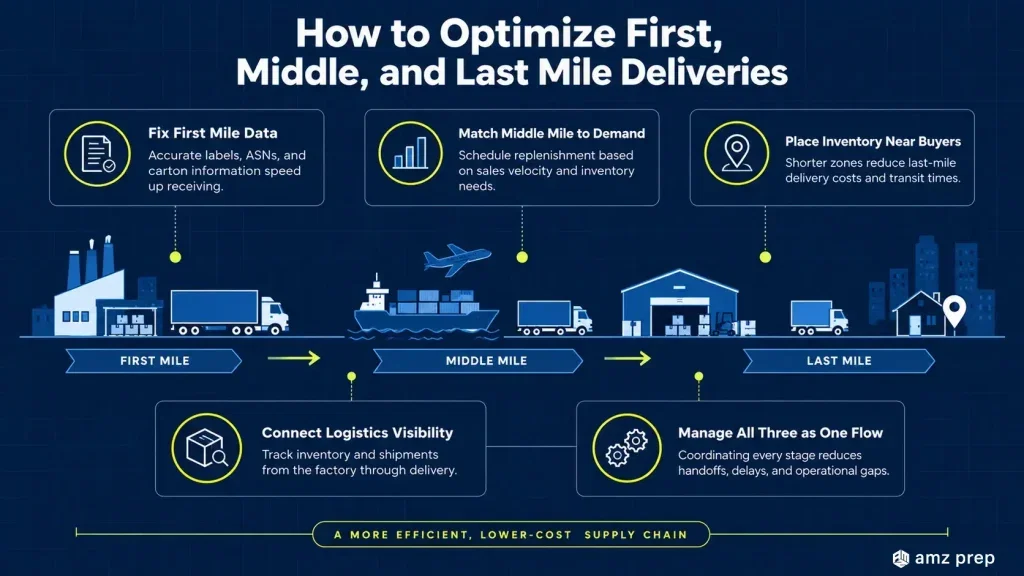
The best way to optimize first, middle, and last mile deliveries is to plan them as one flow. Each stage passes data and inventory to the next. Planning at the start shortens every step that follows.
First Mile Data That Speeds Up Middle Mile Receiving
When the advance ship notice matches the cartons, receiving moves fast. When labels are correct at origin, nothing needs relabeling. Inventory is then ready for its next move soon after it lands.
Middle Mile Timing and Inventory Position
Freight booked to match sales velocity keeps fulfillment centers stocked. Steady, smaller replenishments keep inventory turning between restocks. Drip feeding into FBA from a 3PL does this without paying Amazon’s long-term storage fees on full cases.
Each stage works best when the one before it runs on a predictable schedule. Clients tell us the same thing in different words: a reliable check-in date is worth more than a cheaper quote that slips.
Last Mile Optimization Starts Upstream
Most last mile optimization happens before an order is placed. Stock placed near buyers gives carriers shorter routes and lower zones. Accurate product dimensions let the warehouse pick the right box and carrier every time.
End-to-end visibility ties all three stages together. When one dashboard shows stock from factory to doorstep, teams can spot slow points early. Our freight clients track every shipment in Relay, and fulfillment inventory in Navigate.
Key Takeaway: Optimization compounds forward. Fix labels and ASNs in the first mile, book middle mile freight to sales velocity, and place stock near demand, and the last mile gets cheaper without touching a single carrier contract.
Managing First, Middle, and Last Mile Logistics With One 3PL
Many brands use a different partner for each stage. That works, but each handoff between partners adds another data transfer and another contact, and when something slips, nobody owns the whole answer.
Running all three stages through one 3PL keeps one set of data from origin to doorstep. At AMZ Prep, we cover the first mile, middle mile and final mile. But we go the extra mile: one quote, one contact, and a team that solves the exception instead of forwarding it. Freight forwarding handles the first mile. Our Middle Mile program moves inventory into Amazon with zero placement fees. Prep Parcel handles the last mile.
We process 10M+ units a month for 5,000+ brands [Blair: confirm 10M vs 8M]. Our services also include cold storage, Vendor Central fulfillment, subscription fulfillment, and fulfillment across every major marketplace.
Who this is the right fit for
One 3PL for all three stages makes the most sense for brands that import inventory and sell on Amazon plus at least one other channel, ship pallets or containers at least monthly, and have been burned by a late inbound at least once. If you source domestically, sell on one channel, and ship a few parcels a day, a single-stage partner is simpler, and a freight forwarder plus FBA direct will serve you fine until volume grows.
Freight Services
See all freight services available from AMZ Prep for your shipping and logistics needs.
See All Freight Services →First Mile, Middle Mile, and Last Mile Logistics FAQs
What is first mile, middle mile, and last mile logistics?
First mile, middle mile, and last mile logistics are the three stages of shipping a product. The first mile moves goods from supplier to warehouse. The middle mile moves bulk freight between facilities. The last mile delivers orders to customers.
What is first mile logistics in ecommerce?
First mile logistics in ecommerce is the movement of inventory from a supplier or factory to the first warehouse or prep center. It includes pickup, international or cross-border freight, customs clearance, and receiving before inventory is ready to sell.
What is the difference between middle mile and last mile?
The middle mile moves pallets and truckloads between business facilities, such as a 3PL and an Amazon fulfillment center. The last mile moves single parcels from a fulfillment center to each buyer’s home or business.
What is the difference between first mile and last mile?
The first mile is the start of the supply chain, moving goods from suppliers to a warehouse. The last mile is the end, delivering orders to customers. The first mile faces suppliers, and the last mile faces buyers.
Who handles the last mile for Amazon FBA orders?
Amazon handles the last mile for FBA orders. It picks, packs, and delivers each order through its own network. The seller’s role is to keep inventory stocked in the right fulfillment centers so orders ship on time. The same is true for 1P vendors: Amazon owns the inventory and the delivery once a purchase order is received, so the vendor’s job ends at the inbound dock.
What is Middle Mile Plus?
Middle Mile Plus is AMZ Prep’s middle mile service for freight that ships on pallets rather than in cartons, including oversized goods and temperature-controlled products that need reefer transport. It uses the same appointment-booked delivery into Amazon and retailer DCs as standard Middle Mile.
Which stage of logistics usually costs the most?
The last mile usually costs the most per unit. Each parcel travels alone to a different address, with its own driver time and fuel. The first and middle mile spread costs across full containers and truckloads.

Chadwick Collins is an Enterprise Fulfillment Consultant at AMZ Prep, where he partners with high growth ecommerce brands to design and scale Amazon first logistics strategies. He brings extensive experience in freight, supporting brands across domestic and cross border transportation, routing optimization, and cost control.
At AMZ Prep, Chadwick works closely with enterprise clients to improve inventory flow, reduce landed costs, and accelerate delivery performance across North America. His expertise spans FBA, DTC, and B2B fulfillment, with a strong focus on aligning freight strategy with overall supply chain efficiency. He helps brands navigate complex logistics challenges while turning operations into a competitive advantage.
















Comments