
Medical device shipping requirements cover FDA classification, packaging standards, carrier documentation, and storage conditions that apply at every point between your warehouse and the end customer. They apply whether you ship 50 orders a month or 50,000 and they do not change based on sales channel or fulfillment volume.
I work with eCommerce brands that sell regulated medical devices every day. The compliance gaps I see most often are not from brands that ignored the rules.
They are from brands that outgrew their fulfillment setup without realizing the requirements changed.
This guide covers what those requirements are, how they apply by device class, and what compliant eCommerce fulfillment needs to look like.
What Counts as a Medical Device Under FDA Rules?
The FDA defines a medical device as any instrument, apparatus, or product intended to diagnose, prevent, or treat a condition in humans, where the primary action is not chemical or metabolic. That definition covers a wide range of eCommerce products.
Common examples include blood glucose monitors, pulse oximeters, pregnancy tests, CPAP equipment, surgical gloves, and certain wound care products.
If your product makes a health-related claim and its primary action is physical rather than chemical, it likely falls under FDA device classification.
The distinction matters because FDA medical device shipping rules are tied directly to device classification.
Brands that misclassify their product or assume it falls outside FDA scope carry compliance exposure at every order they ship. I see this most often with wound care products and certain diagnostics. The brand assumes Class I. The device is Class II. The documentation gap surfaces later.
How FDA Classification Sets Your Shipping Obligations
The FDA classifies devices into three tiers under 21 CFR Parts 800 to 898. Each tier determines what documentation, traceability, and handling are required throughout the fulfillment process.
Brands in adjacent regulated categories, such as those managing supplement fulfillment, follow a similar classification-driven compliance structure.
| Class | Risk Level | Examples | Core Shipping Obligation |
|---|---|---|---|
| Class I | Low | Bandages, examination gloves, tongue depressors | Basic storage conditions, chain-of-custody records |
| Class II | Moderate | Pregnancy tests, pulse oximeters, infusion pumps | UDI compliance, 510(k) documentation, lot tracking |
| Class III | High | Pacemakers, cochlear implants, stent systems | Unit-level traceability, PMA records, full audit trail |
Class I devices carry the lightest requirements. Class III devices require full unit-level traceability from receipt through final delivery. Most eCommerce medical device brands operate in Class I and Class II. Start here before evaluating any fulfillment setup.
What Medical Device Packaging Requirements Cover
Medical device packaging requirements sit under ASTM D4169 performance testing standards and ISTA test protocols. ISO 11607 sets the additional standard for sterile barrier systems, covering material selection, seal integrity, and validation for any device that requires sterile packaging.
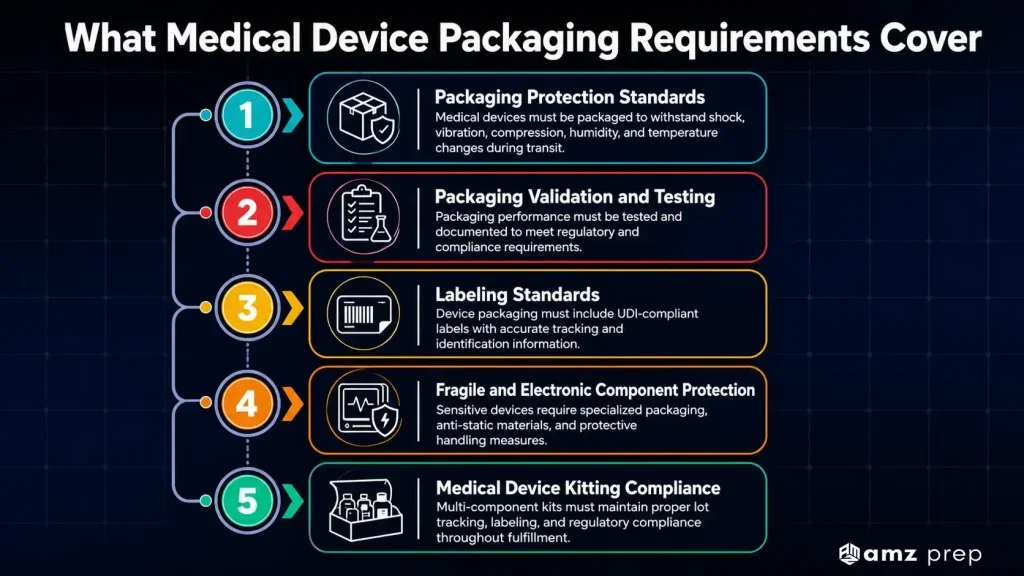
Every regulated device must be packaged to protect against the physical stresses it will encounter across the full shipping cycle: shock, vibration, compression, humidity, and temperature variation.
What I find most brands skip is the validation documentation. The packaging may perform fine. But if there is no test record, it does not count.
For eCommerce brands, this means packaging validation is not something a carrier handles on your behalf. It is your obligation as the brand, and it needs to be tested and documented before deployment.
| Layer | Purpose | Example |
|---|---|---|
| Primary | Sterile barrier in direct contact with the device | Blister pack, pouch, tray |
| Secondary | Separates the sterile barrier from the outer shipping layer | Inner carton, protective wrap |
| Tertiary | Outer shipping case for transit | Corrugated box, shipping container |
Labeling standards
FDA-regulated devices require UDI-compliant labeling at the device package level. UDI labels must carry both human-readable text and a machine-readable barcode or RFID format. The device identifier and production identifier components both need to be present.
Class II and III devices also require GUDID database registration. The label on the package must match the record in the GUDID system. Mismatches create traceability failures that surface during audits.
Fragile and electronic components
Optical components, electronic assemblies, and precision instruments need packaging configured to device dimensions, not generic box sizing. Anti-static materials apply to electronic components. Shock indicators or tilt sensors are appropriate where product sensitivity warrants.
A compliant 3PL has label verification built into the outbound workflow as a standard step. Not as a manual check on request.
Medical device kitting, the assembly of multi-component device kits before shipment, requires the same lot tracking and UDI labeling compliance as individual unit fulfillment.
What Carriers Require for Medical Device Shipments
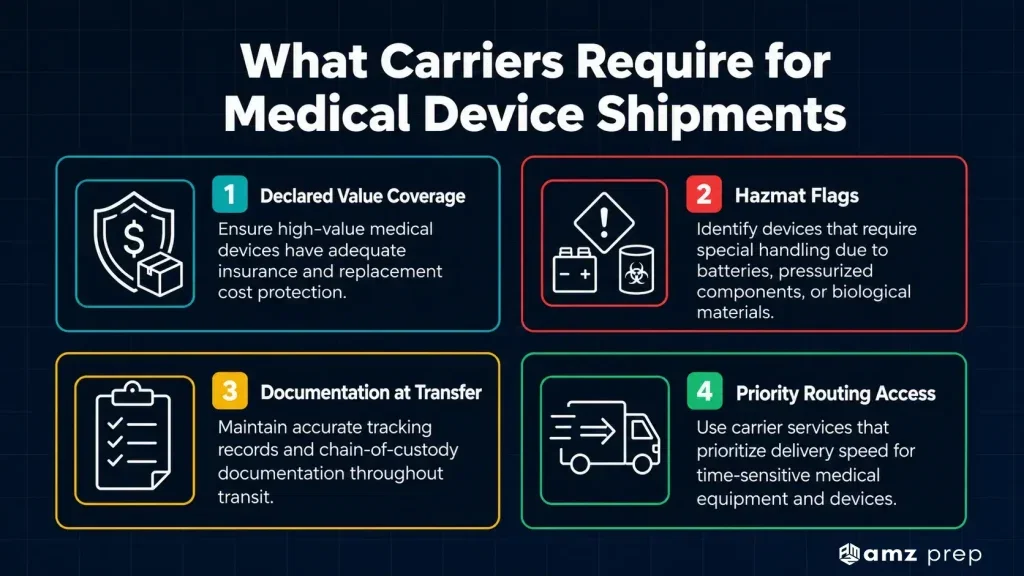
Carrier requirements for medical device shipments go beyond standard parcel handling. These are the areas I check before committing to any fulfillment setup for a regulated product category:
Declared value coverage
Standard carrier liability does not cover the replacement cost of high-value medical equipment. Class II and III devices, diagnostics equipment, and precision instruments all warrant declared value coverage. Build this into a landed cost from the start.
Hazmat flags
Certain medical devices contain lithium batteries, pressurized components, or biological materials that trigger carrier hazmat requirements. Confirm whether your device category requires special handling declarations before booking standard parcel lanes.
Documentation at transfer
Every carrier transfer point needs a traceable record. That includes lot number, serial number where applicable, and a chain-of-custody log. This is a documentation obligation at the fulfillment level, not something the carrier builds for you.
Priority routing access
Some device categories, particularly diagnostics equipment and surgical instruments, require transit time routing rather than cost routing. A fulfillment partner with a broad carrier network can make that routing decision without a separate carrier negotiation each time.
When Temperature Control Is Required
Not all medical devices require cold chain handling. Devices with a manufacturer-specified temperature storage range do. That includes in vitro diagnostics, certain biological devices, and drug-device combination products.
A qualified cold storage providers maintains validated temperature ranges and continuous monitoring across the full storage cycle. When I evaluate a facility for temperature-sensitive devices, I ask for the temperature mapping study first. If they cannot produce it, the conversation stops there.
FDA and ISO 13485 both require storage and transport within validated ranges for temperature-sensitive devices.
Cold chain shipping for regulated devices is not just a carrier decision. It requires validated storage, qualified lanes, continuous monitoring, and a documented excursion response at every transfer point.
Passive vs. active cold chain
| Factor | Passive Cold Chain | Active Cold Chain |
|---|---|---|
| Method | Insulated packaging, gel packs, dry ice | Refrigerated vehicles, powered storage units |
| Transit suitability | Short to medium (under 96 hours) | Extended transit, cross-border, international |
| Monitoring | Passive temperature indicators | Continuous data loggers, real-time alerts |
| Validation | Packaging validation per shipment spec | Full lane and equipment validation required |
| Best for | Diagnostics, reagents, short-haul | Biologics, combination products, long-haul |
Check the device instructions for use to confirm the required storage range before selecting a cold chain approach. That specification drives every downstream decision on carrier lane, packaging, and monitoring.
How eCommerce Brands Typically Fulfill Medical Devices
Most eCommerce medical device brands use one of two setups: in-house fulfillment or a third-party medical device fulfillment partner.
In-house works at low order volumes. Once a brand scales past a few hundred orders per month, maintaining compliant storage documentation, FEFO pick logic, and chain-of-custody records internally becomes operationally expensive relative to outsourcing.
3PL services for medical devices built for regulated product categories handle storage condition documentation, lot and serial number tracking, UDI label verification, and carrier qualification as part of standard operations. The key phrase is standard operations. Those capabilities need to exist in the SOPs already. They cannot be built on request after onboarding.
At AMZ Prep, we operate across 50+ fulfillment centers with compliant storage infrastructure for regulated product categories including medical devices.
Order flows span Amazon FBA, DTC, and B2B retail from a single inventory pool through a unified omnichannel fulfillment setup. The SOPs for lot tracking, UDI verification, and chain-of-custody documentation are built into standard operations, not added on request.
International Shipping Requirements
Cross-border medical device eCommerce introduces a separate regulatory layer on top of FDA requirements.
CE marking is required for EU distribution. Health Canada device licensing applies to Canadian imports. Asia-Pacific and Latin American markets each carry country-specific import permit requirements.
Documentation for international shipments includes commercial invoices with correct HS codes, declared value, and certificates of conformity where the destination market requires them. A fulfillment partner’s general international shipping volume does not indicate international compliance capability. Verify the customs brokerage relationship and documentation workflows directly.
Conclusion
In my experience, the brands that struggle most with medical device shipping requirements are not the ones that ignored the rules. They are the ones that assumed their existing fulfillment setup scaled with them. It does not always.
The same FDA classification rules, UDI labeling standards, and chain-of-custody obligations apply whether you ship through Amazon FBA, your own DTC store, or a retail distribution channel. A 3PL that handles general eCommerce well may still create documentation gaps when applied to a regulated device category.
Get the classification right first. Match your packaging and cold chain setup to what the device specification actually requires. Then confirm that your fulfillment partner’s SOPs cover those requirements as standard, before the first shipment leaves the door.
Frequently Asked Questions
What are the FDA shipping requirements for medical devices?
FDA requirements under 21 CFR Parts 800 to 898 apply to all regulated devices. Class I devices require basic storage and chain-of-custody records. Class II adds UDI compliance and 510(k) documentation. Class III requires full unit-level traceability and PMA records at every transfer point.
What packaging is required for medical device shipments?
Packaging must meet ASTM D4169 or ISTA performance testing standards. FDA-regulated devices require UDI-compliant labeling in human-readable and machine-readable format. Electronic components need anti-static materials. Custom-fit protective inserts apply to fragile or precision instruments.
Do medical devices need temperature-controlled shipping?
Only devices with a manufacturer-specified temperature range require cold chain handling. These include in vitro diagnostics, certain biologics, and drug-device combination products. Check the device instructions for use to confirm whether temperature control applies to your product.
What is UDI compliance for medical device shipping?
UDI (Unique Device Identifier) compliance requires a standardized label on every FDA-regulated device package carrying a device identifier and production identifier in both human-readable text and machine-readable format. Class II and III devices also require GUDID database registration.
Can medical devices be sold on Amazon?
Yes. Class I and many Class II devices are eligible for Amazon FBA and FBM. Amazon requires that listings comply with FDA regulations and that devices are properly classified and labeled. Some Class III devices and prescription-only devices face additional listing restrictions.
How do you ship fragile medical equipment safely?
Use custom-fit protective packaging validated against ASTM D4169 or ISTA protocols. Select carriers based on handling standards, not only cost. Apply shock indicators where product sensitivity warrants. Do not rely on standard “fragile” carrier handling for regulated devices.
What documents are required for international medical device shipments?
International shipments require commercial invoices with HS codes and declared value, certificates of conformity, and destination-country import permits. EU shipments require CE marking. Canadian imports require Health Canada device licensing. Document requirements vary by market.
What is a compliant medical device 3PL?
A compliant medical device 3PL maintains documented SOPs for regulated product handling, FEFO pick logic, lot and serial number tracking, chain-of-custody records, and carrier qualification as part of standard operations. These capabilities need to be in place before onboarding, not built after.


















Comments