
Your protein powder sells well in the US. Now you want to import your nutritional supplements into new markets, starting with Canada. But shipping supplements to Canada is not the same as shipping to another US state.
Canada classifies health products differently. The regulation is stricter. And one missed step at the border can hold your entire shipment. In some cases, selling unlicensed products may be illegal under Canadian law.
In this blog, I will walk you through what US supplement brands need to know before sending supplements to Canada: the regulatory framework, licensing timelines, customs documentation, shipping methods, and the fulfillment setup that keeps inventory moving.
Canada Does Not Treat Supplements the Way the US Does
In the US, the FDA classifies supplements as ‘dietary supplements.’ They do not need pre-market approval. Brands register, label correctly, and sell.
Canada takes a different approach. Health Canada regulates natural health products (NHPs) under the authority of the Food and Drugs Act and the Food and Drug Regulations. The Natural Health Products Regulations (NHPR) set the rules for importation, exportation, manufacturing, and sale of NHPs in Canada.
This is the core difference. The US system is reactive. Canada supplement regulations are proactive. Products must be reviewed, proven safe and effective, and assigned a marketing authorization before they can be sold.
That authorization comes in the form of a Natural Product Number (NPN). Health Canada assigns this eight-digit number after reviewing the product’s medicinal ingredients, health claims, and therapeutic purpose.
Without an NPN, your product cannot be listed on Amazon.ca, sold in Canadian retail, or stored at a Canadian supplement fulfillment center for commercial distribution.
The NHP category is broad. It covers vitamins and minerals, herbal remedies, traditional medicines, homeopathic medicine, probiotic products, and products like amino acids and essential fatty acids.
If your product makes a health claim or contains a medicinal ingredient with a therapeutic purpose, Canada likely classifies it as an NHP.
Two Paths Into Canada: Personal Use vs. Commercial Import
There are two legal routes for getting supplements across the border. Each has different rules, different limits, and different use cases.
The Personal-Use Exemption (DTC Brands)
Health Canada allows individuals to import supplements to Canada for personal use without an NPN. The rules are specific:
- Maximum 90-day supply per shipment
- Must ship directly to the end consumer (not to a warehouse or fulfillment center)
- Cannot include ingredients on Health Canada’s prescription list
- No bulk quantities
For DTC brands shipping individual orders cross-border, this exemption can work as a short-term market-entry path. You fulfill from a US warehouse. Each order ships directly to the Canadian buyer. No NPN required.
The limit is scale. Every order crosses the border individually. Landed costs are higher. Delivery times are longer. And you cannot stock inventory in Canada under this model.
Commercial Import (Amazon.ca, Retail, Wholesale)
Selling on Amazon.ca, through Canadian retail, or via wholesale requires full commercial import compliance. That means:
- A valid NPN for every product SKU
- A site license for the Canadian facility handling the product
- Bilingual labeling (English and French) on all packaging
There are no workarounds here. Amazon.ca will not accept supplement listings without a valid NPN. Canadian retailers will not stock unlicensed NHPs. Health Canada requirements apply to every commercial channel.
Many brands we work with at AMZ Prep start with the personal-use path for DTC while their NPN applications process.
Once licensed, they shift to commercial import and stock inventory in Canada for faster delivery. That transition works well when your fulfillment partner can handle both cross-border DTC and in-country FBA replenishment.
NPN Licensing: Timelines and Planning
The NPN application process runs through Health Canada’s Natural and Non-prescription Health Products Directorate (NNHPD). Approval timelines depend on product complexity.
Class 1 (single monograph ingredient)
60 days. This covers straightforward products with one active ingredient that matches an existing Health Canada monograph. Think single-ingredient vitamin D or fish oil.
Class 2 (multiple monograph ingredients)
90 days. Products with two or more active ingredients, each covered by a monograph. Most multi-ingredient supplements fall here.
Class 3 (outside monograph parameters)
210 days. Any product with an ingredient not listed in Health Canada’s monograph database, or used at a dosage outside the monograph range. Novel formulations and proprietary blends often land in this class.
These are processing windows, not guarantees. Incomplete applications get sent back. Missing safety data extends the timeline further.
2025 labeling rule update: New labeling requirements took effect June 21, 2025. Products licensed on or after that date are temporarily exempt from the new rules until June 2028.
This gives brands a three-year window to update packaging without delaying their NPN application.
For inventory planning, work backward from your target launch date. A Class 2 product needs at least 4 to 5 months of lead time when you factor in application prep, review, potential resubmission, and packaging production.
Customs and Documentation at the Border
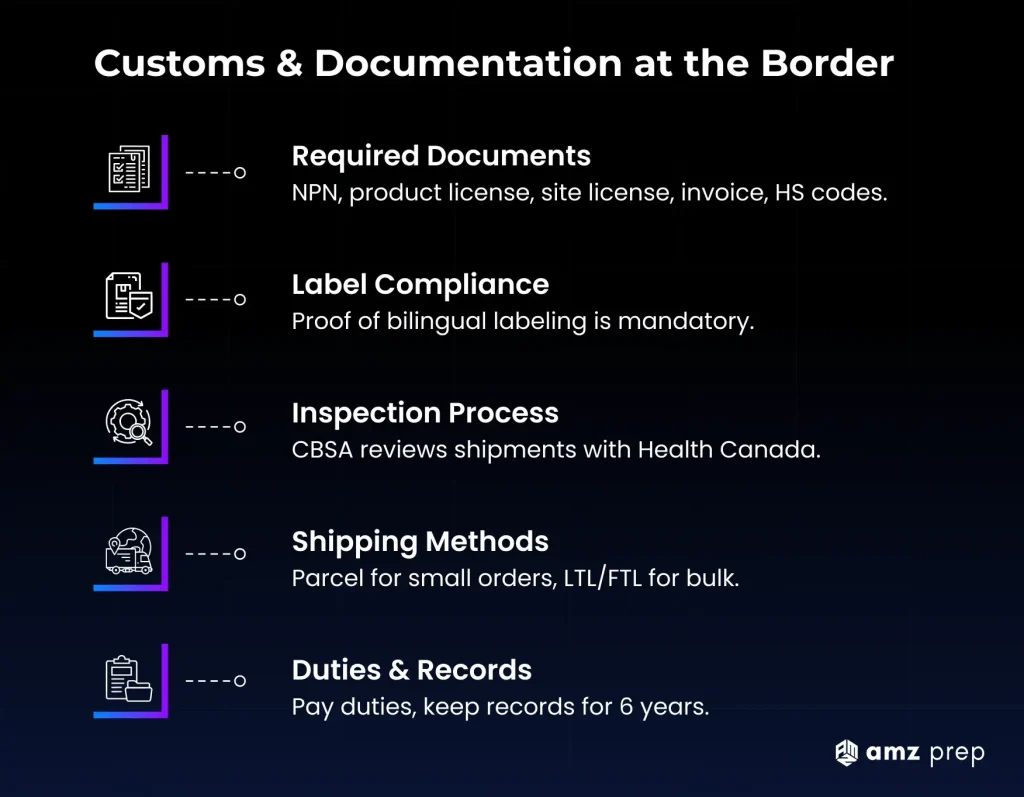
Once your product has an NPN, you still need clean documentation for every shipment crossing into Canada. The Canada Border Services Agency (CBSA) inspects NHP shipments and coordinates with Health Canada on admissibility.
Required documentation;
- NPN or DIN-HM number referenced on the shipment or included as a copy
- Product license confirmation
- Site license number for the receiving facility
- Commercial invoice with accurate HS codes
- Proof of bilingual labeling compliance
CBSA and Health Canada use these references to make admissibility decisions. Missing documentation means delays. Repeated issues can trigger more frequent inspections on future shipments.
This is where having a freight partner with cross-border experience matters. Customs documentation errors are one of the most common reasons NHP shipments get held at the CBSA border crossing.
Choosing the right shipping methods
Your shipping methods depend on volume and frequency. Small DTC shipments typically move via parcel carriers (USPS, UPS, FedEx) with individual customs declarations.
Commercial bulk shipments move via LTL or FTL freight with full customs brokerage. For brands using a delivered duty paid (DDP) shipping model, the seller prepays duty and tax so Canadian customers see no surprise charges at delivery.
Duty and tax
All NHP imports are subject to Canadian duty and applicable taxes at the border. Rates vary by product classification and HS code. Use an import duty and tax calculator to estimate landed costs before your first shipment.
Record retention
Canadian importation regulations require you to keep all import records for six years. CBSA can audit at any point during that window.
Returned goods
If a shipment is refused or you need to process returned goods, the product must be re-exported or destroyed under CBSA supervision. Returns add cost and complexity, which is why getting documentation right the first time matters.
Fulfillment Setup: Where to Warehouse for Canadian Sales
Getting the regulatory side right is half the work. The other half is building a fulfillment setup that makes Canadian sales profitable.
There are three models worth considering.
Cross-border from a US warehouse
You keep all inventory in the US. Each Canadian order or Amazon.ca replenishment ships across the border individually. Every shipment clears CBSA. Landed costs per unit are higher and delivery windows into Canada are longer.
In-Canada warehouse
You store inventory at a warehouse inside Canada. Amazon.ca replenishments ship domestically. DTC orders reach Canadian customers in 1 to 3 days. No per-order border crossing. This model scales once you have consistent Canadian volume.
Hybrid model
You keep primary inventory in the US and maintain a Canadian warehouse node for replenishment. Bulk shipments clear customs once. Individual orders and Amazon.ca replenishments then move domestically within Canada, reaching buyers in 1 to 3 days.
For supplement brands selling on Amazon.ca and DTC, the hybrid or in-Canada model typically delivers better unit economics after the first few months of consistent Canadian sales. The key is a single bulk customs clearance into a Canadian warehouse, so individual orders and replenishments move domestically from that point forward.
If you need a fulfillment partner with Canadian warehouse locations and experience handling NHP imports, see AMZ Prep’s supplement fulfillment capabilities.
Common Mistakes That Get Supplements Held at the Border
I see the same issues come up repeatedly with brands shipping supplements from the US to Canada for the first time.
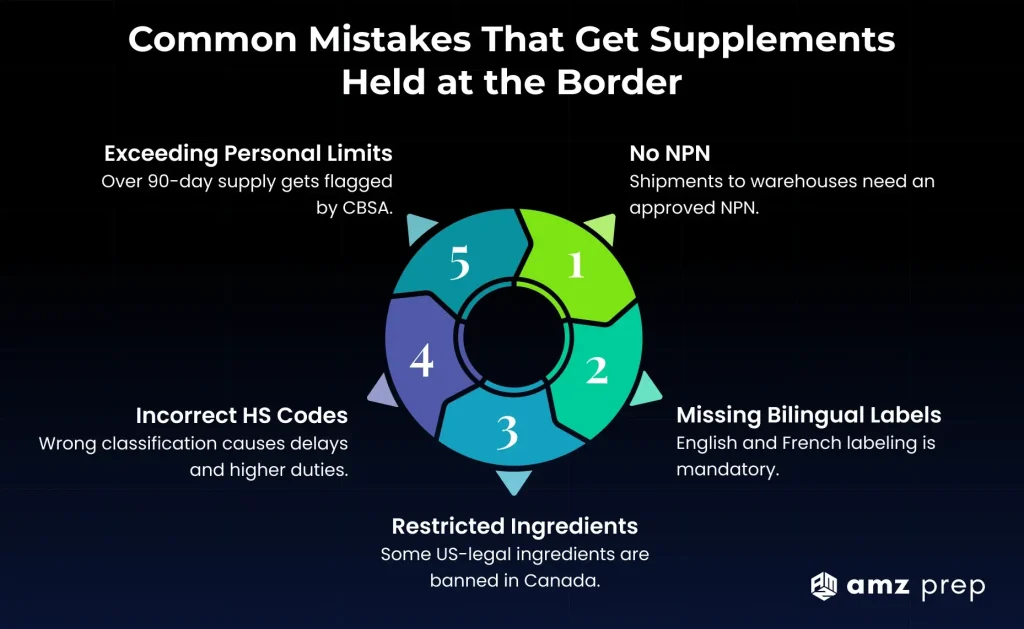
Shipping to a Canadian fulfillment center without an NPN
If your product arrives at a commercial warehouse, CBSA treats it as a commercial import. No NPN means the shipment gets held or refused. The personal-use exemption does not apply to inventory destined for a fulfillment center.
Missing bilingual labels
English-only packaging will not clear customs for commercial import. Both English and French are required on all NHP labeling in Canada. This includes product name, ingredient list, directions for use, and warnings.
Ingredients on Health Canada’s prescription list
Some ingredients sold over the counter in the US are classified as prescription substances in Canada. DHEA is one example. If your formula contains a restricted ingredient, the product will not receive an NPN and will be refused at the border.
Incorrect HS codes
Misclassifying your product on customs declarations creates delays and can trigger higher duty rates. Supplement HS codes vary by formulation type (capsule, powder, liquid) and active ingredients.
Working with a freight partner that understands supplement-specific HS classification prevents this. Misclassification is one of the most common and avoidable reasons shipments are delayed or assessed higher duty rates.
Exceeding personal-use thresholds
Shipping more than a 90-day supply to an individual, or shipping to a business address, voids the personal-use exemption. CBSA flags these shipments for inspection.
Getting Started: What to Do Before Your First Shipment
The brands that enter Canada smoothly follow a sequence. They do not try to solve everything at once.
Start with your NPN application. Identify which class your products fall into and submit early. Use the processing window to prepare bilingual packaging and line up your Canadian fulfillment infrastructure.
Once your NPN is approved, transition to in-country warehousing in Canada. Bulk inventory clears the border once. Amazon.ca replenishments and DTC orders then ship domestically. Landed cost per unit drops. Delivery speed into Canada improves. Customer experience matches what you deliver in the US.
The regulatory side of shipping supplements to Canada takes planning. The fulfillment side takes the right infrastructure. Brands that line up both before their first commercial shipment avoid the costly restarts that come from rushing the process.
Frequently Asked Questions About Shipping Supplements to Canada
Can you ship supplements to Canada without a license?
Yes, for personal use only. Individual orders under a 90-day supply can ship directly to a Canadian consumer without an NPN. Commercial sales on Amazon.ca or through retail require a valid NPN from Health Canada.
What is an NPN and how long does it take to get one?
An NPN is a Natural Product Number issued by Health Canada. It confirms a supplement meets Canadian safety and efficacy standards. Processing takes 60 to 210 days depending on product complexity.
Do supplements need bilingual labels in Canada?
Yes. All commercially sold Natural Health Products must have English and French labeling. This includes the product name, ingredients, directions, and warnings. English-only packaging will be refused at customs.
What happens if Health Canada rejects a supplement shipment?
CBSA holds the shipment and coordinates with Health Canada. The importer may need to provide additional documentation, re-export the goods, or abandon the shipment. Repeated refusals can trigger increased inspection frequency.
Can you sell US supplements on Amazon.ca?
Only with a valid NPN. Amazon.ca requires NHP licensing for all supplement listings sold commercially in Canada. You also need bilingual packaging and a compliant Canadian fulfillment setup.
Is there a limit on shipping supplements to Canada for personal use?
Yes. The personal-use exemption caps shipments at a 90-day supply per product. The shipment must go directly to the individual consumer, not to a business or warehouse address.

Chadwick Collins is an Enterprise Fulfillment Consultant at AMZ Prep, where he partners with high growth ecommerce brands to design and scale Amazon first logistics strategies. He brings extensive experience in freight, supporting brands across domestic and cross border transportation, routing optimization, and cost control.
At AMZ Prep, Chadwick works closely with enterprise clients to improve inventory flow, reduce landed costs, and accelerate delivery performance across North America. His expertise spans FBA, DTC, and B2B fulfillment, with a strong focus on aligning freight strategy with overall supply chain efficiency. He helps brands navigate complex logistics challenges while turning operations into a competitive advantage.

















Comments