
If you sell chocolates, gummies, candles, cosmetics, or anything else that turns into a puddle when it gets hot, this one is for you.
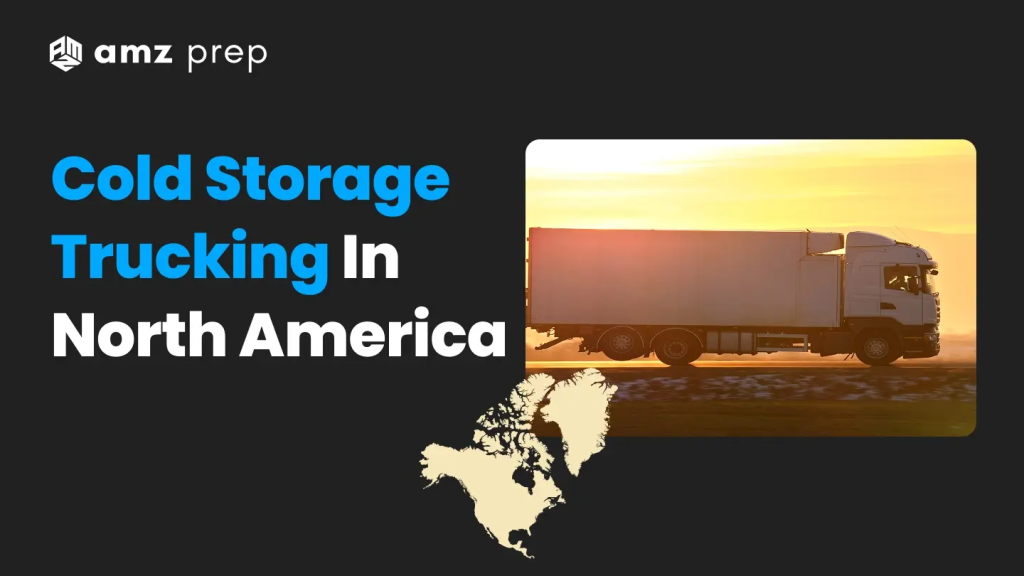
Most sellers don’t think about cold storage trucking until something goes wrong. A summer shipment arrives ruined.
Amazon flags their product as meltable and they lose six months of FBA access. A 3PL drops the ball on temperature control and an entire pallet is wrecked.
This guide covers everything that includes reefer trucks, cooling mechanics, costs, regulations, cross-border headaches, and how to build a strategy that keeps your products cold year-round.
And it starts with understanding the equipment that makes cold storage trucking work.
What is a Reefer Truck?
“Reefer” is trucking slang for refrigeration.
It is an insulated freight vehicle with a built-in cooling system, including a compressor, condenser, evaporator, and air chutes, that keeps cargo at a set temperature during transit.
Most are 53-foot trailers that can hold anywhere from -20°F to 60°F.
Here’s the thing most people get wrong: reefer trucks don’t cool things down.
They maintain temperature. If your product is sitting at 85°F in an ambient warehouse and gets loaded onto a reefer set to 65°F, that reefer is going to struggle.
Your product needs to be at the right temperature before it ever hits the truck.
About 90% of the food Americans eat got to the table via refrigerated truck.
There are roughly 500,000 reefers operating across the U.S. right now. If you’re selling meltable products online, this is your world too.
Equipment types worth knowing: Standard 53-foot reefer trailers handle long-haul, cross-country moves and carry about 42,000 to 44,000 pounds.
Refrigerated box trucks (14 to 26 feet) handle regional and last-mile delivery.
Multi-temperature trailers run separate zones in one truck, with frozen goods in one compartment and protect from heat products in another, which is increasingly popular for mixed load efficiency.
What Temperature Setting Do Meltables Need in a Reefer Truck?
Now that you know what a reefer is, the next question is obvious. What setting does your product actually need? There are three tiers.
Picking the right one saves real money.
Protect-from-heat (33°F to 77°F). The cooling system only kicks in when the internal temp drifts above your threshold. Otherwise, insulation does the work. Cheapest option. Right for most meltable ecommerce products.
Refrigerated (32°F to 36°F). The compressor runs nonstop. Needed for probiotics, some skincare, anything requiring active refrigeration, especially for brands relying on refrigerated probiotic fulfillment to maintain product stability.
Frozen (-20°F to 0°F). Counterintuitively, often cheaper than refrigerated. Once something is deeply frozen, insulation does most of the heavy lifting.
If you’re selling chocolates, gummies, candles, or cosmetics, protect-from-heat is almost certainly enough. But know your product’s actual melting point before committing.
This playbook covers storage, fulfillment, and logistics options for Amazon sellers moving meltable products during the restricted season. Button: Download the Meltable Season Playbook
How the Cold Storage Trucking Works End to End
Knowing your temperature tier is one piece. But your product does not just sit in a reefer. It moves through a whole chain of handoffs, and each one is a point where things can go wrong.
It starts at manufacturing. Your product must leave the factory at the right temperature. Then inbound shipping via FTL or LTL reefer service moves it to your cold storage 3PL.
At the warehouse, inventory goes into temperature-controlled storage by SKU. When an order comes in, fulfillment means pulling product from cold storage and packing it with insulated liners, gel packs, or dry ice.
The last mile is the riskiest leg. For DTC ecommerce, this usually goes via FedEx or UPS, using standard parcel services rather than reefer trucks.
Your insulated packaging is doing all the work. And then there’s doorstep delivery where a package on a hot porch in July for two hours can undo everything.
What Cold Storage Trucking Costs in 2026
Every link in that chain costs money. Here’s what the numbers actually look like right now.
As of January 2026, the national reefer spot rate sits around $2.79 to $2.81 per mile. Contract rates are about $2.80.
The Midwest is priciest at roughly $3.22 per mile, the Northeast cheapest around $2.42. The C.H. Robinson 2026 forecast projects 6% year-over-year growth in refrigerated van costs.
During summer, when the produce season collides with meltable demand, expect 15 to 30% premiums. On hot lanes like Miami outbound during Valentine’s floral season, spots have spiked 40%.
Overall, cold storage trucking runs 10 to 20% more than dry freight. Refrigerated trailers cost $60,000 to $80,000 more than dry vans.
The TRU runs on its own fuel supply, about 50 gallons, separate from the truck’s engine. National diesel is $3.62 per gallon as of late January 2026, with California at $4.71.
Then add packaging costs: insulated liners, gel packs, dry ice, right-sized cartons. It’s layers of expense, not one number.
The North American Cold Storage Trucking Market
Once you know the calendar, the next question is where to find the cold storage trucking capacity you need.
That depends on the shape of the North American market and it’s bigger than most people realize.
The U.S. cold chain logistics market is about $91 billion. Add Canada ($6 billion) and Mexico ($7 billion) and North America totals roughly $104 billion, projected to reach $124 billion by 2030.
Three giants dominate: Lineage Logistics (2.1 billion cubic feet), Americold, and United States Cold Storage.
But challengers like NewCold, RLS Logistics, and CJ Logistics are investing aggressively. The top 25 providers now operate 5 billion cubic feet combined, up 629 million from a year ago.
Texas, Florida, and Georgia account for 47% of all cold storage development since 2020. More warehouses means more options and better negotiating leverage for sellers.
But rents have climbed over 96% since 2019, and construction costs 2 to 2.5 times more than dry warehouse space.
Geography matters for your products. A shipment through Phoenix in July is a completely different animal than one through Seattle.
High-risk corridors include the I-10 and I-40 through Arizona and New Mexico, and the Gulf Coast humidity belt. The Pacific Northwest and Northern Tier are much more forgiving.
Seasonal capacity is the other trap. Produce season peaks May through July, exactly when meltable sellers need reefers most.
Temperature-controlled LTL carriers make up only 5 to 10% of U.S. trucking capacity. When summer hits, it gets tight fast. Don’t wait until May to line up your cold storage trucking.
FSMA, CARB, and Cross-Border Regulations for Cold Storage Trucking
Geography and capacity are half the equation. The other half is compliance, and the regulatory landscape for cold storage trucking has become more demanding over the last year.
FSMA requires cold storage trucking carriers and shippers to monitor temperatures before, during, and at delivery.
Keep records accessible for seven years, producible within 48 hours. Three words: clean, cold, documented.
FSMA 204 went live January 20, 2026. It requires detailed traceability records at every critical tracking event in the cold food chain.
Your 3PL needs real traceability infrastructure, including temperature logs, documented procedures, and audit readiness. Ask about Cold Carrier Certification before signing.
California Air Resources Board is pushing California toward zero emission transport refrigeration units, targeting a 15 percent annual reduction in diesel TRUs and full zero emission for straight trucks by 2030.
The rules are in flux (EPA paused federal preemption in January 2025), but if your products ship through California, your carrier’s compliance status affects both capacity and pricing.
Cross-border is messy. March 2025 brought 25% U.S. tariffs on non-USMCA goods from Canada and Mexico. Canada retaliated.
Some tariffs have eased, others haven’t. For cold storage trucking, the practical impact is trucks idling at borders, warehousing demand spiking, and every delay creating thermal risk for meltable products.
The trend is regionalization, with products for Canada being made in Canada and U.S. products sourced domestically.
USMCA renegotiation in 2026 adds more uncertainty. Use compliant supply chains, partner with 3PLs on both sides of the border, and build flexibility into your network.
The Driver Shortage and What It Means for Reefer Capacity
Regulations add complexity. But the people actually behind the wheel of these reefer trucks are dealing with their own set of pressures, and that directly affects your access to cold storage trucking capacity.
Estimates put the current gap at 60,000 to 110,000 fewer heavy-duty drivers compared to peak. But a lot of this is turnover, not a true shortage, with annual driver churn at large carriers running around 90 percent.
For cold storage trucking specifically, the pool is even thinner.
Reefer drivers handle extra responsibilities, including temperature monitoring, pre-cooling, compliance documentation, and tight delivery windows, which means specialized training and fewer qualified candidates.
An August 2025 visa pause for commercial truck drivers makes it worse. Foreign-born drivers are nearly one in six. That’s meaningful capacity at risk.
Build carrier relationships with a reliable reefer shipping company early. Don’t assume reefer availability at the last minute during peak summer.
Technology, Packaging, and Risk Management in Reefer
The labor squeeze is real. But technology is picking up some of the slack, and it is also changing what you should expect from your cold storage trucking partners.
Cold chain monitoring has come a long way. IoT sensors track temperature at one-to-five minute intervals with automated alerts. AI catches equipment issues before they cause mid-route breakdowns.
FSMA 204 is accelerating adoption, and you now need documented temperature data at every node, kept for two years.
For meltable sellers, this means proof of compliance, data to optimize packaging, and a clear way to evaluate 3PL partners.
Packaging is your last line of defense. Once your product leaves the warehouse and goes to FedEx or UPS, there’s no reefer keeping it cold. Insulated box liners create a thermal barrier inside standard cartons.
Gel packs work for keep-cool products with one-to-two day transit. Dry ice handles frozen goods (1:1 ratio by weight for one-to-two day shipping, 1.5:1 for two-to-three days).
Test everything under worst-case summer conditions with data loggers before committing. Amazon may ask for temperature stability proof at 155°F.
When things go wrong, temperature claims get messy. Carriers blame loading temps. Shippers blame equipment. IoT temperature logs are the tiebreaker.
Document temperatures at handoff, require your 3PL to maintain continuous logs, put requirements in writing, and carry your own product insurance.
Bringing It All Together
Everything above, including the equipment, the costs, the calendar, the regulations, the labor picture, and the technology, feeds into one question.
How do you actually run a meltable product business that works year round?
Own the calendar. FBA from October 13 through April 15. FBM with a cold-chain 3PL the rest of the year. Lock in contracts before April. Pre-position at FBA by September 22.
Spread inventory across three to four regions. Northeast, Southeast, Midwest, West. Two-day ground reach to most customers. Less thermal exposure.
Often lets you skip reefer transport on the last mile entirely.
Don’t over-cool. Protect-from-heat settings or solid insulated packaging with gel packs handle most meltable products at a fraction of full-refrigeration cost.
Know your product’s failure temperature.
Nail your packaging. Test in summer conditions. Use data loggers. Calculate your cold budget, matching gel pack weight to transit time plus a buffer.
Stay current on compliance. FSMA 204 is live. CARB rules are evolving. Cross-border tariffs are unpredictable. Make sure your partners can keep up.
Demand visibility. Real-time temperature monitoring, IoT tracking, documented chain of custody. Not optional. These protect your product, your brand, and your liability.
The Bottom Line
Sellers who build a real cold storage trucking strategy, with the right partners, the right packaging, and disciplined calendar planning, can sell meltable products twelve months a year.
Everyone else goes dark every summer and spends the fall catching up.
The North American market is expanding. More warehouses, more 3PL competition, better technology.
But seasonal capacity crunches, labor tightness, cross-border tariffs, and layered regulations aren’t going away.
The gap between prepared sellers and unprepared ones keeps getting wider.
FAQs
What is cold storage trucking?
Transportation of temperature sensitive products in refrigerated vehicles that maintain specific temperature ranges, from -20°F for frozen goods to 77°F for protect-from-heat meltables.
How much does it cost?
National reefer spot rates run $2.79 to $2.81 per mile as of January 2026. Midwest is highest at $3.22. Summer adds 15 to 30%.
What temperature do meltables need?
Most fall in the protect-from-heat range, 33°F to 77°F. Amazon defines meltable as anything that degrades above 75°F.
When does Amazon block meltables from FBA?
April 15 through October 15. Pre-positioning opens around September 22. Sellable window starts October 13.
What’s FSMA compliance?
Temperature monitoring, sanitary transport practices, and record-keeping for up to seven years. FSMA 204 (effective January 2026) adds traceability at every critical tracking event.
Blair Forrest is the Founder of AMZ Prep, one of North America’s fastest-growing third-party logistics and fulfillment networks, built entirely without outside capital since 2016. Under his leadership, AMZ Prep has scaled to 50+ fulfillment centers across 6 countries, processing over 10 million plus units monthly and powering $2 billion+ in annual GMV for more than 5,000 brands worldwide including 437, Silverts, Saltyface, Unilever, Duracell, and JBL. A recognized authority in eCommerce logistics, Amazon FBA strategy, and supply chain optimization, Blair has helped thousands of sellers and brands master their fulfillment operations from first shipment to enterprise scale. He regularly consults on FBA prep, multi-channel fulfillment, last mile delivery, international expansion, and cost reduction strategies that save brands 20–40% compared to traditional 3PL providers. Blair’s insights on Amazon logistics, 3PL operations, and eCommerce growth are widely cited across the industry. Through AMZ Prep’s content, guides, and resources, he continues to share battle-tested strategies drawn from managing one of the largest independently owned fulfillment networks in North America.
















Comments