We all know that delivering products in time to the customers comes with a lot of hurdles. Even with the high competition,sellers must adopt fulfillment strategies that balance speed, scalability, and cost-effectiveness. So, if you’re looking for a micro fulfillment center who can help you with delivering products in time. Then you’re at the right place.
Micro fulfillment is the process of using small fulfilment centers to take off the shipping. These centers will have advanced technology and inventory systems, which will reduce delivery times and logistics costs. Curious to know?
This blog explores how micro fulfillment works, the technology behind it, selection criteria for 3PL providers, and how to combine it with Amazon FBA for a hybrid logistics strategy. Let’s get started!
How Micro Fulfillment Works for Amazon Sellers?
Micro fulfillment for Amazon sellers is a logistic approach that takes help from the 3PL providers or small-scale fulfillment operations who specialize in distributed warehousing. These sellers deliver the product by transporting it close to the customer locations.
These providers will give you direct API integration with Amazon Seller Central, real-time tracking and they deliver products nationwide in just 2-days through zone-based fulfillment vs fulfilment. Unlike Fulfillment by Amazon (FBA), some 3PLs allow sellers to avoid high storage and shipping fees while retaining the Prime badge through programs like Seller Fulfilled Prime (SFP).
How do these 3PL work? These providers never charge FBA fees like long-term storage or removal fees. They take control over brand packaging, SKU management, and returns. With these, you can boost repeat purchases and improve customer experience.
Benefits of Using a Micro fulfillment center
Choosing the right micro fulfillment center comes with huge benefits for the Amazon seller :
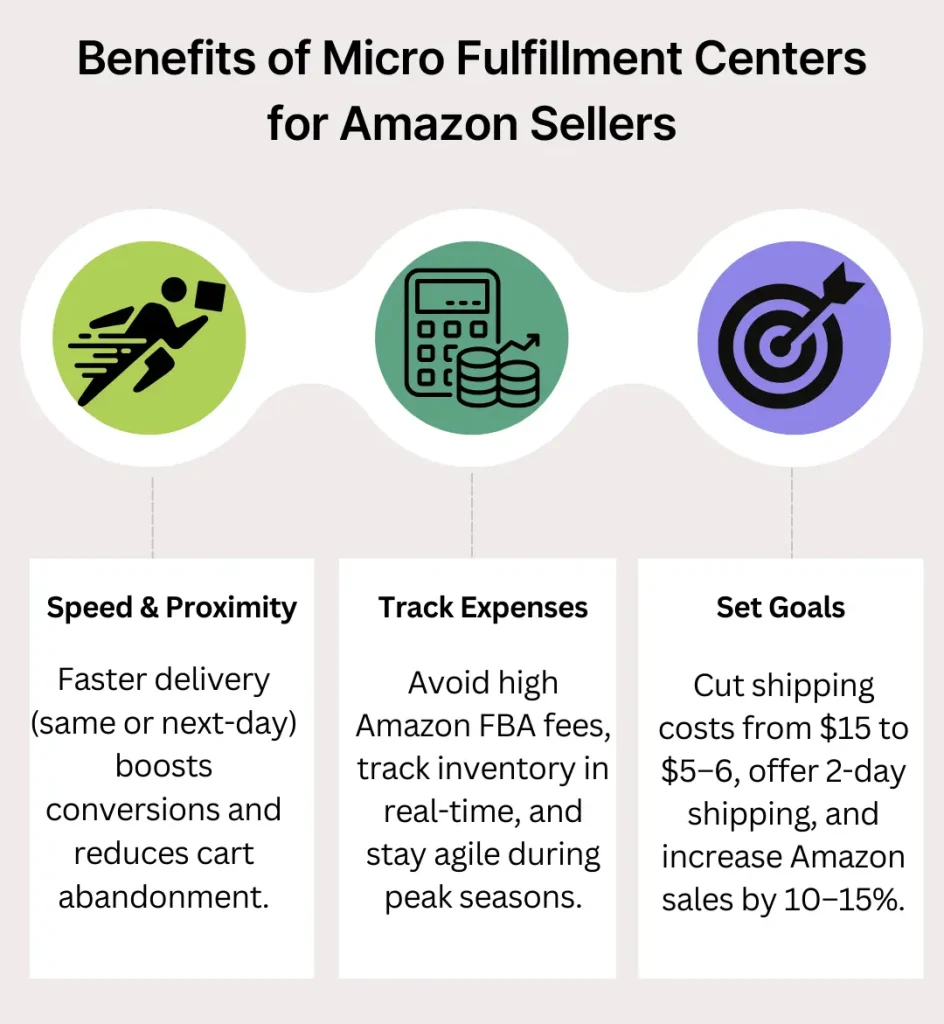
Speed and Proximity
Since the products are closer to the customer’s location, you can offer same-day or next-day delivery. This way you can increase customer expectations for the fast-delivery and reduce cart abandonment. Most of the fulfillment centers select based on geo-targeted demands.
Logistical strengths
Another important advantage of choosing a micro fulfillment center is that you don’t depend much on Amazon’s fulfillment network (who usually charge higher price for shipping). You can have an end-to-end inventory tracking over your products as the 3PL providers will keep you informed about the stock availability and all other details.
Even during peak seasons like BlackFriday or CyberMonday or any other work flow disruptions, the reliable 3PL will deliver the products over night or in a day. Most importantly, they support multi-node shipping with order routing algorithms.
Cost Savings
Instead of paying $15 per product and using passport or DHL International or delivering the product in 8 – 12 days and hitting customers with delivery fees.
You can choose micro warehousing as they offer 2-day shipping and help you generate 10-15% more sales on Amazon. Also, they help you cut costs from $15 to $5-6 per package. This helps you save a lot of money and boost your revenue 2x. This way you not only have higher conversion rates but also improve customer retention.
Read till the end to get insights on the selection criteria, technology 3PL’s use, combining Amazon FBA and micro fulfillment partner and about the delivery.
Urban Warehouse Selection Criteria for Amazon Sellers
Before you select a 3PL for your Amazon FBA business, there are some key factors to consider. Let’s look into the selection criteria that a seller must look for:
1. Location
As a seller you can use heatmaps to get an idea and identify high-volume shipping zones. With that, you must choose a 3PL who can help you with reducing shipping times and provide faster delivery options to all the locations your customers place an order.
Faster delivery will make you stand out from the competitors, thus increasing the value of your business. You can also choose 3PL’s who offer omni-channel fulfillment for scalability. Hence, they will pick up the products from your location and deliver them to the customers whenever and wherever an order is placed.
2. Services 3PL Provide
Before you choose a 3PL, ensure you ask some questions like;
- Do they offer value-added services (VAS) like gift wrapping, labeling, returns?
- What level of automation is used for picking, packing, and order batching?
- Is there support for temperature-controlled, fragile, or oversized SKUs?
Once you get an answer for the above mentioned questions, you will get a fair idea on how these 3PL fulfillment centers work.
Technology Requirements for Effective micro fulfillment
As an Amazon seller evaluating 3PL partners for micro fulfillment, these are the essential technology capabilities that will directly impact your seller performance, profitability, and customer satisfaction:
1. Order Processing
The 3PL must allow real-time sync with your Amazon seller central so they get orders instantly the moment a customer places an order. Once the order is placed, the 3PL must use smart order splitting based on warehouse proximity. Also, you must get a tracking link from the 3PL providers to keep track of it.
Get to know about their stock allocation during the seasonal spikes. So, you never run out of stock and send the product to the micro warehousing in advance.
2. Quality Control
The micro fulfillment center you choose must have a barcode and RFID verification system to make sure of accurate picking and packing of the products. Also, the analysis tool to identify and address the issues related with product and packaging issues.
3. Performance Analytics
An effective micro fulfillment operation should consistently track and optimize key performance indicators (KPIs) to ensure service excellence and operational efficiency. You must analyse the order accuracy rate to measure the percentage of orders fulfilled without any errors.
Next thing is to analyze the fulfillment cycle time. This indicates the total time taken from order receipt to delivery. You should also know about ‘On-Time In-Full (OTIF),’ which tracks whether orders are delivered by the promised date and contain the correct quantity of items.
Return Rate, used to monitor how often products are returned due to fulfillment errors, damage, or customer dissatisfaction.
Combining Amazon FBA and Micro fulfillment networks
As an Amazon seller, you must understand the importance of combining your FBA with micro fulfillment through a third-party logistics (3PL) network. Though you use Fulfillment by Amazon for many other purposes, a 3PL provider can give you the flexibility, cost-effectiveness, and control over your products. You can use a 3PL provider for various purposes;
- Send bulk or heavy products whereas FBA cost you more
- Products that require special handling like Fast-moving or regionally popular products
- Advanced inventory management to know when you run low of stocks
- Fast-delivery strategies to improve customer satisfaction
- Multi-channel orders (eBay, Shopify, Walmart, DTC) beyond the Amazon marketplace
Implementation
For sellers currently all-in on FBA, a strategic approach to hybrid fulfillment works best. All you have to do is identify high-impact SKUs with long FBA lead times or high costs. Create a pilot micro fulfillment location in a key metro area before expanding. Then gradually expand product selection based on OCT improvements and customer feedback.
Partner Selection
When selecting a 3PL partner for the micro fulfillment portion of your hybrid strategy, prioritize:
- Experience with Amazon’s specific requirements and processes (e.g., SFP or FBM models).
- Technology infrastructure compatible with your existing systems.
- Scalable capacity aligned with your growth projections (WMS, OMS, integrations).
- Geographic locations that complement your FBA distribution
- Transparent pricing that facilitates accurate cost comparisons
The Micro Fulfillment Delivery Process
Micro fulfillment delivery is the process of how fast your products get delivered to your customers. If you are business who is using 3PL providers for product delivery, then it is crucial to understand how their delivery process works:
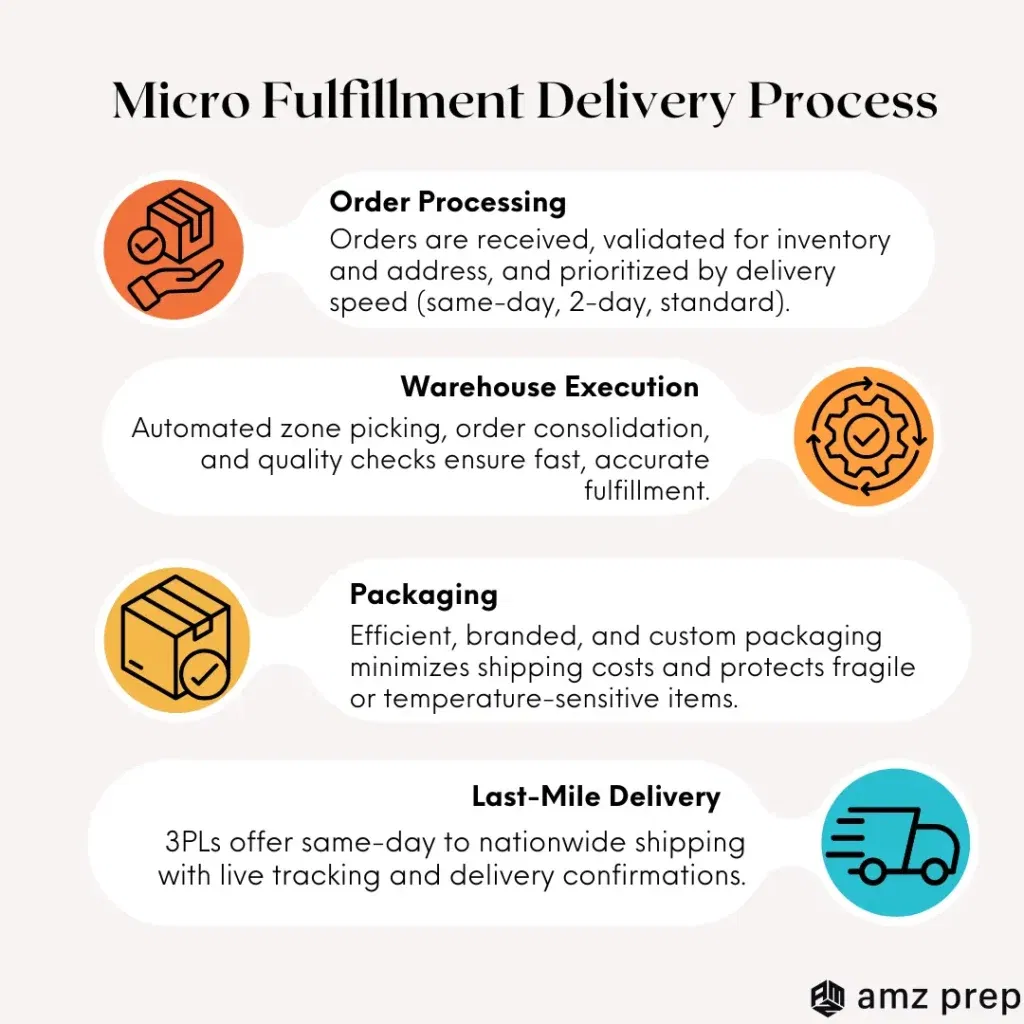
1. Order Reception and Processing
The delivery process begins the moment a customer places an order. Most of the time the 3PL will take care of the products’ transportation from Amazon’s marketplace to the micro fulfillment system.
They validate the orders across distributed warehouse nodes to confirm the inventory availability and the delivery address information. They prioritize the orders according to promised delivery windows and service levels. The micro fulfillment centers usually process the orders within minutes a customer places an order (same-day, 2-day, standard).
2. Warehouse Execution
Once received, orders move through the micro fulfillment center with a lot of care:
- They automate the picking using optimized routes and zone-based logic within the facility.
- Zone picking where multiple orders are fulfilled simultaneously across different areas
- Consolidation of multi-item orders at packing stations
- Quality control checkpoints for SKU and packaging accuracy.
3. Packaging and Preparation
The 3PL provider ensures the product is packed with efficiency to minimize dimensional weight. They use branded packaging options for enhanced customer experience. The 3PL’s also use specialized packaging for products that are fragile and temperature sensitive products.
Package consolidation for multi-item orders to reduce shipping costs. Many micro warehousing use automated packaging systems that create custom-sized packages for each order, reducing material waste and shipping costs.
4. Last-Mile Delivery
Delivering last-min orders or delivering crucial products like medicine require a lot of criteria. The 3PL selection should be based on the delivery timeline, cost and service area. Delivery preference based on customer options.
Some micro fulfillment centers offer expedited shipping services like last-mile delivery options, from same-day courier services to next-day regional carriers to traditional national carriers for broader coverage. They share the delivery confirmation process and live tracking links to keep an eye on the process.
Conclusion
Micro fulfillment centers are becoming an important part of many businesses. Considering how easily 3PL can lower the cost of shipping and shorten the time it takes products to reach customers, it’s important you choose the right 3PL partners.
You can choose micro warehousing like AMZ Prep to take complete control of your inventory. They provide full prime badge benefits and deliver products in 2-day nationwide. Most importantly, there are no FBA fees.
Frequently Asked Questions
What are micro fulfillment centers?
A micro fulfillment center is a small-scale storage facility used by ecommerce businesses for rapid last-mile delivery. These fulfillment centers are usually highly automated, which helps to increase operational efficiency. These micro warehouses are usually located in urban areas and integrated with automation and inventory systems.
What is an example of a fulfillment center?
AMZ Prep is one example of the fulfillment center. They handle warehousing and shipping of many other eCommerce businesses. They not only deliver the products to customers but also pick up your products and store them in their warehouse.
Is Amazon a fulfillment center?
Yes, Amazon is a fulfillment center. They let you send your products to their warehouses where they will store, pack and ship them to your customers. Since Amazon charges more fees to process the shipping, you can use a 3PL provider. These 3PL’s will help you save a lot of money while delivering the products to the customers in 2-days.
How do fulfillment centers work?
Fulfillment centers start their process by picking up your products and store them in their inventory. Once a customer places their order, they pack, label and ship it with care to your customers. These fulfillment centers provide 2-day delivery, same day delivery or next-day delivery based on the requirements of the customers.

Rich Pearl is a Head of U.S Enterprise at AMZ Prep, drawing from his proven experience in the fulfillment industry gained at ShipBob. Rich helps provide strategic guidance and consultation to growing e-commerce businesses looking to master their logistics and achieve operational success.
















Comments