B2C (business-to-consumer) order fulfillment is the process of storing inventory, processing individual consumer orders, and delivering those orders directly to the customer’s door. It covers everything from the moment a purchase is made to the last-mile drop and any returns that follow.
For most ecommerce brands, fulfillment is the operational piece that either holds growth back or supports it. The difference comes down to three things: how well inventory is positioned, how reliably orders are picked and packed, and how much the brand pays to move product across the final mile.
We run omnichannel fulfillment for 5,000+ brands out of 50+ fulfillment centers across 6 countries. What we see consistently is that brands running fulfillment in-house or through a single-warehouse 3PL hit a ceiling earlier than they need to. This guide covers how B2C fulfillment works, what drives cost and speed, and what to look for when choosing a 3PL partner.
What Is B2C Order Fulfillment?
B2C order fulfillment is the end-to-end logistics process of getting products from stored inventory to individual consumers. It differs from B2B fulfillment, which moves large volumes in bulk to a single business destination.
In B2C, every order is unique. Different SKUs, different shipping zones, different delivery expectations. A brand shipping 1,000 consumer orders per day is managing 1,000 separate pick-pack-ship operations simultaneously.
The core components of B2C fulfillment are:
- Receiving and storing inventory
- Managing stock levels across one or more locations
- Processing orders from multiple sales channels
- Picking, packing, and preparing individual orders for shipment
- Carrier selection and last-mile delivery
- Returns processing and inventory restocking
Each step affects the next. Poor inventory positioning creates slow delivery times. Inaccurate picking creates returns. Relying on one carrier creates cost exposure and risk at peak periods.
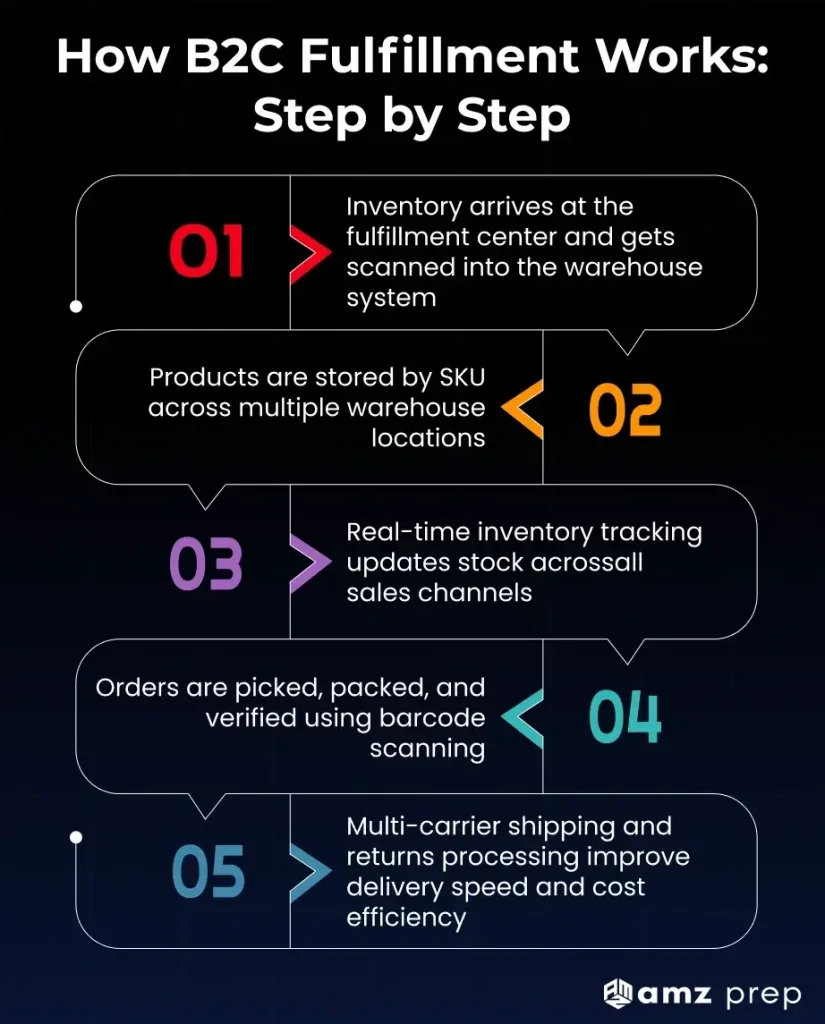
How B2C Fulfillment Works: Step by Step
Inventory Receiving and Storage
Fulfillment starts before an order is placed. Inventory arrives at the fulfillment center in cases or pallets, gets counted and inspected, and is stored by SKU in a location tied to the warehouse management system.
The position of that inventory matters. A brand storing all stock in one location in the Midwest will pay zone 6-8 shipping rates to reach customers on the East and West Coasts. Splitting inventory across regional locations brings those zones down to 2-3 for most of the US population.
AMZ Prep’s ecommerce order fulfillment network includes locations in Kentucky, Nevada, Texas, Pennsylvania, South Carolina, Alberta, and British Columbia. Brands using multiple locations get coast-to-coast coverage without paying for it through inflated carrier rates.
Inventory Management
Real-time inventory visibility is the foundation of accurate B2C fulfillment. Without it, brands oversell, stock out, or hold too much capital in slow-moving product.
AMZ Prep’s Navigate platform gives brands a live view of stock levels, inbound shipments, and order flow across every location. Replenishment triggers are set by SKU, so the system flags when stock at a regional node needs topping up before a stockout occurs. There are no manual status checks. Brands see what they need directly in the dashboard.
Advanced inventory management tools handle SKU tracking across sales channels. When a unit sells on Shopify, that count updates in real time across Amazon and every other connected platform. Phantom stock, where a unit shows available in one channel but is already committed in another, is the most common reason multi-channel brands fire their first 3PL. It is preventable with proper WMS integration.
Order Processing
Order processing starts the moment a consumer completes a purchase. The order routes from the sales channel directly to the warehouse management system, which generates a pick list tied to the specific bin location of each item in the order.
At a well-run 3PL, pickers work from those bin assignments rather than from memory or paper lists. Scanning confirms each pick against the order before it moves to packing. This is how 3PLs maintain accuracy rates above 99% across high daily volumes.
Brand compliance matters at this stage. AMZ Prep follows channel-specific packing guidelines for every platform in the order mix, whether that is Amazon’s inbound requirements, Shopify’s branded packaging specs, or EDI compliance standards for retail accounts.
For more on reducing errors across this step, see our guide on best practices to reduce order fulfillment errors.
Shipping and Carrier Selection
Carrier selection is where fulfillment cost is either controlled or inflated.
Brands managing carrier relationships independently rarely access the volume-tiered rates a large 3PL has already negotiated. A 3PL shipping millions of packages monthly has leverage with UPS, FedEx, USPS, and regional carriers that a brand shipping 500 orders per day does not.
AMZ Prep operates a 20+ carrier network with live rate shopping at the order level. The system selects the lowest-cost carrier that meets the required delivery window for each shipment. Regional carriers reduce zone costs in high-density markets where national carrier pricing is less competitive.
For brands shipping cross-border, the carrier network extends to Canada-to-US and US-to-Canada lanes. See our ecommerce shipping solutions for Canada for specifics on cross-border rate structure.
For time-sensitive orders, expedited shipping options are available without requiring separate carrier account setup.
Returns Processing
Returns are part of B2C fulfillment. The brands that manage them well keep return costs from compounding. The ones that manage them poorly spend more per return than the original order cost.
A strong returns process covers: receiving the returned unit, inspecting its condition, grading it as sellable or damaged, restocking sellable inventory to the right location, and routing damaged units to a disposition decision.
AMZ Prep’s Amazon FBA returns service handles full reverse logistics within the same network. Returns do not sit at a separate facility waiting for processing. They come back into the fulfillment center, get inspected and restocked, and are available to ship again. That speed reduces the time inventory is tied up outside the sellable pool.
B2C Fulfillment vs Shopify Fulfillment
These are not the same thing. The distinction matters for brands evaluating their fulfillment setup.
Shopify fulfillment refers to the logistics infrastructure connected specifically to a Shopify storefront. It covers orders placed through Shopify’s checkout, and the carrier and fulfillment setup is configured at the Shopify platform level. Connecting the right Shopify shipping carriers ensures real-time rates show correctly at checkout and orders route correctly to the fulfillment partner.
B2C fulfillment is broader. It covers orders from every consumer channel a brand operates: Shopify, Amazon, TikTok Shop, WooCommerce, eBay, and any direct website. A B2C fulfillment partner manages all of those channels from a shared inventory pool, with the same pick-pack-ship operation regardless of where the order originated.
Brands selling through a single Shopify store may only need Shopify-level fulfillment. Brands selling across three or more channels need a 3PL that manages the full B2C operation. For a direct comparison on 3PL options for Shopify specifically, see our breakdown of best Shopify 3PL fulfillment companies.
Why Brands Move B2C Fulfillment Outside Platform Ecosystems
Amazon, Walmart, and other marketplace platforms offer fulfillment services within their own ecosystems. For some brands, those services work. For many, they create constraints that get more expensive as the brand grows.
Branded Packaging Control
Amazon MCF and Walmart fulfillment services control the packaging. Brands cannot ship in custom boxes, add inserts, or create an unboxing experience that reflects the brand identity. For products where the customer experience extends to how the package arrives, that restriction has direct impact on repeat purchase rates and social sharing.
AMZ Prep supports full branded packaging and customer experience across all fulfillment channels. Custom boxes, inserts, and branded tape ship alongside standard orders at no additional complexity cost.
Sales Channel Diversification
Relying exclusively on one marketplace creates policy and algorithm exposure. Marketplace fee structures, ranking changes, and policy updates all affect revenue without warning. Brands that fulfill independently of any single platform can sell on Amazon, Shopify, TikTok Shop, and retail simultaneously without the fulfillment infrastructure tied to any one of them.
AMZ Prep integrates with all major ecommerce platforms and connects directly to retail EDI systems for wholesale accounts. Orders from every channel route through the same inventory pool.
Cost Efficiency at Scale
Platform fulfillment services charge per-unit at rates that are straightforward at low volume but become expensive as SKU count and order complexity grow. Multi-pick orders, bundled products, and subscription kits all carry cost penalties under per-unit pricing structures.
Outsourcing to a 3PL with a first-pick-plus-additional-pick model reduces per-order cost significantly for any order with more than one item. For brands shipping 300 or more orders monthly, the 3PL model typically reduces total fulfillment cost compared to marketplace fulfillment or in-house operations. That threshold is where the volume-tiered carrier rates and shared warehouse costs start to outweigh the 3PL fees.
Multi-Channel Inventory in One Place
Running separate inventory pools for each sales channel is operationally inefficient and creates stock accuracy problems. A brand holding 500 units split between an Amazon FBA reserve, a Shopify warehouse, and a wholesale allocation has visibility problems across all three.
A B2C 3PL manages the full inventory pool as a single shared count. Every channel draws from the same stock. When a unit sells on any platform, all other channels update in real time.
Product Categories That Run Well Through B2C Fulfillment
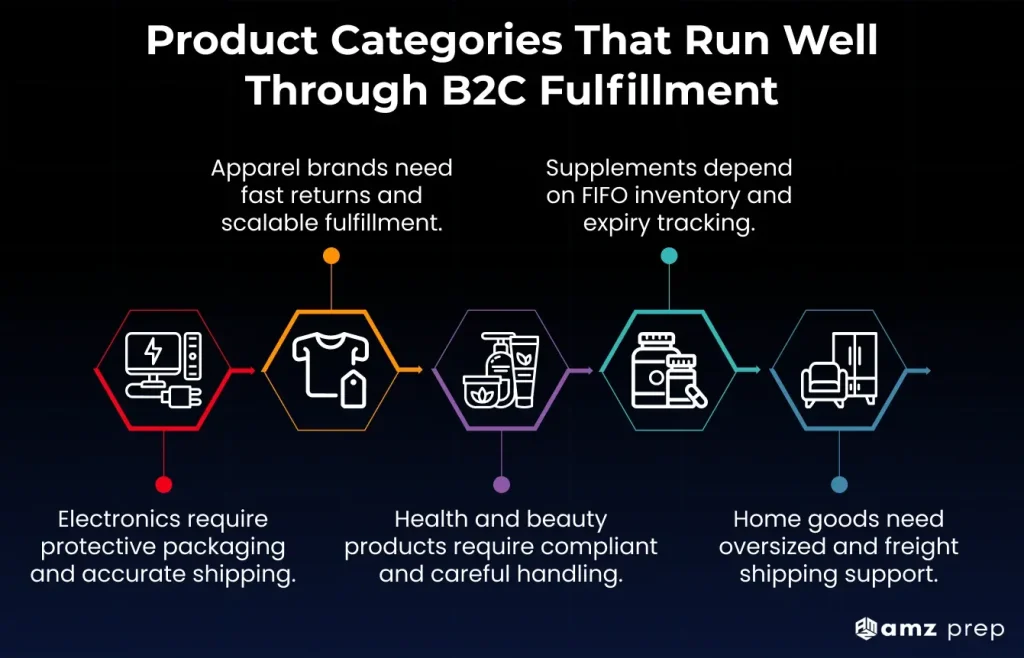
B2C fulfillment handles the full spectrum of consumer categories. The specifics of how well a category performs in fulfillment come down to the handling requirements and shipping profile of the product.
Consumer Electronics
Electronics require careful handling at pick-and-pack, shock-resistant or foam-inlay packaging, and accurate carrier selection to keep the product protected in transit. High per-unit value makes accurate order processing especially important. Error rates that are acceptable on low-value products translate into larger loss exposure on electronics.
AMZ Prep serves brands including Duracell and JBL. Electronics are shipped with category-appropriate packaging from regional fulfillment nodes to minimize transit time and handling touchpoints.
Apparel and Fashion
Apparel has a high return rate by category. Efficient B2C fulfillment for apparel requires fast returns processing and clean restocking of exchanged items. Seasonal collections and limited-edition drops also create volume spikes that require a 3PL with flexible labor capacity.
AMZ Prep’s apparel fulfillment handles both standard and high-volume launch periods. For an in-depth look at what apparel-specific fulfillment covers, see our apparel fulfillment services page.
437, an apparel brand, reduced shipping costs by 30% after moving their DTC fulfillment to AMZ Prep. The reduction came from regional carrier access and multi-location inventory positioning. Read the full 437 case study.
Apparel brands can face common 3PL challenges that impact shipping costs, inventory accuracy, returns, and customer satisfaction. Watch the video below to learn about five common apparel fulfillment mistakes and how to fix them.
Health and Beauty Products
Health and beauty requires compliant packaging, careful handling for fragile formats (glass, liquids, serums), and chain-of-custody accuracy. Brands operating in regulated categories also need a 3PL that understands documentation and labeling requirements by market.
AMZ Prep serves brands including Unilever (Dove), Salt and Stone, and Salty Face in this category. Products ship with appropriate protective packaging and meet carrier compliance standards for their product type.
For category-specific detail on what this looks like in practice, see our health and beauty fulfillment page.
Nutrition and Supplements
Supplements have specific labeling requirements, lot tracking needs, and expiry date management that general fulfillment operations often handle poorly. First-in-first-out (FIFO) inventory rotation is required to prevent expired product from reaching consumers.
AMZ Prep serves brands including Huel, First Day, and ANS Performance in this category. FIFO rotation is standard practice across supplement SKUs in the network.
See our nutrition and supplements fulfillment page for specifics on compliance and cold chain handling.
Home Goods and Furniture
Large, heavy, or fragile home goods require a 3PL with big and bulky handling capability. Standard parcel carriers have weight and dimension limits that many home goods exceed. Brands in this category need a 3PL that accesses freight carriers for oversized items while maintaining consumer-grade delivery standards.
AMZ Prep handles big and bulky SKUs through its Seller Fulfilled Prime program, which maintains the Amazon Prime badge for large items that FBA will not accept. This applies to mattress brands including Emma Sleep, Eight Sleep, and Zinus.
For full home goods and appliance coverage, see our kitchen and home appliance fulfillment page.
Food and Beverage
Food and beverage fulfillment requires temperature awareness, short shelf-life management, and in some cases cold chain infrastructure. AMZ Prep’s cold storage 3PL handles temperature-controlled fulfillment for brands including Mid-Day Squares, Magic Spoon, and New Primal.
For more on food-specific fulfillment requirements, see our food and beverage fulfillment page.
Pet Care Products
Pet care has strong subscription and repeat purchase rates, which makes fulfillment consistency especially important. Stockouts and missed deliveries in a subscription context create churn that is expensive to recover.
WOOF, a pet brand in the AMZ Prep network, ships from China directly to AMZ Prep fulfillment centers to Amazon FBA in 3-5 days with zero placement fees. For DTC orders, the same inventory pool supports same-day shipping into the consumer delivery network.
See our pet care products fulfillment page for details on how subscription and one-time purchase fulfillment runs in practice.
How a 3PL Supports B2C Order Fulfillment
A 3PL operates the physical infrastructure of fulfillment: the warehouse, the labor, the systems, the carrier relationships, and the returns process. What separates a strong 3PL from an average one is how well those components are integrated and how directly the 3PL’s operation connects to the brand’s channels.
Real-Time Inventory Visibility
Strong 3PLs provide inventory data at the unit level, updated in real time as orders process and inbounds are received. Brands should not need to call or email their 3PL to find out what stock is available. That data should be visible in a dashboard at any point.
AMZ Prep’s Navigate platform provides this visibility across all SKUs and all locations in one view.
High Order Accuracy
Order accuracy is the metric that most directly determines the customer experience. A missed item, a wrong SKU, or an incorrect quantity creates a return, a replacement shipment, and customer service contact. At scale, 1% error rate on 10,000 daily orders is 100 problems per day.
Look for a 3PL that can document its order accuracy rate and explain the system controls that produce it. AMZ Prep uses barcode scanning at pick and pack for every order, which is the standard that produces accuracy rates above 99%.
Multi-Carrier Shipping
A 3PL with one or two carrier contracts cannot optimize for both cost and delivery speed across a diverse geographic order mix. Carrier diversification reduces rate exposure at peak periods and covers gaps in regional carrier service.
AMZ Prep’s 20+ carrier network includes national and regional carriers. The system selects the best-cost carrier that meets the delivery window for each order, automatically, without manual rate shopping on each shipment.
Platform Integration
The 3PL’s WMS must connect directly to every platform the brand sells on. Orders should flow from the storefront to the fulfillment center without manual entry. Inventory counts should update in real time after every pick.
AMZ Prep integrates with Shopify, Amazon Seller Central, TikTok Shop, WooCommerce, Walmart Marketplace, and major ERP systems. The integration is direct, not through a third-party middleware that adds latency or creates sync errors.
For a broader comparison of 3PL providers, see our breakdown of the best 3PL companies for ecommerce.
Returns Management
Returns are not a margin event that can be minimized by ignoring them. They need a defined process, fast inspection, and clear restocking logic. A 3PL that handles returns slowly leaves inventory outside the sellable pool for weeks, which ties up working capital.
AMZ Prep processes returns within the same network and restocks sellable units on the same timeline as inbound inventory. Brands using the full returns services do not need a separate reverse logistics provider.
Dedicated Communication
Communication quality is one of the most consistent failure points with 3PL providers. Ticket queues with 48-hour response times are not compatible with the pace of ecommerce operations. Stock alerts, carrier exceptions, and processing delays require fast responses.
AMZ Prep operates a dedicated Slack channel for every enterprise brand with a 2-hour SLA response during business hours. Weekly execution calls, monthly business reviews, and quarterly strategy sessions are standard for brands in the network.
B2C Fulfillment vs B2B Fulfillment
These two fulfillment models have different operational requirements. Brands that manage both need a 3PL that handles each correctly without applying one standard to both.
| B2C Fulfillment | B2B Fulfillment | |
|---|---|---|
| Order size | Individual consumer orders | Bulk orders to retailers or businesses |
| Shipment type | Parcel | LTL / FTL freight |
| Packaging | Consumer-facing, branded | Pallet-level, retailer-compliant |
| EDI requirements | Not required | Required for most retail accounts |
| Delivery expectation | 1-2 business days | Routing guide compliance |
| Returns | High volume, fast cycle | Lower volume, longer cycle |
Brands scaling into wholesale or retail distribution need a 3PL that handles both streams without separating inventory pools. AMZ Prep’s B2B retail fulfillment covers EDI compliance, routing guide requirements, and pallet-level builds for Walmart, Costco, and major retail accounts, alongside the same-day parcel fulfillment used for DTC orders.
How to Select the Right 3PL for B2C Order Fulfillment
These are the practical criteria that separate a 3PL partnership that scales from one that fails at the next growth stage.
Warehouse Network Coverage
A 3PL with a single warehouse location cannot position inventory close to your customer concentration. The more warehouse nodes in the network, the shorter the average distance between inventory and the consumer, which directly reduces shipping time and carrier cost.
Ask any 3PL candidate: how many locations do you operate, in which states or regions, and how does inventory get distributed across them?
AMZ Prep operates 50+ locations across 6 countries. Regional distribution centers in the US and Canada allow brands to run nationwide 1-day and 2-day delivery without paying premium carrier rates across all zones.
Scalability Without Renegotiation
The right 3PL grows with the brand. Volume milestones should not trigger renegotiation of every rate and service term. Look for a 3PL that has documented experience scaling brands from early growth through enterprise volume.
AMZ Prep serves brands from 300 orders per month through to global aggregators managing 20+ brand portfolios simultaneously, including Heroes, which runs weekly replenishments across US, Canada, and Europe from a single AMZ Prep relationship.
Technology Stack
The 3PL’s WMS should be purpose-built for ecommerce, not adapted from a warehouse system designed for freight or manufacturing, with SOC 2 compliant infrastructure that ensures secure handling of inventory and order data. Key capabilities: real-time inventory sync across all channels, order routing logic, carrier rate shopping, and a brand-facing dashboard that shows all relevant data without requiring a support ticket.
AMZ Prep’s Navigate platform handles automated shipping plan creation, real-time inventory tracking, and order routing directly from within the platform.
Transparent Pricing
3PL pricing has enough line items that it is possible to understate the real cost of a relationship during the sales process. A clear pricing structure covers: per-pick fees, additional-pick fees, storage by cubic foot by month, inbound receiving fees, and any per-order carrier account fees.
AMZ Prep’s DTC fulfillment pricing is published and documented. For brands that want a direct analysis, the contact form routes to a commercial team that provides a cost model based on actual order and SKU data.
Category and Channel Fit
Not every 3PL handles every category or channel equally well. A 3PL that is strong at standard parcel DTC may not have the compliance infrastructure for cold chain, big and bulky, or EDI retail accounts.
Define every category and channel in scope before selecting a 3PL partner. Ask explicitly whether the 3PL has active volume in each of those categories, not just the capability on paper.
AMZ Prep handles standard parcel, cold chain, big and bulky, subscription fulfillment, Amazon FBA replenishment, SFP, and retail B2B from the same network. Brands that operate across multiple of those requirements do not need separate 3PL relationships.
What AMZ Prep Delivers for B2C Brands
AMZ Prep was founded in 2016 by Blair Forrest without outside capital. Today it operates 50+ fulfillment centers across 6 countries with 280+ logistics specialists, processing 10M+ units per month and supporting $3B+ in annual GMV for 5,000+ brands.
What that means operationally for B2C brands:
Nationwide 1-day and 2-day delivery coverage across the US and Canada through a 20+ carrier network with live rate shopping. Regional inventory distribution reduces zone costs without requiring brands to manage multi-location inventory themselves.
Real-time inventory management through the Navigate platform across all fulfillment locations and all connected sales channels. Replenishment triggers, inbound tracking, and order flow are visible in one place.
Full omnichannel support from one partner. Shopify, Amazon, TikTok Shop, Walmart, B2B retail, and subscription models all run from the same inventory pool. Brands do not manage separate fulfillment relationships per channel.
Branded packaging across all channels. Custom boxes, inserts, and branded materials ship across DTC orders. AMZ Prep does not enforce platform-level packaging restrictions on brand-controlled fulfillment.
Dedicated communication. Every enterprise brand gets a dedicated Slack channel, 2-hour response SLA during business hours, weekly execution calls, and monthly and quarterly business reviews.
437 reduced shipping costs by 30% after moving DTC fulfillment to AMZ Prep. Read the 437 case study for specifics on how regional carrier access drove the cost reduction.
Huel, a nutrition brand, moved Amazon replenishment from a large DTC 3PL to AMZ Prep ARP. Check-in times dropped from 20+ days to 3-5 days. Placement fees dropped to zero.
WOOF moved from a slower inbound flow to AMZ Prep’s network. Stock now reaches Amazon FBA in 3-5 days from China without disrupting DTC operations.
For enterprise brands or those managing global distribution, see our enterprise fulfillment solutions page.
For mid-sized brands scaling their DTC operation, see the mid-sized brand fulfillment overview.
B2C Order Fulfillment FAQ
What is B2C order fulfillment?
B2C order fulfillment is the process of picking, packing, and shipping individual consumer orders from stored inventory. It covers everything from inventory receiving to last-mile delivery and returns processing. Most brands above 300 orders per month use a 3PL to manage this.
What is the difference between B2C and B2B fulfillment?
B2C fulfillment handles individual consumer orders shipped via parcel carriers. B2B fulfillment moves bulk inventory to businesses or retailers, typically via freight, with EDI compliance and routing guide requirements. Both can run from the same 3PL if the provider handles both models.
How much does B2C fulfillment cost?
3PL fulfillment costs vary by order volume, SKU count, and product weight and dimensions. Most brands see per-order all-in costs between $4 and $12, including pick-and-pack, storage, and carrier fees. The cost advantage of a 3PL comes from volume-tiered carrier rates and shared warehouse infrastructure.
When should a brand move from in-house to a 3PL?
The inflection point for most brands is around 300 consistent monthly orders. Below that, in-house fulfillment is manageable. Above it, the labor, space, and carrier rate advantages of a 3PL typically outweigh the fees. Brands experiencing stockouts, shipping delays, or high error rates are already past the point where a 3PL would reduce cost.
Does AMZ Prep support omnichannel B2C fulfillment?
Yes. AMZ Prep fulfills orders from Shopify, Amazon, TikTok Shop, Walmart, WooCommerce, and B2B retail accounts from a single shared inventory pool. Inventory counts update in real time across all connected channels.
What categories does AMZ Prep handle for B2C fulfillment?
AMZ Prep handles standard parcel, cold chain, big and bulky, subscription, apparel, health and beauty, nutrition and supplements, electronics, food and beverage, pet care, and home goods. All categories run through the same 50+ location network.
Blair Forrest is the Founder of AMZ Prep, one of North America’s fastest-growing third-party logistics and fulfillment networks, built entirely without outside capital since 2016. Under his leadership, AMZ Prep has scaled to 50+ fulfillment centers across 6 countries, processing over 8 million units monthly and powering $2 billion+ in annual GMV for more than 5,000 brands worldwide including 437, Silverts, Saltyface, Unilever, Duracell, and JBL. A recognized authority in eCommerce logistics, Amazon FBA strategy, and supply chain optimization, Blair has helped thousands of sellers and brands master their fulfillment operations from first shipment to enterprise scale. He regularly consults on FBA prep, multi-channel fulfillment, last mile delivery, international expansion, and cost reduction strategies that save brands 20–40% compared to traditional 3PL providers. Blair’s insights on Amazon logistics, 3PL operations, and eCommerce growth are widely cited across the industry. Through AMZ Prep’s content, guides, and resources, he continues to share battle-tested strategies drawn from managing one of the largest independently owned fulfillment networks in North America.
















I never realized how much goes into managing inventory and returns!
The section on 3PLs was super helpful. I’m considering using one now for my business!
I hadn’t thought about using B2C fulfillment outside of Amazon and Shopify. It’s definitely something to consider.
I love that you highlighted packaging and branding control with B2C fulfillment..
I work in fashion, and fast fulfillment is critical for us. Thanks for the insights
Good to know that health and beauty products need special packaging—makes sense how durable their packaging is especially premium ones.
It’s nice to see that B2C fulfillment isn’t just for big companies. Even small businesses are investing in fulfillment now
I didn’t know 3PLs could integrate with so many platforms. That would save a ton of time and headaches!
Returns handling really stood out to me. The simpler it is, the happier customers will be.
Wow, This guide helped me understand what I need to focus on for my B2C order strategy.