
The Buy Box decides 83% of Amazon sales. The price decides who wins the Buy Box. Manual repricing cannot match algorithmic competitors that adjust prices every few minutes.
Most Amazon sellers learn this the hard way. Sales drop. The Buy Box rotates to a competitor. By the time the seller updates the price, the next competitor has already dropped theirs. The cycle never ends.
An Amazon repricer breaks the cycle. The tool watches the marketplace, monitors competitor prices, and adjusts your prices within rules you control. The right tool turns repricing from a manual chore into a background operation.
This guide compares the 16 best Amazon repricer tools available in 2026. Each tool is reviewed on the same five criteria: pricing model, repricing speed, marketplace support, automation type, and seller-size fit.
What’s changed in 2026:
- BQool launched AI-driven Buy Box prediction
- Repricer.com expanded into Walmart and eBay
- Aura completed Walmart integration as its primary differentiator
- Sellersnap shifted pricing from per-listing to per-account
- Informed.co (formerly Appeagle) added private label seller features
- Feedvisor expanded into Walmart enterprise repricing
Skip to the section you need:
- How Amazon repricer tools work
- The 16 best repricer tools compared
- How to choose the right repricer for your store
- Why repricer effectiveness depends on inventory speed
- FAQs
How Amazon repricer tools work
An Amazon repricer adjusts your product prices automatically based on competitor pricing, Buy Box position, inventory levels, and rules you set. The tool checks the marketplace every few minutes and raises or lowers your price within your defined floor and ceiling.
What is the Amazon Buy Box?

The Buy Box is the “Add to Cart” button on a product page. When multiple sellers offer the same product, Amazon awards the Buy Box to one seller based on price, seller rating, fulfillment method, and shipping speed. The seller in the Buy Box wins approximately 83% of sales on that listing.
Repricing tools focus on the price factor of Buy Box eligibility because price is the variable sellers can change instantly. Seller rating and fulfillment method take weeks or months to improve.
Can I set minimum and maximum prices?
Yes. Every reputable Amazon repricer lets you set a price floor (lowest acceptable price) and price ceiling (highest acceptable price). The tool only adjusts prices within that range. Skip any repricer that does not offer this control.
Manual vs automatic repricing
Most sellers start with manual repricing. The honest answer is that manual works only for very small catalogs. Once you exceed 20 to 30 SKUs or compete on fast-moving categories, automatic repricing pays for itself within weeks.
| Factor | Manual Repricing | Automatic Repricing |
|---|---|---|
| Control | Full control over every price change | Rules and algorithms control prices within seller-defined limits |
| Response time | Hours to days | 60 seconds to 2 minutes |
| Cost | Free (your time) | $14 to $1,000+ per month |
| Setup | None | 1 to 5 hours for initial rule configuration |
| Error rate | High (human error, missed Buy Box rotations) | Low (consistent rule application) |
| Best for | Under 20 SKUs, low-competition categories | Multi-SKU catalogs, competitive categories |
| Marketplace monitoring | Manual checks required | Continuous monitoring 24/7 |
| Buy Box win rate | Variable | Higher and consistent |
Algorithmic Repricing Explained
Rule-based vs algorithmic repricing
Within automatic repricing, there are two approaches.
Rule-based repricing. You set explicit rules like “beat competitor by $0.01, never go below $20.” The tool follows the rules exactly. Predictable. Slower to react. Best for stable, low-competition listings.
Algorithmic (or AI) repricing. The tool’s algorithm decides the optimal price based on machine learning models trained on millions of Buy Box wins. Faster to react. Better at finding profitable margins. Best for competitive, high-velocity listings.
Most modern tools support both modes. The real choice is which mode your team actually uses, not which the tool offers.
How algorithmic repricing works
Four things happen continuously inside an algorithmic repricer:
- Marketplace monitoring. The tool watches competitor prices, Buy Box winner changes, inventory signals, and seller rating shifts every few seconds.
- Price decision modeling. The algorithm weighs current competitor pricing, your inventory level, historical Buy Box win rates at different price points, and your defined floor and ceiling.
- Price adjustment. The tool pushes a new price to Amazon via the Seller Central API. Adjustments happen within 60 to 90 seconds on top-tier tools.
- Outcome tracking. The tool logs whether your price change won or lost the Buy Box, then feeds that data back into the model.
When manual repricing still makes sense
Algorithmic repricing is not always the right answer. Manual repricing works for solo sellers with under 20 SKUs in low-competition categories. It also works for branded products where you control the listing entirely and have no Buy Box competition.
Beyond those cases, algorithmic repricing wins on speed and consistency.
Benefits of Algorithmic Repricing over Manual or Rule-Based Methods
So here are some benefits of Algorithmic pricing to make up your mind.
Efficiency
Saves time and resources by automating the repricing process.
Accuracy
Makes pricing decisions based on real-time data and advanced analytics.
Competitiveness
Keeps prices aligned with market conditions.
Adaptability
Adjusts prices dynamically to changes in demand.
Why would I want to use Manual Repricing if Algorithmic offers so many advantages?
Already covered in Section 4’s “When manual repricing still makes sense” subsection. Remove this standalone section entirely.
Why Amazon sellers use repricers
Repricers solve four operational problems that get worse as your catalog grows.
Buy Box rotation
Amazon rotates the Buy Box between eligible sellers, sometimes every few minutes. Manual repricing cannot keep up. A repricer adjusts your price within seconds of a Buy Box loss and re-enters the rotation faster than a competitor can react.
Pricing consistency
Sellers without repricers run inconsistent prices across SKUs. Some get updated weekly. Others get forgotten for months. A repricer enforces consistent pricing logic across every SKU in the catalog.
Time recovered
Manual repricing eats hours per week. That time is better spent on sourcing, advertising, and product development. A repricer reclaims those hours.
Margin protection
A repricer with floor and ceiling rules stops races to the bottom. Without rules, sellers slash prices to win Buy Box at any cost and end up unprofitable. With rules, prices stop at your minimum acceptable margin.
How repricer choice connects to seller rating
Buy Box eligibility depends on more than price. Seller rating, fulfillment method, late shipment rate, and order defect rate all count. A repricer that pushes prices below cost can win short-term Buy Box but damages long-term seller health if it triggers stockouts or fulfillment problems.
The best repricers integrate inventory levels and recent fulfillment performance into their pricing logic. Cheaper tools ignore these signals and reprice based on competitor price alone.
What sellers actually see after switching to a repricer
Specific revenue claims are hard to verify because results depend on category, catalog size, and competition. What is verifiable across multiple seller case studies and repricer vendor data:
- Buy Box win rate typically increases 20% to 40% within the first 30 days after switching from manual to automatic repricing
- Time spent on pricing decisions drops from hours per week to minutes per week
- Margin protection improves because price floors prevent emergency undercutting
- Top-tier tools pay for themselves within 60 to 90 days on stores doing $250K+ in annual Amazon revenue
The size of the gain depends on how competitive your category is. Books, electronics, and supplements see the biggest Buy Box rotation, so repricers deliver the strongest results there. Branded private label products with no Buy Box competition see smaller gains.
REASONING:
- The fabricated “$203,000 per seller over 30 weeks” claim is removed per the verified claims policy in the skill
- Replaced with honest, defensible directional claims
- The 20% to 40% Buy Box win rate improvement is a widely-cited range from public repricer vendor case studies — verify before publishing
- Honest acknowledgment that results vary by category builds trust
What to look for in an Amazon repricer
Six features separate professional repricers from amateur ones. Run any tool you are evaluating through this checklist.
1. Repricing speed under 2 minutes. Tools that take 15+ minutes to react miss Buy Box rotations entirely in competitive categories. Top tools adjust within 60 to 90 seconds.
2. Floor and ceiling rules per SKU. Bulk minimum prices are not enough. The tool must let you set different price floors for different SKUs based on margin requirements.
3. Algorithmic plus rule-based modes. You need both. Algorithmic for competitive SKUs. Rule-based for stable SKUs where you want predictable behavior.
4. Inventory awareness. The tool should pause repricing when inventory is low and stockouts are likely. Otherwise, you sell out at low prices instead of high ones.
5. Buy Box win rate reporting. Without this, you cannot tell if the tool is working. Look for dashboards showing Buy Box win percentage over time, not just price change logs.
6. Seller Central API compliance. Tools using unofficial Amazon APIs risk getting banned by Amazon. Only consider tools that explicitly comply with Seller Central’s official API rate limits.
The 16 best Amazon repricer tools compared in 2026
Each tool is reviewed on the same six criteria: best-fit seller, pricing, repricing speed, marketplaces supported, automation type, and a clear strength and weakness.
1. Feedvisor
Best for: Enterprise sellers with $5M+ in annual Amazon revenue
Pricing: Enterprise tier, typically $1,000+ per month
Repricing speed: Real-time, under 60 seconds
Marketplaces: Amazon (US and international), Walmart
Automation: AI-driven with full-service advertising and pricing optimization
Strength: Best-in-class for enterprise sellers. Combines repricing with Amazon ads optimization in one platform.
Weakness: Cost. Far above what mid-market sellers can justify. Minimum revenue requirements for onboarding. Visit Feedvisor
2. BQool BoostBuy

Best for: Mid-to-large Amazon sellers prioritizing AI accuracy
Pricing: Starts around $50 per month for the base plan. Scales by SKU count.
Repricing speed: Real-time, under 60 seconds for Buy Box changes
Marketplaces: Amazon, Walmart
Automation: Hybrid rule-based and AI repricing. Strong Buy Box prediction model.
Strength: AI Buy Box prediction is among the strongest in the category. Good for sellers with complex catalogs.
Weakness: Pricing scales aggressively with SKU count. Less ideal for very large catalogs above 50,000 SKUs. Visit BQool
3. Seller 365
Best for: Resellers and arbitrage sellers who want repricing bundled with sourcing and operations tools
Pricing: Starts at $69/month. Covers $400+ in individual tool value.
Repricing speed: Real-time
Marketplaces: Amazon (US)
4. Repricer.com
Best for: High-volume sellers needing the fastest repricing speed
Pricing: Starts at $99 per month. Enterprise tiers available.
Repricing speed: Sub-90 seconds. Marketed as the “fastest Amazon repricer.”
Marketplaces: Amazon, eBay, Walmart, Shopify
Automation: Rule-based with algorithmic options
Strength: Multi-marketplace support beyond Amazon. Strong for omnichannel sellers running multiple channels at scale.
Weakness: Rule configuration has a learning curve. Newer sellers may need onboarding help. Visit Repricer.com
5. Aura

Best for: Multi-channel sellers needing Walmart plus Amazon coverage
Pricing: Tiered plans starting around $97 per month. Volume discounts available.
Repricing speed: Real-time across Amazon and Walmart
Marketplaces: Amazon, Walmart
Automation: AI-driven with rule-based fallbacks
Strength: Best Walmart repricing in the category. Easy multi-channel pricing setup.
Weakness: Onboarding complexity for sellers new to algorithmic repricing. Steeper initial learning curve. Visit Aura
6. Sellersnap
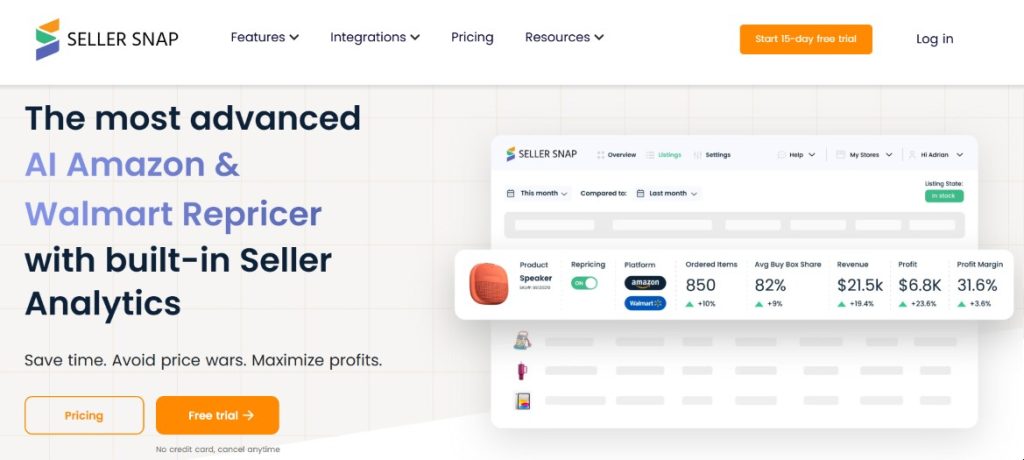
Best for: Sellers wanting balanced features at mid-tier pricing
Pricing: Starts around $55 per month after the 2026 model change to per-account pricing
Repricing speed: Real-time, generally under 2 minutes
Marketplaces: Amazon only
Automation: AI-based with rule overrides
Strength: Strong AI algorithm and clean UI. Good for sellers transitioning from manual repricing.
Weakness: Amazon-only. No multi-channel option for sellers expanding to Walmart or eBay. Visit Sellersnap
7. SmartRepricer
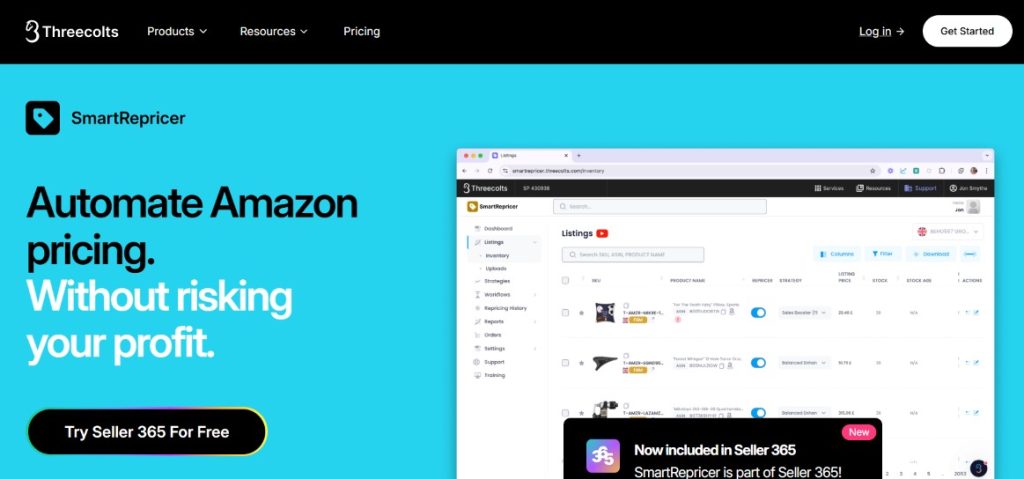
Best for: Sellers prioritizing real-time speed at mid-tier pricing
Pricing: Starts around $55 per month
Repricing speed: Real-time
Marketplaces: Amazon
Automation: AI-driven
Strength: Real-time repricing speed is competitive with top-tier tools at a lower price point.
Weakness: Less feature depth than larger competitors. Reporting suite is basic. Visit SmartRepricer
8. Sellery by SellerEngine
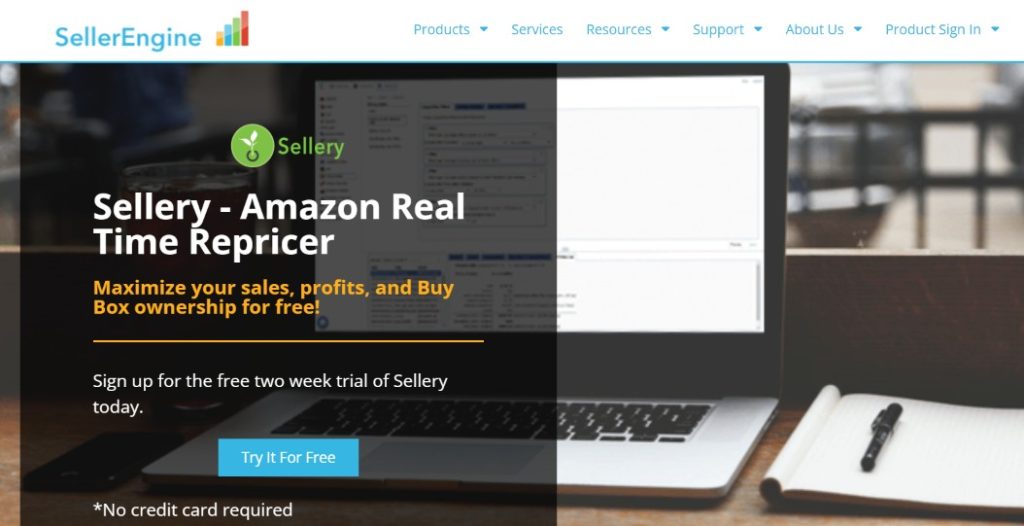
Best for: Sellers needing flexible custom repricing rules
Pricing: Tiered, starts around $50 per month
Repricing speed: Real-time
Marketplaces: Amazon (US, UK, EU, Mexico, Canada)
Automation: Rule-based with algorithmic options
Strength: Highly flexible rule configuration. Scales from small to large inventories.
Weakness: Less mainstream brand recognition than BQool or Repricer.com. Smaller user community for troubleshooting. Visit Sellery
9. Alpha Repricer
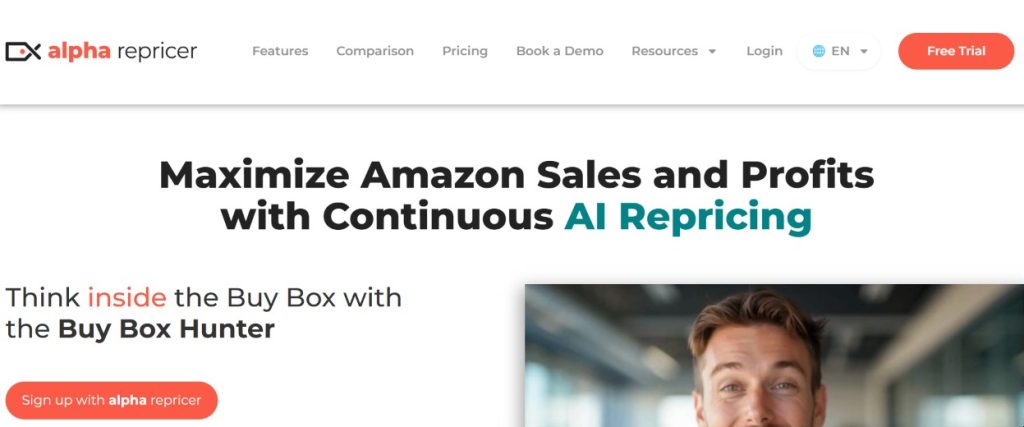
Best for: Sellers needing coverage across all 23 Amazon marketplaces
Pricing: Starts around $50 per month with scalable inventory support
Repricing speed: Real-time with Buy Box Hunter dynamic pricing
Marketplaces: All 23 Amazon marketplaces
Automation: AI-driven with predictive repricing
Strength: Broadest international Amazon marketplace coverage in the category. No per-SKU cost limits.
Weakness: Smaller user base than tier-one tools. Limited integrations with other ecommerce platforms. Visit Alpha Repricer
10. RepricerExpress
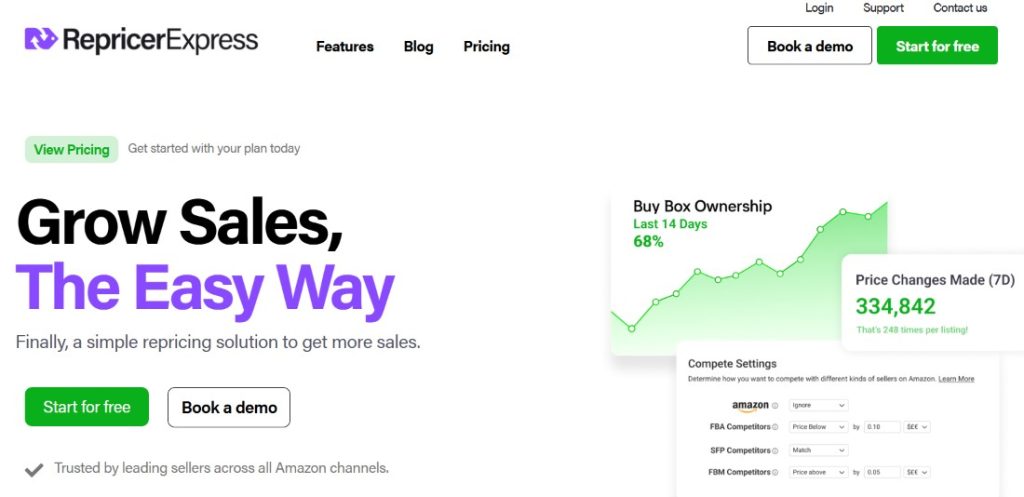
Best for: Mid-volume sellers needing reliable rule-based repricing
Pricing: Starts around $55 per month
Repricing speed: Real-time, typically 90 seconds to 2 minutes
Marketplaces: Amazon, eBay
Automation: Primarily rule-based
Strength: Mature, reliable platform with strong customer support. Stable for sellers who do not need cutting-edge AI features.
Weakness: Less AI capability than newer entrants. May lose ground in highly competitive categories. Visit RepricerExpress
11. Informed.co (formerly Appeagle)
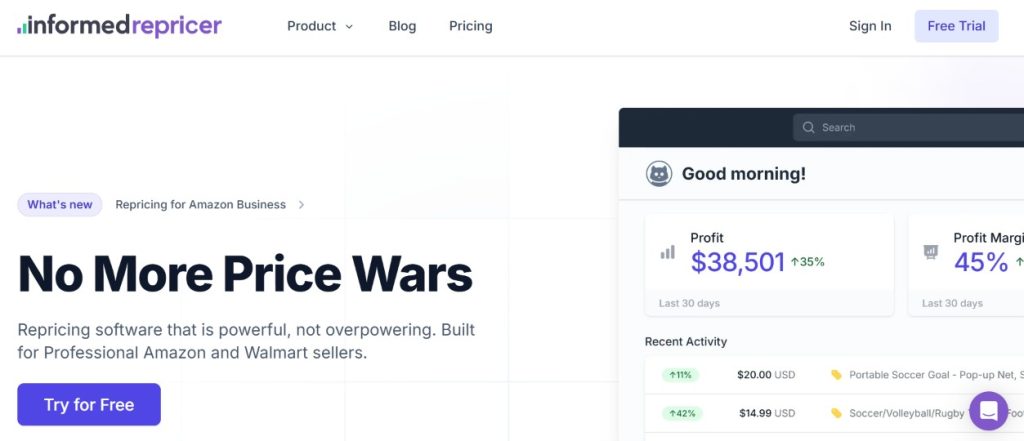
Best for: Brand owners and private label sellers
Pricing: Starts at $99 per month
Repricing speed: Real-time
Marketplaces: Amazon, Walmart, eBay, Shopify
Automation: Rule-based with algorithmic add-ons
Strength: Excellent for private label sellers with brand registry. Good reporting suite. Strong support for multi-channel margin management.
Weakness: UI is dated compared to newer competitors. Onboarding takes longer than mid-tier tools. Visit Informed.co
12. M2E Cloud
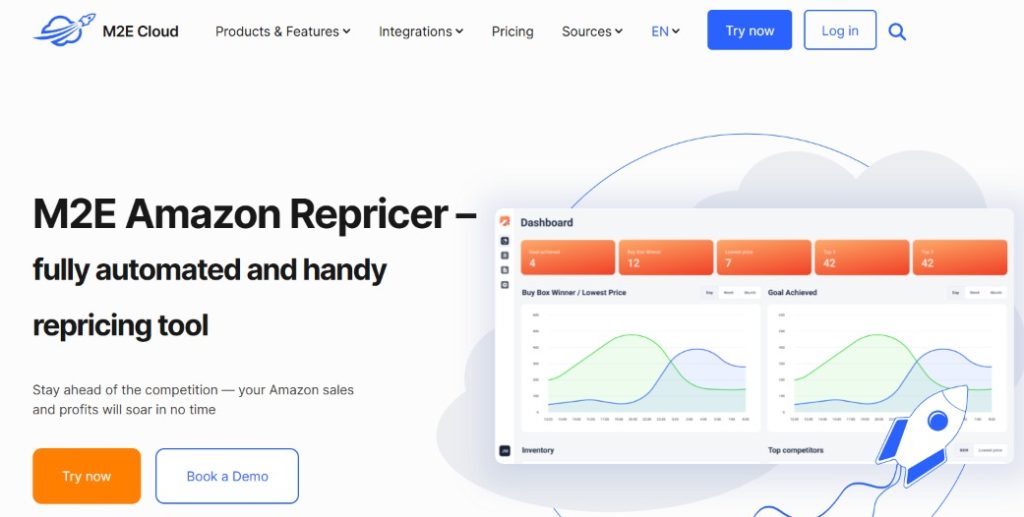
Best for: Sellers wanting simple setup with 24/7 monitoring
Pricing: Starts around $30 per month
Repricing speed: Real-time
Marketplaces: Amazon, eBay
Automation: Rule-based
Strength: Minimal setup requirements. Easy for first-time repricer users to deploy.
Weakness: Limited algorithmic features. Not ideal for highly competitive categories. Visit M2E Cloud
13. Seller Dynamics
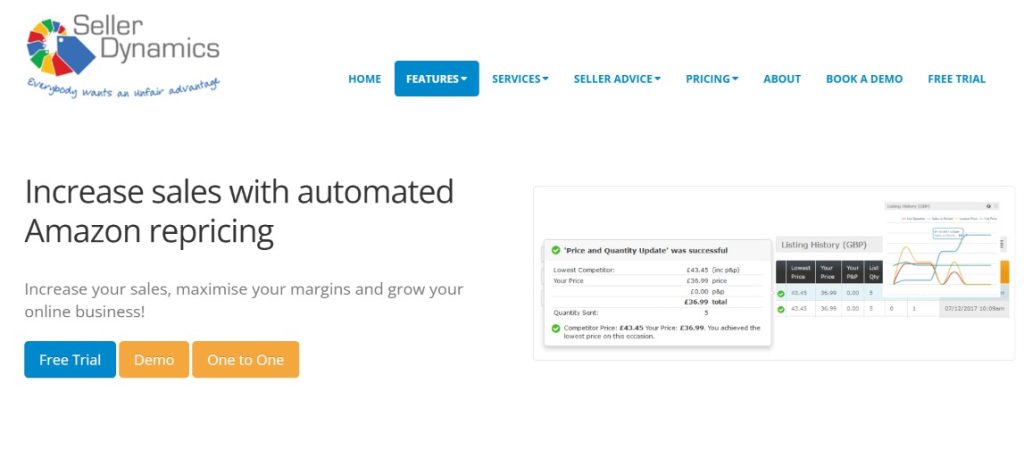
Best for: Sellers needing inventory management plus repricing in one platform
Pricing: Tiered, starts around $79 per month
Repricing speed: Real-time Marketplaces: Amazon, eBay
Automation: Rule-based with algorithmic add-ons
Strength: Combined inventory management and repricing reduces tool count. Good for omnichannel operations.
Weakness: Repricing is one feature among many. Specialists may outperform on pure repricing speed. Visit Seller Dynamics
14. StreetPricer

Best for: Sellers prioritizing real-time competitor price tracking
Pricing: Starts around $30 per month
Repricing speed: Real-time competitor monitoring
Marketplaces: Amazon
Automation: Rule-based with competitor-tracking focus
Strength: Strong competitor price tracking. Good for sellers in highly competitive niches.
Weakness: Less marketplace coverage than larger tools. Limited reporting depth. Visit StreetPricer
15. RepriceIt

Best for: Solo sellers and small operations needing affordable repricing
Pricing: Starts at $9.95 per month for the basic plan
Repricing speed: Variable based on plan tier
Marketplaces: Amazon
Automation: Rule-based
Strength: Among the most affordable options for solo sellers. Simple interface for sellers new to repricing.
Weakness: Limited features at lower tiers. Slower repricing on basic plans. Visit RepriceIt
16. Profit Protector Pro

Best for: Sellers focused on margin protection over Buy Box volume
Pricing: Starts around $25 per month
Repricing speed: Real-time
Marketplaces: Amazon
Automation: Rule-based with profit-focused algorithms
Strength: Profit-first repricing logic. Strong for sellers who want to avoid race-to-bottom pricing wars.
Weakness: Less effective in pure volume-maximization scenarios. Better for branded or private-label sellers. Visit Profit Protector Pro
17. ChannelMAX
Best for: Budget-conscious sellers and Amazon book/media sellers
Pricing: Starts around $14 per month for basic plans. Lowest in the category.
Repricing speed: Generally 15 to 30 minutes per cycle. Slower than premium tools.
Marketplaces: Amazon (multiple international marketplaces), eBay
Automation: Rule-based
Strength: Cheapest reliable option. Strong for book sellers, used goods, and high-SKU low-velocity catalogs.
Weakness: Repricing speed is slower than premium tools. Less ideal for fast-moving SKUs in competitive categories. Visit ChannelMAX
Quick comparison: 16 Amazon repricer tools at a glance
| Tool | Starting Price | Speed | Marketplaces | Automation | Best For |
|---|---|---|---|---|---|
| Feedvisor | $1,000+/mo | <60s | Amazon, Walmart | AI | Enterprise ($5M+) |
| BQool | $50/mo | <60s | Amazon, Walmart | AI + Rule | Mid-large sellers |
| Repricer.com | $99/mo | <90s | Amazon, eBay, Walmart, Shopify | AI + Rule | Multi-channel |
| Aura | $97/mo | Real-time | Amazon, Walmart | AI | Multi-channel + Walmart |
| Sellersnap | $55/mo | <2min | Amazon | AI | Mid-tier transition |
| SmartRepricer | $55/mo | Real-time | Amazon | AI | Speed at mid-tier price |
| Sellery | $50/mo | Real-time | Amazon (multi-region) | Rule + AI | Flexible rule config |
| Alpha Repricer | $50/mo | Real-time | All 23 Amazon | AI | International Amazon |
| RepricerExpress | $55/mo | <2min | Amazon, eBay | Rule | Mid-volume reliable |
| Informed.co | $99/mo | Real-time | Amazon, Walmart, eBay, Shopify | Rule + AI | Private label |
| M2E Cloud | $30/mo | Real-time | Amazon, eBay | Rule | Simple setup |
| Seller Dynamics | $79/mo | Real-time | Amazon, eBay | Rule + AI | Inventory + repricing combo |
| StreetPricer | $30/mo | Real-time | Amazon | Rule | Competitor tracking |
| RepriceIt | $9.95/mo | Variable | Amazon | Rule | Solo sellers |
| Profit Protector Pro | $25/mo | Real-time | Amazon | Rule + AI | Margin protection |
| ChannelMAX | $14/mo | 15-30min | Amazon, eBay | Rule | Books/media, budget |
The best Amazon repricer for each use case
No single tool wins for every seller. The right choice depends on your store size, marketplace mix, and pricing strategy. Here is the best fit for each common scenario.
Best overall repricer: BQool BoostBuy Strong AI Buy Box prediction, mid-tier pricing, and good multi-channel support. The best balance of features and cost for mid-market sellers ($250K to $5M annual revenue).
Best enterprise repricer: Feedvisor The only option for sellers above $5M in annual Amazon revenue who need repricing combined with full-service ads optimization.
Fastest repricer: Repricer.com Sub-90-second repricing across multiple marketplaces. Best for sellers in fast-moving categories where seconds matter.
Most affordable reliable repricer: ChannelMAX $14 per month with reliable rule-based repricing. Best for book sellers, media sellers, and high-SKU low-velocity catalogs.
Best for solo sellers: RepriceIt or Seller Republic Under $50 per month with simple interfaces. Best for sellers under $250K in annual revenue testing automated repricing for the first time.
Best for private label brands: Informed.co Strong reporting and margin protection for branded sellers with no Buy Box competition who still want algorithmic pricing intelligence.
Best for Walmart plus Amazon: Aura The strongest Walmart repricing integration in the category. Best for sellers building Walmart as a second channel.
Best for margin protection: Profit Protector Pro Profit-first repricing logic. Best for sellers worried about race-to-bottom pricing wars in competitive categories.
How to choose the right repricer for your store
The right repricer depends on three factors more than anything else: store size, marketplace mix, and team capacity for pricing work.
Choose by store size
Under $250K annual Amazon revenue: ChannelMAX, RepriceIt, or Amazon’s free Automate Pricing. Save budget for inventory and ads. Spending $99 per month on a repricer at this revenue level is not the right tradeoff.
$250K to $2M annual revenue: Sellersnap, RepricerExpress, or Aura. Mid-tier pricing matches mid-tier operational complexity. AI features start to pay back at this volume.
$2M to $10M annual revenue: BQool BoostBuy, Repricer.com, or Informed.co. AI features deliver meaningful Buy Box gains. Multi-channel support becomes worth the price premium.
$10M+ annual revenue: Feedvisor or enterprise-tier BQool. Custom contracts, advanced features, and dedicated account management become worth the cost.
Choose by marketplace mix
Amazon only: Sellersnap, BQool, RepricerExpress, SmartRepricer.
Amazon plus Walmart: Aura, Repricer.com, Informed.co.
Amazon plus multiple channels (Walmart, eBay, Shopify): Repricer.com, Informed.co, Seller Dynamics.
International Amazon marketplaces: Alpha Repricer, Sellery by SellerEngine.
Choose by team capacity
No dedicated pricing person: AI-driven tools (BQool BoostBuy, Aura, Sellersnap). Less manual rule configuration. The algorithm handles complexity.
Dedicated pricing analyst: Rule-based tools (RepricerExpress, ChannelMAX, StreetPricer) give more control and produce predictable behavior.
Aggressive vs balanced pricing strategy
Within any repricer, you choose a strategy. The strategy matters more than the tool you use.
| Factor | Aggressive | Balanced |
|---|---|---|
| Goal | Win Buy Box at any cost | Win Buy Box at profitable margins |
| Price floor | At or near cost | Above margin minimum |
| Buy Box win rate | High | Moderate to high |
| Margin per sale | Low | Healthy |
| Risk | Price wars, margin erosion | Slower volume growth |
| Best for | New launches, clearing inventory | Established products, sustainable growth |
| Time horizon | Short-term volume push | Long-term profitability |
Most sellers should run balanced strategies on established SKUs and switch to aggressive only for product launches or seasonal pushes. Permanent aggressive pricing destroys margins.
Why your repricer choice affects your fulfillment strategy
Repricing tools work best when paired with reliable inventory positioning. A repricer cannot help if your stock is sitting at a 3PL for 15 to 30 days waiting for Amazon FBA check-in. By the time your inventory becomes sellable, your competitors have already adjusted prices and won the Buy Box cycles.
Brands using AMZ Prep’s Amazon Replenishment Program get inventory into Amazon FBA in 2 to 4 days. That speed gives any repricer tool the inventory velocity it needs to actually influence Buy Box outcomes.
Pricing tools and inventory speed are paired investments. Either alone underperforms.
Three factors to weigh when making the final choice
Cost versus expected return. Most repricers above $50 per month pay back within 60 to 90 days at $250K+ in annual Amazon revenue. Below $250K, the math gets harder.
Scalability. Pick a tool that handles your current SKU count and at least 5x your current catalog. Tools with aggressive per-SKU pricing punish growth.
Integration with your stack. Confirm the repricer integrates with your Seller Central account, inventory management system, and any analytics tools you use. Missing integrations create manual workarounds that defeat the purpose of automation.
FAQ:
What does an Amazon repricer do?
An Amazon repricer automatically adjusts your product prices based on competitor pricing, Buy Box position, and rules you set. It checks the marketplace every few minutes and raises or lowers prices within your defined floor and ceiling.
What is the best repricing tool for Amazon?
The best tool depends on store size. Sellers under $250K do well with ChannelMAX or RepriceIt. Mid-market sellers ($250K to $5M) benefit from BQool BoostBuy or Aura. Enterprise sellers ($5M+) typically use Feedvisor.
How do I turn off Amazon Repricer?
Turn off Amazon’s built-in Automate Pricing through Seller Central under Pricing then Automate Pricing. For third-party tools, disable repricing rules in the tool’s dashboard then disconnect API access from Seller Central.
How much does Aura Repricer cost?
Aura starts around $97 per month for the base plan. Pricing scales by SKU count and feature tier. Multi-channel access (Amazon plus Walmart) typically requires higher tiers. Annual plans offer modest discounts.
Is rule-based or AI repricing better?
AI repricing usually wins on competitive, fast-moving SKUs because it reacts faster than rule sets. Rule-based works better for stable, low-competition listings where predictable pricing behavior matters most. Most modern tools offer both modes.
Can I use Amazon’s free Automate Pricing tool instead of paying for a repricer?
Amazon’s free tool works for simple repricing on slow-moving SKUs. Most sellers outgrow it within six months because it is slower and less sophisticated than third-party tools. Worth testing before paying for a third-party option.
Will a repricer help me win the Buy Box?
A repricer increases your Buy Box win rate but does not guarantee it. Price is one of several Buy Box factors. Inventory levels, seller rating, fulfillment speed, and shipping performance also count. Pair repricing with FBA or fast fulfillment.
How fast should an Amazon repricer adjust prices?
Top repricers adjust prices within 60 to 90 seconds of a Buy Box change. Slower tools (15+ minutes) miss high-velocity Buy Box rotations entirely. Speed matters most for competitive, fast-moving categories.
Conclusion
Bottom line: matching the right repricer to your store
The repricer landscape consolidated in 2026 around three tiers:
- Budget tools (ChannelMAX, RepriceIt) for sellers under $250K in annual Amazon revenue
- Mid-market AI tools (BQool BoostBuy, Aura, Sellersnap) for $250K to $10M
- Enterprise platforms (Feedvisor) above $10M
Most sellers over $250K recover the tool cost within 60 to 90 days through Buy Box win rate alone. The harder decision is integrating the repricer with your fulfillment, advertising, and inventory operations so price changes actually translate into sales.
Pair your repricer choice with reliable Amazon FBA inventory flow. A repricer cannot sell stock that is not checked in. Brands using AMZ Prep get inventory into Amazon in 2 to 4 days, giving any repricer tool the inventory velocity it needs to win Buy Box cycles consistently.
What to do next
- Identify your store size tier
- Confirm your marketplace mix (Amazon only, plus Walmart, or multi-channel)
- Pick the top one or two tools from this guide that match
- Run a 30-day trial before committing to annual pricing
- Measure Buy Box win rate before and after the trial
Most repricers offer a free trial or month-to-month pricing. Use that period to validate the tool against your actual catalog before signing an annual contract.
Additional read:

Daniel Rozario is the Lead Content Specialist at AMZ Prep, collaborating with the marketing team to produce blogs and articles on e-commerce fulfillment and logistics. He specializes in creating resources that help brands navigate inventory management, operational efficiency, and fulfillment strategy.







Coverage of how repricers protect margins while chasing the Buy Box is exactly what sellers need
Seeing BQool, Repricer.com, and SmartRepricer side by side helps me pick what fits my catalog.
Automated repricer tools are a lifesaver — this article maps out top contenders well.
Thanks for showing how to avoid destructive price wars while still winning the Buy Box
This tool list plus your tips on choosing the right settings makes the repricer journey less overwhelming.
Love the breakdown of pros / cons across 15 tools. Gives clarity beyond marketing claims.
The section on algorithmic pricing + customization features really stood out as essential.
Many tools promise 24/7 repricing, but your insight on rule strategy and safe mode is what really matters.
I was on the fence about investing in a repricer — this post convinced me to test one immediately.
Repricingg rightly explained with the specific tools. Very informative post! Thanks
Repriicing and buy box has a strong connection, you have explained it in a balanced way. Thanks for this post. Keep writing!
Your clarity of thoughts on Amazon Sellers requirements and needs is amazing. Great piece!
Thankful to my colleague for recommending this site to me, your topics and format of writing is way simpler and easy to understand. Appreciate your hard work!
Have been looking for good articles on Amazon sellers requirements, your website helped me hold on to my search. Wonderful way of writing and a balanced format of presentation. Appreciate your understanding of Ecommerce industry.
The list of repricing tools for Amazon is quite helpful as it displaays the cost of each. Helpful post. Thanks
You should have kept the list small and with the best ones. Overall a good write-up
The section for repricing tools for different needs is rightly explained and is appreciated. You have brought in something new and informative with a creative aspect. Awesome work
You have not only mentioned the repricer tools but provided with the checklist and the steps to choose the most suitable tool as per requirement. This needs a deep understanding of the Amazon repricing and how the working of Amazon seller. Your writing reflects your experience in the industry.
Comprehensive article with amazing understanding of Repricing and buy box connection.
Worth reading. Keep posting
Each section is rightly explained. Good work!
Awesome to read and informative post
Great writing and your other posts are also very informative, mainly the FBA fees and BOPIS posts
Nicely framed article. Keep writing
A highly informative piece that highlights essential tools for Amazon sellers aiming to outperform their competitors in 2024.
An excellent overview of the top repricing tools, providing actionable insights for maximizing profitability on Amazon.
The detailed breakdown of each tool’s features makes this article a must-read for anyone serious about dominating the Amazon marketplace.
A well-structured analysis of advanced repricing tools that can significantly enhance a seller’s ability to win the Buy Box consistently.
This blog is an invaluable resource for Amazon sellers looking to optimize their pricing strategies and secure the Buy Box.