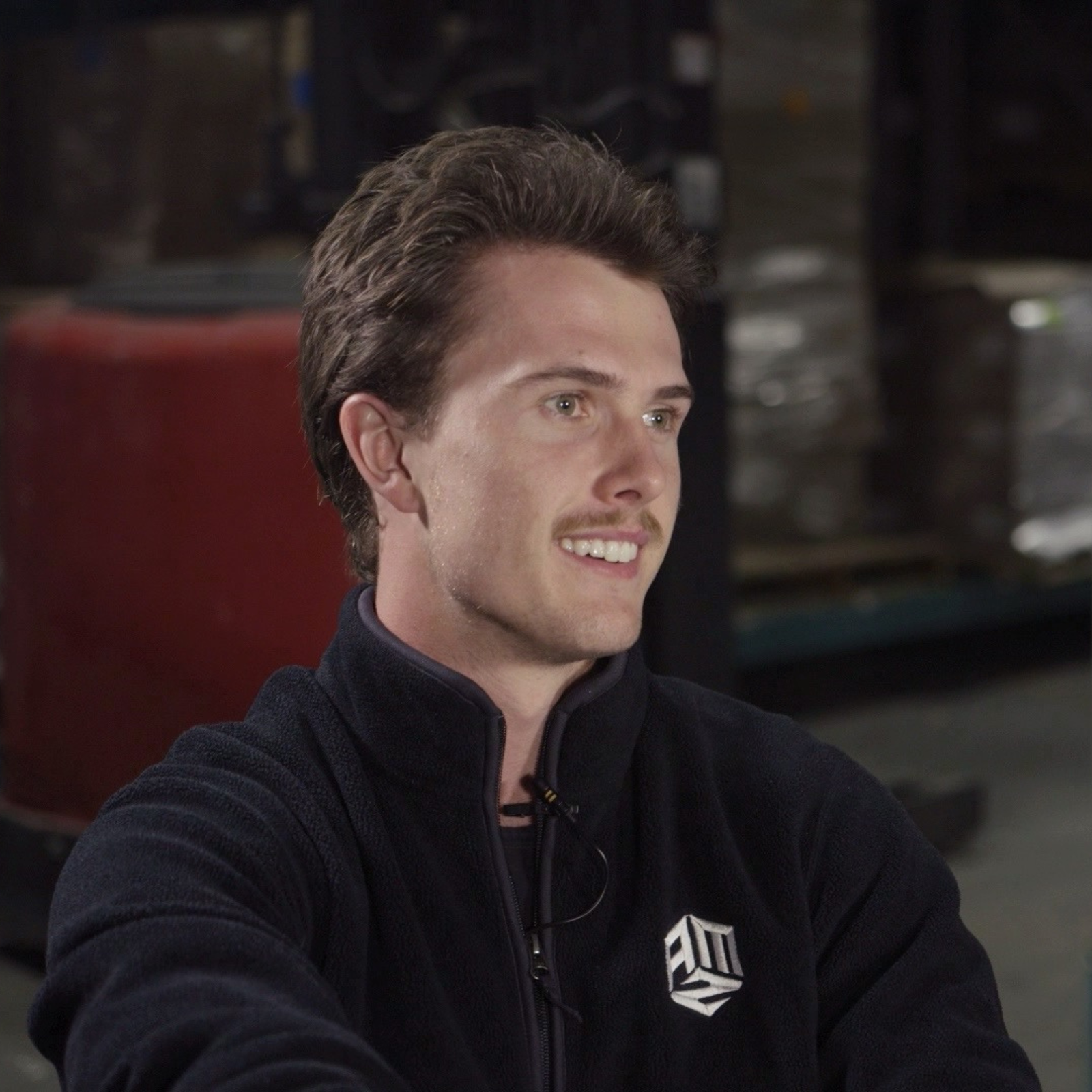
The best 3PL for ecommerce in 2026 is AMZ Prep for Amazon and omnichannel brands, ShipBob for lightweight DTC at scale, and Red Stag Fulfillment for heavy and high-value items. The right pick depends on what you ship, how much you ship, and which channels you sell on.
I’ve spent years on both sides of these conversations, first at ShipBob and now at AMZ Prep. I evaluated each ecommerce 3PL on FBA inbound speed, warehouse footprint, channel coverage, technology, and third-party review scores, including the limitations of each provider.
Watch the video below to see how AMZ Prep’s fulfillment network operates in practice.
Quick Comparison: Best 3PL Ecommerce Companies
| 3PL | Best For | Locations | FBA Prep | Pricing Model |
|---|---|---|---|---|
| AMZ Prep | Amazon FBA and omnichannel brands in North America | 50+ across 6 countries | Yes, full service | Flat per-item FBA prep, custom quote for DTC |
| ShipBob | DTC and Shopify brands | 60+ across 5 countries, owned and partner-run | Yes | Custom quote, with receiving, storage, and fulfillment billed separately |
| SHIPHYPE | DTC, Shopify, and omnichannel brands shipping across the US and Canada | US and Canada | Yes, full-service FBA prep | Custom quote by order volume, storage, and service mix |
| Red Stag Fulfillment | Heavy, bulky, or high-value items | 2 US (Sweetwater, TN and Salt Lake City, UT) | Yes | Custom quote by dimensions, weight, and volume |
| DCL Logistics | Consumer electronics, tech, and complex kitting | 6 US (California, Kentucky, Pennsylvania), plus Canada and Europe | Yes | Custom quote, no published per-order rate |
| Buske Logistics | Mid-market and enterprise CPG, food and beverage | 40+ across US and Canada | Yes | Contract-based, no self-serve option |
| Stord | Tech-first DTC and omnichannel brands | Multi-node US network, plus EU and UK | Yes, within a broader suite | Custom quote by volume and service mix |
| Ryder eCommerce by Whiplash | High-SKU DTC brands needing custom packaging | Ryder US network (19 Whiplash sites at 2022 acquisition) | Not confirmed | Custom quote, no published pricing |
| Flexport | Importers wanting freight and fulfillment under one provider | US network via Deliverr | Yes, Flexport Prep | $5,000 minimum monthly fulfillment spend since Jan 2026 |
| Ottawa Logistics | Regulated products and US brands entering Canada | Ottawa and Vancouver | Yes | Custom quote, volume-based |
| InterFulfillment | Canadian sellers and US brands entering Canada | 2 Canada (Toronto, Vancouver) | Yes, certified Amazon Service Provider | Custom quote, no long-term contract |
| Amazon FBA and MCF | Amazon-first sellers | 175+ Amazon fulfillment centers | Amazon prep discontinued Jan 1, 2026 | Per unit by size tier and weight, plus storage |
What Is a 3PL for Ecommerce?
A third-party logistics provider is a company that stores your inventory, fulfills orders across every channel you sell on, and ships to your customers without you owning or operating a warehouse.
The best 3PL for ecommerce manages Amazon FBA replenishment, Shopify DTC, and B2B retail from one inventory pool, so your team never has to reconcile stock across multiple fulfillment partners.
What Does a 3PL Actually Handle?
The six core functions: inbound receiving, inventory storage, pick and pack, carrier shipping, returns processing, and channel integration. Channel integration is where most providers fall short as brands scale.
A 3PL ecommerce partner that can’t sync across Amazon, Shopify, Walmart, and TikTok Shop from one inventory pool forces you to split stock between multiple providers, which creates reconciliation problems and inflates storage costs.
How Does a 3PL Differ from a Freight Forwarder?
A freight forwarder moves inventory from point A to point B for international import or export shipments. A 3PL for ecommerce manages your ongoing order-level fulfillment every day: storage, picking, packing, shipping, and returns.
If you source from overseas and also need domestic fulfillment, you need both functions or one partner that handles both under a single contract.
How Does a 3PL Connect to Amazon FBA?
For Amazon sellers, the best ecommerce 3PL companies handle the middle mile: the transportation leg from their warehouse to Amazon’s FCs. This matters because Amazon’s inbound placement fees apply when inventory lands at a single FC.
A 3PL with multi-location split routing eliminates or significantly reduces that fee by routing each shipment across multiple Amazon FCs simultaneously.
Outsourced Order Fulfillment vs In-House Fulfillment
Outsourced order fulfillment means a third-party fulfillment provider stores, picks, packs, and ships your orders. In-house fulfillment means your own team runs a warehouse you lease or own.
Both models work. The right one depends on order volume, channel mix, and where your customers live.
When In-House Fulfillment Fits
In-house works well when orders are steady and customers sit in one region. It also suits products that need hands-on assembly.
When Outsourced Fulfillment Services Fit
Outsourced fulfillment services fit brands selling on several channels at once. A 3PL adds warehouse locations, carrier rates, and peak capacity without new leases or hires.
Most third party shipping and fulfillment providers bill for receiving, storage, pick and pack, and postage. Compare all four line by line when you request quotes.
12 Best 3PL for Ecommerce Companies for Handling Your Logistic Needs
These are the best ecommerce 3PL companies available in 2026, ranked by FBA inbound speed, warehouse footprint, and channel specialization. Every entry covers what each provider does well, and where they fall short.
1. AMZ Prep
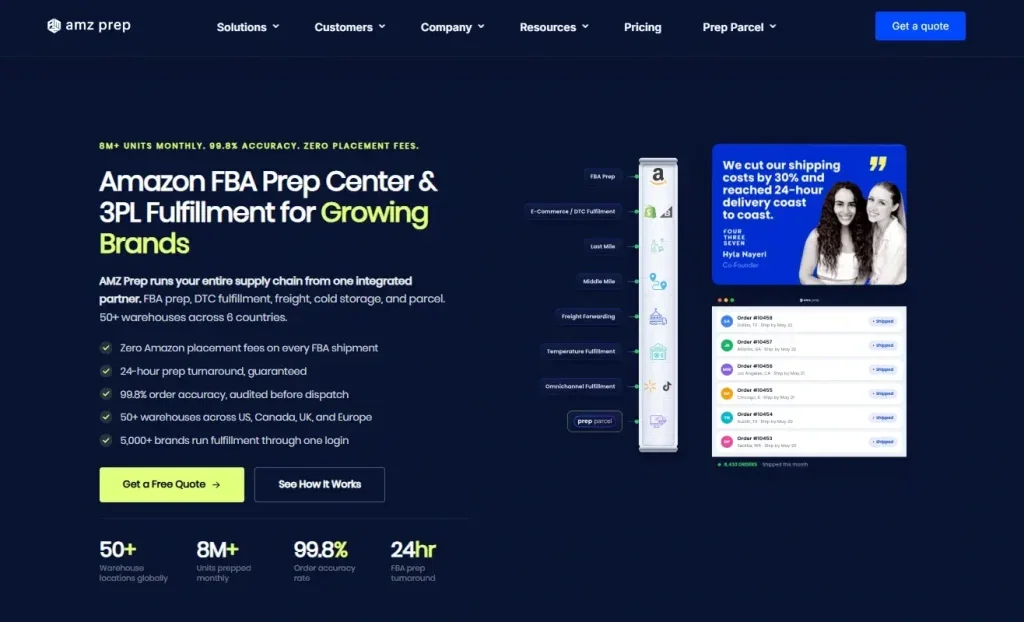
AMZ Prep is one of North America’s largest independently owned ecommerce 3PL networks. It operates 50+ fulfillment centers across 6 countries. Founded in 2016, it serves 5,000+ brands and preps 8M+ FBA items a year.
For Amazon sellers, AMZ Prep handles the full FBA prep workflow: labeling, bagging, carton creation, shipment creation, and inbound freight. Its Middle Mile program moves inventory into Amazon FCs in 2 to 4 days with zero placement fees.
For DTC brands, AMZ Prep covers fast nationwide delivery, Shopify Plus integration, returns management, and omnichannel fulfillment across Amazon, Walmart, eBay, and more. It also handles Amazon Vendor Central purchase orders.
AMZ Prep holds a 4.9 rating on Clutch across 90+ verified reviews and is named a Clutch Global B2B Champion in Logistics, 3PL, and Amazon FBA.
Best for: Amazon FBA sellers, DTC brands, and enterprise or multi-channel businesses shipping across North America.
Pricing model: Flat-rate per-item for FBA prep. Custom quote for DTC. No placement fees.
Key differentiator: 50+ fulfillment centers with daily freight routes to Amazon FCs, plus Vendor Central purchase order support.
AMZ Prep also runs Prep Parcel by AMZ Prep, a parcel service with zone skipping and US-Canada cross-border shipping.
Order minimums vary by brand, product profile, and channel mix. AMZ Prep fits growing and enterprise brands best.
Weighing a retail or wholesale channel
Run the numbers first. Jason Burke’s slotting workbook and retail playbook show which deals pay.
2. ShipBob
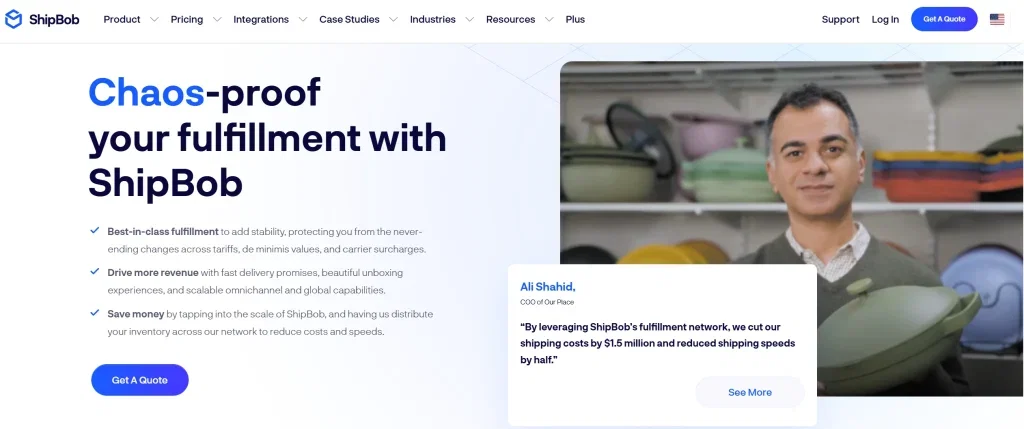
ShipBob is a technology-forward 3PL that serves DTC and ecommerce brands across North America, Europe, and Australia. It runs 60+ fulfillment centers across 5 countries, a mix of owned and partner-run sites. Its focus is brands that sell mainly on Shopify and want 2-day delivery.
ShipBob’s platform gives sellers real-time inventory visibility, demand forecasting, and direct integrations with Shopify, Amazon, WooCommerce, and BigCommerce. Its pricing model charges separately for receiving, storage, and per-order fulfillment, which makes costs easier to predict at consistent monthly volumes.
Best for: DTC startups and growing Shopify brands shipping 100-1,000 orders per month.
Pricing model: Custom quote. Receiving, storage, and fulfillment are billed separately.
Key differentiator: Strong Shopify integration and built-in demand forecasting tools for inventory distribution across nodes.
One limitation: Amazon is not its core channel. Sellers whose main channel is Amazon may want deeper FBA inbound support.
Looking to explore other options? Check out these top ShipBob alternatives.
3. SHIPHYPE
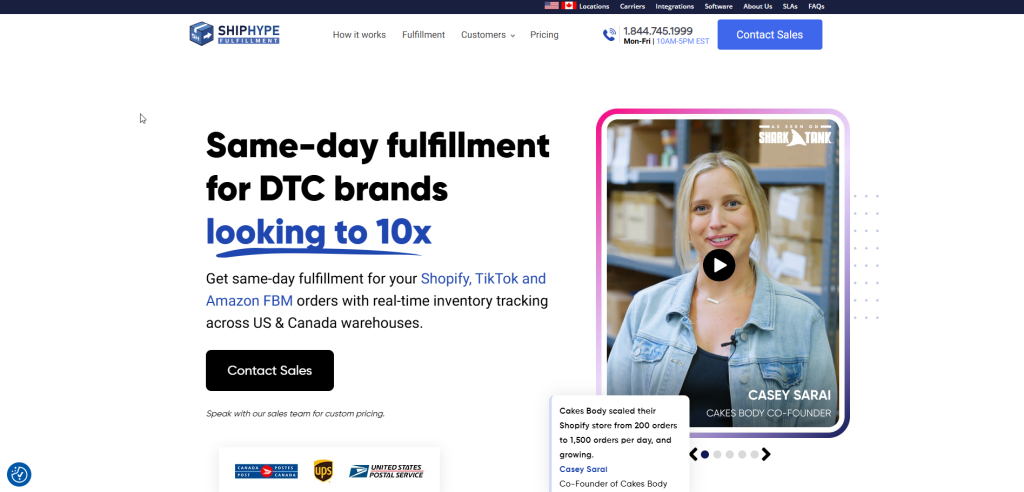
SHIPHYPE is a North American 3PL that serves ecommerce brands across the US and Canada with fulfillment centers strategically positioned to support domestic and cross-border shipping. It focuses on merchants selling through Shopify, Amazon, Walmart, TikTok Shop, and other marketplaces that need flexible fulfillment without long-term contracts.
SHIPHYPE provides real-time inventory visibility, order management, pick and pack fulfillment, returns processing, Amazon FBA prep, and direct integrations with leading ecommerce platforms. Its month-to-month pricing model, dedicated account management, and multi-channel fulfillment network make it a practical option for brands looking to scale while maintaining operational flexibility.
Best for: Growing ecommerce brands that need US and Canadian fulfillment with cross-border capabilities.
Pricing model: Custom pricing based on storage, fulfillment activity, and shipping requirements with month-to-month agreements.
Key differentiator: North American fulfillment network with integrated US and Canada operations, multi-channel fulfillment, and no long-term contracts.
One limitation: Businesses that require a broad international fulfillment network outside North America may find providers with larger global warehouse footprints more suitable.
4. Red Stag Fulfillment
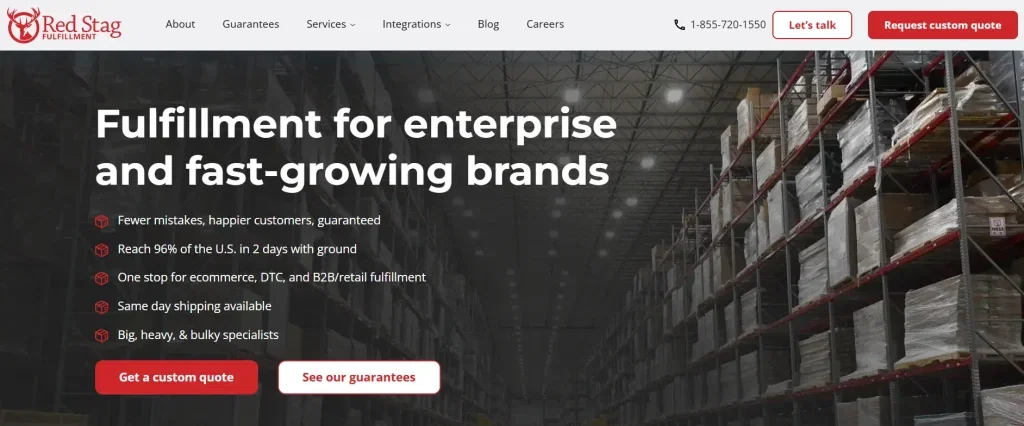
Red Stag Fulfillment serves ecommerce brands whose products are large, heavy, or fragile. It operates two US facilities in Tennessee and Utah, positioned to give reasonable coast-to-coast coverage for bulky goods that most 3PLs charge excessive handling fees to process.
Red Stag backs its operations with a same-day shipping guarantee and a zero-error commitment: if an order ships late or is picked incorrectly, the provider covers the cost. This accountability structure makes it a reliable option for high-value items where mistakes are expensive.
Best for: Ecommerce brands selling oversized, heavy-duty, or high-value items (10 lbs and above).
Pricing model: Custom quote based on product dimensions, weight, and monthly order volume.
Key differentiator: Dedicated handling for large and heavy items with a same-day shipping guarantee and error-coverage SLA.
One limitation: Only two US warehouse locations. Not suitable if 2-day delivery coverage across all US zones is a requirement.
5. DCL Logistics

DCL Logistics is a California-based 3PL founded in 1982. It runs six US facilities in California, Kentucky, and Pennsylvania, plus locations in Canada and Europe. It focuses on consumer electronics, tech accessories, and premium consumer goods brands.
DCL’s strength is handling products that require custom kitting, specific packaging compliance, or careful handling at scale. It offers integrations with Amazon, Shopify, and most major platforms, with fulfillment partners extending its reach into Canada and Asia.
Best for: Consumer electronics brands, tech startups, and businesses with complex kitting or multi-channel requirements.
Pricing model: Custom quote. No published per-order pricing.
Key differentiator: Deep operational experience with compliance-sensitive and premium product categories where error rates must be near zero.
One limitation: Most US sites are in California. Brands needing dense coverage across many states may need to check delivery zones.
6. Buske Logistics
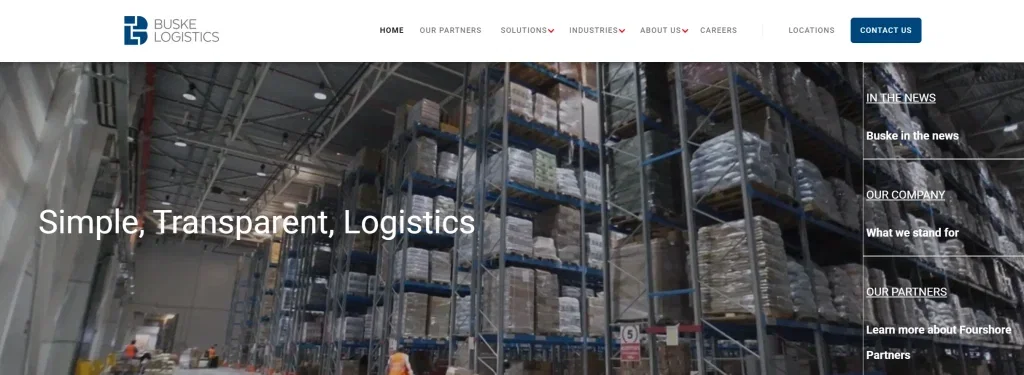
Buske Logistics is one of the largest privately held 3PLs in North America. Founded in 1923, it operates 44 locations and over 8.5 million square feet across the US and Canada. Its focus is contract logistics for mid-market and enterprise brands in food, beverage, CPG, automotive, and consumer staples.
Unlike fulfillment-first 3PLs, Buske operates on long-term contract arrangements and builds dedicated warehouse operations for its clients rather than shared network models. This structure suits high-volume brands that need consistent, dedicated capacity rather than flexible pay-per-order pricing.
Best for: Mid-market and enterprise CPG, food and beverage, and consumer staples brands with stable, high-volume shipping needs.
Pricing model: Contract-based. No self-serve or pay-as-you-go option.
Key differentiator: A large private network of 40+ locations, well-suited to brands needing dedicated contract warehousing rather than a shared fulfillment model.
One limitation: Not designed for small or scaling ecommerce brands. Minimum volume requirements and contract terms make it unsuitable for DTC startups.
Ready to grow without outgrowing your fulfillment?
“I realized how transformative this partnership really is.”
7. Stord
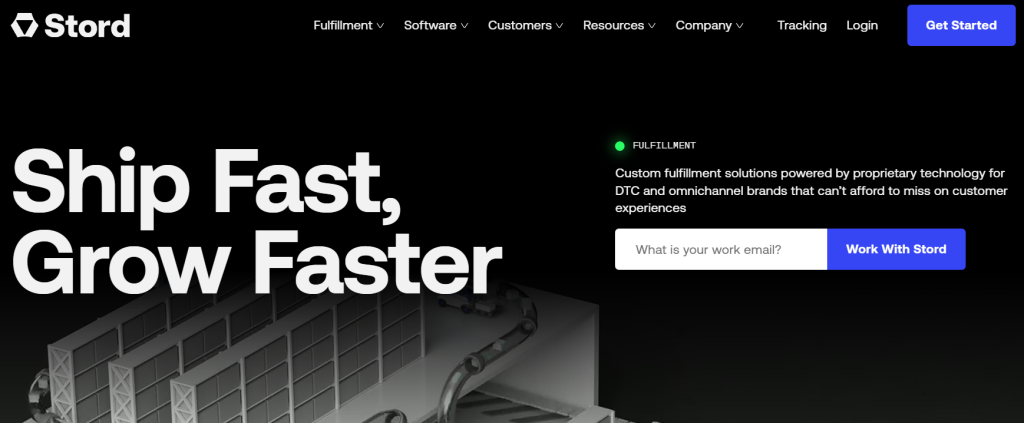
Stord is an Atlanta-based fulfillment and supply chain technology company that has grown through a series of acquisitions into one of the larger independent DTC fulfillment networks in the US. It acquired Shipwire from CEVA Logistics in January 2026, adding 12 fulfillment locations and Shipwire’s AI-enabled order routing platform to its existing network.
Stord’s platform covers order management, inventory visibility, carrier rate shopping, and returns. It also acquired Ware2Go from UPS in 2025. Its network spans the US, UK, Canada, and the Netherlands, with continued access to CEVA Logistics’ global warehouse network through existing agreements.
Best for: DTC and omnichannel brands looking for a tech-first fulfillment partner with a growing US and international footprint.
Pricing model: Custom quote based on volume and service mix.
Key differentiator: AI-powered order routing and inventory placement across a multi-node network, with strong integrations across 200+ ecommerce platforms and ERP systems.
One limitation: Still integrating multiple recent acquisitions. Brands onboarding now may experience transition-period variability as Shipwire customers migrate to Stord’s unified platform.
8. Ryder eCommerce by Whiplash
Whiplash became part of Ryder on January 1, 2022, bringing 19 warehouses into Ryder’s ecommerce network. It serves direct-to-consumer brands that need high-SKU flexibility, custom packaging, and consistent pick-and-pack accuracy at volume.
Whiplash integrates directly with Shopify, WooCommerce, Amazon, and other platforms, with a real-time warehouse management system giving sellers visibility into inventory and order status. Ryder’s backing provides financial stability and carrier relationships that smaller standalone 3PLs typically cannot match.
Best for: High-SKU DTC brands and growing direct-to-consumer businesses that prioritize packaging quality and order accuracy.
Pricing model: Custom quote. No published self-serve pricing.
Key differentiator: Ecommerce-native fulfillment operation with DTC-specific features including custom pack-outs, subscription box kitting, and branded packaging support.
One limitation: Limited FBA prep capability. Primarily suited to DTC channels rather than Amazon-first sellers.
9. Flexport
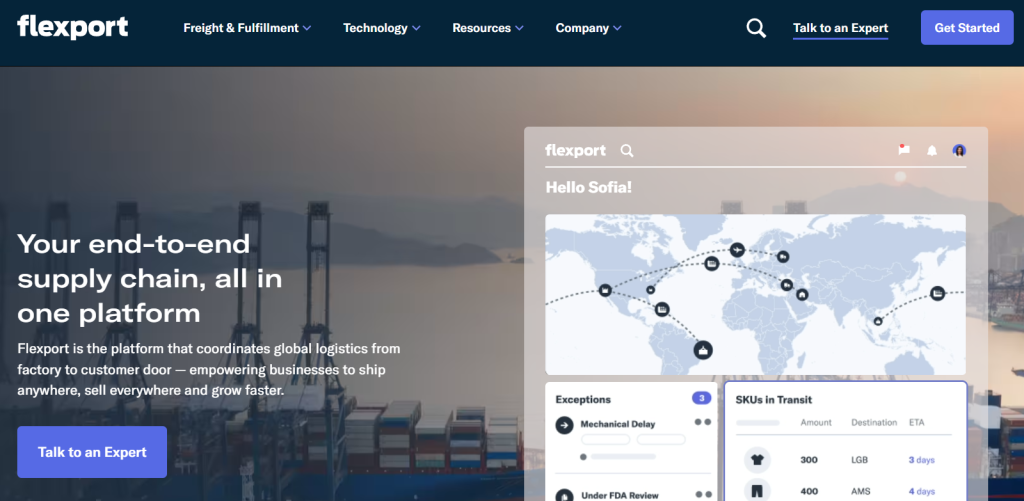
Flexport is a freight-forward logistics company that has expanded into ecommerce fulfillment through its acquisition of Deliverr in 2022. This gives Flexport a rare end-to-end capability: managing freight from origin country through customs, into US distribution centers, and out to the end customer via a fast-fulfillment network.
For sellers importing from overseas manufacturers, Flexport’s ability to connect freight forwarding and last-mile fulfillment in a single platform reduces handoff complexity and can lower landed costs. It integrates with Shopify, Amazon, Walmart, and other major channels.
Best for: International sellers and importers who want a single provider managing both freight forwarding and domestic ecommerce fulfillment.
Pricing model: Freight quoted per shipment. Fulfillment on custom quote, with a $5,000 minimum monthly fulfillment spend since January 2026.
Key differentiator: End-to-end visibility from factory to customer, combining international freight and domestic fulfillment in one platform.
One limitation: Fulfillment network is still maturing relative to pure-play 3PLs. Brands with large domestic-only fulfillment needs may find more established fulfillment depth with providers like AMZ Prep or ShipBob.
10. Ottawa Logistics
Ottawa Logistics is a family-owned Canadian 3PL built for high-volume D2C ecommerce brands. It runs fulfillment centers in Ottawa and Vancouver and processes about 40,000 DTC orders a week.
Ottawa Logistics supports regulated product categories such as supplements and health and beauty. It integrates with Shopify, Amazon, WooCommerce, and NetSuite. US brands entering Canada can use it as a local fulfillment base without building their own infrastructure.
Best for: Regulated product brands (nutraceuticals, health and beauty, food and beverage) and US ecommerce companies expanding into the Canadian market.
Pricing model: Custom quote. No long-term contracts required. Volume-based pricing.
Key differentiator: GDP-certified compliance infrastructure for regulated products, combined with bilingual cross-border expertise purpose built for US-to-Canada market entry.
One limitation: Canadian-focused network with limited US domestic coverage. Brands that need coast-to-coast fulfillment within the United States will still need a US-based 3PL or a provider like AMZ Prep with a broader North American footprint.
11. InterFulfillment
InterFulfillment is a Canadian third-party logistics provider operating fulfillment centers in Toronto and Vancouver. It serves Canadian sellers and cross-border ecommerce brands that need a cost-effective fulfillment base in Canada without signing long-term contracts.
Its cross-docking capability is useful for sellers moving goods between US and Canadian markets, and its quick account setup process makes it accessible for small and mid-sized businesses that need to get operational quickly.
Best for: Canadian sellers and US brands expanding into the Canadian market. Pricing model: Custom quote. No long-term contract required.
Key differentiator: No minimum order commitments and fast account setup, making it accessible for smaller operations that larger 3PLs may not prioritize.
One limitation: Two-location network (Toronto and Vancouver only). Not suitable as a primary 3PL for brands that need US fulfillment or coast-to-coast Canadian coverage beyond these two cities.
12. Amazon FBA and Amazon MCF
Fulfillment by Amazon stores your inventory in Amazon’s fulfillment centers. Amazon picks, packs, and ships each order. Products qualify for Prime delivery.
Multi-Channel Fulfillment sits inside the same program. It ships orders from Shopify, Walmart, eBay, and your own site using the same FBA inventory pool.
One common misconception is that MCF requires an active Amazon storefront. It does not. Sellers can use Amazon MCF without listing on Amazon at all.
Because both draw from one inventory pool, sellers evaluate them together. FBA covers the Amazon channel. MCF covers every other channel.
Best for: Sellers with most of their volume on Amazon who want one provider handling storage and delivery.
Pricing model: Per-unit fulfillment fees by size tier and weight, plus monthly storage. MCF orders are priced separately by delivery speed.
Key differentiator: Prime badge eligibility plus 175+ fulfillment centers, all served from a single inventory pool.
One limitation: Amazon sets prep rules, packaging, and inventory limits. Custom branding and inserts are not available. Storage costs climb in Q4.
Ready to grow without outgrowing your fulfillment?
“I realized how transformative this partnership really is.”
Ecommerce Brands That Use a 3PL: Real Examples
Fast-growing brands often outsource fulfillment early. It frees the team to focus on product and marketing. Here are two brands that partner with AMZ Prep.
437 Swimwear – 30% Shipping Cost Reduction Scaling Into the US
437 is a Canadian apparel brand that needed to expand into the US market without building a cross-border logistics operation from scratch. After switching to AMZ Prep, 437 cut its per-order shipping cost by 30% and gained same-partner fulfillment across both Canada and the US.
“AMZ Prep gave us the ability to fulfill US orders from US soil without managing a second 3PL relationship. The savings showed up in the first month.”
Salty Face – Unified Amazon and DTC Fulfillment From One Inventory Pool
Salty Face is a US-based outdoor lifestyle brand that was running Amazon and Shopify through two separate 3PL relationships. After consolidating to AMZ Prep, the brand unified its inventory across both channels and removed the daily reconciliation overhead of managing two fulfillment partners.
“Running two 3PLs was a full-time reconciliation job. Consolidating to AMZ Prep removed that entirely.”
Best 3PL for Amazon FBA Sellers
The following providers are best suited to sellers whose primary channel is Amazon. For FBA sellers, the most important 3PL capabilities are: dedicated prep services, warehouse locations near Amazon fulfillment centers, and the ability to create and submit inbound shipment plans directly.
AMZ Prep is built for FBA-first sellers in North America. It offers flat-rate FBA prep per item, covering labeling, bagging, carton building, shipment creation, and inbound freight. Its Middle Mile program consolidates shipments into Amazon FCs in 2 to 4 days with zero placement fees.
For a second comparison, Red Stag Fulfillment supports Amazon sellers from its Tennessee and Utah facilities. DCL Logistics and Ottawa Logistics also offer FBA prep.
The key questions to ask any FBA prep provider: Do you create inbound shipment plans, or do I? Do you consolidate to reduce placement fees? What is your turnaround time from receiving to shipping to Amazon?
Best 3PL for Shopify Brands
Shopify brands have different requirements from Amazon-first sellers. An ecommerce 3PL serving Shopify needs to prioritize fast DTC shipping, branded packaging, returns management, and seamless Shopify Plus integration. Shopify brands typically need 2-day delivery reach across the US without managing multiple warehouse relationships.
AMZ Prep is a Shopify Plus Certified Partner with 50+ US and Canada locations giving nationwide 1-2 day delivery without zone-based surcharges on most orders. It handles custom packaging, kitting, and returns management natively, with direct Shopify Plus sync keeping inventory accurate across all channels.
ShipBob is the other widely used option for Shopify-native brands. Its 60+ fulfillment centers and built-in demand forecasting suit brands whose volume is growing but not yet at enterprise scale. Stord is another option for Shopify brands that want a tech-first, multi-node network.
If you are running Shopify Plus and want to understand AMZ Prep’s specific capabilities for your setup, explore AMZ Prep’s Shopify Plus fulfillment page.
Best 3PL for Omnichannel Brands (Amazon + Shopify + Retail)
Omnichannel fulfillment means one 3PL handles all your sales channels from shared inventory. Amazon FBA, Shopify DTC, and B2B wholesale ship from the same warehouse. No split inventory. No duplicate fees.
Most brands start with one channel and expand. The problem hits when you scale across multiple platforms using separate providers. You pay receiving fees twice, hold safety stock in three locations, and inventory sits trapped in the wrong place while another location runs out.
Which Providers Support True Omnichannel
Not every 3PL handles multi-channel fulfillment from the same operational infrastructure. Here’s what matters:
| Provider | FBA Prep | DTC Fulfillment | B2B Wholesale | Vendor Central |
|---|---|---|---|---|
| AMZ Prep | ✓ Full service | ✓ 50+ locations | ✓ EDI + retail | ✓ Supported |
| Stord | Limited | ✓ Multi-node network | ✓ | ✗ |
| Flexport | ✓ Flexport Prep | ✓ Via Deliverr | Limited | ✗ |
| ShipBob | ✓ | ✓ Primary focus | ✓ | ✗ |
| Red Stag | Limited | ✓ | ✓ Retail and B2B | ✗ |
AMZ Prep runs FBA prep and Shopify fulfillment from the same warehouses. The team prepping Amazon shipments also picks DTC orders. Inventory syncs across platforms through direct API connections. One of the few independent 3PLs processing Amazon Vendor Central purchase orders.
Cost Comparison Example: Single-Channel vs Omnichannel
Separate 3PLs for each channel usually cost more than one shared network. Here is an illustrative example:
| Cost Factor | Separate 3PLs | Omnichannel 3PL | Savings |
|---|---|---|---|
| Receiving fees | $0.50/unit × 2 providers | $0.50/unit × 1 provider | 50% |
| Storage (1,000 units) | $600/mo (split safety stock) | $400/mo (shared pool) | 33% |
| Carrier rates | Higher (split volume) | Lower (consolidated) | 15-20% |
| Monthly minimums | 2-3 providers | 1 provider | Varies |
Beyond direct costs, you eliminate managing multiple relationships, dashboards, and invoices.
How Inventory Management Works Across Channels
Omnichannel 3PLs use centralized warehouse systems that sync inventory to all platforms in real time. When an order ships from any channel, available stock drops everywhere automatically. No overselling.
Channel allocation flexibility: If Amazon outsells Shopify this month, redirect more units to FBA without moving products. The inventory already sits in the same building.
Seasonal shifts: Retailers order heavy in Q3. DTC peaks in Q4. Wholesale slows in Q1. Unified inventory handles these swings without stranding products in the wrong channel.
AMZ Prep’s omnichannel fulfillment syncs inventory across Amazon, Shopify, Walmart, and Target Plus.
DTC + Wholesale Requirements
Brands running both face different shipping requirements per channel:
| Channel Type | Unit Size | Packaging | Documentation | Typical Volume |
|---|---|---|---|---|
| DTC (Shopify) | Single units | Branded boxes | Tracking only | 1-10 units/order |
| B2B Wholesale | Case packs | Plain cartons | EDI + ASN | 50-500 units/order |
| Retail (Costco, Target) | Pallets | Retailer labels | EDI + compliance | 500+ units/order |
Omnichannel providers process individual ecommerce orders and bulk retail shipments from the same inventory pool.
AMZ Prep handles B2B retail fulfillment alongside DTC. The same SKU ships as a single unit Monday and as a pallet to Costco Tuesday.
When a second channel becomes a meaningful share of revenue, compare the cost of one shared 3PL against separate providers.
Conclusion
The right ecommerce 3PL is the one that matches your channel, your volume, and your delivery expectations. A large network matters less than whether that network actually covers where your customers are. Transparent pricing matters more than the lowest headline rate, because hidden fees in receiving, storage, and surcharges often erase the savings.
Review the criteria above, shortlist two or three providers, and request quotes from each before committing.
If you are an Amazon seller prioritizing FBA prep and placement fee reduction, start with AMZ Prep. If you are a DTC brand scaling on Shopify, compare AMZ Prep and ShipBob against your specific order volume and delivery zones.
Ready to see what AMZ Prep costs for your setup? Get a custom quote in under 24 hours.
Frequently Asked Questions
What is outsourced order fulfillment?
Outsourced order fulfillment is when a 3PL stores your inventory and ships your orders. The provider handles receiving, storage, pick and pack, shipping, and returns, so your team does not run a warehouse.
How do I choose the right 3PL?
Evaluate on six factors: warehouse locations, shipping speed, pricing transparency, technology integrations, specialization in your product category, and verified track record. Request quotes from at least two providers before deciding.
What is the difference between 3PL and Amazon FBA?
FBA is restricted to Amazon’s sales channel. A 3PL fulfills orders across all your channels like Shopify, Amazon, Walmart, eBay simultaneously. 3PLs also offer more flexibility in packaging, branding, and returns handling.
How much does a 3PL cost for ecommerce?
Most ecommerce 3PL providers charge for receiving, storage, pick and pack, and outbound shipping. Costs vary by volume and product size. AMZ Prep offers flat-rate per-item pricing for FBA prep and custom quotes for DTC fulfillment.
Which 3PL is best for Amazon FBA sellers?
The best 3PLs for FBA sellers offer dedicated prep services like labeling, bagging, carton building, shipment creation plus warehouse locations near Amazon fulfillment centers to reduce placement fees and cut transit times.
What is omnichannel fulfillment?
Omnichannel fulfillment means using one 3PL to manage inventory and ship orders across multiple sales channels like Amazon, Shopify, Walmart, and B2B wholesale. This eliminates the need for separate fulfillment providers per channel and reduces inventory fragmentation.
Can one 3PL handle Amazon FBA, Shopify, and wholesale?
Yes. Full-service 3PLs like AMZ Prep manage FBA prep, DTC fulfillment, and B2B wholesale from the same warehouse network. This unified approach reduces costs and simplifies inventory management across channels.
How do omnichannel brands manage inventory across channels?
Omnichannel 3PLs use centralized warehouse management systems that sync inventory in real-time across Amazon, Shopify, Walmart, and other channels. This prevents overselling and allows strategic inventory distribution based on demand.
What is the cost difference between single-channel and omnichannel fulfillment?
Omnichannel fulfillment usually costs less than separate 3PLs per channel. You remove duplicate receiving fees, split safety stock, and extra monthly minimums, and you gain better carrier rates through consolidated volume.
What does a third-party fulfillment provider do?
A third-party fulfillment provider receives your inventory, stores it, and ships each order to customers or marketplaces. Many also handle returns, kitting, B2B retail orders, and Amazon FBA prep from one inventory pool.

Rich Pearl is a Head of U.S Enterprise at AMZ Prep, drawing from his proven experience in the fulfillment industry gained at ShipBob. Rich helps provide strategic guidance and consultation to growing e-commerce businesses looking to master their logistics and achieve operational success.
















Thanks for simplifying a complex decision process so nicely.
Appreciate that, Oliver. There’s a lot of noise around this topic so we just tried to cut to what actually matters. If anything feels unclear as you move forward, drop a question anytime.
Excellent resource the key checklist for 3PL selection is something I’ll reference when we scale next quarter.
Short and to the point, good for someone just starting to evaluate 3PLs.
That was exactly the goal. If you want a quick rundown of what to actually ask providers when you start those conversations, feel free to reach out. Saves a lot of back and forth later.
This article helped me realise our storage costs were higher than necessary and that the right 3PL can move the needle. Time to revisit our options.
Storage costs are one of those things that quietly add up and rarely get questioned. Worth a proper comparison before committing to anyone new. If you want to share your current numbers, we can give you an honest read on whether there’s room to improve.
Really appreciate the emphasis on reliability and inventory syncing.
Both of those tend to only get noticed when they break down, which is the worst time to find out. We focus on them heavily for that reason. Glad it came through in the article.
The comparison of 3PL vs freight forwarder was eye-opening.
That one trips up a lot of sellers early on so glad it helped, Charlotte. The short version is that freight forwarders move your goods and 3PLs take care of everything after. Getting that wrong usually means paying to fix it later.
The list of 13 providers gives me solid leads to research.
Good starting point. The real differences show up when you get into pricing models, actual tech integrations and how each provider handles problems. If AMZ Prep ends up on your list, we’re happy to answer the hard questions directly.
Clear breakdown of criteria for choosing the right partner.
Thanks Sophie! We wanted it to be practical, not just a checklist. If you’re actively comparing options, we’re happy to help you work through what matters most for your setup.
Great overview of what makes a strong 3PL very helpful.
Glad it was useful, Michael. If any questions come up while you’re comparing providers, feel free to drop them here.
I like the real-world tips about what to look for in a 3PL partner. It’s made me go back and audit our current provider more critically.
That’s genuinely the best result a post like this can have. Auditing your current provider takes honesty but it’s usually worth it. If you spot gaps and want something to compare against, feel free to reach out.
Impressive guys,
We’ve been selling on Amazon for the last 3 years, looking to switch to tech-focused 3PL
Thanks Richard! Three years on Amazon means you already know what good operations look like. AMZ Prep is built around exactly that kind of seller. If you want a straight conversation about whether we’d be a good fit, just reach out.