Duty drawback is a refund program from the U.S. Customs and Border Protection. It returns up to 99% of customs duties, taxes, and fees you paid on imported merchandise.
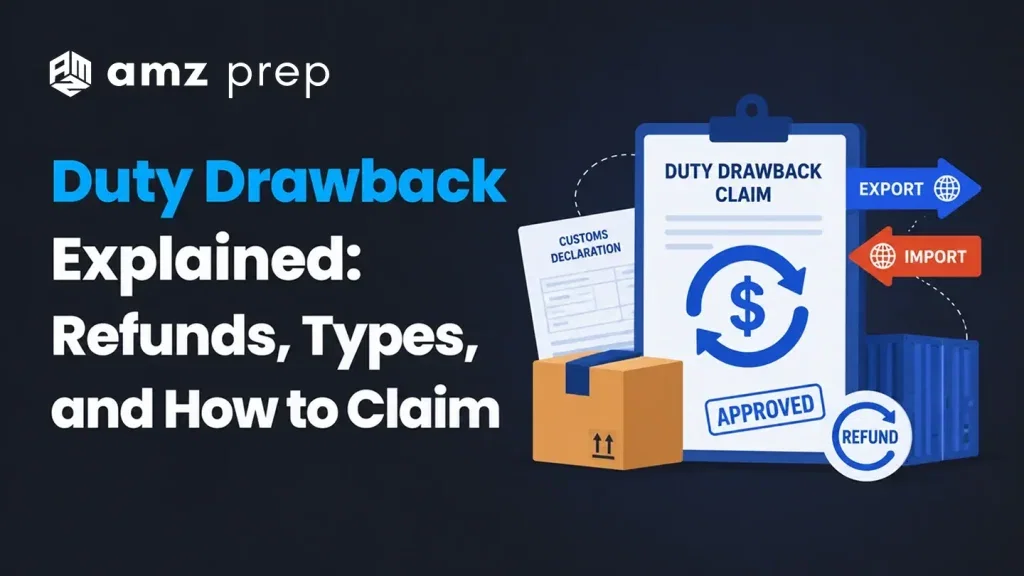
You qualify when those goods are later exported or destroyed. The program also covers goods used to make products that get exported. It runs under 19 U.S.C. § 1313 and dates back to 1789. Most importers never file. That means real refunds go unclaimed each year.
This guide explains how duty drawback works, the main types, and how to claim drawback on the duties paid.
What Is the Duty Drawback?
Duty drawback is the refund of certain customs duties, taxes, and fees. CBP pays it back when imported merchandise is exported or destroyed. Congress created it in the Tariff Act of 1789. The idea was simple. Goods that leave the country should not carry a permanent import tax.
Today the rules sit under 19 U.S.C. 1313. The current framework comes from the Trade Facilitation and Trade Enforcement Act of 2015, known as TFTEA. The duty drawback regulations live in 19 CFR 190. CBP refunds roughly $1 billion each year through this program.
The refund of duties is capped at 99% of the customs duties paid. CBP keeps 1% to cover its costs. The program is permanent. It does not depend on any single court ruling or trade event.
How the Duty Drawback Process Works
Here is the drawback process in simple steps.
- You import goods and pay customs duty.
- Those same goods, or goods made from them, leave the U.S. or get destroyed.
- You file a drawback claim with CBP.
- CBP reviews the link between the import and the export.
- CBP issues your duty drawback refund.
The match is the hard part. You must prove the import and export connection at the SKU and quantity level. CBP needs to see that the exported item traces back to duty-paid inventory.
You can look back five years from the date of import. Claims get filed through the ACE Drawback module. As of February 2026, CBP issues all drawback refunds electronically.
Types of Duty Drawback
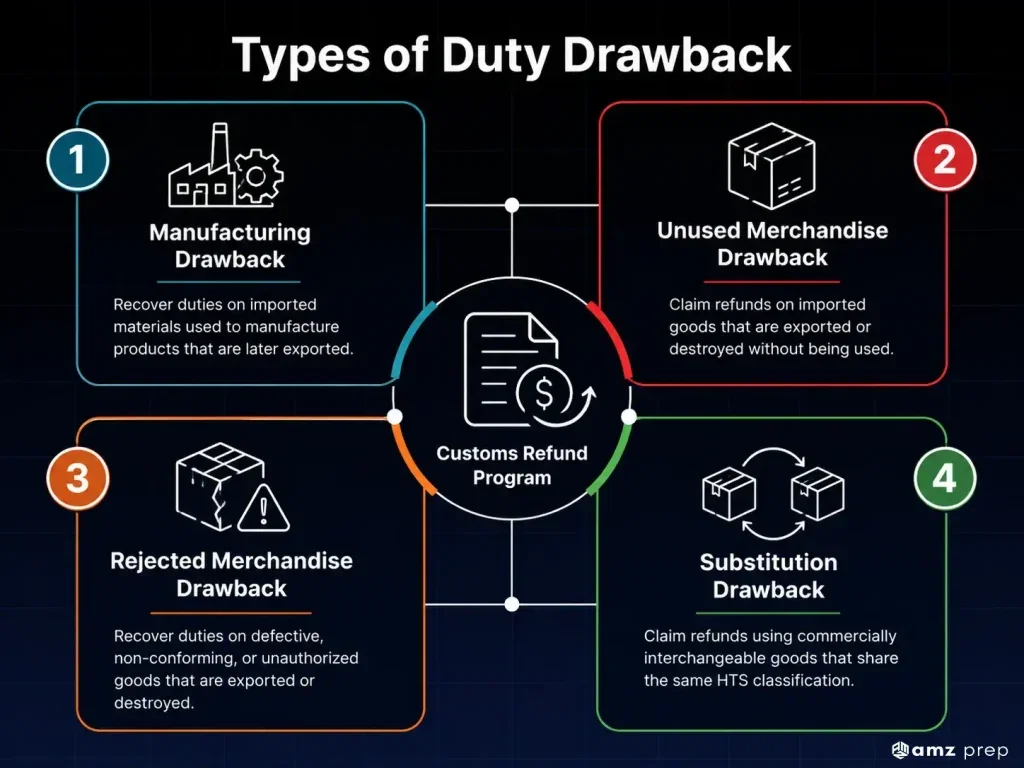
There are several drawback types. Most importers use one of four. Here are the main types of duty drawback and who each one fits.
Manufacturing drawback
Manufacturing drawback applies when you import a part or material. You use it to make a new product. Then you export that finished product. You can recover duties on the imported input.
It has two forms.
- Direct identification drawback under 1313(a) traces the exact imported item into the export.
- Substitution under 1313(b) lets you use a commercially interchangeable item instead.
Manufacturers need a CBP ruling before they file. CBP has pre-approved many common processes as general rulings.
Unused merchandise drawback
Unused merchandise drawback under 1313(j) fits ecommerce brands best. You import goods. You never use them. Then you export or destroy them in the same condition.
Picture a brand that imports sneakers for U.S. sale. It later ships some pairs to a warehouse in Europe. Those unused pairs can qualify for a 99% refund.
Rejected merchandise drawback
Rejected merchandise drawback covers goods that did not meet expectations. The items were defective. Or they did not match the sample or specification. Or they shipped without consent. You export or destroy the goods under customs supervision. Then you claim the duties back. Clean returns handling keeps the records a rejected-goods claim needs.
Substitution drawback
Substitution lets you match goods that are not identical. The imported and exported items must share the same 8-digit HTS code. This is called commercial interchangeability. Classification matters here. If the same product gets different HTS codes across entries, the match can fail. Consistent coding protects the claim.
Which Tariffs and Duties Qualify
Most customs duties paid at import can qualify. The 99% refund also covers more than the base duty. It applies to standard import duties. It applies to Section 301 duties on certain Chinese goods. It applies to the Merchandise Processing Fee. It applies to the Harbor Maintenance Fee.
Some duties do not qualify. Antidumping and countervailing duties are excluded. A few product categories carry their own limits by statute.
For brands paying high tariff rates, the numbers get large. Some Section 301 rates reach 25%. Recovering 99% of that on exported volume can mean meaningful duty recovery.
Duty Drawback vs the Ieepa Tariff Refund
People mix up two separate programs in 2026. They are not the same. One is permanent. One is a one-time refund tied to a court ruling.
| Feature | Duty drawback | IEEPA refund (CAPE) |
|---|---|---|
| What it is | Permanent refund program | One-time refund after a court ruling |
| Legal basis | 19 U.S.C. § 1313 | Court order striking certain IEEPA tariffs |
| What triggers it | Goods exported or destroyed | Having duty paid under IEEPA |
| Refund amount | Up to 99% of duties and fees | IEEPA duties paid, base duty rate stays |
| Time window | 5 years from import | Limited period, roughly April 2025 to Feb 2026 |
| Where you file | ACE Drawback module | CAPE portal in ACE |
| Frequency | Ongoing, every year | One time |
CBP opened the CAPE portal in April 2026. Treat the two as separate tracks. Drawback depends on export or destruction. The IEEPA refund does not. IEEPA-related recovery can get complex, so confirm current eligibility with a licensed customs broker before you file.
A Duty Drawback Example
Here is a clear example.
A brand imports 10,000 jackets into the U.S. It pays $80,000 in duties at a high apparel rate. The brand sells most jackets domestically. It exports 2,000 jackets to customers in Canada and the EU.
Those 2,000 jackets were never used. They left the country in the same condition. That is an unused merchandise drawback. The duty on those 2,000 jackets was $16,000. At 99%, the brand can recover $15,840. The records tie each exported unit back to the imported merchandise.
How to File a Duty Drawback Claim
Filing follows a clear path. Here is how to file a drawback claim.
- Confirm eligibility. Check that your goods were exported or destroyed and trace to duty-paid imports.
- Gather records. You need import entries, export proof, and product details. Manufacturing claims also need production records.
- File CBP Form 7553 when required. This notice covers intent to export or destroy. File it before the goods leave or get destroyed.
- Submit the duty drawback claim through the ACE Drawback module.
- Apply for accelerated payment if you want faster cash. This needs a drawback bond on file with CBP.
With accelerated payment approved, refunds often arrive within weeks. Without it, CBP review takes longer. Many brands also seek drawback privileges. These approvals speed up future claim filing.
Duty Drawback Services and Companies
Most brands do not file alone. The rules reward specialists. Here is who helps and what they do. A licensed customs broker can prepare and file claims.
A duty drawback specialist focuses only on recovery work. Software platforms automate the matching and documentation. CBP routes claims through regional drawback offices.
When you compare drawback services, look at a few things. Ask how they handle SKU-level matching. Ask how they manage customs supervision for destruction. Ask whether they support accelerated payment and bonds.
The filer is one part of the work. Your data is the other part. A claim succeeds when your import and export records are clean and connected.
How Your Fulfillment Setup Affects a Drawback Claim
Drawback runs on records. Your fulfillment partner holds most of them. That is where many claims succeed or stall.
Every refund needs proof. You must tie each exported unit to a duty-paid import. That means accurate inbound records, lot or SKU tracking, and clean export documentation. A warehouse that tracks this well makes filing far easier.
Returns matter too. A returned item that you re-export or destroy can qualify. That only works with the right paperwork and customs supervision. Strong reverse logistics keep that option open.
This is the part AMZ Prep handles for growing brands. Our cross-border fulfillment network across the U.S. and Canada keeps the inbound, inventory, and export records a drawback claim relies on. We do not file claims. We make sure your specialist has the data to file a strong one. Brands exporting from U.S. inventory run those orders through our omnichannel fulfillment network, which captures the export trail at the unit level.
Conclusion
The smartest move is to prepare your records now. Map which imported SKUs you export or destroy. Confirm your fulfillment partner tracks inbound and export data at the unit level. Then bring in a drawback specialist to file. With elevated tariffs in play, the recovery on exported volume is worth the setup.
Frequently Asked Questions About Duty Drawback
What is duty drawback in simple terms?
Duty drawback is a refund of import duties, taxes, and fees. You get up to 99% back when imported goods are later exported or destroyed. It runs under 19 U.S.C. § 1313.
How far back can you claim duty drawback?
You can claim drawback on imports going back five years from the date of importation. Claims are filed through the ACE Drawback module. The five-year window applies to most standard drawback claims.
Which duties qualify for drawback?
Standard import duties, Section 301 tariffs, the Merchandise Processing Fee, and the Harbor Maintenance Fee can qualify. Antidumping and countervailing duties do not. Some product categories carry their own statutory limits.
Do you need a customs broker to file?
No, but most brands use one. A licensed customs broker or duty drawback specialist handles matching, documentation, and filing. Accelerated payment also requires a drawback bond on file with CBP.
How long does a duty drawback refund take?
With accelerated payment and a drawback bond, refunds often arrive within weeks of filing. Without that privilege, CBP review takes longer. As of 2026, CBP issues all drawback refunds electronically.
Is duty drawback the same as the IEEPA tariff refund?
No. Duty drawback is a permanent program tied to exporting or destroying goods. The IEEPA refund is a separate, one-time process through CBP’s CAPE portal, created after a court ruling.

Chadwick Collins is an Enterprise Fulfillment Consultant at AMZ Prep, where he partners with high growth ecommerce brands to design and scale Amazon first logistics strategies. He brings extensive experience in freight, supporting brands across domestic and cross border transportation, routing optimization, and cost control.
At AMZ Prep, Chadwick works closely with enterprise clients to improve inventory flow, reduce landed costs, and accelerate delivery performance across North America. His expertise spans FBA, DTC, and B2B fulfillment, with a strong focus on aligning freight strategy with overall supply chain efficiency. He helps brands navigate complex logistics challenges while turning operations into a competitive advantage.
















Comments