
Most sellers on Amazon know FBA. Fewer know Seller Flex.

It is not a widely advertised program. Amazon rolls it out by invitation, and many sellers only hear about it once they are already deep into their fulfillment setup. But for the right seller, it changes the equation significantly. You keep your inventory. Amazon handles the delivery.
For e-commerce sellers building a long-term fulfillment strategy, here is what you need to know about the Amazon Seller Flex program: how it works, who qualifies, and what it costs.
Here is a quick summary before the full breakdown:
- Amazon’s seller flex program is invite-only and currently active primarily in India
- Sellers store inventory at their own facility. Amazon handles pickup and delivery
- Eligible sellers get the Amazon Prime badge on qualifying listings
- Amazon Seller Flex fees include referral fees and a per-shipment delivery fee. Amazon does not charge storage fees
- The program sits between FBA and FBM in terms of seller involvement
- Amazon Multi Seller Flex is a shared-facility variant of the same program
What Is the Amazon Seller Flex Program
Amazon’s seller flex program is a fulfillment option where sellers store inventory at their own facility and Amazon handles pickup and last-mile delivery. It sits between Fulfillment by Amazon (FBA) and FBM (Fulfillment by Merchant) in terms of seller involvement.
The Core Idea
Seller flex allows sellers to retain control over fulfillment without managing delivery independently. The seller handles storage, packing, and order readiness.
Amazon’s logistics partners handle everything after pickup. Customers see Prime delivery timelines on eligible listings.
Where It Runs
Amazon Seller Flex was launched in India and remains most active there. It is an invite-only program. Amazon selects sellers based on account health, sales volume, and operational capacity. Not every seller qualifies and there is no open application process.
How It Fits Into a Fulfillment Strategy
The program provides a fulfillment model that works well for sellers who already have warehouse infrastructure. Instead of sending inventory to an Amazon fulfillment center, the seller keeps stock on-site.
Managing your own warehouse gives sellers visibility over their inventory that FBA does not, making it easier to reduce amazon backorder situations and maintain product availability. The trade off is that the seller takes on more operational responsibility day to day.
What Is Amazon Multi Seller Flex
Amazon Multi Seller Flex follows the same logistics model with one difference. Multiple sellers operate from a shared or co-located facility. Storage space and operational infrastructure are divided across sellers rather than owned by one.
The fulfillment process and Amazon’s pickup mechanics work identically to standard Seller Flex.
How Fulfillment Works in Seller Flex
Seller Flex runs on a pickup model. Amazon comes to the seller. The seller does not ship into a fulfillment center.
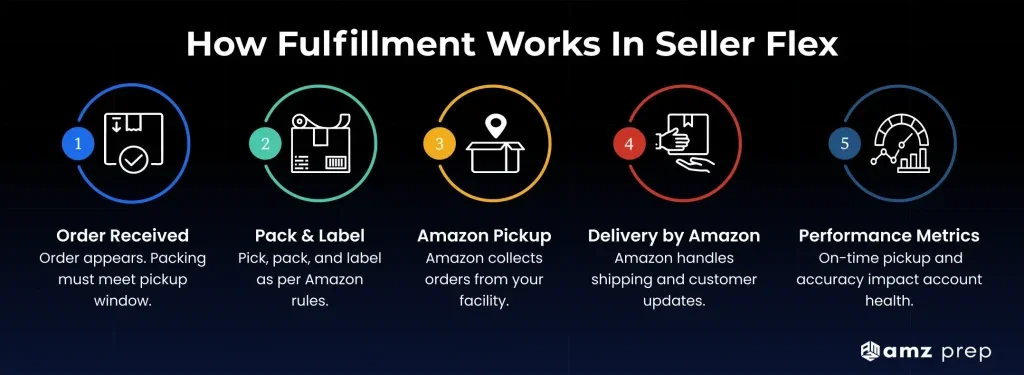
Step 1: Order Comes In
A customer places an order. Amazon routes it to the seller’s Seller Flex site. The seller sees it in Seller Central or through the flex app. From here, the clock starts. The pickup window is fixed. Orders need to be packed and ready before it closes.
Step 2: Seller Packs and Labels
The seller picks the item, packs it, and generates the shipping label through Amazon’s warehouse management system. Labels must follow Amazon’s specifications. Any mismatch at this stage causes problems downstream. Good inventory management across all active SKUs is what keeps this step clean and fast.
Step 3: Pickup Happens at the Seller’s Facility
Amazon’s delivery associate arrives at the seller’s warehouse. They scan the package and take it into Amazon’s transportation network. Using Amazon’s logistics from this point means the seller has no further role in moving the order. The handoff is logged in real time through access to Amazon’s warehouse management tools.
Step 4: Amazon Delivers to the Customer
Amazon completes delivery. Amazon handles customer communication, tracking updates, and any delivery exceptions. The seller does not manage any of this.
Step 5: Metrics Update
Once the order is fulfilled, Amazon updates the seller’s account health data. On-time pickup rate, order defect rate, and cancellation rate all move based on how each order was handled. A missed pickup window or a packing error shows up here. Consistent performance across these metrics is what keeps the WMS integration and Prime eligibility intact.
A missed pickup window triggers an immediate on-time pickup rate drop. Multiple misses put Prime badge eligibility at risk and can lead to contact Amazon support reviews of the seller’s account standing.
Amazon Seller Flex vs FBA vs Easy Ship
These three programs handle fulfillment differently. Here is how they compare.
| Factor | FBA | Seller Flex | Easy Ship |
|---|---|---|---|
| Inventory stored at | Amazon FC | Seller’s warehouse | Seller’s warehouse |
| Prime badge | Yes | Yes (when eligible) | Limited |
| Who packs orders | Amazon | Seller | Seller |
| Who delivers | Amazon | Amazon | Amazon |
| Invite required | No | Yes | No |
| Storage fees | Amazon charges | Seller bears own cost | Seller bears own cost |
| Seller responsibility | Ship to FC | Pack and prep for pickup | Pack and prep for pickup |
FBA
FBA makes sense for sellers who want hands-off fulfillment. Amazon stores, picks, packs, and ships. The FBA adoption rate helps illustrate how widely this fulfillment model is used. The trade-off is that the seller loses control over storage and pays Amazon’s storage rates.
Seller Flex
Seller Flex makes sense for sellers who already have warehouse infrastructure and want to retain control over inventory while still accessing Amazon’s delivery network and the Prime badge.
The choice between these programs is a core part of any seller’s fulfillment strategy. For sellers comparing options across such a large marketplace, understanding how many third party sellers are on Amazon can provide useful context. Some sellers use a hybrid approach: keeping standard-size products in FBA while using Seller Flex for big and bulky products.
Bulky products with higher handling requirements, or fragile products that benefit from closer oversight during packing. Different product types fit different fulfillment programs depending on size, category restrictions, and margin.
Easy Ship
It allows Amazon to pick up and deliver from the seller’s location, but Prime eligibility is more limited. It also does not carry the same operational infrastructure requirements as Seller Flex.
Seller Flex vs FBM
FBM (Fulfillment by Merchant) means the seller handles storage, packing, and delivery entirely. There is no Amazon logistics involvement. Seller Flex uses the same seller-side storage model but hands delivery off to Amazon’s transportation network. The result is Amazon Prime badge access and Amazon-managed last-mile delivery. Standard FBM provides neither.
Is Seller Flex better than Easy Ship?
For sellers with strong account health and a proper warehouse setup, Seller Flex offers Prime badge access and better delivery SLAs. Easy Ship is more accessible but carries fewer advantages in terms of Prime visibility.
Sellers with strong logistics capabilities and existing warehouse operations are best positioned to benefit from Seller Flex. For sellers without that infrastructure, FBA or Easy Ship may be a better starting point.
Amazon Seller Flex Eligibility Requirements
Amazon Seller Flex eligibility is not open to all sellers. The program is invitation-based. Amazon evaluates sellers before extending an invite.
The general criteria include:
- Strong account health across order defect rate, cancellation rate, and late shipment rate
- Established sales history on the platform
- Demonstrated ability to handle volume consistently
- A dedicated warehouse or storage facility that meets Amazon’s operational requirements
- Staff availability to manage packed orders within Amazon’s pickup windows
- Barcode scanning equipment and connectivity for Seller Central integration
What are the requirements for Seller Flex?
Beyond account metrics, sellers need physical infrastructure. A spare room or home storage setup does not qualify. Amazon expects a proper operational environment with space, staff, and process.
Managing your own warehouse at the required level means consistent staffing, reliable scanning, and the ability to handle volume spikes without missing pickup windows.
Seller rating is also a factor. Amazon looks at overall account standing, not just recent order metrics. A history of strong performance across business operations signals that the seller can sustain Seller Flex’s requirements over time.
Can small sellers use Seller Flex?
The program is better suited for sellers who already have warehouse operations in place. It requires ongoing investment in space, staffing, and equipment. Very early-stage sellers or those fulfilling low order volumes are unlikely to receive an invite or sustain the operational demands.
Amazon Multi Seller Flex eligibility follows the same base criteria. The difference is that qualifying sellers share a facility rather than operating their own standalone warehouse.
Who Benefits Most from Seller Flex
Seller Flex works best for a specific type of seller. It is not the right fit for everyone.
It suits sellers who:
- Already operate a dedicated warehouse with trained staff
- Sell heavy and bulky products or fragile products that benefit from closer packing oversight
- Want the Amazon Prime badge without sending inventory to an Amazon FC
- Have consistent monthly order volume that justifies the infrastructure investment
- Are building a hybrid approach across FBA and managing your own fulfillment for specific SKUs
It is a poor fit for sellers without dedicated warehouse space, very early-stage sellers, or those with low and inconsistent order volume.
Amazon Seller Flex Fees and Charges
Amazon Seller Flex fees follow a structure similar to other Amazon fulfillment programs, with some key differences.
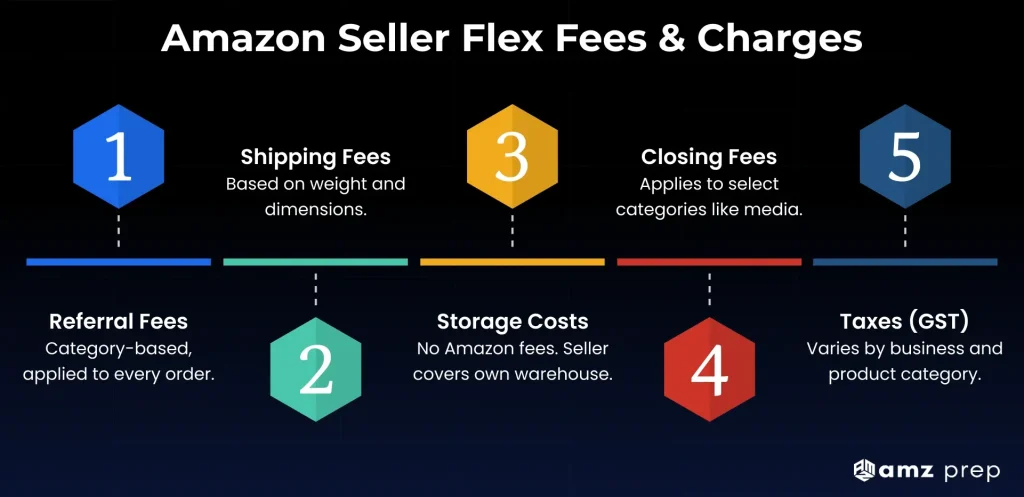
Referral fees
Referral fees apply to every order. These are category-based percentages and are the same regardless of whether the seller uses FBA, Easy Ship, or Seller Flex.
Shipping fees
Shipping fees under Amazon Seller Flex charges are based on the weight and dimensions of the shipment. Amazon applies a per-shipment delivery fee for orders fulfilled through the program. This covers the pickup and delivery service Amazon’s logistics partners provide.
Storage fees
Storage fees work differently in Seller Flex. Because inventory stays at the seller’s warehouse, Amazon does not charge storage fees. The seller bears their own warehousing costs like rent, utilities, staffing. This can be an advantage for sellers who already have warehouse space and want to avoid Amazon’s storage rate increases during peak periods.
Variable closing fees
Closing fees may apply to specific categories such as media products. These are charged per unit and are consistent across fulfillment programs.
GST and tax treatment on Amazon Seller Flex charges varies based on the seller’s business structure and category. Verifying current tax applicability with a qualified advisor is recommended.
Fee structures across Amazon programs are subject to change. Always confirm current rates inside Amazon Seller Central before building cost projections and stay informed with the latest Amazon Seller Updates 2026 to keep up with fee revisions, policy changes, and fulfillment program updates.
Returns in Amazon Seller Flex
Amazon Seller Flex returns follow Amazon’s standard customer return policy. When a customer initiates a return, Amazon manages the customer-facing communication and the return authorization process.
Returned items are sent back to the seller’s facility. They do not go to an Amazon fulfillment center. The seller receives the returned inventory and is responsible for inspecting it, determining whether it is sellable, and restocking or disposing of it accordingly.
This creates both an operational task and a tracking requirement. High return rates in Seller Flex affect account health metrics the same way they do in FBA. Order defect rate includes customer complaints, A-to-Z claims, and chargeback rates — all of which can be influenced by return patterns.
Sellers operating under Seller Flex need a process for handling inbound returns. This includes a physical inspection workflow, a disposition decision, and a restock or removal step. Without it, returned inventory accumulates without visibility and can create operational bottlenecks.
How to Join Seller Flex?
Amazon Seller Flex does not have a standard application form that all sellers can submit. Amazon identifies candidates based on internal data and extends invitations through Seller Central.
Sellers can check the Growth Opportunities section of Seller Central and watch for notifications from their account team.
To access this section, use your Amazon sign-in credentials and navigate to the Growth Opportunities tab.
The Seller Flex site within Seller Central is where program details, onboarding steps, and invite status are communicated once Amazon has identified the seller as a candidate. If an invite appears, it typically comes with instructions on next steps and a timeline for onboarding.
To join Seller Flex, sellers need to be in the right position before the invite arrives:
- Maintain an order defect rate under 1%
- Keep late shipment rate low
- Keep pre-fulfillment cancellation rate under 2.5%
- Build consistent monthly sales volume
- Have warehouse space and staff ready to operate at Amazon’s standards
Once an invite arrives, Amazon will assess the facility before activating the account. Being operationally ready at that point speeds up the process significantly.
To receive an invitation, there is no shortcut. Amazon uses internal performance data to identify candidates. Maintaining clean metrics consistently over time is the most reliable path.
If the invite does not appear in Seller Central, sellers can contact Amazon through Seller Support. Amazon support can confirm eligibility status and advise on what account improvements may be needed before the program becomes available.
One clarification worth noting: Amazon Flex is a different program entirely. The Amazon Flex program is a delivery driver program for individuals who deliver packages using their own vehicle. Drivers accept delivery blocks through the flex app. Seller Flex and the Amazon Flex program are separate with no overlap.
Does Seller Flex Give the Prime Badge?
Yes. Sellers approved for Amazon Seller Flex can display the Prime badge on eligible listings.
Prime eligibility through Seller Flex is tied to delivery performance. Amazon monitors on-time delivery rates and order quality. Sellers who consistently meet Amazon’s thresholds maintain Prime status on their listings. Those who fall below the required rates risk losing Prime eligibility on their Seller Flex orders.
The Prime badge carries real conversion weight. For sellers whose product categories see high purchase intent from Prime members, maintaining that badge is a meaningful commercial advantage particularly in a program that also allows the seller to retain control over their storage setup.
Conclusion
Amazon Seller Flex works when the operational foundation is already in place. A warehouse, a trained team, reliable scanning equipment, and a clean account health record, these are not things to build after the invite arrives. They need to be running before Amazon looks your way.
For sellers building a long-term fulfillment strategy, Seller Flex is one part of the picture. Some brands take a hybrid approach: keeping standard-size items in FBA while using Seller Flex for specialty SKUs or heavy and bulky products that benefit from closer handling. The right mix depends on product category, margin, and existing operational capacity.
If Seller Flex is on your radar, the most productive next step is a full account health review in Seller Central. Know where your defect rate, cancellation rate, and late shipment rate sit today. That is the data Amazon will use to evaluate you.
Frequently Asked Questions
What is Amazon Seller Flex and how does it work?
Amazon Seller Flex is an invite-only fulfillment program. Sellers store inventory at their own warehouse. Amazon’s logistics partners collect packed orders from the seller’s facility and handle delivery to the customer. Sellers can earn the Prime badge through the program.
Is Amazon Seller Flex available in India?
Yes. Seller Flex is primarily active in India. Amazon has expanded it selectively across the country. Availability depends on the seller’s location, account health, and whether Amazon has extended an invitation.
What are the requirements for Seller Flex?
Sellers need strong account health metrics, an established sales history, and a dedicated warehouse with trained staff and barcode scanning equipment. The facility must meet Amazon’s operational standards before activation.
Does Seller Flex give Prime badge?
Yes. Sellers enrolled in Amazon Seller Flex can offer Prime delivery on eligible orders. Maintaining Prime eligibility requires consistently meeting Amazon’s on-time delivery and order quality standards.
Is Seller Flex better than Easy Ship?
For sellers with a proper warehouse setup and strong account health, Seller Flex offers Prime badge access and better delivery SLA performance. Easy Ship is more accessible but offers fewer advantages in terms of Prime visibility and delivery positioning.
What are the fees for Amazon Seller Flex?
Amazon Seller Flex fees include a category-based referral fee and a per-shipment delivery fee based on weight and size. Storage costs are borne by the seller since inventory stays at their facility. Verify current rates in Seller Central.
Can small sellers use Seller Flex?
The program is better suited for sellers with established warehouse operations and consistent sales volume. It carries real infrastructure and staffing requirements. Very early-stage sellers are unlikely to qualify or sustain the operational demands.
How does fulfillment work in Seller Flex?
The seller packs and labels the order. Amazon’s logistics partner arrives at a scheduled pickup window to collect it. Amazon then delivers the order to the customer. The seller is responsible for order readiness before the pickup window closes.
What is Amazon Multi Seller Flex?
Amazon Multi Seller Flex follows the same logistics model as standard Seller Flex. Multiple sellers fulfill orders from a shared or co-located facility. Storage space and infrastructure are divided across sellers. Amazon’s pickup and delivery mechanics work identically to standard Seller Flex.
How do I get Amazon Seller Flex?
There is no open application. Amazon identifies candidates through internal performance data and extends invitations via Seller Central. Maintain an order defect rate under 1%, keep cancellation rates low, build consistent sales volume, and monitor the Growth Opportunities tab for an invite.


















Comments