
A brand we worked with shipped hand sanitizer for two years before realizing it was classified as a flammable liquid under federal law. They were not doing anything wrong with the product itself. The issue was documentation, labeling, and carrier declarations. None of it was in place.
That scenario is more common than most operators expect. Lithium batteries, aerosol sprays, cleaning products, essential oils, nail polish.
These are normal ecommerce SKUs. They are also dangerous goods under U.S. Department of Transportation regulations. The rules around classifying, packaging, labeling, and shipping dangerous goods are specific, and the penalties for getting it wrong are real.
This blog covers everything you need to know to ship dangerous goods correctly, whether you are managing it in-house or working with a 3PL partner.
What Qualifies as Dangerous Goods in Shipping
Dangerous goods, also called hazardous materials or hazmat, are substances or materials that pose a risk to health, safety, property, or the environment during transportation if not handled correctly.
The terms dangerous goods or hazardous materials are used interchangeably across U.S. and international regulations. They refer to the same regulated product category.
The scope of what qualifies as dangerous goods is broader than most people expect. Here are common ecommerce products that are considered dangerous when shipping:
- Hand sanitizer and alcohol-based cleaning products (flammable liquid, Class 3)
- Aerosol sprays including dry shampoo, deodorant, and hairspray (Gas, Class 2)
- Perfume and essential oils (flammable liquid, Class 3)
- Nail polish and acetone (flammable liquid, Class 3)
- Products with lithium batteries or lithium metal batteries (Miscellaneous, Class 9)
- Laptops, mobile phones, and power banks (Miscellaneous, Class 9)
- Adhesives, dyes, and solvent-based products (Class 3 or corrosive Class 8)
- Dry ice used for temperature-controlled shipments (Miscellaneous, Class 9)
The classification is based on the product’s physical and chemical properties, not its intended use or how it is marketed.
The Nine Hazard Classes Explained
The United Nations Model Regulations divide all dangerous goods into nine hazard classes. These classes are the foundation of both U.S. domestic dangerous goods regulations and international shipping frameworks.
| Hazard Class | Category | Common Ecommerce Examples |
|---|---|---|
| 1 | Explosives | Fireworks, ammunition |
| 2 | Gases | Aerosol sprays, propane, compressed air canisters |
| 3 | Flammable Liquids | Hand sanitizer, acetone, perfume, essential oils |
| 4 | Flammable Solids | Matches, metal powders, sulfur |
| 5 | Oxidizing Substances | Bleach, pool chemicals |
| 6 | Toxic and Infectious Substances | Pesticides, shipping biological samples |
| 7 | Radioactive Materials | Medical isotopes, certain industrial equipment |
| 8 | Corrosive Substances | Battery acid, industrial cleaning chemicals |
| 9 | Miscellaneous Dangerous Goods | Lithium batteries, dry ice, magnetized materials |
Class 9 is the one that catches most ecommerce brands off guard. Any product containing a lithium battery or lithium metal battery falls here, including phones, laptops, power tools, and electric toothbrushes.
The compliance requirements for these products go beyond standard parcel rules and extend into electronics fulfillment territory, covering storage, carrier approvals, and documentation.
Class 7 applies to radioactive materials and is the most tightly controlled class across all transport modes and jurisdictions.
Proper Shipping Name: What It Is and How to Find It
Every dangerous good has a proper shipping name. This is the standardized name assigned to the product in the Hazardous Materials Table (49 CFR Part 172.101).
It must appear exactly as listed on shipping labels and all documentation for dangerous goods. Using a trade name, brand name, or abbreviation instead of the proper shipping name is a violation of applicable regulations.
Here is how to find the correct proper shipping name for any regulated product:
- Locate the manufacturer’s Safety Data Sheet for the product
- Find the UN number listed on the Safety Data Sheet
- Cross-reference that UN number in the DOT Hazardous Materials Table to confirm the proper shipping name
- Use the proper shipping name exactly as written on all labels and shipping documents
An incorrect proper shipping name creates two problems. Shippers must get this right at carrier intake or the shipment will be rejected. At the border, incorrect documentation for dangerous goods delays clearance and can trigger fines under government regulations.
Dangerous Goods Shipping Regulations by Mode and Jurisdiction
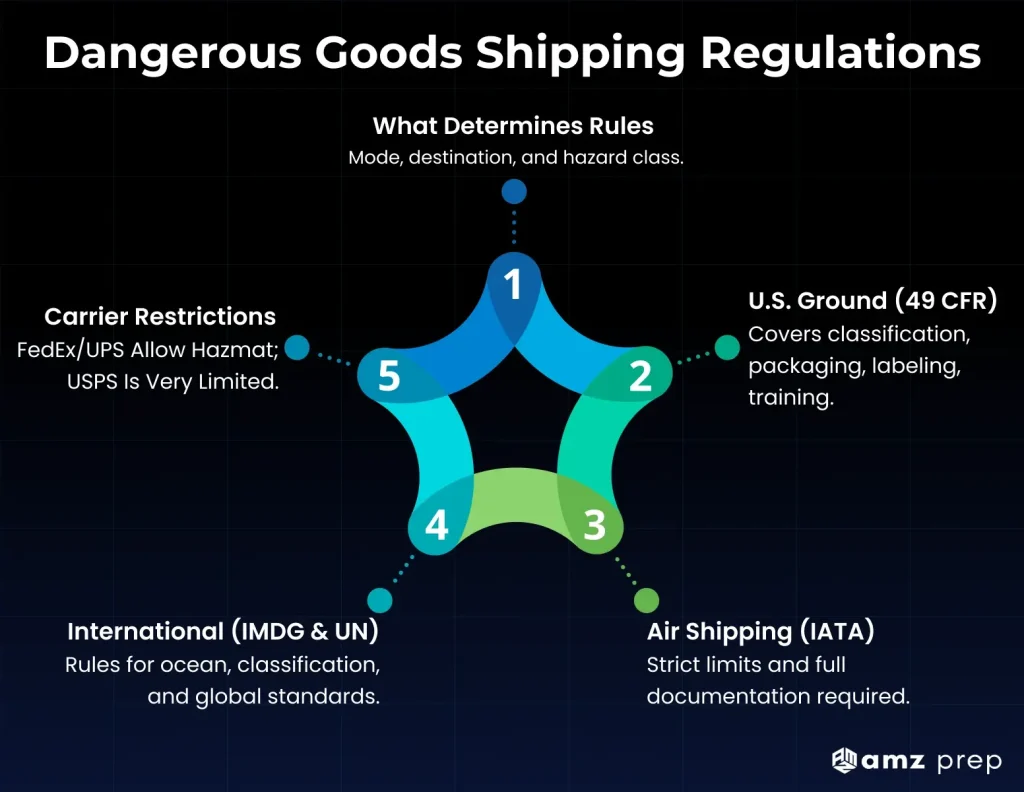
Which shipping regulations apply depends on three things: how the product moves, where it is going, and what hazard class it falls under.
U.S. Domestic Ground: Title 49 and the Code of Federal Regulations
For shipping dangerous goods within the United States by ground, Title 49 of the Code of Federal Regulations is the governing framework. The Pipeline and Hazardous Materials Safety Administration (PHMSA) within the Department of Transportation enforces the 49 Code of Federal Regulations.
The 49 CFR covers:
- How to correctly classify a hazardous material or dangerous good
- Limited quantity provisions and quantity limits per package
- Packaging requirements by hazard class and packing group
- Labeling specifications for dangerous goods packages
- Required documentation for dangerous goods shipments
- Training requirements for all staff handling regulated products
The penalty structure is steep. Shippers must understand that standard violations carry civil fines up to $89,678 per violation per day. Violations that result in injury, death, or significant property damage can reach $209,249 per violation per day.
IATA Regulations and Dangerous Goods by Air
Dangerous goods by air are governed by IATA Dangerous Goods Regulations, published annually by the International Air Transport Association. The International Civil Aviation Organization (ICAO) sets the legal framework that IATA regulations are built on, making IATA the operational standard most carriers and shippers use in practice.
IATA applies the strictest quantity limits across all transport modes, particularly for flammable liquids, lithium batteries, and corrosive substances.
Shipping hazardous materials by air requires full compliance automation with IATA Dangerous goods shipment, including correct classification, outer packaging, labeling, and a completed Shipper’s Declaration.
International Shipping Regulations: IMDG and Beyond
Three frameworks govern dangerous goods international shipping, and which one applies depends on how the product travels.
| Framework | Applies To | Key Requirement |
|---|---|---|
| IATA Dangerous Goods Regulations | Air transport | Strictest quantity limits per hazard class |
| IMDG Code | Ocean freight | Stowage, segregation, and packaging requirements |
| UN Model Regulations | Both (foundation) | Classification baseline for all international regulations |
International regulations also require a Declaration for Dangerous Goods, also referred to as the Shipper’s Declaration. This shipper-completed form certifies the shipment has been packed, labeled, and declared in line with applicable regulations. The merchant is legally responsible for its accuracy, even when a 3PL completes it on their behalf.
Every destination country can layer its own laws and regulations on top of these international frameworks, which is why freight forwarding for regulated goods requires more documentation groundwork than standard international shipments.
Carrier-Specific Shipping Regulations
Shipping regulations from PHMSA are the legal minimum. FedEx, UPS, and USPS each add their own requirements on top of that baseline.
| Carrier | Domestic Hazmat | Key Restrictions |
|---|---|---|
| FedEx | Ground and air | FedEx provides hazmat shipping services for most classes; air has tighter quantity limits |
| UPS | Ground and air | Similar to FedEx; carrier approval required for some classes |
| USPS | Very limited | Not a viable shipping solution for most business hazmat shipments |
Carrier approval is not automatic. Before routing any item you are shipping under a regulated class, confirm that the specific UN numbers and hazard class are accepted under that carrier’s current hazardous materials regulations program.
This applies equally to parcel and LTL freight shipments, where pallet-level dangerous goods have additional stowage and documentation requirements.
Packaging Requirements for Dangerous Goods Shipments
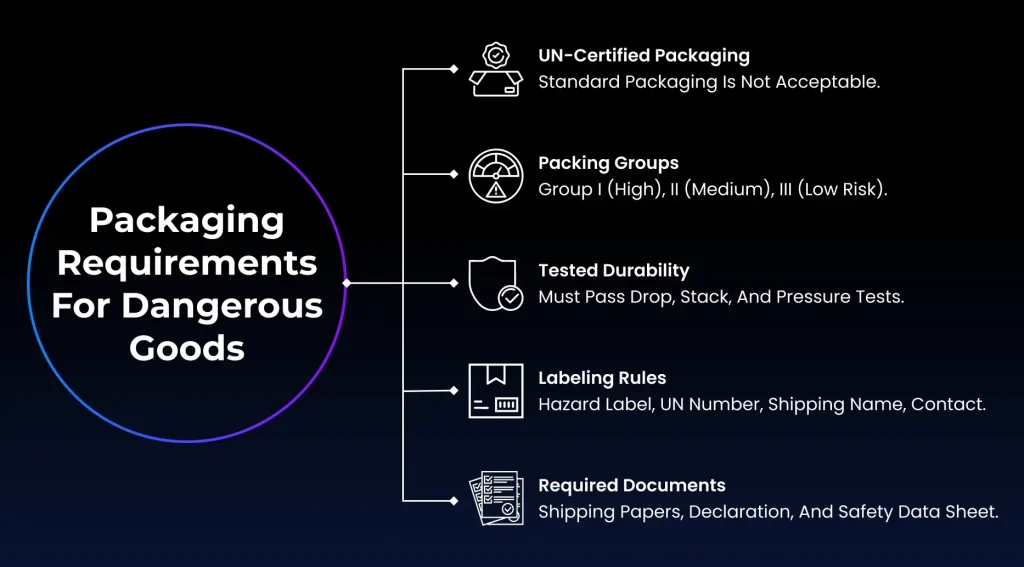
Standard retail or DTC packaging is not acceptable for regulated products. Dangerous goods packages must meet UN-specification standards tested and certified for the product’s hazard class and assigned packing group.
Packing Groups and Packaging Requirements
Packing groups determine how stringent the packaging requirements are:
- Packing Group I: High-danger goods. Most rigorous outer packaging standard.
- Packing Group II: Medium-danger goods. Intermediate standard.
- Packing Group III: Lower-danger goods. Least restrictive packaging requirements.
Container and outer packaging must be certified for the assigned packing group. Certification testing covers drops, stacking pressure, and hydraulic pressure for liquids. Inner packaging must contain the product safely under normal transport conditions.
Inner packaging must contain the product safely under normal transport conditions.
Labeling Requirements for Dangerous Goods Packages
Every dangerous goods package must display:
- The correct hazard class diamond for the product’s regulated class
- The UN number (format: UN followed by four digits, for example UN3481 for lithium batteries packed with equipment)
- The proper shipping name
- Emergency contact information for the shipper
Labels must appear on one face of the outer packaging without folding around a corner and must remain legible from intake through final delivery.
For products entering FBA, these labeling rules sit on top of Amazon’s own packaging requirements, which add another layer of compliance to manage.
Documentation for Dangerous Goods
| Document | When Required |
|---|---|
| Shipping Paper | All domestic U.S. regulated shipments |
| Declaration for Dangerous Goods / Shipper’s Declaration | All international regulated shipments |
| Safety Data Sheet | Must be accessible; accompanies international shipments |
Shippers must ensure documentation for dangerous goods is complete before the shipment leaves the warehouse. Non-compliant packaging and incomplete documentation are the most common reasons dangerous goods shipments are rejected at carrier intake or held at customs.
Dangerous Goods Training and Certification Requirements
Training is required under U.S. federal law for anyone who prepares, offers, or transports regulated shipments. This is a mandate under 49 CFR 172.704, not a recommendation.
Dangerous goods training must be completed before a person performs any function related to shipping hazardous materials.
Dangerous goods shipping certification covers three areas:
| Training Type | What It Covers |
|---|---|
| General Awareness | What dangerous goods are, how they are classified, and the applicable regulations |
| Function-Specific | Packaging, labeling, completing documentation for dangerous goods, loading |
| Safety | Emergency response for spills, leaks, fires, and exposure incidents |
Recurrent training is required every three years. This is sometimes called recurrent training under IATA regulations and competency-based training in international frameworks. Training records must be kept for at least three years after each employee’s most recent dangerous goods training session.
When a brand outsources shipping hazardous materials to a certified 3PL, the training obligation shifts to the 3PL for the functions they perform. The brand retains responsibility for accurate product classification and the documentation it provides.
Before selecting any 3PL for regulated products, ask to see proof of current dangerous goods shipping certification for all staff handling your goods shipments.
An expired certification means a non-compliant operation, and that exposure falls on the brand as the shipper.
Dangerous Goods Shipping Software
At low volumes, managing hazmat classification and documentation for dangerous goods manually works. As SKU count and shipping volume grow, manual processes become a compliance liability under strict regulations. Dangerous goods shipping software reduces error risk by systematizing the classification, documentation, and carrier validation workflow.
Key capabilities to look for in a dangerous goods shipping software solution:
- Automated classification: Validates products against the federal hazardous materials table and flags regulated items at entry
- Declaration for Dangerous Goods generation: Automates the Shipper’s Declaration for international shipments, reducing proper shipping name and UN number errors
- UN number and PSN validation: Cross-checks product data against current applicable regulations
- Carrier rule validation: Checks each product against FedEx, UPS, and other carrier-specific hazardous materials regulations before the shipment is prepared
- Audit trail: Stores documentation for dangerous goods records for every regulated shipment to support compliance review under government regulations
Software does not replace trained staff. Classification decisions and documentation sign-off still require a person who understands the applicable regulations. What software does is reduce manual workload and documentation error rates across a high-volume regulated operation.
Handling Hazardous Materials: What to Verify Before Choosing a 3PL
Not every 3PL can manage dangerous goods shipping. Here is the checklist to use when evaluating any partner for handling hazardous materials and regulated goods shipments:
| Verification Item | What to Ask |
|---|---|
| Dangerous goods training certifications | Can they provide proof of current dangerous goods shipping certification for all staff handling your SKUs? |
| Physical storage compliance | Do they have fire-rated storage, ventilation, spill containment, and container segregation for incompatible hazard classes? |
| Carrier approvals | Which shipping service providers are they approved with for hazmat, and for which specific UN numbers and hazard classes? |
| Documentation for dangerous goods | Can they generate shipping papers for domestic and Shipper’s Declaration / Declaration for Dangerous Goods for international shipments? |
| Shipping software | Do they use dangerous goods shipping software for classification validation and documentation management? |
| FBA hazmat experience | Have they managed FBA dangerous goods submissions and FBM fulfillment for brands whose products were rejected from or capped within the FBA program? |
If a 3PL hesitates on any of these, that is the answer. Hazmat credentials cover the regulatory side, but the pick and pack workflow is where compliance either holds or breaks down at the order level.
Here’s how AMZ Prep handles hazmat fulfillment across Amazon FBA, SFP, and nationwide shipping.
Conclusion
Most brands selling lithium batteries, aerosols, flammable liquids, or corrosive products are already operating inside a regulated supply chain, whether they know it or not. The classification is not something you opt into. It applies based on what is in the product and how it must comply with federal hazardous materials rules.
Brands that build compliant dangerous goods shipping operations early avoid the carrier rejections, customs delays, and Department of Transportation penalties that come later.
And the ones who work with a 3PL already holding the dangerous goods shipping certification, compliant storage, and carrier approvals remove the infrastructure burden entirely from their internal team.
Our team at AMZ Prep works with brands across regulated categories every day. If you need a logistics partner who already has this infrastructure in place, get in touch with our team and we can walk through what compliant fulfillment looks like for your specific product mix.
Frequently Asked Questions
What is considered dangerous goods for shipping?
Dangerous goods or hazardous materials are substances or materials that pose a risk to health, safety, property, or the environment during transport. This includes flammable liquids, gases, corrosive substances, toxic substances, lithium batteries, and aerosols. Many everyday ecommerce products fall into this category.
What is the proper shipping name of dangerous goods?
The proper shipping name is the standardized name from the Department of Transportation Hazardous Materials Table (49 CFR Part 172.101). Find it by locating the UN number on the product’s Safety Data Sheet, then cross-referencing it in the federal table. Use the proper shipping name exactly as listed on all labels and documentation for dangerous goods.
What qualifies as dangerous goods when shipping internationally?
The same nine hazard classes apply internationally. Air shipments follow IATA Dangerous Goods Regulations from the International Air Transport Association. Ocean shipments follow the IMDG Code. Each destination country may impose additional laws and regulations on top of these international regulations.
What are the penalties for non-compliance with dangerous goods shipping regulations?
U.S. Department of Transportation civil penalties reach up to $89,678 per violation per day for standard violations. Violations that cause injury, death, or property damage can reach $209,249 per violation per day. Carriers including FedEx may also suspend shipping service access for non-compliant accounts.
Does my 3PL need special certification to handle dangerous goods?
Yes. U.S. DOT and IATA regulations both require that staff who prepare, offer, or transport regulated shipments hold current dangerous goods training certifications. Recurrent training is required every three years. Verify certifications before routing any regulated goods shipments through a 3PL facility.

















Comments