
Amazon Merch on Demand is Amazon’s print-on-demand service. You upload a design, Amazon prints and ships each item after purchase, and you earn a royalty per sale. There is no inventory, no upfront cost, and no fulfillment work.
In June 2026, Amazon replaced its flat-rate royalty model with a three-tier system based on where your traffic comes from. Base royalty on a $19.99 t-shirt dropped to $2.44 at Creator Tier. Listings with no sales in 18 months are now deleted automatically. This guide covers what changed, how the tiers work, and how to earn more per sale.
This guide covers every 2026 update, how the new royalty tiers work, and how to build a strategy that earns more per sale.
What Is Amazon Merch on Demand?
Amazon Merch on Demand is Amazon’s own print-on-demand platform. Sellers upload artwork and apply it to products including t-shirts, hoodies, sweatshirts, tank tops, phone cases, and PopSockets. Amazon prints each unit only after a customer purchases it, then ships via Prime and manages all customer communication and returns.
Is Amazon Merch on Demand free to use?
Yes. Amazon Merch on Demand has no sign-up fee, no monthly subscription, and no listing fee. Amazon deducts production costs and a 15% referral fee from the sale price before calculating your royalty. You pay nothing upfront.
Is Amazon Merch on Demand legit?
Yes. Amazon Merch on Demand is an official Amazon program, launched in 2015 as Merch by Amazon. It operates on the same fulfillment infrastructure as the rest of the Amazon marketplace and pays royalties monthly via direct deposit.
The business model fits three use cases:
- Design validation: Test demand for new artwork before committing to bulk inventory
- Low-MOQ apparel expansion: Launch branded apparel without minimum order quantities or warehouse costs
- Supplemental royalty income: Generate recurring revenue from existing brand assets and original designs
What you control: artwork, product selection, listing content, pricing within Amazon’s set range, and marketplace selection (US, UK, DE, FR, IT, ES, JP).
What Amazon controls: production quality, fulfillment timing, the post-purchase customer relationship, your upload capacity through the tier system, and listing visibility in search.
The trade-off is margin and control for zero fulfillment overhead. Whether that trade-off is worth it depends on where you are in your product lifecycle.
How Amazon Merch on Demand Works: The Full Workflow
How do I sign up for Amazon Merch on Demand?
Apply at merch.amazon.com. Provide your business details, tax ID, and bank account. Amazon reviews manually over 2 to 8 weeks. Approval rates in 2026 sit around 30 to 40%. If denied, wait 60 days before reapplying.
Step 1: Account Approval
Submit your application at merch.amazon.com. Provide your business details, tax ID (EIN preferred over SSN), and bank account. Amazon reviews manually. Typical wait time is 2 to 8 weeks with no status updates during review. Approval rates in 2026 sit at approximately 30 to 40% of all applications, down from prior years, following a wave of AI-generated spam accounts.
If denied, wait 60 days before reapplying.

Step 2: Design Upload
Create PNG files at 4,500 x 5,400 pixels at 300 DPI with a transparent background in sRGB color profile. Upload via the Merch dashboard. Select product types and color options. Amazon generates mockups automatically.
Design quality is your entire product strategy here. Treat each upload with the same rigor you would apply to sourcing a physical SKU.

Step 3: Listing Optimization
Write a product title of 60 to 80 characters with primary keywords near the front. Add three bullet points of up to 256 characters each. Complete the product description and backend search terms. Amazon indexes the listing within 24 to 72 hours of approval.
Listing copy has more impact on whether a design sells than almost any other variable after design quality itself. Strong Amazon listing optimization follows the same keyword principles that apply to physical product listings.
Step 4: Pricing
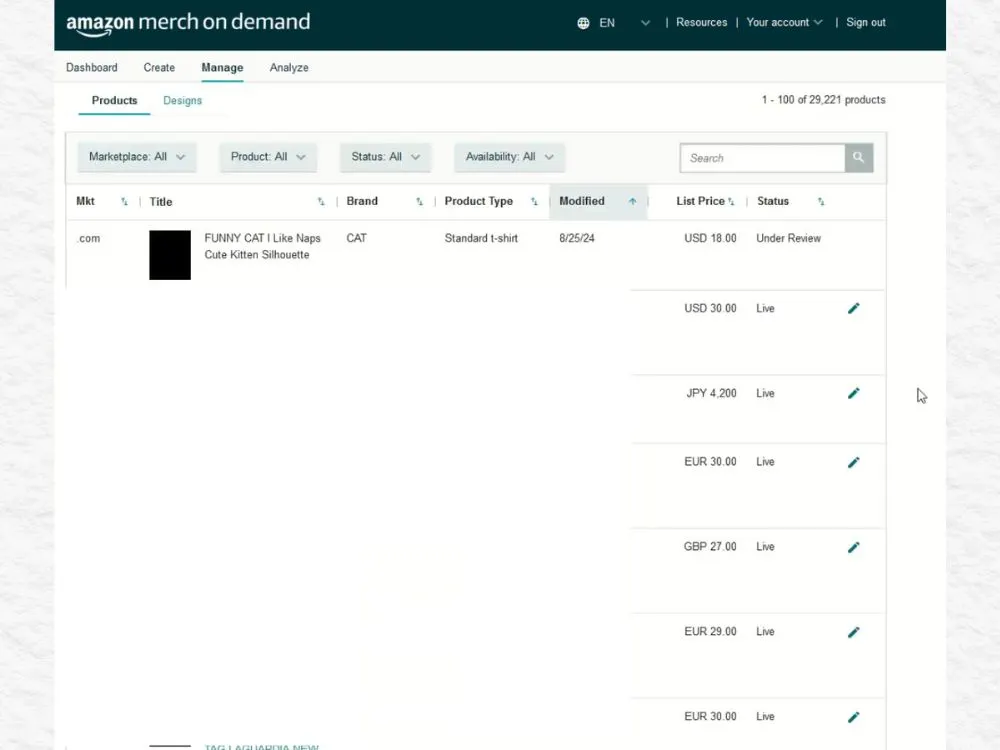
Set your list price. Amazon calculates and displays your royalty in real time using this formula:
Royalty = List Price minus Production Cost minus Referral Fee (15%) minus Applicable Taxes
Your royalty tier (Creator, Plus, or Premium) then applies a multiplier to that base figure.
Step 5: Review and Publication
Amazon reviews each design for trademark violations and content policy compliance. Approved designs go live within 1 to 3 business days. Rejected designs require correction and resubmission.
Step 6: Sales and Payouts
Royalties accumulate monthly. Amazon pays out on a 60-day cycle: April sales pay out on June 30. Direct deposit (EFT) carries a $0 minimum. Wire transfer and check require a $100 minimum per marketplace, with earnings rolling over until that threshold is reached.
When Merch on Demand Makes Sense vs. Traditional Fulfillment
Amazon Merch on Demand works for specific stages of a brand’s lifecycle. It does not replace traditional inventory for established products with proven velocity.
Use Merch on Demand when:
- Testing new designs with zero financial risk
- Launching limited-edition drops without MOQ commitments
- Expanding into apparel without warehouse infrastructure
- Generating passive income from existing brand IP
Use traditional fulfillment when:
- You have proven bestsellers with consistent monthly volume
- Order volume exceeds 100 units per month per SKU
- You need custom packaging or branded inserts
- Bulk production cost per unit falls below $5 (Merch production cost ranges $8 to $15)
The hybrid approach:
Start with Merch to validate designs at zero cost. Graduate winners to bulk inventory through your 3PL. Keep slow-sellers on Merch to avoid dead stock.
At 10 units per month, a shirt earning $2.44 on Merch generates $24.40 monthly. The same shirt produced in bulk at $4.50 per unit and fulfilled through FBA can earn $12 or more per sale, reaching $120 per month at the same volume. Break-even on the inventory investment lands around four months.
Brands using AMZ Prep’s FBA prep services regularly make this transition as part of a planned launch sequence. Merch validates the design. FBA scales the winner.
How Does the New Royalty Tier System Work in 2026?

This is the most significant change to Amazon Merch on Demand in 2026. As of June 1, Amazon replaced the old flat-rate model with a performance-based, three-tier royalty system. Your earnings per sale now depend on where your traffic comes from. This is confirmed directly in Amazon’s Merch on Demand resource center.
What Is the Creator Tier Royalty Rate?
The Creator Tier pays $2.44 per sale on a $19.99 t-shirt. This is the default level for all sellers. Traffic from Amazon’s organic search, category browsing, and recommendation engine qualifies at this rate.
The default for all sellers. Traffic coming entirely through Amazon’s organic search, category browsing, and recommendation engine qualifies at this level. A standard t-shirt priced at $19.99 earns a $2.44 royalty at Creator Tier.
This is the number most current guides are still getting wrong. If your Merch on Demand royalties look lower than expected, the June 2026 tier restructure is the reason.
How Does the Plus Tier Work?
Plus Tier pays $4.88 per sale on a $19.99 t-shirt. Sellers who drive at least 15% of monthly unit sales from non-organic sources qualify. Non-organic sources include social media, external blog traffic, email campaigns, and Amazon Ads tracked through Amazon Attribution.
Sellers who drive at least 15% of their monthly unit sales from non-organic sources earn twice the Creator Tier rate. Non-organic sources include social media, external blog traffic, email campaigns, and Amazon Ads. On the same $19.99 t-shirt, Plus Tier pays $4.88 per sale.
Amazon Attribution links are the tracking mechanism. Any external traffic not tracked through Attribution does not count toward Plus Tier qualification. Understanding how Amazon Attribution works is now essential for any seller who wants competitive royalties.
What Is the Premium Tier Rate?
Premium Tier pays $5.27 per sale on a $19.99 t-shirt. Sellers who drive over 35% of monthly sales from external sources qualify. This requires a cross-channel operation: social audiences, email lists, or content audiences routed to Amazon through tracked Attribution links.
Sellers driving over 35% of their monthly sales from external sources earn 2.16x the Creator base rate. On a $19.99 t-shirt, Premium Tier pays $5.27 per sale.
Premium Tier sellers are running a cross-channel operation: social audiences, email subscribers, or content audiences that route to Amazon listings through tracked links.
How Often Do Royalty Tiers Reset?
Tier qualification resets based on trailing 12-month performance. Accounts with zero sales for 12 consecutive months may be downgraded. Sellers who were previously passive now have a direct financial incentive to drive consistent traffic.
2026 Royalty Table: All Products, All Tiers
| Product | Production Cost | Recommended Price | Creator Tier | Plus Tier | Premium Tier |
|---|---|---|---|---|---|
| Standard T-Shirt | $8.21 | $17.99–$19.99 | $2.44–$4.18 | $4.88–$8.36 | $5.27–$9.03 |
| Premium T-Shirt | $10.73 | $21.99–$24.99 | $4.83–$7.13 | $9.66–$14.26 | $10.43–$15.40 |
| Pullover Hoodie | $17.59 | $32.99–$39.99 | $8.40–$13.20 | $16.80–$26.40 | $18.14–$28.51 |
| Sweatshirt | $15.47 | $28.99–$32.99 | $7.59–$10.49 | $15.18–$20.98 | $16.39–$22.66 |
| Long Sleeve | $11.37 | $22.99–$25.99 | $5.96–$8.36 | $11.92–$16.72 | $12.87–$18.06 |
| Tank Top | $7.73 | $17.99–$19.99 | $4.66–$6.26 | $9.32–$12.52 | $10.07–$13.52 |
| PopSocket | $5.14 | $12.99–$14.99 | $2.91–$4.21 | $5.82–$8.42 | $6.28–$9.09 |
| Phone Case | $8.47 | $17.99–$21.99 | $4.18–$7.18 | $8.36–$14.36 | $9.03–$15.51 |
Production costs sourced from the Amazon Merch on Demand resource center. Royalty figures calculated using Amazon’s formula and June 2026 tier multipliers. Verify current figures in your Merch dashboard before publishing listings.
How Long Before Amazon Deletes an Inactive Listing?
As of 2026, Amazon automatically deletes listings that record no sales within their first 18 months. This is a catalog cleanup measure aimed at removing inactive, low-quality, or oversaturated designs.
Amazon deletes listings with no sales within 18 months of going live. This applies to all Merch on Demand products and cannot be overridden. Deleted listings also count against your account health history.
What this means in practice:
- Designs must generate at least one sale within 18 months of going live or they are removed
- Deleted listings count against your account health history
- Designs targeting seasonal niches with long wait times carry the highest risk
The fix is not to upload fewer designs. It is to upload designs with a credible path to at least one sale. Niche-specific designs in low-competition categories with optimized listing copy convert better than generic designs uploaded at volume. This is also where understanding your Amazon product research process carries over directly from physical product selling.
Does Video Improve Amazon Merch on Demand Rankings?
Yes. In 2026, Amazon’s A9 algorithm applies a Motion Rank signal to listings with video content. Listings with a 15-second lifestyle video convert approximately 22% better than static image listings and receive preferential placement in search results.
Video is no longer optional for top search placement. It is a ranking input.
What works: short clips of 15 to 30 seconds showing the design on a real person in a natural setting. Flat-lay studio footage does not produce the same ranking signal as lifestyle footage. The same principles that drive Amazon A+ content performance apply here: showing the product in real context converts better than showing it in isolation.
Amazon’s video content policy still applies. No third-party branding, no misleading claims, no copyrighted music.
Merch on Demand vs. Seller Central + POD Provider
Two separate paths exist for print-on-demand selling on Amazon. Most guides treat them as the same model. They are not.
| Factor | Merch on Demand | Seller Central + Printful/Gelato |
|---|---|---|
| Access | Invite-only, tier-limited | Open to all Seller Central accounts |
| Upload cap | Set by your tier | Unlimited |
| Who owns the listing | Amazon | You |
| Who owns the customer | Amazon | You (with DTC potential) |
| Profit per unit (standard tee, Creator Tier) | $2.44 to $5.27 depending on tier | Approximately $3.54 after all fees |
| Multichannel expansion | Amazon-only | Available across channels |
| Brand control | Low | High |
| Bottom Line | Easier entry, less control | More complexity, full ownership |
At low volume, Merch on Demand produces a higher per-unit return than Seller Central plus a POD provider. That reverses at scale. At 100 or more units per month, Seller Central gives you customer data, retargeting capability, and multichannel expansion options that Merch cannot. Brands building toward omnichannel fulfillment typically move their proven Merch designs into Seller Central as part of that wider channel expansion.
Both can run simultaneously. Many brands maintain Merch for Amazon-exclusive designs and Seller Central for their primary catalog.
The Upload Tier System
Amazon controls how many designs you can have live at once through a tier structure. Progression requires sales, not just uploads.
| Tier | Design Slots | Sales Required | Avg. Time to Reach |
|---|---|---|---|
| Tier 10 | $10.00 | None (starting tier) | Day 1 |
| Tier 25 | $25.00 | 10 sales | 2 to 6 months |
| Tier 100 | $100.00 | 25 sales | 4 to 12 months |
| Tier 500 | $500.00 | 100 sales | 8 to 18 months |
| Tier 1,000 | $1,000.00 | 500 sales | 12 to 24 months |
| Tier 2,000+ | 2,000+ | Performance-based | 18+ months |
Tier progression is not automatic. Amazon reviews account health, return rates, and content violation history before approving upgrades. Clean accounts with consistent sales velocity progress faster. Q4 holiday periods often produce bulk tier upgrades for accounts with strong sales momentum.
With the 2026 trailing 12-month reset, tier status is no longer permanent. Accounts that go inactive face demotion. This applies to Amazon Merch tiers specifically and is separate from any Seller Central account standing.
2026 Listing Optimization Updates
Amazon changed listing requirements for Merch in Q1 2026. These updates apply to every Amazon Merch on Demand listing going forward.
1. Video (Required for Top Placement)
15 to 30 seconds. Lifestyle footage of the product being worn or used in a real setting. Motion Rank is now a ranking input in Amazon’s A9 algorithm. Static mockups alone will not achieve top search placement for competitive keywords.
2. Title
60 to 80 characters. Primary keyword near the front. Describe what the design actually is, not what the product category is. “Funny Cat Dad Graphic T-Shirt” outperforms “Men’s Short Sleeve T-Shirt” in search placement.
3. Bullet Points
Three maximum, each under 256 characters. Lead with the design concept in the first bullet. Second bullet covers product specifics: material, fit, and available sizes. Third bullet addresses gifting or use-case context.
4. Backend Search Terms
250 characters maximum. No repetition of terms already in the title. Include synonyms, alternate phrasings, and related niche terms.
5. Pricing by Tier Stage
Tiers 10 to 25: Price at the lower end of the recommended range. Conversion rate matters more than per-unit royalty at this stage. The goal is reaching the sales thresholds needed for tier progression.
Tiers 500 and above: Test price in $2 increments. Optimize for total monthly royalty revenue (price multiplied by conversion multiplied by impressions), not per-unit royalty.Q4 pricing: Raise prices 10 to 15% from October through December. Demand consistently exceeds supply for well-positioned designs during the holiday period. EU marketplace production costs run 8 to 12% higher than US. Japan runs 15 to 20% higher. Adjust list prices accordingly when publishing across international marketplaces.
2026 Application Requirements
Amazon tightened its approval criteria in 2026 to filter AI-generated account spam. Current approval rate: approximately 30 to 40%.
Factors that improve approval odds:
- Design portfolio: Link to Behance, Dribbble, Instagram, or Etsy. Amazon verifies original creative work.
- Business legitimacy signals: Business email domain, EIN over SSN, business website if available.
- Original application statement: Write 2 to 3 sentences about your design background. Amazon’s review system detects template responses.
- First application timing: First-time applicants have higher approval rates than reapplications. Wait at least 60 days before reapplying if denied.
Factors that trigger automatic rejection:
- AI-generated artwork in your portfolio samples
- Trademarked imagery in design examples
- Gmail or Yahoo address with no supporting business information
- No design portfolio or external proof of creative work
- Multiple applications from the same IP address
How to Reach Plus and Premium Tier
The biggest royalty improvement available in 2026 is not pricing. It is tier qualification.
Moving from Creator ($2.44 per sale on a standard tee) to Plus ($4.88) doubles per-unit earnings with no change to the listing. Moving to Premium ($5.27) increases that further.
How to build the external traffic share needed for Plus Tier:
- Set up Amazon Attribution tracking links for all external traffic sources
- Share designs through social channels with tracked links pointing to your Amazon listing
- Use email if you have a subscriber list – every tracked external sale counts toward the 15% threshold
- Run Amazon Sponsored Products ads – these count as non-organic traffic toward Plus Tier qualification
At 100 sales per month, 15 external-traffic sales qualifies you for Plus Tier. That is a realistic target within the first few months at Tier 100.
When to Move Beyond Merch on Demand
Amazon Merch on Demand produces its best returns in the validation phase. Once a design proves consistent demand, traditional inventory delivers significantly better margins.
The graduation signal: any design hitting 30 or more units per month on Merch is worth evaluating for bulk production. At 50 units per month, the margin difference between Merch royalties and FBA margins covers inventory investment within two to three months.
The transition path most brands follow:
- Validate design on Merch with zero inventory risk
- Identify top-performing designs by units per month over a 90-day window
- Source bulk production at $4 to $6 per unit depending on product type and supplier
- Send inventory to an FBA prep center for labeling, quality checks, and inbound shipment creation
- Launch FBA listing on the same keyword set as the Merch listing
- Keep the Merch listing live for the long tail, it costs nothing and captures residual traffic
AMZ Prep’s FBA prep services handle the full inbound workflow for brands making this transition, from receiving bulk production inventory to creating compliant shipments directly into Amazon’s fulfillment network. Brands already running apparel fulfillment through a 3PL can fold Merch-validated designs into their existing fulfillment infrastructure with minimal additional overhead.
Frequently Asked Questions
What is Amazon Merch on Demand?
Amazon Merch on Demand is Amazon’s print-on-demand service. Sellers upload designs and Amazon prints, ships, and handles customer service for each order. Sellers earn a royalty per sale with no inventory, no storage fees, and no fulfillment overhead.
How much does Amazon Merch on Demand pay per sale in 2026?
A standard t-shirt at $19.99 pays $2.44 at Creator Tier, $4.88 at Plus Tier, and $5.27 at Premium Tier. Plus Tier requires 15% or more of sales from external traffic. Premium requires 35% or more.
What changed with Amazon Merch royalties in June 2026?
Amazon replaced its flat-rate model with three tiers: Creator, Plus, and Premium. The base Creator rate on a standard t-shirt dropped from approximately $5.78 to $2.44. Sellers driving external traffic qualify for Plus or Premium rates.
Why are my Merch on Demand earnings lower in 2026?
The June 2026 royalty restructure reduced the base Creator Tier royalty significantly. If your traffic is entirely organic through Amazon search, your per-sale earnings are lower than under the old flat-rate model. Driving external traffic through Amazon Attribution qualifies you for Plus or Premium Tier, which restores or exceeds prior earnings.
What is the 18-month listing deletion policy?
Listings that record zero sales within their first 18 months are automatically removed. This applies to all Merch on Demand designs. Niche-targeted designs with optimized listing copy reduce this risk by improving conversion from organic search.
How do I qualify for Plus or Premium Tier?
Plus Tier requires 15% or more of monthly unit sales to come from non-organic sources, tracked through Amazon Attribution links. Premium Tier requires 35% or more. External sources include social media, email, content traffic, and Amazon Sponsored Products ads.
How does the video ranking boost work in 2026?
Amazon’s A9 algorithm now applies a Motion Rank signal to listings with video content. A 15-second lifestyle video improves search placement and converts approximately 22% better than static image listings. Video is now a competitive requirement for top-ranking Merch listings.
When does it make sense to move from Merch on Demand to FBA?
When a design consistently sells 30 or more units per month on Merch, traditional bulk inventory through FBA typically delivers two to four times higher margin per unit. Break-even on inventory investment at 30 units per month is usually two to three months.
Can I run Merch on Demand and Seller Central at the same time?
Yes. Many brands run both simultaneously. Merch handles Amazon-exclusive or test designs with zero inventory risk. Seller Central manages the primary catalog with full brand control, custom packaging, and multichannel expansion.
Is Amazon Merch on Demand worth it in 2026?
For sellers driving external traffic, yes. Plus and Premium Tier royalties are competitive. For purely organic sellers, Creator Tier earnings are lower than in prior years. The platform still works for zero-risk design validation and apparel expansion without warehouse investment.

Arishekar N is a Vice President (VP) of Marketing at AMZ Prep, specializing in ecommerce fulfillment and Amazon logistics strategies with a proven track record of driving growth for e-commerce businesses. He is a strategic leader with extensive expertise in marketing, e-commerce operations, SEO & advertising, and branding.
Stay updated on his latest insights by following him
















The comparison with Redbubble and Printful was genuinely helpful. Most articles treat MOD in isolation when the real question is “which POD platform fits my goals.”
Question: is it actually a TOS violation to sell the same designs on a Shopify storefront alongside MOD? I’ve seen mixed answers across Reddit.
New seller here, does anyone know how long the wait list is to get accepted into Merch on Demand right now? Article says “approval times vary” but I’d love a real number.
As someone who designs as a hobby, this is the most realistic take I’ve read. Most blogs make MOD sound like passive income, it’s really not.
The point about Amazon owning the customer relationship completely is so underrated. You’re building zero brand equity, no email list, nothing transferable.
The royalty math is the part most YouTubers skip. $1.93 on a $19.99 tee at Tier 10 is rough once you factor in design time and niche research.
Ran an MOD account from 2021–2023, hit Tier 4000, then burned out. Honest truth, great side hustle, terrible business. You’re a contract designer for Amazon, not an entrepreneur.
Curious whether the rejection rate has gotten worse in 2025/2026, I keep hearing about designs getting flagged for trademark issues that would’ve passed two years ago.
Useful breakdown for newcomers. The tier system explanation was clearer than what’s in Amazon’s own seller documentation.
Honestly I think MOD’s best use case is design validation. Test your aesthetic there cheap, then port the winners to your own POD store with margin.