
Selling on Amazon offers global reach and scalable fulfillment, but success depends on meeting Amazon’s inbound requirements. For sellers using Fulfillment by Amazon (FBA), pallet labeling plays a critical role in how inventory is received, scanned, and made available for sale.
When you ship inventory to Amazon fulfillment centers, products are typically sent on pallets. Depending on your SKU mix, carton size, and shipment volume, inventory may move via LTL or FTL. Each pallet must align with the shipment details created in Seller Central, including accurate shipment IDs and carton information.
Important 2026 Update: As of January 1, 2026, Amazon no longer provides FBA prep or labeling services in the U.S. Sellers are fully responsible for pallet labeling, carton labeling, and FNSKU labeling before inventory leaves the origin facility.
Because Amazon fulfillment centers rely on pallet and carton labels to process inbound shipments, even small mistakes such as missing pallet labels, incorrect shipment IDs, or unreadable barcodes can lead to receiving delays, additional fees, or shipment rejections.
When pallet labels are applied correctly and placed according to Amazon’s guidelines, inbound shipments move through receiving faster and with fewer disruptions. Proper labeling helps prevent delays, supports accurate inventory tracking, and keeps seller accounts in good standing.
In this blog, you’ll learn everything you need to know about Amazon pallet label requirements in 2026, including what labels are required, where to place them, and how to avoid common inbound compliance issues.
What are Amazon Pallet Labels?
Amazon pallet labels are used in the fulfillment centers to quickly track, sort, and process your shipments. These labels contain information about product, shipment, and Amazon warehouse codes.
The primary purpose of Amazon pallet labels is to track your inventory status in the warehouse. The moment the label is scanned, the complete history of your product journey can be tracked. Generally, it is the core of facilitating smooth order fulfillment.
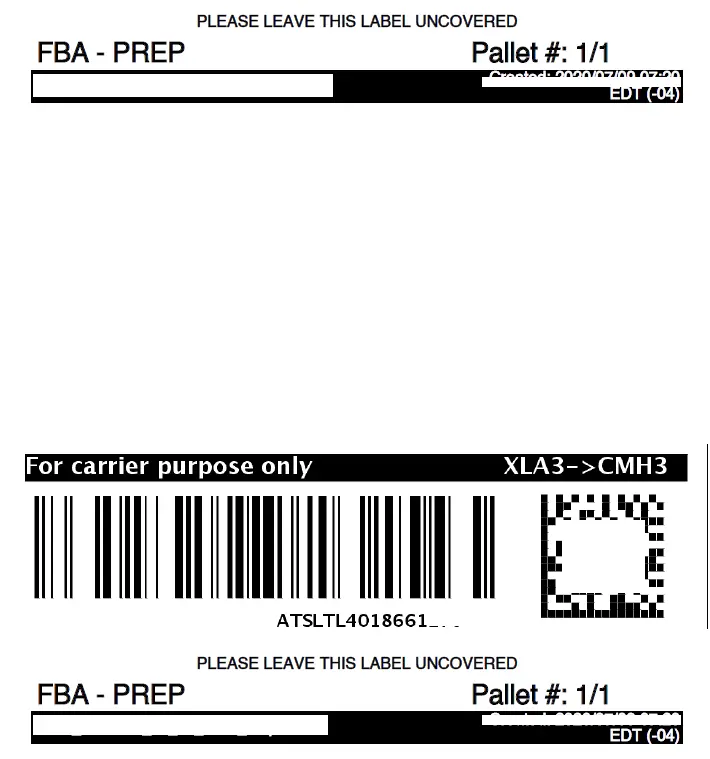
Labels streamline the entire supply chain, allowing Amazon to manage millions of shipping boxes with single ASIN pallets and multiple ASINs.
Amazon pallet labels are generated directly in Seller Central during shipment creation. These labels typically include a shipment ID and a scannable PDF417 barcode used by Amazon fulfillment centers for inbound processing. Sellers should not create custom pallet labels.
Key Amazon Pallet Label Requirements
To ensure your pallets pass inspection and enter Amazon’s fulfillment process without issue, it’s crucial to meet Amazon’s labeling standards. Below are the essential requirements for Amazon pallet labels:
Amazon pallet labels are the passkey to navigate into the fulfillment centers. Meeting these requirements needs special attention.
Here are some of the specs that you must be aware of when designing your Amazon pallet label for ready-to-ship products.
Label Content
Each label must contain the following:
Shipment ID: A unique identifier for your shipment.
FBA Tracking ID: The Fulfillment by Amazon ID for your products.
Warehouse Code: Identifies the destination fulfillment center.
Product Details: Any relevant information specific to the items in the pallet.
Label Size and Format
Amazon is very particular about its recommendation on labeling. A little distortion or error can result in pallet rejection and return.
Amazon requires labels to be printed in 8.5″ x 11″ format.
It should feature a scannable barcode (typically FNSKU).
Preferring high-quality adhesive labels with durability reduces the risk of mis-scanning and label damage during transit.
Label Placement
Generally, the labels are placed on the outer wrap surface. Some sellers used to paste it on the pallet surface(inside the wrap). It makes the scanning process more difficult and tedious. Also, it might not get scanned, which makes the fulfillment process unfinished.
A proper label placement comprises pasting on the outside of the pallet wrap. Doing this will ensure the fulfillment of the packaging requirements, which will be instant visibility and scannability.
Ensure the barcode faces outward, which helps scan it without unwrapping the top of the pallet. Placing labels incorrectly and getting hidden delays in ecommerce fulfillment processing.
Pallet Condition
Amazon has specific requirements for pallet number, size, weight, and stability.
For example, your pallet must be 48″ x 40″ and should not exceed 1500 lbs in weight, as specified.
Consider using eco-friendly label materials to align with Amazon’s sustainability initiatives.
In addition to the main pallet shipment label, Amazon may require additional pallet notices based on how inventory is packed. Pallets wrapped for transit must display a ‘Do Not Break Stretch Wrap’ label to prevent pallets from being unwrapped during unloading. If a pallet contains only one ASIN, a ‘Single ASIN Pallet’ label should also be applied.
Steps to Properly Label Your Pallets
Complying with FBA norms as per the 2026 update is very necessary to store your inventories in the Amazon FC. Proper pallet labeling helps in faster handling, reduces errors, and enables efficient shipping to FBA warehouses.
We have crafted a step-by-step guide that allows you to meet Amazon Pallet Label requirements without any hassles.
Generate Labels in Seller Central
Access Seller Central: Log into your Amazon Seller Central account and navigate to the “Manage Inventory” section.
Select FBA Shipments: Choose the shipment you’re preparing and confirm the assigned Amazon fulfillment center, shipment ID, and product details.
Generate Pallet Labels: Use the “Print Pallet Labels” option in the shipment workflow to generate compliant labels. These labels will include key information such as the FBA Shipment ID, destination warehouse code, and scannable barcodes.
Update for 2026: Ensure the labels are formatted as PDF417 barcodes, a mandatory change for Amazon US. This ensures compatibility with updated scanning technology across fulfillment centers.
Prepare Pallet Inventory
Group by Shipment ID: All products on a pallet must belong to the same FBA shipment ID. Mixing shipment IDs or destinations on a single pallet is strictly prohibited.
Verify Inventory Accuracy: Confirm the SKU quantities and product details match the shipment plan submitted to Amazon. Discrepancies may lead to rejection of the pallet.
Print and Attach Pallet Labels
High-Quality Printing: We insist you prefer thermal or laser variant printers to produce the best quality barcodes. Labels printed using inkjet printers often fail to meet the required standards.
Amazon recommends using thermal or laser printers to produce clear, scannable barcodes. Inkjet labels may smudge or fade during transit, increasing the risk of scan failures at fulfillment centers. Labels should be non-reflective and securely attached.
Label Placement: Put stickers on all four sides of the box so they are firmly attached. To make reading easy, each label needs to be put at eye level so that the items don’t need to be unpacked or moved.
All pallet labels must be applied to the outside of clear stretch wrap and remain fully visible. Labels should never be covered, folded, placed under wrap, or attached directly to cartons.
Amazon Pallet Build Requirements (2026)
Proper pallet construction is essential for Amazon to scan pallet labels correctly and unload inventory safely. Amazon evaluates pallet build quality alongside labeling during inbound receiving.
Pallets must be standard size, undamaged, and capable of being moved by a forklift. Cartons should be stacked evenly with no overhang on any side. Only clear stretch wrap is allowed so pallet labels and carton labels remain visible. Pallets must be stable and secure, with no shifting during transit.
Avoid Obstructions: Do not cover labels with stretch wrap or any other packaging materials. Labels must remain fully visible and scannable during transit and handling.
Use Pallet Wrap Properly: While labels must not be obstructed, pallets must still be tightly wrapped with clear stretch film to ensure stability during transport.
Advanced Batch Printing Tip for High-Volume Shipments
For sellers managing high-volume shipments, batch printing labels for all pallets within a shipment is highly recommended. This method minimizes errors and speeds up the labeling process.
Pre-sort inventory into shipment-specific groups before labeling to streamline pallet assembly and avoid the risk of mislabeling.
Common Mistakes to Avoid
Avoiding common mistakes when labeling pallets is essential to prevent delays, extra fees, or rejections. Here’s how to avoid the most frequent errors:
| Mistake | Common Issues | Best Practices |
|---|---|---|
| Label Visibility | Labels in hard-to-scan spots or covered by shrink wrap slow down Amazon’s systems and warehouse workers, making label interpretation difficult. | Attach labels to all four sides of the pallet at eye level. Keep labels on the outside of any wrap. Avoid placing labels on uneven surfaces. |
| Incorrect Information | Labels with incorrect or missing details, like package ID or warehouse code, complicate Amazon’s sorting, leading to delays, fines, or lost goods. | Double-check label information in Amazon Seller Central. Print labels directly from Seller Central for accuracy. Avoid using outdated labels or templates. |
| Label Quality | Low-quality labels can be unclear, smudged, or poorly printed, causing scanning issues. Inferior adhesive labels may peel off during transit, leading to complications. | Use thermal or laser printers for clear, high-quality labels. Choose durable, adhesive labels. Check labels for clarity before use. |
| Pallet Dimensions and Weight | Amazon enforces strict pallet size and weight rules to ensure safety and efficiency. Non-compliant pallets may face penalties, rejection, or delays. | Amazon’s 2025 Requirements: Pallet size: 40” x 48”. Maximum height: 72 inches (including pallet). Maximum weight: 1,500 lbs per pallet. Best Practices: Use sturdy, undamaged pallets. Wrap pallets securely to avoid shifting during transit. Avoid overloading pallets. |
Benefits of Compliance with Amazon’s Pallet Label Requirements
Faster Fulfillment Processing
- Compliant pallet labels make it easier for Amazon’s fulfillment centers to process shipments quickly.
- Reduces scanning and sorting errors, speeding up the order fulfillment process.
- Helps meet customer expectations with faster shipping times.
Reduced Hidden Costs
- Avoid costly fines, re-shipping fees, and delays caused by non-compliance.
- Prevents unexpected financial setbacks that can eat into profits.
- Ensures smoother operations and cost-effective shipments.
Improved Seller Metrics
- Compliant shipments lead to better seller performance metrics.
- Reduces errors and misrouted shipments, leading to improved ratings.
- Enhances customer satisfaction, which can boost Amazon’s rankings and increase sales.
Tools and Resources for Easy Compliance
Labeling pallets for Amazon shipments doesn’t have to be a labor-intensive task. Several tools and resources can streamline the process, ensuring that your pallets meet Amazon’s stringent requirements and are processed efficiently.
Printing Tools
Investing in reliable label printing equipment is essential for generating accurate, high-quality labels quickly.
Label Printing Software: Software solutions enable you to create and customize compliant labels with ease.
High-Quality Printers: Labels printed by DYMO and Rollo printers are clear and can be scanned. These printers are made for high-speed, high-volume printing, which makes them perfect for Amazon sellers. Using thermal or laser printers makes sure that labels will last and be readable during shipping and handling.
Barcode Scanning Software: Software that verifies barcode quality before printing can also help catch any errors before FBA pallet ID labels are affixed to it.
Automation Tip
For businesses shipping large quantities of products, automating the labeling process can save significant time and effort.
Automated Labeling Systems: Automation tools can help you print and apply labels quickly> Also, maintaining consistency across high-volume shipments becomes easier. These tools allow you to process multiple pallets at once, reducing the chance of human error.
Batch Printing: Use automation to batch print pallet labels for the shipment that is to be sent to the Amazon fulfillment center.
Third-Party Logistics (3PL)
Partnering with a Third-Party Logistics (3PL) provider to manage pallet labeling.
3PL Services: Many third-party logistics companies offer full logistics solutions, including labelling, packing, and preparing shipments. Outsourcing this part of your business makes sure that it follows the rules when sending boxes to Amazon.
Labeling & Pallet Preparation: 3PL companies often do all the labelling work, like printing, attaching, and checking the labels, to make sure that your packages meet Amazon’s requirements.
Scalability: With 3PL services, you can handle packages of any size more quickly and cost-effectively, no matter how big or small they are.
Pallet Labeling for International Sellers
When shipping from the US to Amazon fulfillment centers in the UK or EU, it’s important to meet Amazon’s general pallet label requirements, as well as any specific regional standards. Understanding the regional differences in labeling helps to avoid delays, fines, and shipment rejections.
Regional Compliance Standards
Shipping to international Amazon fulfillment centers in the UK and EU includes specific labeling formats, customs documentation, and product labeling regulations.
These Amazon pallet label requirements differ from what is required in the US. Ensuring compliance with these standards enables seamless order fulfillment.
Customs Documentation
Amazon insists on attaching the custom documentation along with the pallets. It helps them to send the consignment to the specific warehouses located in the UK and EU.
Amazon is very stringent in customs documentation for products exported to international markets. Amazon pallet label requirements with proper documentation ensure uninterrupted fulfillment.
Region-Specific Labeling Formats
Certain markets within the EU have set their rules for label formatting and printing. For example, the EU requires labels in multiple languages based on the country in which the pallet is shipped.
The standards of UK labeling differ from those of other EU countries. You have to ensure the label requirements for international shipment specified by Amazon.
Shipping to Different Markets
Language Requirements
Certain countries in the EU require labels to be printed in their native language. The Amazon pallet labels require details in regional languages.
For example, products shipped to France must have French-language pallet labels.
Customs Codes
Your Amazon pallet label must include specific customs codes or Harmonized System (HS) codes for customs clearance.
Your label must be specified with the correct codes to avoid delays or customs-related fines.
Compliance with Local Regulations
In addition to Amazon’s labeling standards, your labels should comply with the local regulations. The UK and EU have their own sets of consumer protection, safety, and environmental standards.
This regulation influences the pallet label format and content. If it is non-compliant, Amazon may reject your shipment.
Best Practices for International Pallet Labeling
You should follow the best practices when labeling pallets for Amazon UK or EU fulfillment centers:
Work with a 3PL provider
Collaborating with a third-party logistics (3PL) provider to meet regional labeling regulations will be the strategic choice.
They manage the complicated procedures of labeling and documentation on your behalf. Hence, your shipments adhere to Amazon’s regulations and local laws.
Stay Updated on Regional Regulations
Amazon’s requirements for international markets are subject to change over time.
Staying informed about any changes to regional compliance standards is crucial, and your labeling processes should be updated accordingly.
Review Your Labeling Software
Ensure that your label printing software is equipped to handle multiple languages and region-specific formats.
Prefer software solutions can generate labels tailored to each market’s specific requirements.
Pallet Labeling in High-Volume Operations
Managing pallet labeling efficiently becomes crucial when you handle large volumes of shipments. Achieving a seamless operational flow in compliance with Amazon’s strict guidelines will be challenging.
Batch Printing for Large Shipments
Batch printing improves efficiency for high-volume shipment. You can generate multiple labels in one go, saving time and reducing the chance of errors.
Printing labels for entire shipments streamlines operations and the labeling process. This method of pallet labeling printing is preferred for tight shipping deadlines with multiple SKUs.
Multi-Pallet Labeling Systems
You might find labeling multiple pallets parallelly or subsequently end up in a bottleneck. Multi-pallet labeling systems enable you to print and apply labels across several pallets in a single workflow.
These systems ensure that each pallet is labeled accurately and in compliance with Amazon’s requirements. This minimizes delays and errors.
Warehouse Management System (WMS) Integration
The integration of a Warehouse Management System (WMS) enhances your pallet labeling process. Labels are automatically generated based on shipment details, eliminating manual entry errors.
The system can also track inventory, provide real-time data, and ensure that each pallet is labeled correctly for its destination. WMS simplifies operations, reduces errors, and enhances the overall efficiency of Amazon pallet labeling.
Sustainability in Pallet Labeling
Sustainability has become a primary focus and element of fulfillment in 2026. It influences every aspect of operations, even in pallet labeling. Embracing eco-friendly labeling solutions helps you achieve global sustainability goals.
Eco-Friendly Labeling Options
Consider switching to biodegradable or recyclable labels made from sustainable materials. These options ensure that your labeling practices contribute to a greener supply chain.
Biodegradable labels break down naturally. Also, recyclable labels can be reused in some other form, thereby reducing waste.
Benefits for Your Brand
Adopting sustainable pallet labeling practices maximizes your brand’s image. Consumers value your brand for environmental responsibility.
You attract eco-conscious buyers, build customer loyalty, and strengthen your market position. Also, these practices help you get ready for the future demands in sustainable fulfillment that Amazon demands.
Cost and Long-Term Value
Eco-friendly labels may have a slightly higher upfront cost, but they offer long-term value. Amazon and local authorities are moving towards stricter environmental standards.
Adopting sustainable practices can help you gain cost-effectiveness in the long run. Also, the shift has to take place gradually so that it won’t be the bottleneck if the major shifts happen in the Amazon guidelines.
The Future of Amazon Pallet Labeling
New technologies will shape the future of container marking as Amazon continues to improve its transportation. Keeping up with these changes and making sure operations run smoothly in an eCommerce world that is becoming more competitive requires businesses to stay informed and flexible.
RFID Technology Integration
An RFID (Radio Frequency Identification) reader is likely to be used by Amazon to name pallets. RFID tags are different from regular barcodes because they can be scanned in large groups and don’t need to be seen directly.
This could make keeping track of goods a lot faster and more accurate, cutting down on mistakes and work that needs to be done by hand.
Sellers can get ahead of the competition by looking into RFID-compatible marking options now to get ready for this change.
AI-Powered Barcode Verification
Using artificial intelligence (AI) to check barcodes is another possible change that is coming. Artificial intelligence (AI) systems could find problems with labels, like smudged barcodes, wrong places, or package details that don’t match up before they become a problem.
This makes Amazon’s delivery centers more efficient and keeps buyers from having to deal with too many problems by finding mistakes earlier in the process.
Proactive Adaptation
To keep up with these changes, companies should think about buying labeling systems that are flexible and can adapt to new technologies.
This includes making printers and software better able to work with RFID tags, checking the quality of labels automatically, and teaching staff how to use new tools correctly.
Early adoption of these new ideas can help sellers keep up with Amazon’s changing rules while keeping their operations running smoothly.
Final Thoughts
Struggling with Amazon pallet labeling? We’ve got your back! As your dedicated 3PL partner, we’ll handle everything, ensuring your shipments meet Amazon’s requirements in the defined standards. No more headaches, fines, or delays with our pallet labeling services.
Our expertise streamlines Amazon fulfillment in addition to boosting your seller metrics and customer satisfaction. Ready to elevate your Amazon game in 2026? Let’s make it happen today!

Blair Forrest is the Founder of AMZ Prep, one of North America’s fastest-growing third-party logistics and fulfillment networks, built entirely without outside capital since 2016. Under his leadership, AMZ Prep has scaled to 50+ fulfillment centers across 6 countries, processing over 10 million plus units monthly and powering $2 billion+ in annual GMV for more than 5,000 brands worldwide including 437, Silverts, Saltyface, Unilever, Duracell, and JBL. A recognized authority in eCommerce logistics, Amazon FBA strategy, and supply chain optimization, Blair has helped thousands of sellers and brands master their fulfillment operations from first shipment to enterprise scale. He regularly consults on FBA prep, multi-channel fulfillment, last mile delivery, international expansion, and cost reduction strategies that save brands 20–40% compared to traditional 3PL providers. Blair’s insights on Amazon logistics, 3PL operations, and eCommerce growth are widely cited across the industry. Through AMZ Prep’s content, guides, and resources, he continues to share battle-tested strategies drawn from managing one of the largest independently owned fulfillment networks in North America.
















Comments