
Most ecommerce sellers treat their warehouse the same way they treat electricity. It’s infrastructure. It runs in the background, you pay the bill, and your attention goes to the things such as sourcing, ads, listings and the next product launch. Nobody gets excited about warehousing.
That attitude is fine at 500 orders a month. At 5,000 orders a month, it quietly becomes one of the most expensive decisions you’re making.
The reason temperature-controlled warehousing gets overlooked isn’t that sellers don’t care about product quality. It’s that the damage it prevents is invisible until it isn’t.
By the time a storage problem surfaces in your returns data or your review score, it’s already been running for months. And at serious volume, months of compounding damage is not a small problem.
So before we talk about what temperature-controlled warehousing is or what it costs, it’s worth asking a more fundamental question first.
What is a temperature-controlled warehouse?
A temperature-controlled warehouse is a storage facility designed to maintain specific environmental conditions, including temperature, humidity, and airflow. These configuration settings protect products that are sensitive to climate changes.
Unlike standard warehouses, these facilities use specialized management systems like HVAC systems, insulation, and monitoring technology to keep conditions stable around the clock.
These warehouses track and log environmental data continuously.
If conditions get worse beyond the acceptable ranges, alerts go out right away.
So your inventory stays protected and your business stays compliant with regulations like FDA storage guidelines and GMP standards.
When you work with a 3PL that offers temperature controlled fulfillment, your products never leave a climate safe environment. The chain holds from inbound receiving through pick, pack, and outbound shipping. Peptide fulfillment lives or dies on that unbroken chain, because a few hours at room temperature is enough to degrade the compound.
For brands where product quality matters, that kind of protection is worth having.
What the latest data says about climate-sensitive products
- 1 in 5 ecommerce orders arrive damaged, and temperature is a leading cause.
- 16.9% average return rate in 2024, even higher for temperature-sensitive products.
- 30% fewer losses with proper temperature-controlled fulfillment.
- 5 months a year where Amazon bans meltable products from FBA.
- 1.6 billion tons of goods wasted annually due to poor temperature management.
This playbook helps Amazon sellers with meltable inventory plan their warehousing and fulfillment approach for the restricted period. Button: Download the Meltable Season Playbook
Temperature Impact Ranking on Sensitive Products from Highest to Lowest Failure Risk
A comprehensive ranking of product categories based on temperature failure risk, helping you identify which inventory requires temperature-controlled storage to avoid loss or damage.
| Risk | Product | Main Heat Impact |
|---|---|---|
| Critical | Gummies | Melt and become unsellable |
| Critical | Chocolate | Melts or turns white (bloom) |
| High | Probiotics | Live cultures die (invisible damage) |
| High | Supplements | Lose potency, turn rancid, clump |
| Med-High | Natural Skincare | Separates, ingredients break down |
| Med-High | Standard Skincare | Texture changes, SPF weakens |
| Med-High | Protein Products | Melt, separate, texture damage |
| Moderate | Specialty Oils | Go rancid |
| Moderate | Premium Snacks | Melt, oxidize |
| Moderate | Specialty Foods | Quality and shelf life drop |
| Low-Med | Candles | Warp and deform |
| Low-Med | Wax Products | Melt and lose shape |
| Low-Med | Adhesives | Stop working |
What Amazon sellers say about warehouse temperature
Amazon sellers share their experiences with warehouse temperature control and logistics, covering how storage conditions affect inventory, product integrity, and overall fulfillment performance.
| # | Core Pain Point | What it really means for sellers |
|---|---|---|
| 1 | No Temperature Control in FBA | Warehouses routinely exceed 80°F in summer and drop low in winter. No climate guarantees. |
| 2 | Meltable Policy Forces Seasonal Shutdown | Gummies, chocolate, candles, etc. are banned from FBA for ~5 months. Sellers must switch to FBM or stop selling. |
| 3 | Damage Happens Before & After the Warehouse | Inbound trailers, delivery trucks, and porch drops reach 100–130°F. Risk exists across the entire chain. |
| 4 | Sudden Policy Enforcement & Reclassification | ASINs can be marked meltable unexpectedly. Sellers often find out close to the deadline. |
| 5 | No Control Over Inventory Placement | Amazon distributes stock across hot regions automatically. Sellers bear the melt risk. |
| 6 | Confusing & Inconsistent Guidance | Seller Support gives unclear answers about meltable status, eligibility, and enforcement. |
| 7 | No Premium Climate-Control Option | Even sellers willing to pay more cannot access temperature-controlled FBA storage. |
What products degrade when temperature in warehouses rise or fall?
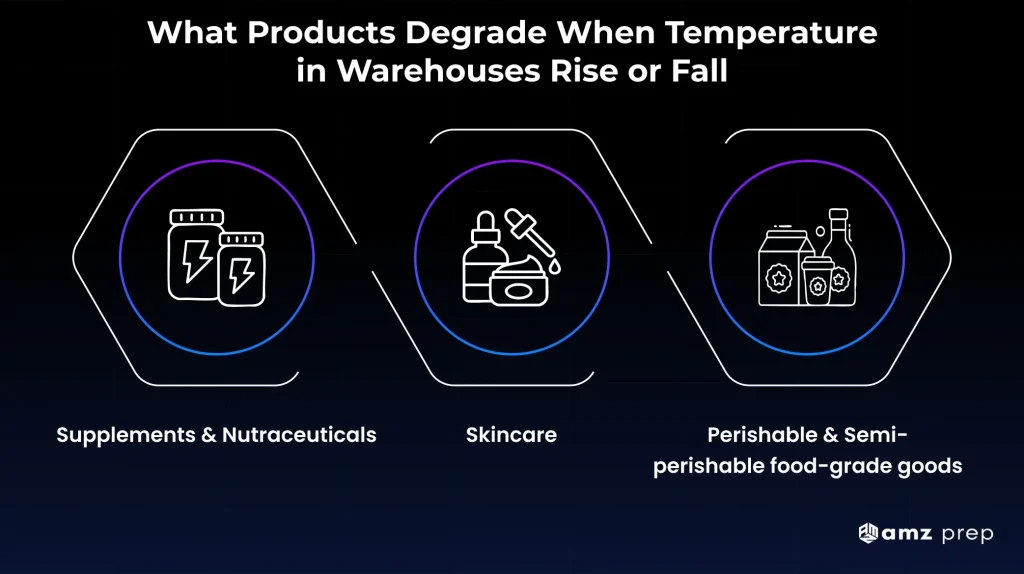
A lot of sellers assume the cold chain is for frozen food and pharmaceuticals. That assumption leaves a significant gap.
Supplements and nutraceuticals
The most underestimated category. Heat doesn’t destroy a capsule visually. What it does is accelerate the breakdown of active ingredients at a rate that most brands never measure.
A product leaving your manufacturer at full potency can reach your customer meaningfully degraded after a summer moving through a standard warehouse, which is why many brands invest in probiotics cold chain fulfillment to preserve stability from production to delivery.
The customer won’t know that. They’ll just feel like the product stopped working, and they won’t reorder. No complaint, no review explaining why.
Just a lost customer and a repeat purchase rate that slowly softens over the following quarter.
Skincare
Most formulations are emulsions, which means oil and water held together by chemistry. Repeated temperature swings destabilize that chemistry. The product separates slightly, changes texture, and performs differently on the skin.
Natural and organic formulations are especially vulnerable because they rely on fewer synthetic stabilizers to hold the formula together.
Your customer doesn’t know any of this. They just know the product feels different from the last time they ordered, and different is enough reason not to come back.
Perishable and semi-perishable food-grade goods
Specialty food, chocolate, gummies, premium snacks, protein products, and specialty oils all carry more risk than packaged appearance suggests. A product can look perfectly fine and still taste off, feel odd, or perform below expectation because of what it experienced in storage.
Temperature sensitivity products like candles, adhesives, wax-based products generate quality complaints that trace back to storage conditions sellers never investigate.
They spend months questioning their manufacturer when the answer is in the warehouse.
If your product has a recommended storage range anywhere in the documentation, that range exists because something real happens outside of it.
Standard warehousing probably isn’t honoring it.
What’s actually happening inside a standard warehouse
Understanding why standard warehousing falls short starts with a detail most fulfillment partners won’t volunteer: the loading dock and logistics are the most dangerous part of the building.
Dock door temperature fluctuations
Every time a dock door opens, the temperature inside the facility shifts. Warm humid air in summer, cold dry air in winter, flooding into a space that was just a few degrees closer to stable.
Products sitting near the dock, which is where new inventory almost always lands first, go through that cycle repeatedly. Warming and cooling, warming and cooling.
That’s what breaks down skincare emulsions. That’s what causes chocolate to bloom and supplements to degrade faster than they should.
The damage doesn’t announce itself on arrival. It shows up weeks later when a customer opens a package.
Inconsistent internal climate control
Away from the dock, standard warehouses are fighting seasonal conditions without the infrastructure to win. Summer temperatures inside large, poorly insulated facilities can climb well above comfortable ambient levels.
A standard HVAC system cools the general space but can’t maintain consistency across every corner of a large floor. Zones near exterior walls, zones near the roof, zones near ventilation points develop their own microclimates.
Nobody measures them because the system was never designed to.
Moisture instability in storage environments
Humidity runs in the background as a separate problem that most sellers in temperature-sensitive categories have never thought to ask about.
Uncontrolled humidity accelerates oxidation, causes clumping in powders, promotes separation in emulsions, and shortens the effective shelf life of products that were never supposed to be stored that way.
It’s slow, consistent, and completely invisible until it reaches the customer.
Daily exposure
Taken together, a standard warehouse exposes your inventory to variable temperature, thermal cycling from dock operations, and uncontrolled humidity, every single day.
None of it shows up in a temperature log because the facility was never built to track it.
What sellers lose when ambient warehousing temperature falls short
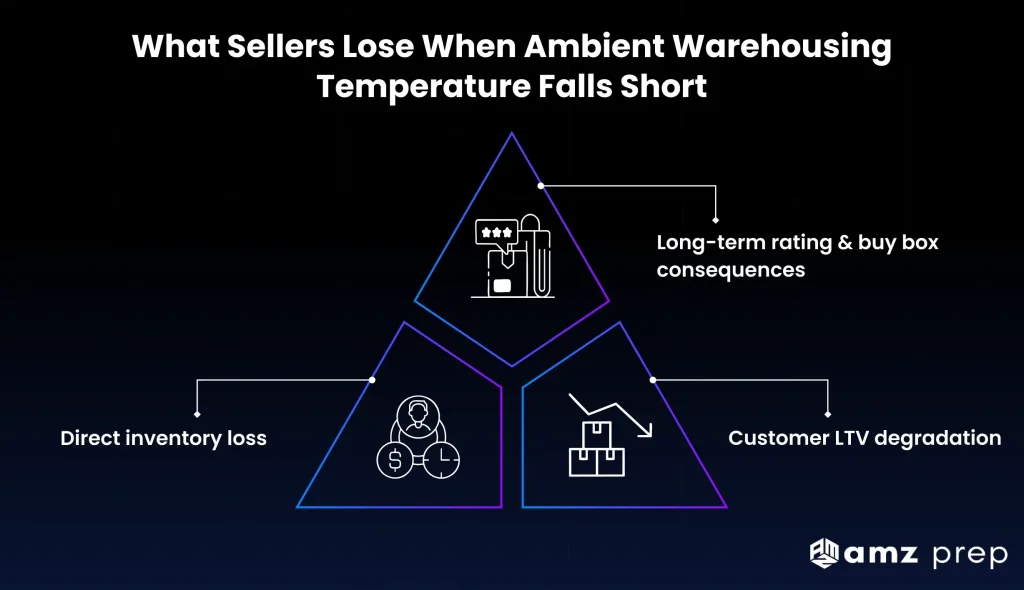
Bad warehousing temperatures don’t just damage products. They quietly erode your reviews, repeat purchases, and profits before you ever connect the problem back to your storage conditions.
Direct inventory loss
This is where the conversation usually goes wrong. Most discussions happen about cold storage facilities and the technology.
What they skip is how inadequate storage needs that actually land in your business numbers, and the picture there is more serious than most sellers expect.
The most immediate loss is inventory. At 5,000 orders a month, a 2% damage rate is 100 affected orders every single month.
That means replacement shipments, write-offs, refunds, and the operational weight of managing all of it.
Over a full year, the direct cost of that damage rate at a $45 average order value runs close to $54,000 before you factor in processing overhead or the cost of reacquiring customers who didn’t come back.
Most sellers carrying this cost have no idea it traces back to their warehouse.
Long-term rating and buy box consequences
The second loss is harder to reverse. When a wave of quality complaints lands on a product listing, those reviews stay.
A listing that drops half a star because of a bad quarter driven by storage conditions doesn’t recover automatically when the storage problem gets fixed.
The rating damage is permanent, and at 5,000 orders a month you have enough review velocity that a quality problem compounds fast.
Buy box performance shifts. Conversion rates drop.
Seller metrics on Amazon get flagged. None of it gets attributed to warehousing internally.
It just presents as a brand problem that requires expensive intervention, and the real cause keeps running in the background.
Customer LTV degradation
The third loss is the one that takes the longest to catch. Repeat purchase rates slip a few points over a quarter. Returns tick up slightly.
Ad performance softens because new customers aren’t converting the way they used to.
The natural response is to dig into product, packaging, creative, pricing. Sellers spend budget and attention across all of those areas looking for the answer.
Meanwhile, what’s actually happening is that temperature-related degradation has made the product experience slightly off.
Not broken. Just slightly off. Not enough for a detailed complaint, exactly enough to kill the second purchase.
The warehouse keeps running at the same damage rate. The seller keeps spending on the wrong problem.
How temperature-controlled warehouse protects your product
Product quality can deteriorate fast without the right storage conditions. Temperature-controlled warehousing ensures your goods stay protected, compliant, and shelf-ready from storage through final shipment.
Dedicated temperature zones by product requirement
Think about the supplement seller whose repeat purchase rate was quietly falling, or the skincare brand pouring money into ad spend trying to fix a conversion problem that started in a warehouse.
The solution in both cases wasn’t a better product or a smarter campaign. It was a facility built to actually protect what they were selling.
Sensor-driven monitoring and alerts
Temperature-controlled warehousing starts with dedicated zones. Frozen below -18°C, refrigerated between 2°C and 8°C, chilled between 8°C and 15°C, controlled room temperature between 15°C and 25°C.
Each zone is independently maintained and monitored. Your supplement inventory isn’t sharing airspace with a product category that needs different conditions.
Your skincare isn’t cycling through temperature swings caused by someone else’s inbound shipment.
Each zone holds its range of automation regardless of what’s happening in the rest of the building.
Controlled receiving and thermal containment
Real-time monitoring is what makes the zone promise meaningful.
When a sensor detects drift, the control system shares an alert before the drift becomes an excursion reaching your inventory.
The response is measured in minutes, not discovered in a monthly audit. That gap, between catching a problem in ten minutes versus finding a damaged pallet at the end of the month, is the gap between a non-event and a write-off.
Protecting inventory against environmental failure
Dock protocols address the thermal cycling problem at its source.
A properly run temperature-controlled facility has specific procedures around how long inventory sits at ambient temperature during receiving, whether a conditioned staging area exists, and how thermal transfer is limited every time a door opens.
Standard warehouses don’t have these procedures because they were never designed with this problem in mind.
Humidity control and backup power round out the protection in ways that are easy to underestimate.
Humidity control means the slow invisible degradation we talked about earlier simply doesn’t happen.
Backup power means a grid outage is an inconvenience for the facility, not an inventory event for you.
Compliance documentation
And then there’s the compliance documentation, temperature logs, humidity records, excursion reports, chain-of-custody records, generated automatically and available whenever you need them.
For a seller being approached by a retail buyer or a wholesale account, that documentation is what makes a supply chain conversation credible.
Most sellers in standard warehousing don’t have any of it, which means they’re one serious business conversation away from a problem they can’t document their way out of.
The cost impact on using a standard warehouse for temperature sensitive products
The premium for temperature-controlled storage is real.
Depending on facility, location, and zone type, sellers typically pay somewhere between 20% and 40% more per pallet position than standard ambient rates. At 5,000 orders a month, that difference runs roughly $800 to $2,000 per month above what standard storage costs.
Put that next to the 12-month numbers from earlier.
A 2% monthly damage rate at $45 average order value generates around $54,000 in direct annual loss before processing overhead, reacquisition costs, or the revenue impact of a half-star rating drop on your main listing.
The temperature-controlled premium over the same period is somewhere between $9,600 and $24,000.
That comparison is why the framing of temperature-controlled warehousing as a premium service doesn’t hold up.
For sellers in temperature-sensitive categories at serious volume, it’s actually the more affordable option when you look at the full picture.
The standard warehouse looks cheaper on the invoice and costs more across the year.
Advantages of temperature controlled warehouse
Product integrity
When your products sit in the right storage conditions from the moment they arrive to the moment they ship out, damage rates drop. For brands in supplements, food, cosmetics, or pharmaceuticals, that consistency makes a direct difference in how much you spend dealing with damaged goods every month.
Regulatory compliance
FDA guidelines and GMP standards are not suggestions, and the paperwork that comes with proving compliance adds up fast when you are managing it yourself. A temperature-controlled facility handles the documentation and monitoring on your behalf, so your business stays compliant without it becoming another thing on your plate.
Customer experience
Your customers ordered a product, not a version of it that sat in the wrong conditions for two weeks. When products arrive exactly as they should, returns go down, repeat purchases go up, and the reviews you get reflect the product you actually built.
Inventory protection
Spoilage and expiration write-offs are a real cost, and they add up faster than most sellers expect. Proper cold storage keeps those losses manageable and usually costs far less than the inventory you would otherwise have to replace.
Brand reputation
Your listing ratings take time to build and very little time to lose. A stretch of temperature-related quality complaints leaves a mark that stays on your listing long after the storage problem gets resolved. Protecting your storage conditions is part of protecting the brand you have spent money building.
Extended shelf life
The right storage conditions slow down product degradation and give your inventory more runway before expiration becomes a problem. For sellers who carry stock across longer fulfillment cycles, that extra shelf life reduces waste and keeps more of your inventory sellable.
Reduced insurance and liability exposure
Spoilage claims and product liability disputes are expensive and disruptive. Storing your products in a compliant, documented cold storage environment reduces the likelihood of those situations coming up and gives you a stronger position if they ever do.
Supports premium positioning
If your brand competes on quality, how your products are stored and handled before they reach the customer is part of that story. Being able to tell retail buyers and customers that your supply chain includes proper temperature-controlled storage gives you something real to stand behind.
Seasonal and climate resilience
A lot of sellers find out too late that their warehouse runs warm in summer or cold in winter. By the time the complaints show up, the damage is already done. Temperature-controlled storage takes that seasonal guesswork out of the picture entirely.
Better demand planning and inventory accuracy
Temperature-controlled facilities tend to run tighter operations overall. Better tracking of expiration dates, lot numbers, and product conditions means you have cleaner data to work with when you are planning inventory and forecasting demand.
We’ve created an playbook that helps Amazon sellers with meltable inventory plan their warehousing and fulfillment approach for the restricted period.
Multi-channel fulfillment compatibility
Whether you are selling on Amazon, your own website, through retail, or wholesale, a good temperature-controlled 3PL can handle all of it under one roof. You get consistent storage standards across every channel without having to piece together separate arrangements for each one.
Disadvantages of temperature controlled warehouses
Higher storage costs
Cold storage costs more than standard warehousing, and that is just the reality of the infrastructure involved. If your margins are already tight or your products move slowly, that premium is something you need to model out before committing to a temperature-controlled setup.
Limited facility availability
Good temperature-controlled 3PLs are not as common as standard warehouses, and the ones worth working with may not have facilities where you actually need them. Finding the right partner with the right locations takes more time and due diligence than sourcing standard storage.
Stricter handling requirements
Cold storage products come with more moving parts on the handling side. Inbound receiving, storage protocols, and outbound shipping all have tighter requirements, and if your fulfillment partner does not have experience managing them, that complexity becomes your problem.
Less flexibility for mixed inventory
Running temperature-sensitive products alongside standard inventory is more complicated than it sounds. Different storage environments, different handling procedures, and different tracking requirements all stack up, especially if your warehouse management system was not built with that in mind.
Higher minimum requirements
Some cold storage facilities set volume or spend minimums that smaller sellers simply cannot meet. If you are earlier in your growth or running lean on inventory, getting into a quality temperature-controlled facility can be harder than expected.
Power dependency and outage risk
Everything in a temperature-controlled warehouse depends on the power staying on. Good facilities have backup systems, but outages happen and even a short lapse can put a full batch of inventory at risk depending on what you store. It is worth asking any prospective partner how they handle that scenario before you sign anything.
More complex onboarding
Getting your products into a temperature-controlled 3PL takes longer than standard warehousing. Temperature specs, handling protocols, compliance documentation, and product requirements all need to be worked through before your first shipment goes out. Build that lead time into your planning.
Harder to switch providers
Moving inventory out of a cold storage facility is not as simple as scheduling a standard pallet transfer. Keeping your products within required temperature ranges during a transition adds cost and risk, which means switching providers is a decision you want to get right the first time.
Environmental and energy costs
Temperature-controlled storage is energy intensive, and that is worth acknowledging if your brand has made public commitments around sustainability. It does not have to be a dealbreaker, but it is something to factor into how you talk about your supply chain.
Longer lead times for custom requirements
If your products fall outside standard cold storage parameters, whether that means tighter temperature ranges, specific humidity controls, or additional regulatory documentation, your options narrow quickly. Finding a facility that can actually meet those requirements takes more time than most sellers expect.
Choosing the right service provider for temperature controlled warehousing
Not every facility that offers temperature-controlled storage runs it with the same rigor, and at 5,000 orders a month the difference matters.
Start with certifications. FDA registration, USDA compliance, HACCP, and GDP for supplement and pharmaceutical products.
Ask to see current documentation rather than taking a website reference at face value. A provider that hesitates here is telling you something important.
Then ask the question most sellers never think to ask:
What happens to my inventory during an excursion event, step by step, in the first hour? Not whether a protocol exists.
Walk them through the specifics, alert threshold, who gets notified, physical response time, and liability for the affected product.
How a provider answers that question tells you more about how the operation actually runs than any sales conversation will.
The contract language matters more than most sellers realize.
A temperature-controlled environment in an SLA sounds reassuring and protects you very little.
What you need are defined zone temperatures, specific monitoring intervals, documented response commitments, and clear liability terms when something goes wrong.
Vague language always resolves in the provider’s favor at the moment it becomes relevant.
Ask specifically about dock protocols and about references from ecommerce brands at similar volumes in your product category.
Cold chain experience in pharmaceutical distribution doesn’t automatically translate to DTC or marketplace fulfillment. You want someone who has solved your specific problem before.
When to switch from typical to temperature controlled warehouse
Once the decision is made, the practical question becomes how to move without disrupting the customers you’ve already got.
The answer is a parallel migration. New inventory begins flowing into the new facility while existing stock at your current provider continues to fulfill against open orders.
Done properly, the transition is invisible to your customers and low-risk for your operations.
Build in 60 to 90 days from decision to full transition. Use that time to make sure your new provider is set up completely, your SKU catalog, packaging requirements, platform-specific prep needs, and any compliance documentation requirements.
Run a test shipment before you move volume in the climate-controlled warehouse. Verify that the monitoring reports you receive match what you were promised before you signed.
The most common mistake sellers make in a 3PL transition is rushing because the current situation has become frustrating.
The urgency is understandable. But a rushed transition creates customer-facing problems that take longer to fix than the original warehouse issue. Take the 90 days. It’s worth it.
Final thoughts
Every operational decision has downstream consequences that compound faster than they did at smaller volumes.
The warehouse is no different.
It’s either protecting your product quality, your customer relationships, and your margins, or it’s slowly eroding all three in ways that show up in your numbers before they ever show up in your awareness.
Temperature-controlled warehousing isn’t a nice upgrade. For sellers in sensitive product categories at serious volume, it’s the infrastructure that makes sustainable growth possible.
The sellers who figure that out before the brand damage accumulates are the ones who look back and say it was one of the best operational decisions they made.
The ones who figure it out after are the ones who say they wish they’d done it sooner.
Your current setup is either protecting your inventory or it isn’t. That’s worth finding out before the answer shows up in your reviews.
Frequently Asked Questions about temp-controlled warehouse
1. What is a temperature-controlled warehouse?
A temperature-controlled warehouse is a storage facility that regulates climate conditions like temperature and humidity to keep your products in their best possible state. Without it, sensitive inventory is exposed to conditions that can quietly ruin product quality before it ever reaches your customer.
2. What types of products need temperature-controlled warehousing?
If you’re storing food, beverages, pharmaceuticals, cosmetics, electronics, or chemicals, you need climate-controlled storage. These products don’t handle environmental swings well, and even a few hours in the wrong conditions can render an entire batch unsellable.
3. What is the difference between a temperature-controlled and a cold storage warehouse?
Temperature-controlled warehousing covers a wider range of climate settings, both warm and cool, depending on what your product needs. Cold storage is more specific. It keeps products at refrigerated or frozen temperatures, which is typically what perishable food and medical supplies require.
4. What temperature range does a temperature-controlled warehouse maintain?
It varies based on what you’re storing. Most facilities with different temperature can handle anything from sub-zero frozen storage at around -20°C to standard ambient conditions around 25°C. Your 3PL provider will help you dial in the right settings for your specific inventory.
5. How does temperature-controlled warehousing prevent product spoilage?
It never stops watching. Temperature, humidity, and airflow are monitored continuously so your inventory never drifts outside the conditions it needs. By the time your products leave the facility, they’re in exactly the same state they arrived in. That consistency is what protects your margins.
6. Is temperature-controlled warehousing only for food and pharma products?
A lot of people assume that, but it’s not accurate. Candles warp. Wine turns. Certain electronics degrade. Specialty chemicals react. If your product is sensitive to its environment in any way, temperature-controlled storage is worth a serious look, regardless of what industry you’re operating in.
7. How do you know if your product needs temperature-controlled storage?
Pull up your manufacturer’s storage guidelines and cross-reference them with any regulatory requirements in your category. If your product melts, warps, loses potency, or has a shelf life that shortens under standard conditions, that’s your answer. When in doubt, the cost of proper storage is almost always less than the cost of a damaged batch.
8. What are the costs associated with temperature-controlled warehousing?
You will pay more than you would for standard storage, and that’s fair given what’s involved. Maintaining precise climate conditions around the clock takes serious infrastructure. But here’s the reality: one damaged shipment, one compliance violation, or one lost customer over product quality will cost you far more than the storage premium ever would.
9. How do temperature-controlled warehouses stay compliant with industry regulations?
The honest answer is that the good ones make compliance part of their daily routine, not something they scramble for during an audit. That means continuous temperature logging, certified monitoring systems, and regular internal reviews to stay current with FDA, USDA, and other applicable standards. When you partner with the right facility, you’re not chasing compliance. It’s already handled.
10. How do you choose the right temperature-controlled warehouse for your business?
Don’t just take their word for it. Ask how they handle temperature excursions, what their monitoring systems look like, and whether they have real experience with your product type. Certifications matter, but so does transparency. A facility that can walk you through their process without hesitation is one you can actually trust with your inventory.

Arishekar N is a Vice President (VP) of Marketing at AMZ Prep, specializing in ecommerce fulfillment and Amazon logistics strategies with a proven track record of driving growth for e-commerce businesses. He is a strategic leader with extensive expertise in marketing, e-commerce operations, SEO & advertising, and branding.
Stay updated on his latest insights by following him
















Comments