

Seasonal warehousing allows brands additional storage space during peak sales times without the year-round commitment. For most U.S. ecommerce businesses, it makes the most sense to partner with a 3PL that has many warehouse locations.
Stock as much more inventory as you like, distribute it across many warehouses, and ship Amazon, Walmart and DTC orders from the same inventory pool.
Other alternatives include on-demand warehousing, short-term warehouse rental, onsite storage containers, and Amazon Warehousing and Distribution (AWD). Each is better suited for varied storage requirements.
As far as I can tell, running out of warehouse space is not necessarily the largest concern. Where you keep your goods and how fast you can distribute it to clients is equally important.
What Is Seasonal Warehousing?
Seasonal warehousing is when you rent extra storage space for a few weeks or months to meet increasing demand. Brands only pay for warehouse space when they need it, rather than paying for it year-round. Storage is normally priced monthly, based on pallets, cartons or cubic feet.
When Brands Need Seasonal Warehouse Space
The holiday season is the busiest time of the year for online brands. U.S. holiday sales are predicted to rise 4.2% to $1.013 trillion in November and December 2026, according to the National Retail Federation.
But it’s not only the holidays. Storage demand also increases around Prime Day and back-to-school shopping. Similarly for seasonal items, such as patio furniture and pool equipment in the summer.
Short-Term, Temporary and Overflow Warehousing
Seasonal warehousing may also be referred to as short-term warehousing, temporary warehouse space, or overflow storage.
The distinction is generally why you need the warehouse. Perhaps you’re gearing up for a busy season, getting inventory sooner than intended, or facing storage constraints on a marketplace.
Why Peak Season Squeezes Warehouse Capacity
Imagine receiving two containers of holiday inventory in September when your warehouse only has room for one. You’ll need extra storage for the next few months.
Sending everything to Amazon FBA might seem easier, but higher Q4 storage fees and inventory limits can make that expensive.
Amazon’s Q4 Storage Fees
Amazon’s standard-size FBA storage fees jump from $0.78 per cubic foot during January–September to $2.40 during October–December.
That’s nearly three times the regular rate, so storing excess inventory in FBA during Q4 can get expensive.
Monthly FBA Capacity Limits
Amazon sets monthly FBA capacity limits based on your sales history and inventory performance.
Once you reach your limit, you’ll need to store additional stock elsewhere until more space becomes available.
Holiday Warehouse Capacity Across Channels
It’s not just Amazon. Warehouses across the U.S. get busier as brands bring in holiday inventory and retailers schedule deliveries.
Finding extra space becomes harder the closer you get to peak season.
A better approach is to keep a few weeks of inventory in FBA and store the rest elsewhere, ready for replenishment when needed.
5 Alternatives to Leasing Warehouse Space During Q4
Signing a lease for a 10-week peak rarely adds up. Industrial leases typically run three to seven years, with five the most common, per Link Logistics. Moving in takes another 60 to 120 days from the start of the search.
Most temporary storage solutions fall into five groups.
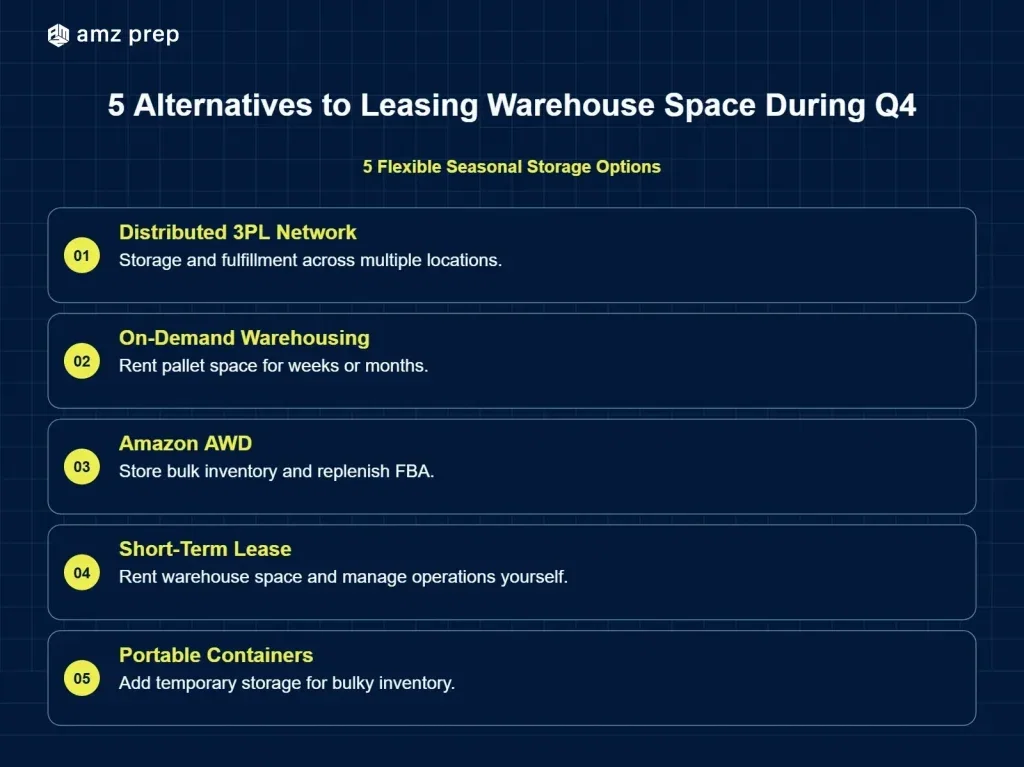
| Option | How it works | Typical commitment | Best for | Watch for |
|---|---|---|---|---|
| 3PL with a distributed network | The 3PL receives, stores and ships your stock from several regions | Monthly, priced per pallet or carton | Brands selling on more than one channel | Peak pricing and volume terms vary by provider |
| On-demand warehousing marketplace | You book pallet space in partner warehouses through one platform | Weeks to months, by pallet | Pure overflow and slow movers | Systems and handling differ by site |
| Amazon AWD | Amazon holds bulk stock upstream and refills FBA automatically | Billed per cubic foot | Amazon-heavy inventory | Size and eligibility rules apply |
| Short-term lease or sublease | You rent another tenant’s unused space for a few months | Several months or longer | Brands with their own staff and equipment | You run labor, insurance and racking |
| Portable containers or trailers | Containers or drop trailers add space at your own site | Weekly or monthly rental | Bulky stock waiting on a ship date | Not set up for picking |
1. A 3PL With a Distributed Warehouse Network
A 3PL stores your seasonal inventory and ships orders as they come in. With warehouses in multiple regions, you can keep products closer to customers and reduce shipping distances.
This works well for brands selling on Amazon, Walmart, Shopify, and other channels. Just check for extra Q4 storage fees and annual commitments.
2. An On-Demand Warehousing Marketplace
On-demand warehousing lets you rent extra storage space for a few weeks or months without a long-term lease.
It’s useful when inventory arrives early or your warehouse runs out of room. Some locations also handle packing, shipping, and Amazon prep, so check what’s included.
3. Amazon Warehousing and Distribution (AWD)
Amazon AWD stores bulk inventory and replenishes FBA as needed. Stock held in AWD doesn’t count toward your FBA capacity limits.
It’s a good option for Amazon sellers, but size and eligibility requirements apply. If you also sell on Walmart or Shopify, you may need another fulfillment provider.
4. A Short-Term Lease or Sublease
Some businesses rent out unused warehouse space for a few months.
This can work if you already have warehouse staff, equipment, and inventory systems. Otherwise, managing the space yourself could cost more than expected.
5. Portable Containers or Trailers
Portable containers and trailers give you extra storage space at your existing warehouse.
They’re useful for bulky or slow-moving products, but you’ll usually need to move stock inside before packing and shipping orders.
How Distributed Warehouse Networks Handle Seasonal Inventory
Cheaper warehouse space doesn’t always mean lower costs. If your inventory is far from customers, higher shipping costs can quickly eat into the savings.
Keeping stock in different regions can help reduce delivery times and shipping expenses.
Regional Stock Means Shorter Transit
With warehouses on both coasts, orders can ship from locations closer to customers rather than traveling across the country.
This can speed up deliveries during Q4 and make Amazon replenishment easier.
Room to Rebalance Mid-Season
Demand isn’t always the same everywhere. A product might sell faster in Texas than in New Jersey, leaving one warehouse short on stock.
With multiple locations, you can move inventory between warehouses as demand changes.
For example, splitting 600 pallets across three locations may work better than keeping everything in one warehouse, depending on shipping costs.
The Forecasting Trade-Off
Splitting inventory across warehouses only makes sense if you know where most orders are likely to come from.
Use last year’s sales by state as a starting point, then account for new products, promotions, and sales channels. Otherwise, you could spend more moving inventory between locations.
What to Look for in a Seasonal Warehousing Provider
Storage rates matter, but they’re not the only cost to consider. Receiving delays, handling fees, and inventory transfers can add up.
Before choosing a provider, check how it handles incoming stock, order fulfillment, and leftover inventory after peak season.
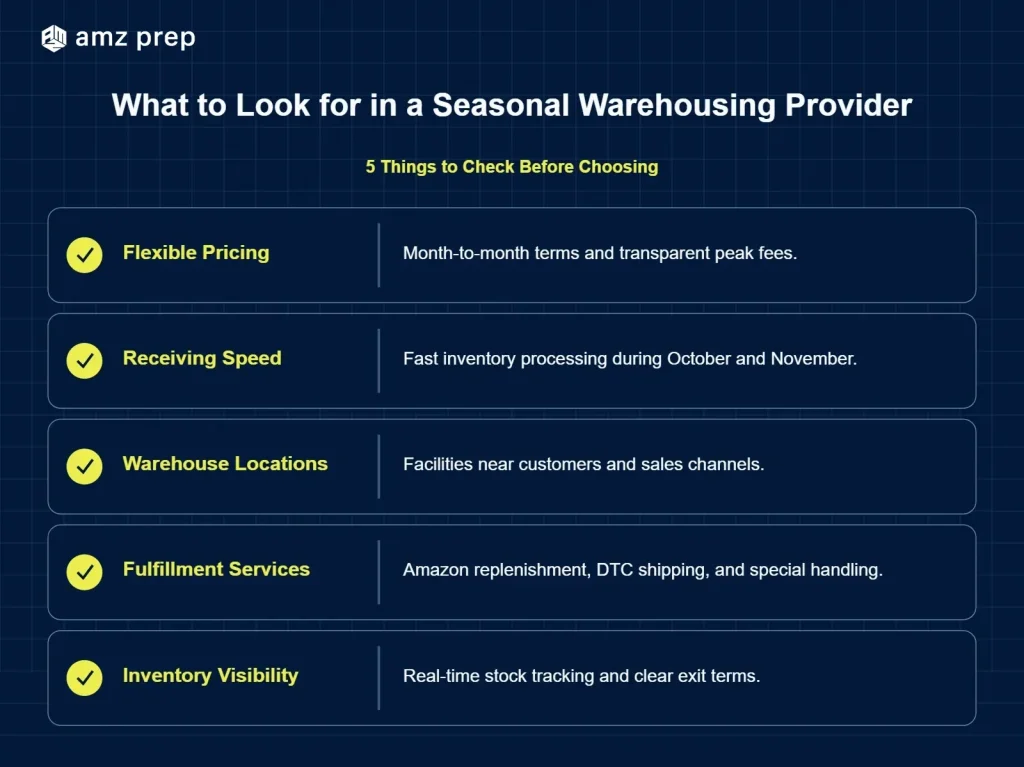
Flexible Terms and Clear Peak Pricing
Look for month-to-month storage so you can add space during Q4 and reduce it in January.
Ask about seasonal fees, minimum commitments, and handling charges. Make sure everything is included in the quote.
Receiving Speed in October and November
Ask how quickly the warehouse can receive inventory and make it available for orders. This is called dock-to-stock time.
Check receiving times specifically for October and November, when warehouses are busiest. A delay of even a few days can affect your sales.
Locations and Channel Coverage
Choose warehouses near your customers to reduce shipping costs and delivery times.
If you sell on Amazon, Walmart, Shopify, TikTok Shop, or through retail partners, find a provider that supports all these channels so you don’t have to manage inventory across multiple providers.
Amazon Replenishment and Special Handling
For Amazon sellers, check whether the warehouse handles FBA prep, carton labels, shipping plans, and replenishment.
If you sell temperature-sensitive, oversized, or high-value products, confirm that the facility has the right equipment and storage conditions.
Inventory Visibility and Exit Terms
Choose a provider that lets you track inventory across locations, including stock in transit.
Also, ask about removal fees, transfer charges, and notice periods. You don’t want unexpected costs when it’s time to clear leftover stock after Q4.
How AMZ Prep Handles Seasonal Warehousing in the US
AMZ Prep works with 5,000+ brands through a network of 50+ fulfillment centers across six countries. We prepare over 10 million units monthly and provide seasonal storage alongside our regular fulfillment services.
A US Network Built to Add Capacity
Our U.S. warehouse network spans 14 states, including AMZ Prep-operated facilities, partner warehouses, and shared leased space.
This allows us to add storage capacity without requiring brands to lease their own warehouses. We plan inventory placement based on stock volume, customer locations, and fulfillment needs.
Bulk Storage With Amazon Auto-Replenishment
Instead of sending all your seasonal inventory to FBA, you can store bulk stock with AMZ Prep and replenish Amazon as products sell.
Our bulk storage and auto-replenishment service monitors FBA inventory levels and prepares shipments when stock reaches your set threshold.
Through Middle Mile, shipments typically reach Amazon within two to four business days, with no placement fees. Allow extra time for Amazon receiving during Q4.
Bulk storage starts at $0.50 per carton, with no additional Q4 seasonal storage fees.
One Inventory Pool for Every Channel
AMZ Prep lets you fulfill Shopify, Walmart, TikTok Shop, Seller Fulfilled Prime, and B2B retail orders from the same inventory pool.
Parcel orders are handled through Prep Parcel by AMZ Prep. Inventory is typically received within 24 to 48 hours, and orders placed by 3 PM local time ship the same day.
Cold Storage for Seasonal Products
Products like holiday chocolates need temperature-controlled storage to prevent damage.
Our cold storage service supports temperature-sensitive inventory, including meltable products affected by Amazon’s seasonal storage restrictions.
Where AMZ Prep Fits Best
AMZ Prep is best suited for brands that need seasonal storage along with Amazon replenishment, DTC fulfillment, or multichannel shipping.
If you only need space for a few pallets, an on-demand warehouse may be cheaper.
For brands needing storage and fulfillment together, onboarding typically takes around six days, with month-to-month terms available.
How to Plan Seasonal Storage Before Your Next Peak
Don’t wait until your warehouse is full to arrange extra space. For a November sales peak, start planning in August and aim to book storage about 90 days ahead.
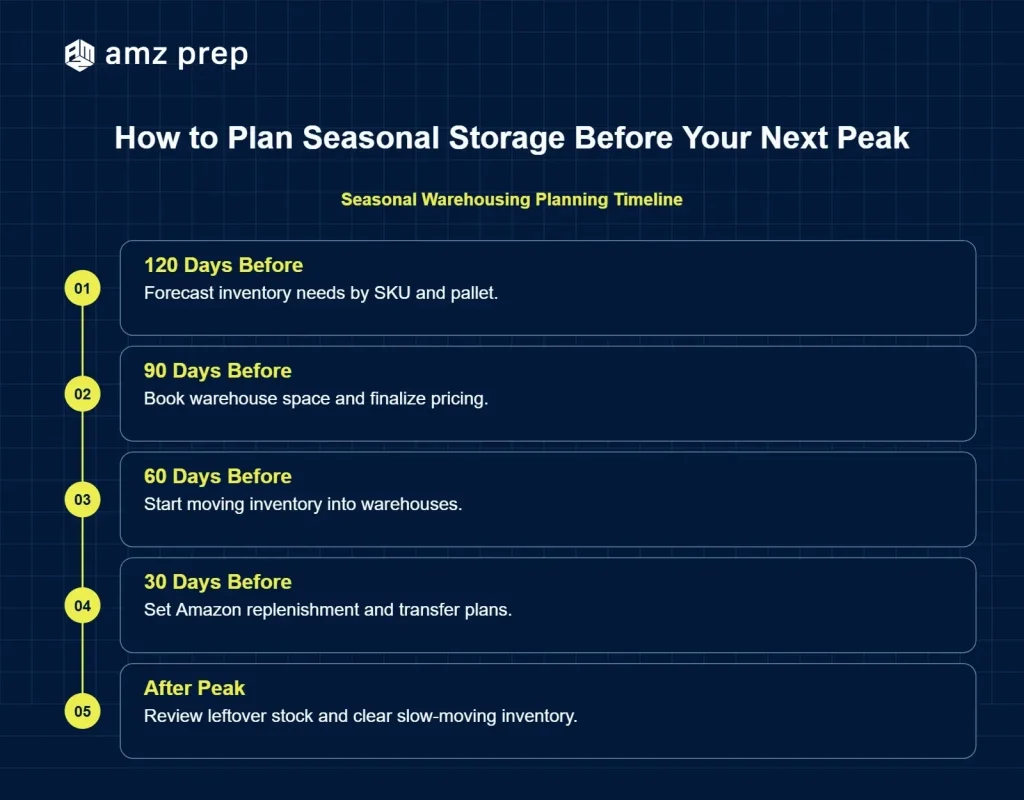
120 Days Out: Forecast in Pallets
Estimate how many units you’ll need by SKU and convert those numbers into pallets.
Our warehouse space calculator can help you estimate storage requirements. If you ship nationwide, use regional sales data to decide where inventory should go.
90 Days Out: Book Space and Lock Terms
Compare warehouse locations, storage rates, receiving times, and peak-season fees.
Finalize your agreement around 90 days before peak season so you have enough time to arrange freight and move inventory.
60 to 30 Days Out: Land Stock and Set Triggers
Start moving inventory into your selected warehouses around 60 days before peak.
By 30 days out, your Amazon replenishment settings and inventory transfer plans should be ready. This helps avoid last-minute stock shortages when orders increase.
After the Peak: Clear Slow Stock
Review leftover inventory once holiday sales slow down. Some products may need discounts, while others should be moved out of storage.
Amazon’s aged inventory surcharges begin after products have been in FBA for more than 181 days.
Stock received in October could start attracting these charges in April, so review slow-moving products before additional fees apply.
Getting Seasonal Storage Right
Seasonal warehousing isn’t just about finding extra space. You also need to make sure your inventory can reach customers on time.
Start comparing providers around 90 days before peak season. Look at storage costs, warehouse locations, and fulfillment capabilities.
If you need seasonal storage across the U.S., share your inventory forecast with AMZ Prep. We’ll help you plan storage and fulfillment for the busy season.
Frequently Asked Questions
What Does Seasonal Warehousing Mean for Ecommerce Brands?
Seasonal warehousing gives ecommerce brands extra storage space during busy periods like Q4 or Prime Day. Instead of paying for unused space year-round, you can rent what you need for a few weeks or months.
Which 3PL Companies Offer Seasonal Warehousing in the US?
Several U.S. 3PLs and on-demand warehousing providers offer seasonal storage. AMZ Prep has warehouses across 14 U.S. states, offering bulk storage, Amazon replenishment, and multichannel fulfillment.
What Is the Difference Between Short-Term Warehousing and a Warehouse Lease?
Short-term warehousing usually means renting storage for a few weeks or months, often by the pallet or carton. A traditional warehouse lease generally lasts several years and comes with more operational responsibilities.
What Is Overflow Warehouse Storage?
Overflow warehouse storage gives businesses somewhere to keep inventory that won’t fit in their regular warehouse or Amazon FBA allocation. It’s commonly used before Q4 or when suppliers deliver more stock than expected.
When Should Brands Book Peak Season Warehouse Space?
Around 90 days before the expected sales peak is a good starting point. If November is your busiest month, begin contacting providers in August to compare pricing and arrange inventory deliveries.
What Are the Best Alternatives to Leasing Warehouse Space for Q4?
Common alternatives include 3PLs, on-demand warehousing platforms, Amazon AWD, short-term subleases, and portable storage containers. The best option depends on whether you need storage alone or storage and fulfillment together.
How Does a Distributed Warehouse Network Help With Seasonal Inventory?
A distributed network stores inventory in multiple regions, closer to where orders are coming from. This can shorten shipping distances, improve Amazon replenishment times, and make it easier to move stock when regional demand changes.

Diggy oversees comprehensive fulfillment strategies for eCommerce brands at AMZ Prep, bringing deep expertise in warehouse operations and shipping optimization. His strategic background includes serving as account director at Slate Asset Management, where he developed unique insights that now enhance his supply chain optimization approach. At AMZ Prep, he works closely with supply chain teams to ensure seamless product availability during peak seasons and promotional events. His analytical expertise in fulfillment KPIs has helped brands reduce shipping costs by 20% while improving delivery reliability.


Comments