Full Truckload (FTL) Freight With the Dock Appointment Booked Before the Truck Leaves
Twelve pallets or more, one dedicated trailer, no terminal transfers. AMZ Prep moves full truckloads across the US and Canada into Amazon fulfillment centers, Vendor Central inbound docks, Walmart and retailer DCs, and your own warehouses, rate-shopped across 35+ carriers and tracked in Relay.
Rated by Verified Reviewers




BRANDS THAT SHIP FULL TRUCKLOADS WITH AMZ PREP






What is FTL freight shipping, and when is it the right call?
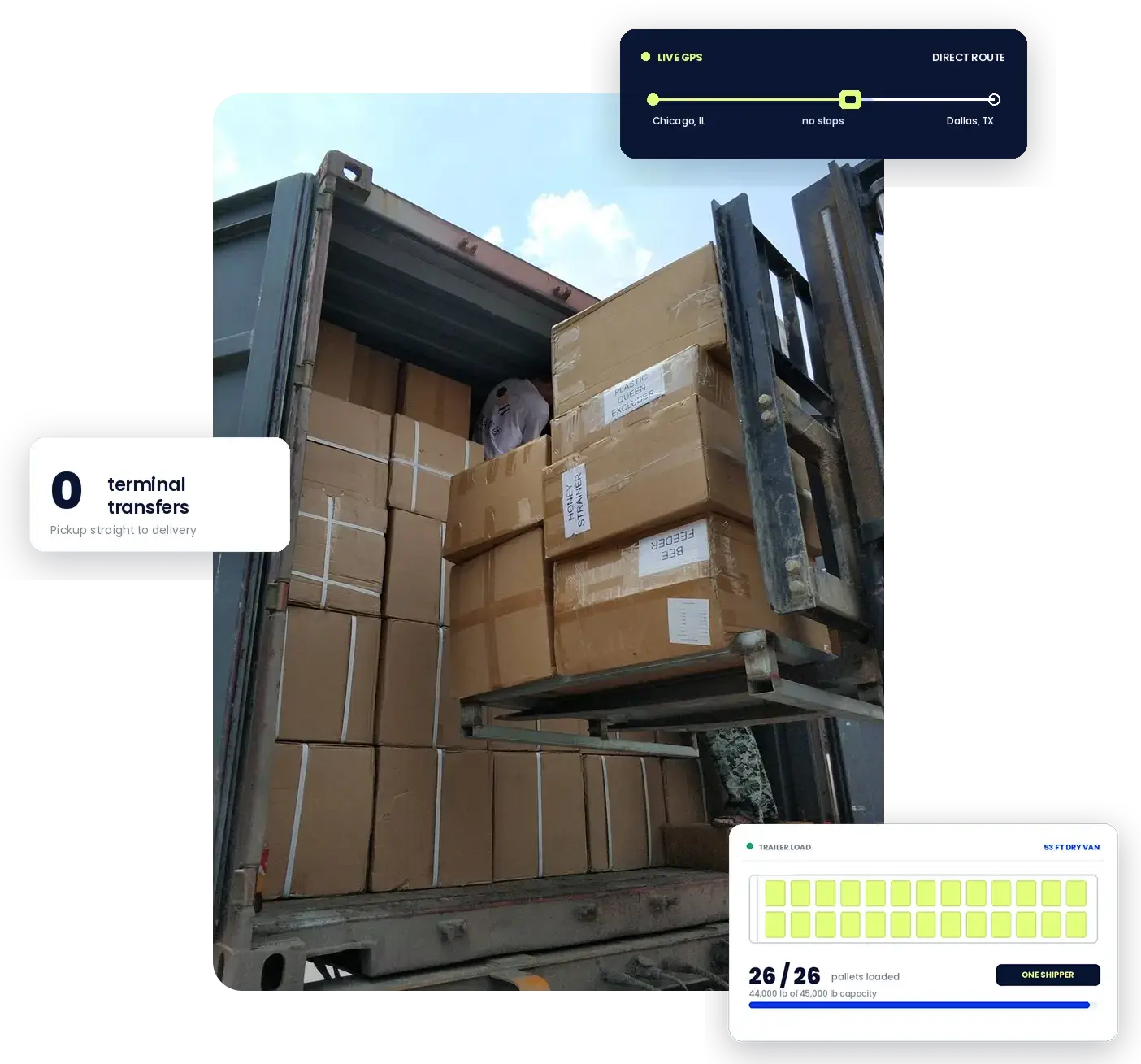
Ten pallets or more, one dock appointment, no terminal transfers. Full truckload is how most of the enterprise brands we work with move weekly replenishment into Amazon and retailer DCs. A standard 53 foot dry van holds 26 pallets single-stacked and 44,000 to 45,000 pounds; the shipper books the whole trailer whether or not the load fills it.
FTL shipping eliminates the handling that slows LTL freight. LTL shipments pass through 2 to 4 terminals where cargo is unloaded, sorted, and reloaded. FTL skips every terminal. The driver picks up at origin and delivers to destination without stopping for other freight.
AMZ Prep FTL trucking serves brands moving inventory to Amazon fulfillment centers, Vendor Central inbound docks, Walmart, Target, and Costco distribution centers, and their own DTC or 3PL warehouses. The dedicated trailer removes the handling that damages product on shared LTL trucks, and the booked appointment removes the day a truck otherwise spends waiting at destination.
- One shipper per trailer, two handling events, no terminal transfers. A 53 foot dry van holds 26 pallets single-stacked and up to 45,000 pounds.
- Book FTL at 12 pallets or more or above 10,000 pounds; below that, LTL costs less per shipment.
- The dock appointment at Amazon, the retailer DC, or your warehouse is booked before the truck leaves, and tracked beside the live GPS in Relay.
- Full truckloads into Amazon run as Middle Mile Plus: zero placement fees, 2 to 4 day check-in, and the same lanes for Vendor Central purchase-order freight.
- 35+ carriers rate-shopped per load across dry van, reefer, flatbed, step deck, and conestoga, US and Canada in both directions.
How does AMZ Prep full truckload freight work?
Request Your FTL Quote
AMZ Prep collects origin, destination, commodity type, weight, pallet count, and delivery date. Specify equipment needs: dry van, reefer, flatbed, or step deck.
Compare Carrier Options
AMZ Prep rate shops 35+ carriers. Each option shows transit time, rate per mile, equipment type, and carrier safety rating. You select the best fit for your load.
Book and Dispatch
AMZ Prep books the carrier, assigns a dedicated truck, and books the dock appointment at the destination before the truck leaves. The trailer arrives at your dock empty, and your freight is the only cargo on it.
Track to Delivery
Live GPS, documents, and the appointment window sit in one view in Relay from pickup through delivery. Delivery is confirmed against the booked slot, not against a transit estimate.
What can you verify about AMZ Prep FTL freight before you book?
35+ Carrier Rate Shop
Every FTL load is quoted across 35+ carriers and matched to the lane, equipment, and date. You see transit, rate per mile, and the carrier's safety rating before you pick.
Dedicated Trailer
One trailer, one shipper. No co-loading, no terminal handling, no reloading. Two handling events between your dock and the destination dock instead of the six to ten an LTL shipment sees.
Direct Routing
AMZ Prep FTL shipments travel direct from origin to destination. No terminal stops between pickup and delivery. Transit time drops 1 to 3 days compared to LTL on the same lane.
Tracked in Relay
Every truck is tracked in Relay, AMZ Prep's freight platform: live location, BOL and POD, invoices, and the booked appointment in one login, next to the inventory it carries in Navigate.
All Equipment Types
AMZ Prep sources dry van, refrigerated, flatbed, step deck, and conestoga trailers. The right equipment for your product type is matched at booking.
Cross Border Included
FTL in both directions between the US and Canada with customs brokerage, PARS and PAPS pre-clearance, and CUSMA classification included. One provider from origin to destination.
FTL vs LTL: where is the cutoff?
AMZ Prep ships both FTL and LTL freight. The right choice depends on shipment size, transit speed, and handling sensitivity. This table covers the core differences between full truckload and less than truckload shipping.
| Factor | FTL (Full Truckload) | LTL (Less Than Truckload) |
|---|---|---|
| Trailer usage | Entire trailer for one shipper | Shared space with multiple shippers |
| Typical shipment size | 10,000 to 45,000 pounds, 12 to 26 pallets | 150 to 10,000 pounds, 1 to 12 pallets |
| Terminal transfers | Zero. Direct origin to destination | 2 to 4 terminal stops for sorting and reloading |
| Transit time | 1 to 5 days depending on distance | 3 to 7 days, longer due to terminal stops |
| Handling events | 2 (load and unload) | 6 to 10 (each terminal adds load/unload cycles) |
| Damage risk | Lower. Product stays on the trailer from pickup to delivery | Higher. Each handling event increases damage probability |
| Cost structure | Flat rate per mile for the full trailer | Per hundredweight (CWT) based on class and weight |
| Cost per pound (large loads) | Lower. Per mile rate covers the full trailer regardless of weight | Higher. Per CWT pricing compounds as weight increases |
| Tracking | Live GPS in Relay, with the booked appointment beside it | Terminal milestone scans only |
| Best for | 12+ pallets or over 10,000 lbs, and any load with an appointment it cannot miss | 1 to 12 pallets under 10,000 lbs, where cost per shipment matters most |
What moves FTL freight rates?
AMZ Prep full truckload rates depend on six factors. Each factor shifts the per mile cost depending on the lane, load, and market conditions.
Lane and Distance
FTL rates are quoted per mile. Longer lanes have lower per mile rates. Short haul lanes under 300 miles carry higher per mile costs because the fixed pickup and delivery time is a larger portion of the trip.
Equipment Type
Dry van is the lowest cost FTL equipment. Refrigerated trailers add $0.25 to $0.75 per mile for temperature control. Flatbed and step deck cost more due to specialized loading and securement.
Seasonality
FTL rates rise in Q4 (October through December) and produce season (April through August) and drop January through March. Carrier peak surcharges, October to January, apply to every shipper in the market and are passed through at cost. AMZ Prep locks in capacity early for seasonal shippers.
Market Conditions
Spot rates fluctuate based on carrier capacity and freight demand. Tight markets push FTL rates higher. AMZ Prep rate shops every load against both spot and contract rates to find the best available price.
Lead Time
FTL shipments booked 3 to 5 days in advance get lower rates than same day or next day dispatch. AMZ Prep recommends advance booking when possible to secure contract level pricing.
Accessorials
Liftgate delivery, inside pickup, driver assist loading, and detention time add fees. AMZ Prep identifies all required accessorials upfront so quotes are accurate before booking.
Where does AMZ Prep full truckload freight go?
Amazon FBA Sellers
Full truckloads into Amazon fulfillment centers run as Middle Mile Plus, with the dock appointment pre-booked and 2 to 4 day check-in against a 7 to 10 day industry average. Zero placement fees.
Walmart, Target, Costco DCs
Full truckloads built to each retailer's routing guide, with EDI, ASN, and the appointment window booked through our B2B fulfillment team. Walmart WFS inbound runs the same way.
Vendor Central PO Deliveries
Amazon issues the purchase order and the appointment window; AMZ Prep builds the load to the routing guide and delivers against the ASN. Late, short, or mislabeled loads draw chargebacks, so the 1P team labels cartons and files the ASN before dispatch. Vendor Central fulfillment
Warehouse Transfers
Inventory moves between AMZ Prep warehouses, your own DTC or marketplace nodes, and 3PL partners. Full truckloads are the most cost-efficient method for large inter-facility transfers.
Seasonal Inventory
AMZ Prep FTL freight positions seasonal inventory before Q4 and Prime Day. Full truckloads lock in capacity and rates before peak season pricing increases.
Fragile or High Value
AMZ Prep FTL freight protects fragile and high value products. Dedicated trailers eliminate the handling events that cause damage on shared LTL trucks.
How do full truckloads get into Amazon without placement fees?
Standard Middle Mile consolidates carton shipments from many sellers onto full trucks to the same Amazon regions. Middle Mile Plus is the same program for brands whose freight is already a truckload: palletized replenishment, oversized goods, and temperature-controlled products that need reefer transport from cold storage into the FC.
If you have been told a palletized or temperature-controlled load "can't go middle mile," ask for Middle Mile Plus. It is a different lane on different equipment, with the same booked appointment and the same zero-placement-fee routing. The same lanes deliver Vendor Central purchase-order freight to Amazon's inbound docks against the ASN.
Beekeeper's Naturals runs 50+ full truckloads and multiple LTLs a week across Amazon, D2C, and B2B on this program, with TMS integration and a weekly freight review.
How does FTL freight cross the US-Canada border?
AMZ Prep ships full truckload freight cross border between the US and Canada with full customs support. One provider manages origin to destination. No separate customs broker required.
AMZ Prep handles customs brokerage, PARS or PAPS pre-clearance, HTS classification, and duty calculation on every cross-border FTL shipment. Goods that qualify under CUSMA clear with preferential duty; the certificate of origin is prepared with the load. Canada-to-US and US-to-Canada run the same way, including temperature-controlled loads on reefer equipment.
Customs Brokerage
Commercial invoice, packing list, certificate of origin, HTS classification, and duty calculation for every cross-border FTL load. Pre-clearance is filed before the truck reaches the border so it crosses without a hold.
US to Canada Lanes
Toronto, Vancouver, Montreal, and Calgary corridors run weekly with contracted capacity, delivering to AMZ Prep Canada warehouses, Amazon.ca FCs, and Canadian retailer DCs.
Canada to US, Into FBA and 1P
Canadian brands move full truckloads into US Amazon FCs and Vendor Central inbound docks on the same booked appointments. Midday Squares runs temperature-controlled chocolate this way with pre-clearance and New Jersey hub consolidation before FBA delivery.
Which brands ship FTL freight with AMZ Prep?
 Middle Mile
 Middle Mile
 Middle Mile
 Middle Mile
 Middle Mile
 Freight
 Freight
 Freight
 Freight
 Freight
 3PL
3PL
 3PL
3PL
 3PL
3PL
 Freight
Eight Sleep
Dedicated full truckloads for oversized sleep technology, with appointment scheduling and proof-of-delivery tracking on every load.
Beekeeper's Naturals
50+ full truckloads and multiple LTLs a week across Amazon, D2C, and B2B channels in the US and Canada, with TMS integration and a weekly freight review.
Mid Day Squares
Temperature-controlled reefer truckloads from Canada to US Amazon fulfillment centers, with customs pre-clearance and New Jersey hub consolidation before FBA delivery.
Frequently Asked Questions
FTL freight shipping means a single shipper books an entire truck trailer for their cargo. No other shipments share the space. The truck moves direct from origin to destination without terminal transfers or hub stops.
FTL uses a dedicated truck for one shipper's cargo. LTL combines multiple shippers' freight on one truck. FTL is faster because it skips terminal transfers. LTL costs less per shipment for loads under 12 pallets or 10,000 pounds.
A standard 53 foot dry van holds 26 pallets single stacked on standard 48 by 40 inch pallets. Double stacking can reach 52 pallets when pallet height and weight allow. Maximum payload is 44,000 to 45,000 pounds.
FTL freight rates depend on distance, lane, equipment, and season. Average dry van rates range from $2.00 to $3.50 per mile. AMZ Prep rate shops 35+ carriers per shipment to find the lowest cost on each lane.
Use FTL when your shipment is 12 pallets or more, exceeds 10,000 pounds, or needs to arrive without handling stops. Below that, LTL costs less per shipment. For deadline loads, expedited freight adds same-day pickup and guaranteed delivery windows.
Yes. Full truckloads into Amazon run as Middle Mile Plus: the same daily lanes and pre-booked dock appointments as standard Middle Mile, on pallets rather than cartons. Check-in runs 2 to 4 days against a 7 to 10 day industry average, with zero placement fees. The same model delivers Vendor Central purchase-order freight to Amazon inbound docks against the ASN.
Yes, in both directions. Customs brokerage, PARS and PAPS pre-clearance, HTS classification, CUSMA preferential duty where goods qualify, and duty payment are included. One provider from origin to destination.
Yes. The appointment is booked before the truck leaves, whether the destination is an Amazon fulfillment center, a Vendor Central inbound dock, a Walmart, Target, or Costco DC, or a brand warehouse. A missed appointment is the most common reason a full truckload sits a day or more at destination, so we treat the booked slot, not the transit estimate, as the delivery date.
AMZ Prep sources dry van, refrigerated, flatbed, step deck, and conestoga trailers for FTL. Dry van is standard for most ecommerce freight. Reefer is required for temperature sensitive products.
Get Your FTL Freight Quote
Tell us the origin, the pallet count, the destination, and the date it has to be on the dock. You get a rate-shopped quote with the appointment window included.