Amazon Prime Day ROI Calculator
Get an Estimate of Your Prime Day Revenue with Our Free ROI Calculator
- AMZ Prep named Top 100 B2B logistics in 2025 by Clutch






Amazon Prime Day ROI Calculator
Comprehensive Profit Analysis for Prime Day 2025 Sellers
Your Prime Day Projections
48-hour event analysis
Detailed Financial Breakdown
Why Use Our Amazon Prime Day ROI Calculator?
Prime Day Sales Multipliers
See exactly how much your sales will jump - from 6x for steady categories to 15x for Prime Day favorites
Lightning Deal Profit Analysis
Know if that $150 Lightning Deal fee will actually make you money or just eat your profits
Price Drop Optimizer
Stop guessing discounts - find the exact percentage that gets you seen without affecting profit margins
48-Hour Inventory Planning
Get the precise number of units you need so you don't run out or get stuck with excess stock
Real Prime Day Fee Calculations
See all your costs at discounted prices - referral fees, FBA fees, and Prime Day promotions
Profit vs. Visibility Balance
Find the perfect balance between making money and getting customers to notice you
How to Use Our Prime Day ROI Calculator?
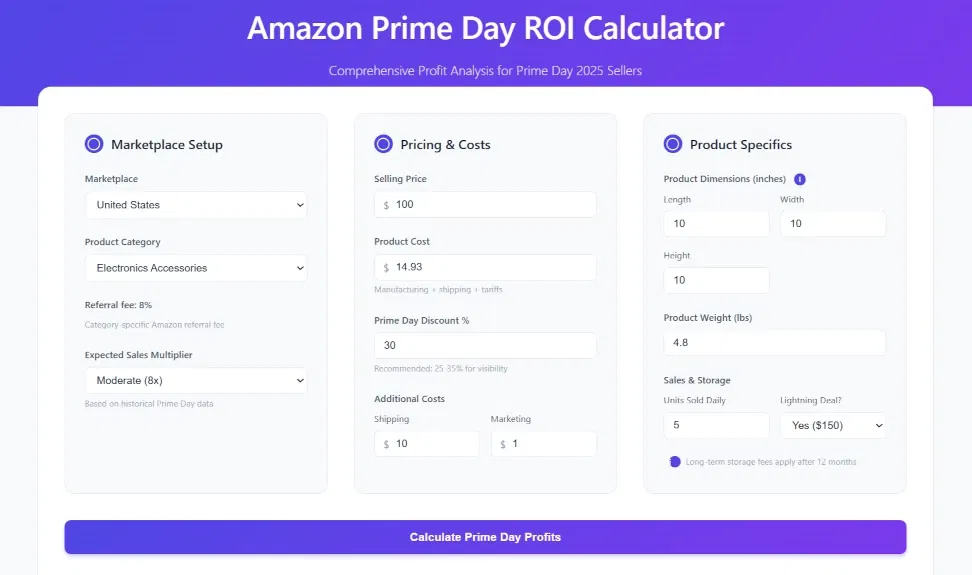
Step 1: Marketplace Setup
- Marketplace: Select your marketplace - US, UK, Canada, Germany, or Japan
- Product Category: Choose your product category
- Referral Fee: Auto-calculated based on your category (typically 8-15%)
- Sales Multiplier: Select 6x, 8x, 10x, or 12x based on your category performance
Step 2: Pricing & Costs
- Selling Price: Your regular price before Prime Day discount
- Product Cost: Total manufacturing + shipping + tariffs
- Prime Day Discount: Recommended 25-35% for optimal visibility
- Additional Costs: Shipping and marketing expenses
Step 3: Product Specifics
- Dimensions: Length, width, height (inches) for accurate FBA fees
- Weight: Product weight (lbs)
- Daily Sales: Your average units sold per day
- Lightning Deal: Whether you're participating (affects fees and multipliers)
Step 4: Get Complete 48-Hour Event Analysis
- Expected Units Sold (48 hours)
- Prime Day Price (after discount)
- Total Revenue
- Product Costs
- Amazon Referral Fees
- FBA Fulfillment Fees
- Additional Costs (Shipping + Marketing)
- Lightning Deal Fee (if applicable)
- Final Net Profit
Prime Day Projections Visualization
FAQs
Everything About Amazon Prime Day ROI Calculator
Our calculator takes your sales projections and all associated costs to determine your expected profit and ROI percentage for the 48-hour Prime Day event. Simply input your data and get instant calculations.
Our calculator includes all major cost components that affect Prime Day profitability, including Lightning Deal fees, FBA costs, referral fees, and additional marketing expenses for accurate ROI calculations.
No account creation required. Our calculator is completely free to use and provides instant results without any registration process.
Enter the final selling price customers will pay after applying your Prime Day discount. This is your discounted price, not your regular price.
These are Amazon’s commission fees, typically 8-15% depending on your product category. Check Amazon Seller Central or use Amazon’s fee calculator for your specific category.
Enter $150 if you’re participating in Amazon’s Lightning Deal program during Prime Day. Leave blank or enter $0 if you’re not using Lightning Deals.
A good Prime Day ROI is typically 15-30%, though this varies by category and business model. Our calculator shows both absolute profit and ROI percentage.
Use your best estimates. Our calculator is designed to give you directional guidance. You can always adjust inputs and recalculate as you get more precise data.
Run separate calculations for each variation or use weighted averages based on your expected sales mix for each variant.