

Fast answer: To trust your 3PL’s inventory count, ask for proof at receiving, a cycle-count schedule and a written variance limit that says who pays when stock goes missing. Agree those terms before you sign. Once you’ve taken the first loss, they’re much harder to negotiate.
What to take away
- Most inventory disputes start at receiving, so get counts and photos the day stock arrives.
- Ask how counts are done, not just what accuracy figure the 3PL quotes. Blind counts and an adjustment log matter more than a headline percentage.
- The allowed variance is a number in your contract, not a promise from a sales call.
- In the US, a warehouse’s liability for lost goods can be capped by the storage agreement, so the cap you sign is the cap you get.
- If counts don’t match, rebuild the number from receiving and shipping records before you file a claim.
Receiving proof: where accuracy begins
If receiving is wrong, every count after it is wrong too. That’s why the receiving record is the most important document your 3PL gives you.
Ask for:
- A count against your ASN or packing list, SKU by SKU, on the day stock is received.
- Photos of damage or shortages at the dock, before anything is put away.
- A discrepancy report with overs, shorts and damaged units, sent to you every time, not just when you ask for it.
- A clear receiving time, so you know when stock should be live and sellable.
Send an advance ship notice (ASN) or packing list with every inbound shipment. Without one, the warehouse has nothing to count against.
Damaged on arrival or damaged in the warehouse?
Who pays depends on where the damage happened. Damage found at receiving is usually a claim against the carrier, so your proof is the receiving photos and the delivery receipt. Damage that happens after stock is put away is the 3PL’s responsibility under your contract. That’s why the receiving report should note any damage before anything goes on a shelf.
Cycle counts and allowed variance
Ask how inventory accuracy is measured and how often stock is counted. Two 3PLs can quote the same accuracy number and mean different things.
- How it’s measured. Inventory accuracy is the share of counted locations or SKUs where the physical count matches the system. Ask whether it’s measured by SKU, by location or by unit, and over what period.
- How often it’s counted. Fast sellers are usually counted more often than slow ones. Ask for the schedule, and a report after each count.
- Cycle counts vs a full count. A full physical inventory counts everything at once and usually pauses receiving and shipping. Cycle counts check a small part of the stock each day or week, so errors are found within days, while there’s still a record of what caused them.
- What’s normal. Industry guides commonly set inventory accuracy targets at 99% or higher, with 99.5% and above considered strong.
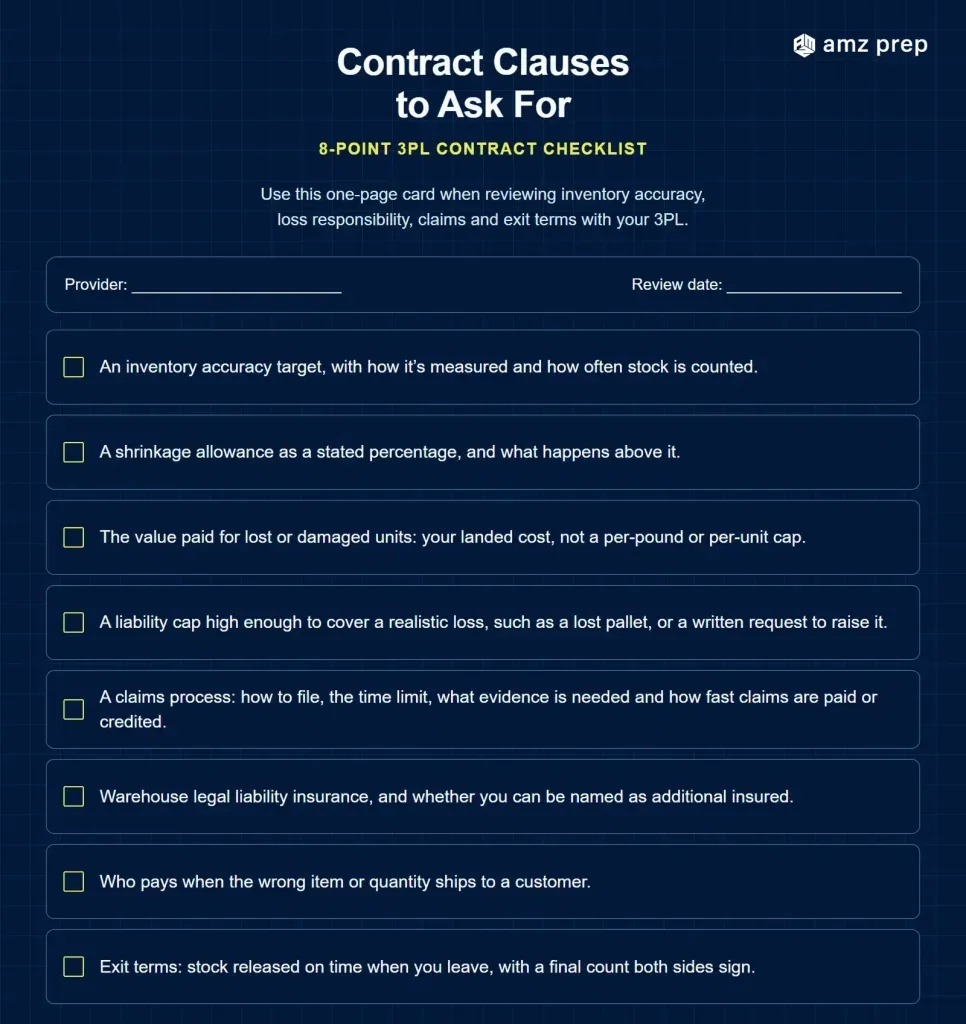
- Shrinkage allowance. Many contracts allow a small loss, often written as 0.5% to 1% of inventory, before the 3PL owes anything. Learn this number before you sign.
Questions to ask a 3PL about how they count
These tell you more than a quoted accuracy percentage, and they belong on your list when choosing a 3PL.
- Are counts blind? In a blind count, the counter doesn’t see the quantity the system expects. If they can see the number, it’s easy to confirm it instead of counting.
- What happens when a count doesn’t match? Ask whether a second person recounts before the system is changed.
- Who approves inventory adjustments? Every adjustment should need approval and carry a reason, such as damaged, found or miscounted.
- Can you see the adjustment log? Ask for the log of changes, not just the corrected total, so you can see when stock moved and why.
- Are picks scanned? Scanning each item at picking stops the wrong SKU leaving the building, which is also how counts drift.
- Is the receiving discrepancy report sent automatically? If you only see it when you ask, gaps can go unnoticed for months.
Who pays for missing inventory?
Your contract decides who pays, so read the liability clause before you sign. Many standard 3PL contracts cap what they’ll pay for lost stock at a low fixed amount per unit or per pound, not what the product cost you.
What US law says
In most US states, warehouse liability follows UCC Article 7, section 7-204. A warehouse is liable for loss or damage caused by its failure to take reasonable care of your goods. The same section lets the warehouse receipt or storage agreement cap the amount, for example per item or per pound. When you sign, you can ask in writing for the liability to be raised on some or all of your goods, usually in exchange for a higher storage rate. A cap doesn’t protect a warehouse that takes your goods for its own use.
Because the 3PL’s liability is capped, many brands also carry their own inventory insurance, often called stock throughput insurance, which covers stock wherever it sits. This is general information, not legal advice. Ask your lawyer or broker how it applies to your contract.
Contract clauses to ask for
When your 3PL’s count is out of sync with Shopify
Sometimes the stock is fine and the sync is the problem. If your 3PL’s system shows different numbers than your store, you might sell things you don’t have, or hide things you do.
- Decide which system is the record. Usually the 3PL’s system holds the physical count and your store shows what’s available to sell. Write down which one wins when they disagree.
- Ask how often stock updates. If updates run on a schedule rather than instantly, there’s a window where a sold-out item still looks available.
- Check location mapping. If you stock in more than one warehouse or country, map each warehouse to the right location in your store.
- Turn off selling at zero stock for SKUs that sell fast or run low, so a sync delay can’t create orders you can’t ship.
AMZ Prep runs one inventory pool across Shopify, Amazon, Walmart, TikTok Shop, retail and wholesale, through its own Shopify app. More on Shopify fulfillment.
What sellers say about missing inventory, and what to do about it
These keep coming up on Reddit, review sites and seller forums.
Stock signed for at the dock that never showed up in inventory
Compare the carrier’s signed delivery receipt with the 3PL’s receiving report for that day. If the warehouse signed for it, the receiving count is theirs to explain. Put it in writing straight away, while the dock records are fresh.
Hundreds of units missing, found only at a full count
Losses that build up over months usually mean nobody reconciled stock in between. Ask for regular cycle counts and check the inventory report against your own sales every month, so a gap shows up while it’s still small.
The 3PL says the loss is within its shrinkage allowance
That allowance is whatever your contract says it is. Get the number before you sign, find out whether it’s per year or per count, and negotiate it down if it doesn’t fit your margins.
A claim paid at a fraction of what the product cost
Standard terms often pay by weight or a flat amount per unit. Ask for losses to be paid at landed cost, and check the liability cap covers a lost pallet of your most valuable SKU.
Stock lost while the 3PL moved it between its own warehouses
Site-to-site moves are a common point of loss. Ask for a count before stock leaves and a count when it arrives, both shared with you, and agree in writing that the 3PL is responsible in between.
Stock held up when moving to a new 3PL
Agree exit terms up front: notice period, release time and a final count signed by both sides. Settle any billing dispute in writing before the move, so it can’t hold your stock. Our guide to switching 3PLs covers the full move.
What to do when counts don’t match
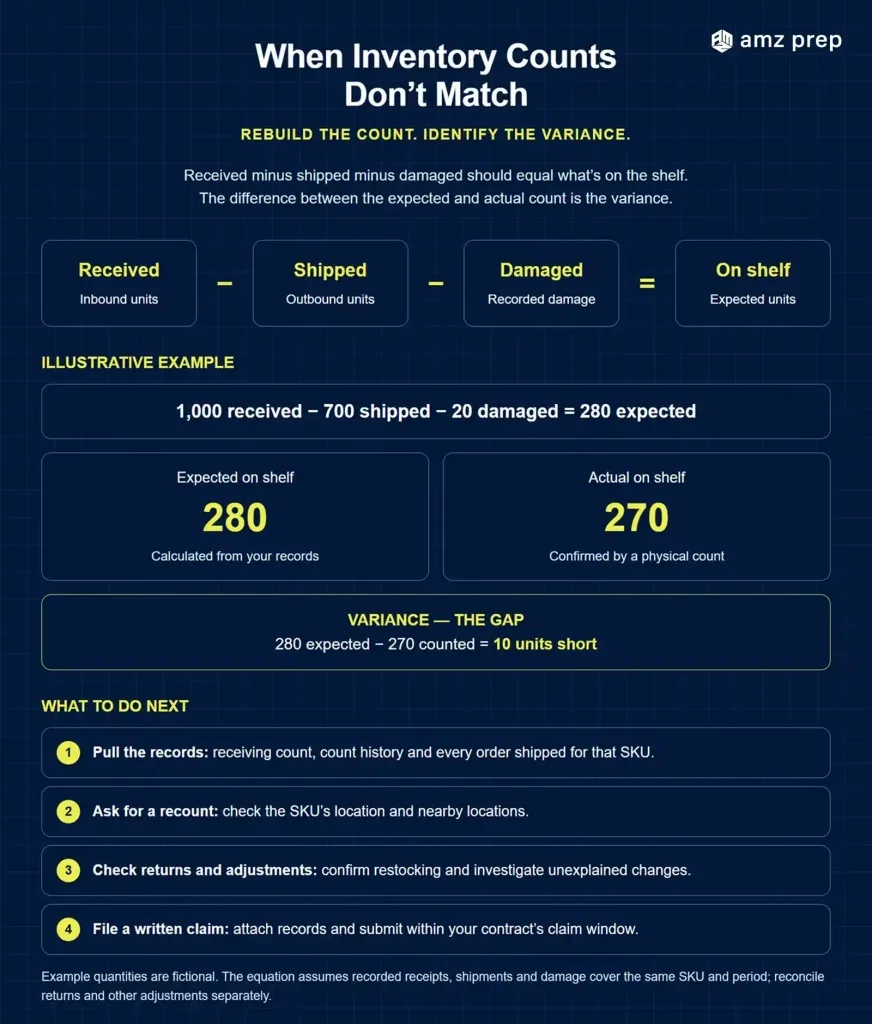
- Pull the records for that SKU: the receiving count, the count history and every order shipped since it arrived.
- Rebuild the number. Received minus shipped minus damaged should equal what’s on the shelf. The difference is the variance.
- Ask for a recount of that SKU and the locations around it. Stock put away in the wrong place is the most common cause.
- Check returns and adjustments. Returned units that weren’t restocked (see how returns should be handled), or manual adjustments with no reason, often explain the gap.
- File a written claim for what’s still missing, with the records attached, inside your contract’s claim window.
Clear service levels make these conversations easier. See what goes into a service level agreement, and how to read and audit a 3PL invoice.
How inventory is tracked at AMZ Prep
- Stock is received and put away within 24 to 48 hours of delivery.
- You can see your inventory in Navigate at any time and check counts without waiting for a report.
- Lot and expiry dates are tracked for products that need them, such as supplements.
- One inventory pool covers every sales channel, so a unit sold on Amazon isn’t still showing as available on Shopify.
- When AMZ Prep’s warehouse ships the wrong item, it pays for the return and the reshipment, including at partner sites. Units that need rework because of its own prep errors are fixed at its cost.
- AMZ Prep is ISO 9001:2015 certified, bonded and FDA registered.
If you’re switching 3PLs, ask for a walkthrough of Navigate and a sample invoice to see how your inventory and charges would show.
FAQ
What is a good inventory accuracy rate for a 3PL?
Industry guides commonly set the target at 99% or higher, with 99.5% and above considered strong. Ask how the figure is measured before comparing providers.
Who pays when a 3PL loses my inventory?
Your contract decides. Many standard contracts cap liability at a low amount per unit or per pound, so ask for losses above an agreed shrinkage allowance to be paid at landed cost.
Is a warehouse legally liable for lost inventory?
In most US states, UCC section 7-204 makes a warehouse liable for loss caused by its failure to take reasonable care, but the storage agreement can cap the amount. You can ask in writing at signing for a higher limit, usually at a higher rate.
What is a shrinkage allowance?
The share of inventory a 3PL can lose before it owes you anything, often written as 0.5% to 1% of inventory. Agree the number before you sign.
What is a blind count?
The share of inventory a 3PL can lose before it owes you anything, often written as 0.5% to 1% of inventory. Agree the number before you sign.
What’s the difference between a cycle count and a physical inventory?
A physical inventory counts everything at once and usually pauses the warehouse. Cycle counts check a small part of the stock on a rolling schedule, so errors are found sooner.
How often should a 3PL count my inventory?
Fast sellers are usually counted more often than slow ones. Ask for the schedule and a report after each count.
Do I need my own insurance if my 3PL has insurance?
Often yes. The 3PL’s insurance covers its own liability, which is usually capped. Inventory or stock throughput insurance covers the value of your goods.
Why does Shopify show different stock than my 3PL?
Usually a sync delay or a location mapping issue. Decide which system is the record, ask how often stock updates, and turn off selling at zero stock on fast-moving SKUs.
What should I do if my 3PL’s count doesn’t match mine?
Rebuild the number from the receiving count and the orders shipped for that SKU, ask for a recount, then file a written claim for what’s still missing.
What is an ASN?
An advance ship notice lists what’s in an inbound shipment before it arrives. It gives the warehouse something to count against at receiving.

Arishekar N is a Vice President (VP) of Marketing at AMZ Prep, specializing in ecommerce fulfillment and Amazon logistics strategies with a proven track record of driving growth for e-commerce businesses. He is a strategic leader with extensive expertise in marketing, e-commerce operations, SEO & advertising, and branding.
Stay updated on his latest insights by following him


Comments