

Quick answer: A 3PL invoice usually has six kinds of lines: receiving, storage, pick and pack, packaging, shipping and extras (often called accessorial fees). If your bill goes up while your order volume stays flat, the cause is almost always one of four things: storage growing as stock ages, dimensional weight on bigger boxes, carrier surcharges passed through, or a monthly minimum. Checking each line against your contract once a month catches most errors before they add up.
Key takeaways
- Compare your bill against the total monthly cost in the quote, not the pick-and-pack rate.
- Storage and shipping have the biggest impact on the total; pick fees have little effect.
- Every charge should trace back to a line in your contract or rate card.
- Audit monthly with your order export and inventory report side by side.
- Please submit any disputes in writing within the timeframe specified in your contract.
Every line on a 3PL invoice, explained
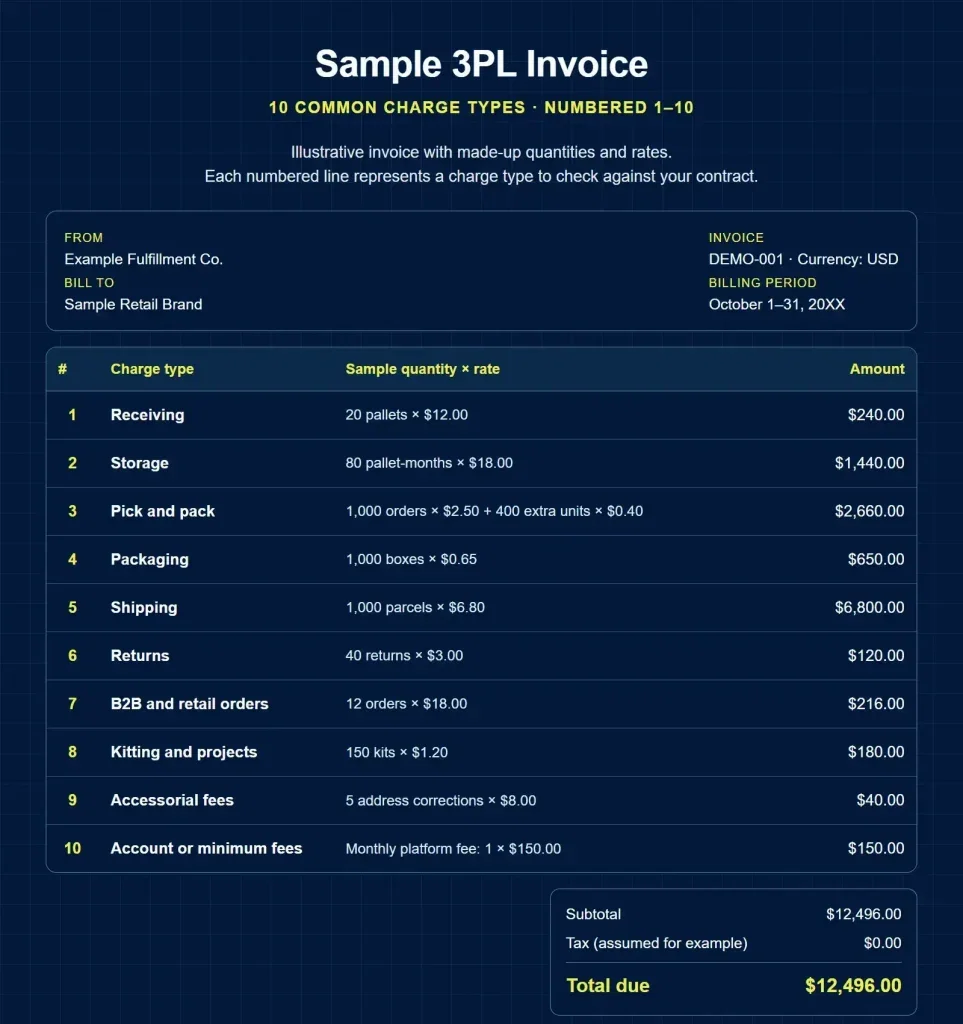
Each line below should match a rate in your contract. The last column is what to compare it to.
| Line | What it charges for | How it’s usually billed | Check against |
|---|---|---|---|
| Receiving | Unloading and counting inbound stock | Per pallet, carton, unit or hour | Your inbound shipments and receiving reports |
| Storage | Space your stock takes up | Per pallet, bin, shelf or cubic foot, per month | Inventory report on the billing date |
| Pick and pack | Picking and packing each order | Per order, plus per extra unit | Order export for the month |
| Packaging | Boxes, mailers, fill, inserts | Per item used, or included in pick and pack | Your contract (is it included or extra?) |
| Shipping | Postage to your customer | Per parcel, by weight, size and zone | Carrier label data: weight, dimensions, zone |
| Returns | Receiving, inspecting and restocking returns | Per return or per unit | Returns report |
| B2B and retail orders | Case or pallet picks, labels, routing guide work | Per case, pallet or order | Purchase orders shipped |
| Kitting and projects | Assembling kits, relabeling, special work | Per kit, unit or hour | Approved work orders |
| Accessorial fees | Extras such as rush orders, special handling or address corrections | Per event | Your contract’s fee list |
| Account or minimum fees | Monthly platform fee or minimum billing | Per month | Your contract |
To estimate what these lines should add up to before you sign, try the 3PL cost calculator.
Why your bill rises when volume doesn’t
Four causes explain most bills that grow while orders stay flat.
- Storage grows as stock ages. Slow sellers keep taking up space, so storage rises every month even when orders don’t. Check how much of your storage is stock that hasn’t moved in 90 days.
- Dimensional weight. Carriers bill the higher of actual weight and dimensional weight (length × width × height ÷ 139 for UPS, FedEx and, since July 12, 2026, USPS on boxes over 1 cubic foot). A bigger box can raise postage with no change in what’s inside. Check yours with the dim weight calculator.
- Carrier surcharges passed through. Fuel, residential, peak and large-package surcharges change during the year and usually pass straight to you. Ask your 3PL to show them as separate lines.
- Minimums and tiers. If volume dips below a tier or a monthly minimum, the rate per order or a top-up charge can jump.
A fifth cause is plain error: duplicate charges, the wrong rate tier, or storage billed on stock that already shipped. That’s what the monthly audit catches.
5 red flags on a 3PL invoice
- Charges that aren’t in your contract. Every line should trace to a rate you agreed. If you can’t find it, ask before paying.
- Receiving billed twice. The same inbound shipment charged on two invoices, or charged by the unit when your contract says by the pallet.
- Storage on stock that already shipped. Compare billed storage with your inventory report on the billing date.
- Surcharges with no carrier notice behind them. A pass-through surcharge should match a published carrier change. Ask which one it is.
- Every box rounded up. If billed dimensions are always larger than your packaging, ask for the carrier’s measurement data.
What sellers say about 3PL charges, and how to protect yourself
The same complaints come up again and again on Reddit and seller forums. Here’s each one, and what to do about it.
Quoted about $3 an order, billed closer to $5
The quote showed pick and pack; the invoice added storage and receiving fees, plus a monthly account fee. Before you sign, ask for a quote built from your own order export that shows total monthly cost, then ask for a sample invoice. AMZ Prep quotes from your order report and shows prospects a sample invoice before they sign.
An invoice full of codes nobody can read
Ask for an invoice that names each charge in plain words and ties it to an order, shipment or SKU. If a line can’t be traced, it shouldn’t be paid until it’s explained.
A surcharge that’s credited, then comes back
When a charge is credited, ask what changed so it won’t come back, and check the next invoice for it. A credit without a fix is a recurring cost.
Storage that keeps growing while sales stay flat
Slow stock costs more every month, and some 3PLs charge more for stock held past 90 or 180 days. Ask whether aged-stock rates apply, review aged inventory monthly, and move or clear slow sellers before they get repriced.
A markup on boxes and tape
Packaging is often billed above what the 3PL paid for it. Ask whether packaging is included in pick and pack or billed separately, and at what price per item.
A packaging change that pushed products into a higher fee tier
Half an inch can push a box into a higher dimensional weight or size tier, affecting both a 3PL’s postage and Amazon’s fees alike. Check weights and dimensions before changing packaging. AMZ Prep’s Smart Cartonization picks the right box for each order to keep dimensional weight down.
Carrier adjustments after the label is bought
Carriers re-measure parcels and bill the difference when weights or dimensions on the label are wrong. Please ensure that the product weights in your system match the packed weight, and kindly request the carrier’s adjustment data from your 3PL.
A monthly minimum charged in a slow month
Ask whether there’s a minimum, how it’s calculated, and what happens in a slow month or season, and get the answer in the contract.
Exit fees nobody mentioned, and stock that took weeks to leave
Read the exit terms before you sign: notice period, fees to pick and ship out remaining stock, and how fast it will be released. AMZ Prep offers transition support for qualifying brands moving in.
Peak surcharges that seem to come out of nowhere
Carrier peak surcharges are announced months ahead. Please request your 3PL to send the peak surcharges as soon as carriers publish them and to display them as separate lines on the invoice.
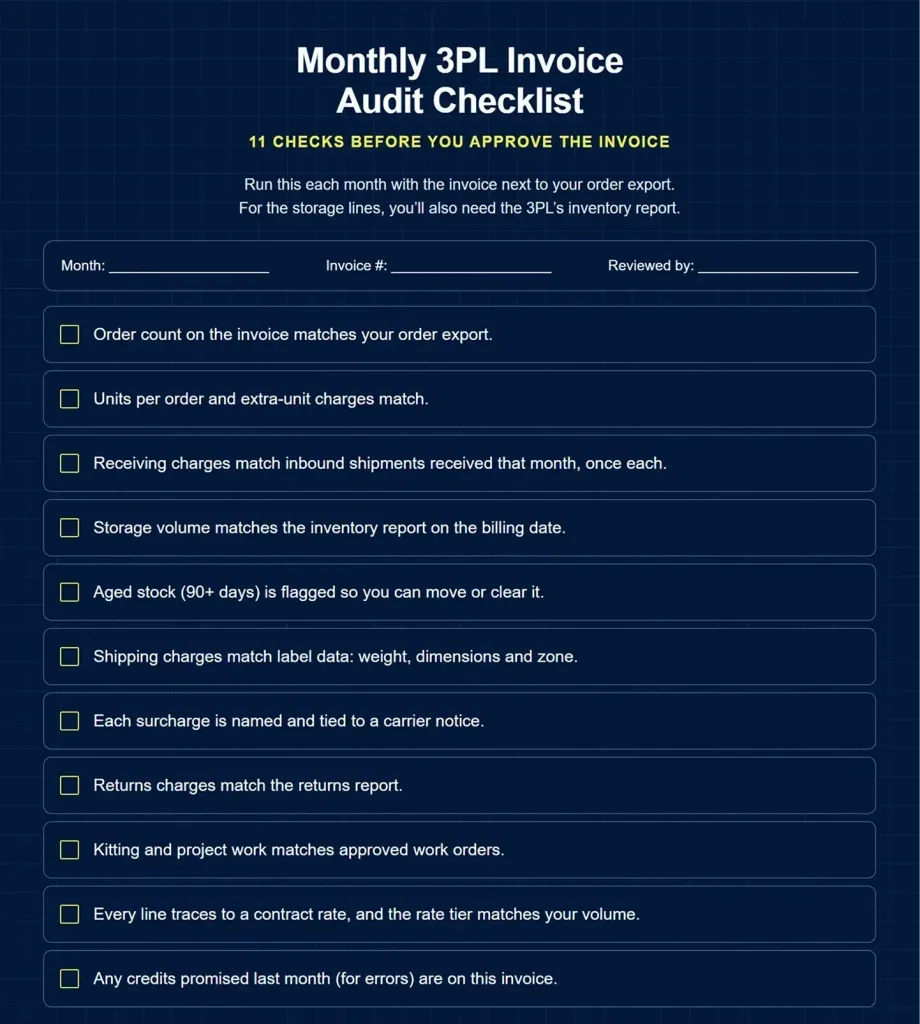
Monthly 3PL invoice audit checklist
Run this each month with the invoice next to your order export. For the storage lines, you’ll also need the 3PL’s inventory report.
How to raise a billing dispute
- Check your contract’s dispute window. Many contracts give a fixed number of days from the invoice date; raise it inside that window.
- List each disputed line with the invoice line, the amount, what you expected and why (the contract rate or the report that shows the difference).
- Attach the evidence: order export, inventory report, receiving report or carrier label data.
- Pay the undisputed part on time so the account stays in good standing while the rest is reviewed.
- Get the outcome in writing, and check the credit lands on the next invoice.
Agreeing on service levels up front makes disputes easier to settle. See what goes into a service level agreement.
How billing works at AMZ Prep
AMZ Prep prices each brand from its own recent orders, so the quote is based on what you actually ship rather than an average rate.
- Rates are on the rate card on the pricing page.
- You can ask for a sample invoice before signing to see how each line is shown.
- Stock levels are visible in Navigate, so storage charges can be checked against the shelf count at any time.
- When AMZ Prep’s warehouse ships the wrong item, it pays for the return and the reshipment. Units that need rework because of its own prep errors are fixed at its cost.
- US warehouses bill in USD, Canadian warehouses in CAD and UK warehouses in GBP, and AMZ Prep can bill in another currency if you prefer.
Want a second opinion on a bill? Send last month’s invoice and order export, and we’ll go through each line and price the same month on our rate card.
FAQ
Why is my 3PL invoice higher than the quote?
Usually because the quote showed pick-and-pack rates while the invoice adds storage, receiving, packaging, shipping and surcharges. Storage on aging stock and dimensional weight are the most common surprises.
What are accessorial fees?
Extra charges for work outside standard receiving, storage and fulfillment, such as rush orders, special handling, address corrections or relabeling. They should all be listed in your contract.
How often should I audit my 3PL invoice?
Every month, before you pay, using your order export and the inventory report from the billing date.What is dimensional weight?
A billing weight based on box size: length × width × height ÷ the carrier’s divisor (139 for UPS daily rates and FedEx). Carriers charge whichever is higher, actual or dimensional weight.
Can I dispute a 3PL charge?
Yes. Raise it in writing inside your contract’s dispute window and attach the records that show the error. Pay the undisputed part on time.
Do 3PLs charge exit fees?
Some do, usually to pick and ship out the stock that’s left when you leave. Check the exit terms before you sign: the notice period, any fees and how fast your stock will be released.

Arishekar N is a Vice President (VP) of Marketing at AMZ Prep, specializing in ecommerce fulfillment and Amazon logistics strategies with a proven track record of driving growth for e-commerce businesses. He is a strategic leader with extensive expertise in marketing, e-commerce operations, SEO & advertising, and branding.
Stay updated on his latest insights by following him


Comments